Burg Kalsmunt: An Imperial Castle Above Wetzlar, Germany


Site at a Glance
- Rating
- 4.2
- Popularity
- Low
- Country
- Germany
- Primary era
- Medieval
- External website
- Open
- Eras represented
- Medieval, Modern
- Civilizations
- German, Holy Roman Empire, Kingdom of Prussia
- Site type
- Military
- Remains
- Castle
On this page13 sections
History
Burg Kalsmunt is the ruin of a former imperial castle above Wetzlar, Germany. Its origins are uncertain, but the medieval stronghold was expanded around 1180 by Emperor Frederick I Barbarossa as a Reichsburg, an imperial castle held for the ruler and used to supervise territory, administration, and strategic settlements. From its hilltop position, Kalsmunt protected Wetzlar, the imperial reeveship, and the surrounding Wetterau as imperial territory.
Origins and Imperial Expansion
The beginnings of Kalsmunt have been interpreted in different ways. Karl Metz proposed an early Roman foundation, while another tradition attributes its construction around 785 to Charlemagne, the Frankish ruler crowned emperor in 800. According to that tradition, Charlemagne called the site Carols Mons, Carlmund, or Carlmont. These proposed origins precede the better-defined medieval development of the castle.
Around 1180, Frederick Barbarossa enlarged the imperial castle above Wetzlar. The work strengthened the ruler’s position in the city and in the imperial reeveship, an administrative and judicial authority exercised on behalf of the king or emperor. Kalsmunt also became associated with an imperial mint, although its exact year of operation is unknown. A silver denarius, a medieval coin, struck under Frederick bears the name “Calsmund.” The mint was probably situated in Wetzlar, a trading city, rather than on the hill, and its establishment may date to about 1160. In 1241, a mint master named Arnoldus monetarius was recorded in Wetzlar.
Castle Men and Medieval Conflicts
The castle’s surrounding lordship appears in the records through members of the Kalsmunt family. A man called Winterus of Kalsmunt first appears in 1226. In 1238, the knight Winter of Kalsmunt received half of Obbornhofen as a fief from the lords of Münzenberg. The family later included Conrad of Calsmunt, who was born at the castle, became burgrave of Friedberg, and belonged to the Knighthood of the Silver Cross between 1250 and 1300.
Kalsmunt was strengthened in 1252, when several castle men were named. Wetzlar’s town fortifications received confirmation by charter in 1257, reinforcing the defensive framework around the city and castle.
In 1284, a medieval impostor called Tile Kolup presented himself as Emperor Frederick II. Many people in Wetzlar initially believed his claim. After suspicion arose, he was imprisoned and interrogated at Kalsmunt before being burned at the stake on 7 July 1285.
The castle also became involved in Wetzlar’s dispute with the Roman-German king. On 28 June 1285, the castle men and the city agreed not to admit the city’s enemies into Kalsmunt, while the castle itself maintained neutrality. The stronghold was never attacked. In 1286, King Rudolf of Habsburg appointed Count Adolf of Nassau as castle captain. Adolf held the office until his election as Roman-German king in 1292, when he transferred it to Gottfried of Merenberg.
From Nassau Control to Municipal Ownership
After the death of Hartrad VI of Merenberg, the lordship of Merenberg and the captaincy of Kalsmunt passed to the House of Nassau-Weilburg. The family repeatedly used the captaincy as collateral. By about 1500, Kalsmunt no longer had military importance. As an imperial fief, a territory granted directly by the emperor or king, it was then entirely in the possession of the lords of Nassau-Weilburg.
In 1536, Count Philipp III of Nassau-Weilburg transferred the Wetzlar reeveship and Burg Kalsmunt to Landgrave Philip the Magnanimous of Hesse as part of a larger territorial exchange. Philip, the sixteenth-century landgrave of Hesse, became the castle captain. In 1609, the Landgrave of Hesse ordered the surviving remains to be recorded and surveyed. The resulting plan is the oldest known ground plan of Kalsmunt.
A proposal to enlarge the castle into a fortress was made in 1740 but abandoned because of its cost. Since 1803, Kalsmunt has belonged to the city of Wetzlar. In 1836, the Wetzlar Historical and Antiquarian Society, led by its chairman Paul Wigand, commissioned a ground-level entrance through the thick wall of the main tower. Before that alteration, access had been gained at first-floor level through a separate structure connected with the tower.
Excavation and Wartime History
The Wetzlar municipal building authority ordered excavations in 1928. During the Second World War, the city’s industrial installations made Wetzlar a target for Allied bombing. A 2-centimetre anti-aircraft gun was installed on the castle tower to protect the nearby Ernst Leitz optical works. The gun position was moved to ground positions during 1944, but Kalsmunt was struck during the first bombing of Wetzlar on 20 July 1944.
During the final fighting in 1945, Wetzlar’s combat commander, Major Schimpff, established his command post in an underground bunker within the hill. It remained the center of the city’s political and military command until the end of the war. The capture of Wetzlar by United States forces left physical traces at Kalsmunt, including a bomb crater and German and American cartridges and cartridge cases.
Since 2013, extensive archaeological research has continued around the ruin through cooperation between the Kalsmunt support association and the Prehistoric Seminar of Philipps University Marburg. Burg Kalsmunt is designated as a cultural heritage monument in Hesse.
Remains
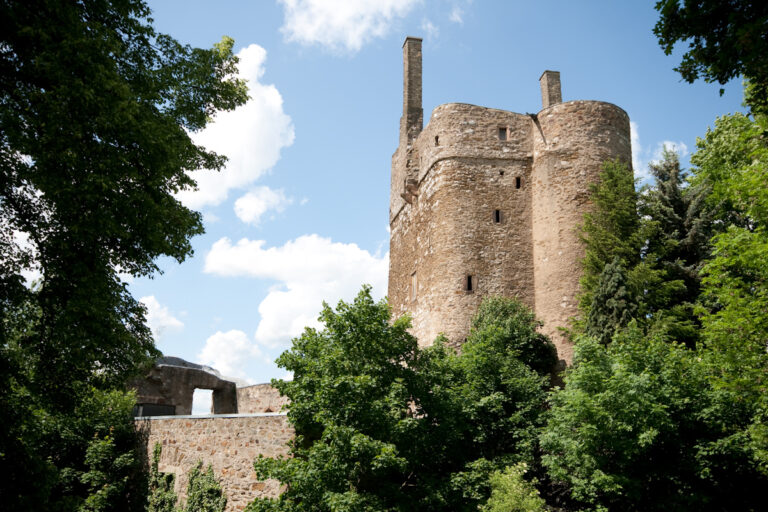
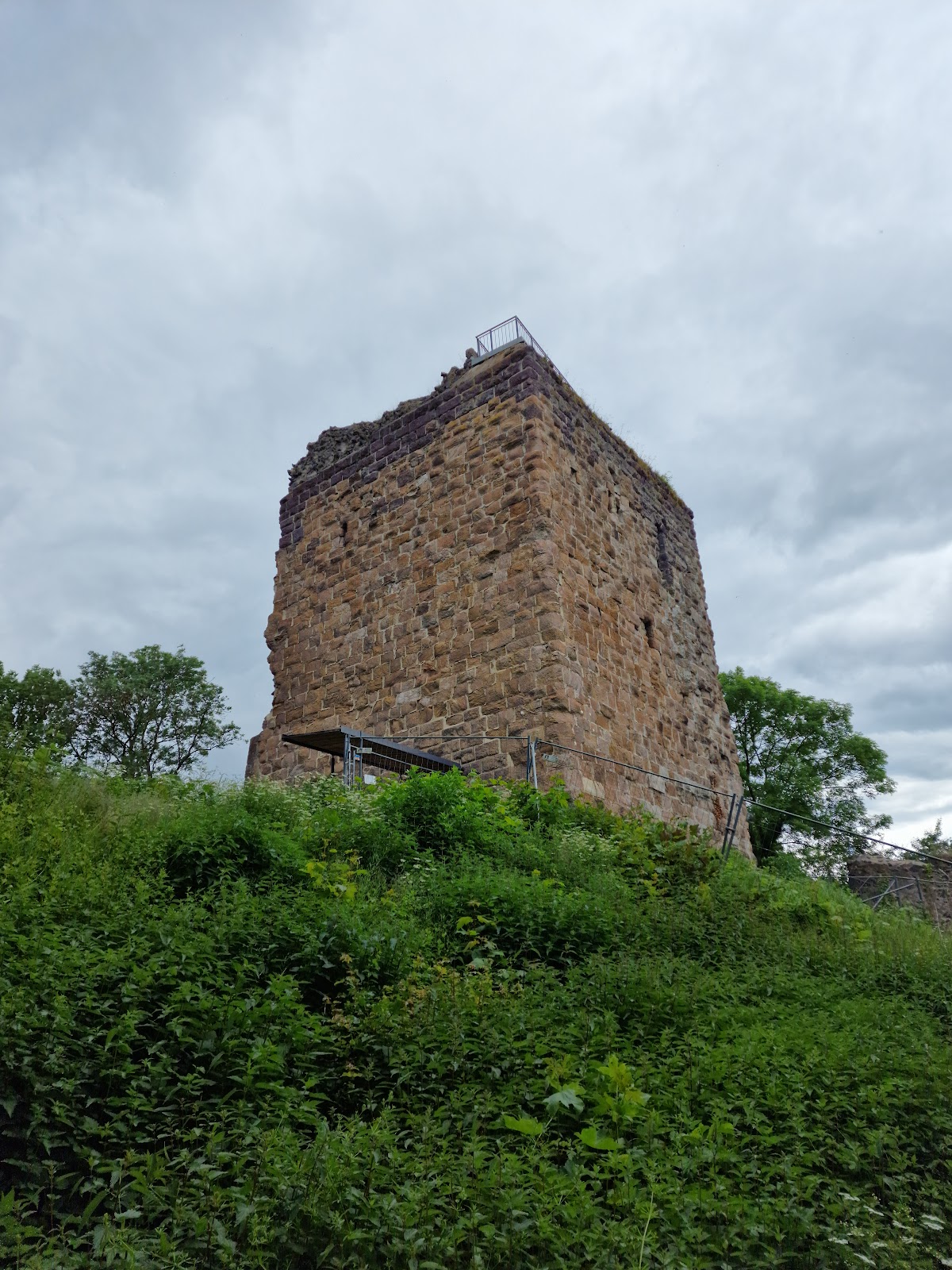
Burg Kalsmunt occupies a basalt cone above Wetzlar, about 850 metres southwest of the old town. The elevation is listed at 256 metres above sea level, while the prominent hill is given as 241 metres, with a difference of 90 metres from Schillerplatz in the old town. The formerly unforested elevation is now overgrown. The surviving castle is a ruin whose principal remains are the main defensive tower, parts of a gate tower, and remnants of residential buildings.
Medieval Castle Structures
The main defensive tower
The castle’s Bergfried, the principal defensive tower of a medieval German castle, has walls up to three metres thick. It served as a strong refuge and observation structure rather than as a permanent residence. Its present entrance at ground level was cut through the masonry in 1836. Earlier access was at first-floor level through a separate structure leading into the tower.
Gate and residential remains
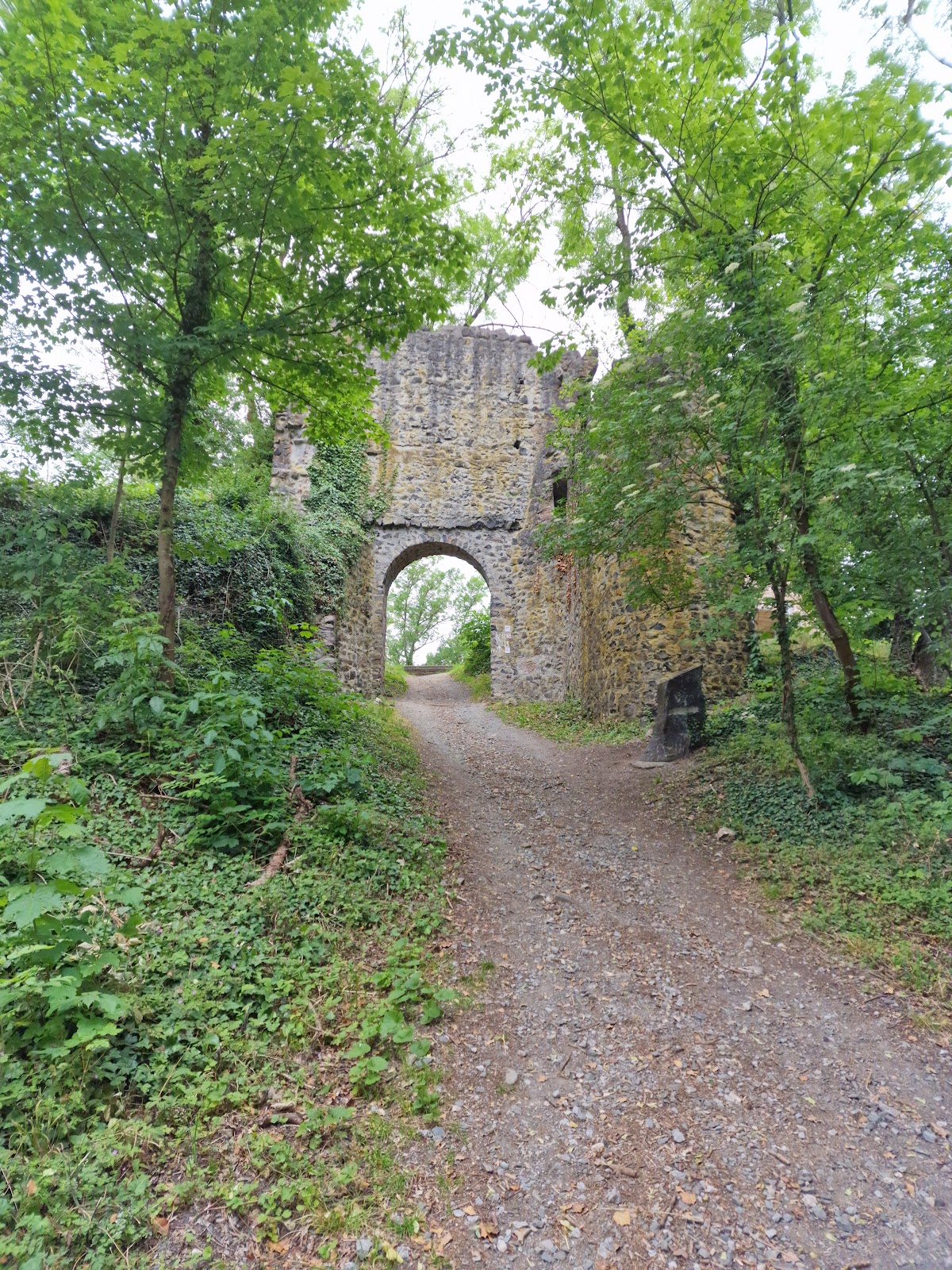
Parts of a gate tower and remnants of residential buildings survive alongside the Bergfried. Together, these fragments represent the castle’s entrance arrangements and living quarters, while the tower remains the most substantial standing element of the medieval ruin.
Wartime Alterations and Archaeology
Changes to the tower
During the Second World War, the medieval masonry of the tower was stabilized with cement. A concrete ceiling was inserted, and the southwestern half was built up to support shelters, reinforcement, and a 2-centimetre anti-aircraft gun. The present viewing platform still rests on these wartime structures, linking the surviving medieval tower with its twentieth-century military adaptation.
Underground command post
An underground bunker was constructed within the hill during the Second World War. It served as Major Schimpff’s command post during the final fighting in 1945. A bomb crater and recovered German and American ammunition provide physical traces of the battle for Wetzlar.
Excavated areas
Archaeological investigations have included excavation areas around the ruin. The work conducted since 2013 has extended the study of Kalsmunt beyond its standing walls and continues the earlier surveys and excavations carried out in 1609 and 1928.