Altenberg Abbey, Solms: A Former Premonstratensian Nunnery


Site at a Glance
- Rating
- 4.5
- Popularity
- Low
- Country
- Germany
- Primary era
- Medieval
- External website
- Open
- Eras represented
- Medieval, Early Modern
- Civilizations
- Holy Roman Empire
- Site type
- Religious
- Remains
- Monastery
On this page12 sections
History
Altenberg Abbey, Solms, in Germany, is a former Premonstratensian nunnery on the Michelsberg above the Lahn, between Wetzlar and Solms-Oberbiel. Its history began in 1167, when the priest Gottfried of Beselich founded a chapel dedicated to the Archangel Michael on the “Old Mountain.” The Premonstratensians were a Catholic religious order founded in the twelfth century, and a women’s convent developed around the chapel about 1170 after Abbot Engelbert of Rommersdorf sent twelve women from Wülfersberg to establish it. Rommersdorf Abbey became Altenberg’s mother house.
Foundation and imperial status
Noble women from the surrounding region entered the convent, including members of the Houses of Nassau and Solms. Christina of Biel, the second superior, used her personal fortune to lay the foundation for the abbey’s later wealth. Before 1192, Emperor Frederick I Barbarossa granted Altenberg imperial immediacy, a legal position that placed the institution directly under the Holy Roman Emperor rather than beneath an intervening territorial ruler. The House of Solms later sought the imperial bailiwick, a form of protective and administrative guardianship, but Altenberg retained its imperial status until 1802.
Gertrud’s rule and dynastic connections
In 1248, Gertrud, the daughter of Saint Elisabeth of Thuringia and aunt of the first Hessian landgrave Heinrich, became the convent’s third superior. During her forty-nine-year tenure, the abbey flourished. Its church was built between 1260 and 1270, and the convent acquired extensive property along the Lahn, in the Wetterau, and in the Hessian Hinterland, including the Hülshof, now part of Bad Endbach. After Gertrud died in 1297, she was venerated as a blessed person.
Gertrud’s successor, Katharina of Nassau, led the convent from 1297 to 1304. She was an aunt of King Adolf of Nassau and a sister of Otto I, reinforcing Altenberg’s close relationship with the House of Nassau. Otto I was among those associated with burials at the abbey. Altenberg also served at times as a burial place for the House of Solms, giving the convent a continuing dynastic role alongside its religious one.
Confessional continuity and war damage
Unlike many nobles in the surrounding area, Altenberg did not adopt the Reformation. It remained a Catholic enclave under the Electorate of Trier, the ecclesiastical principality ruled by the Archbishop-Elector of Trier. During the Thirty Years’ War, the European conflict of 1618 to 1648 that combined religious and dynastic struggles within the Holy Roman Empire, Swedish soldiers burned the abbey in 1636. The community recovered under the superior Katharina of Derschen, who held office from 1644 to 1655.
Secularization and later uses
After 1802, the imperial secularization settlement, which transferred many church properties to secular rulers, brought the abbey complex to the Princes of Solms-Braunfels. They dissolved the convent, made the property a domain, and used it as a summer residence. Many of the abbey’s artworks were moved to other castles for protection. The former abbey church became an Evangelical parish church.
Since the end of the First World War, the complex has served several purposes. A children’s home was established there after 1947, and a fire seriously damaged the buildings in 1952. Renovation followed in 1955. The Königsberger Diakonie der Barmherzigkeit, a community associated with the Evangelical Alliance, later leased the buildings as its mother house until 2054 and operated a care facility there until 2010. Financial difficulties led the Kloster Altenberg charitable company to assume the lease’s rights and obligations for three years from August 2010.
From 2009 to 2011, the Technical University of Central Hesse used parts of the former abbey as offices and attempted to establish part-time vocational training there. In 2018, Lukas Haltiner of the Protestant Christusbruderschaft Selbitz community initiated a new religious community at Altenberg. Six men moved into former care rooms and developed the complex as a spiritual center. After Haltiner’s death, the community joined the Christocentric Community of Bonn in 2022. That community left Altenberg in August 2023 because rising energy costs made financing and extending the lease impossible.
Remains
Abbey complex and church
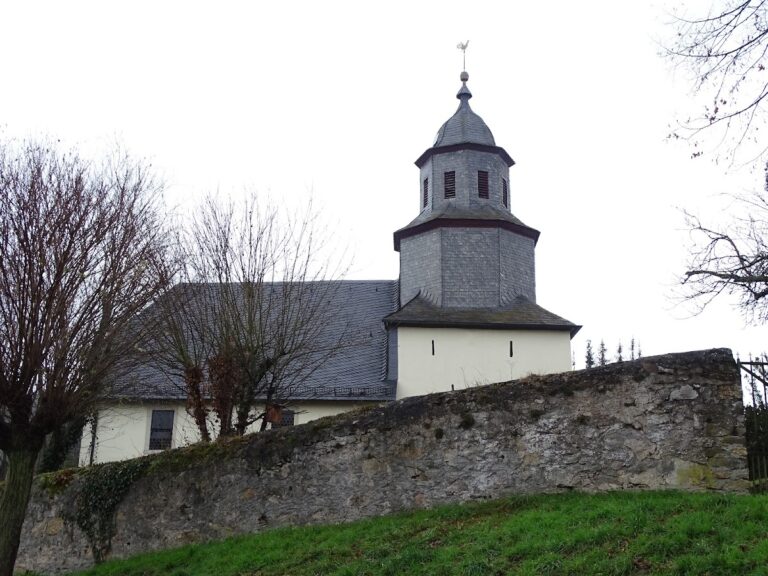
The surviving complex includes the thirteenth-century former abbey church, convent buildings, and numerous service and agricultural structures from the seventeenth century. An outer wall encloses almost the entire site, preserving the physical distinction between the former religious establishment and its surroundings. The church remains in use as an Evangelical parish church, while the convent and supporting buildings reflect the abbey’s religious and economic organization over successive periods.
Former abbey church
Constructed between 1260 and 1270 during Gertrud’s period as superior, the former abbey church is the principal surviving medieval building. Its later conversion into an Evangelical parish church forms part of the complex’s post-secularization history and its present physical use.
Baroque organ
Johann Wilhelm Schöler built the church’s third organ in 1757. Earlier instruments had been installed in 1452 and 1653. Schöler’s Baroque organ has 23 stops, two manuals, and a pedal division. A stop controls a distinct set of pipes, a manual is a keyboard played by the hands, and the pedal division is operated with the feet. Apart from maintenance-related changes and minor repairs, the instrument is almost unchanged. Its restricted keyboards and gentle but varied tones were designed for liturgical use.
Dispersed artistic and devotional remains
Winged altarpiece
A winged altarpiece dating from 1330 was dispersed after the convent was dissolved. This type of altar has painted or sculpted panels that open and close like wings. Parts of the altarpiece are preserved at Braunfels Castle, while its wings, made by an unknown master, are displayed at the Städel Museum in Frankfurt.
Arm reliquary of Saint Elisabeth
An arm reliquary of Saint Elisabeth has been kept in the chapel of Sayn Castle since the abbey’s dissolution. Its preservation elsewhere reflects the movement of Altenberg’s sacred artworks and objects after the convent ceased to exist.
Nearby sites