Church of San Adrián de Vadoluengo: A Romanesque Hermitage in Spain
Site at a Glance
- Rating
- 4.6
- Popularity
- Very Low
- Country
- Spain
- Primary era
- Medieval
- Eras represented
- Medieval
- Civilizations
- Crown of Aragon, Kingdom of Navarre
- Site type
- Religious
- Remains
- Church
On this page10 sections
History
The Church of San Adrián de Vadoluengo is a twelfth-century Romanesque Catholic hermitage in Sangüesa, Spain, built in the medieval frontier zone between Navarra and Aragon. It stands at Vadoluengo, a name meaning “wide ford” in Navarro-Aragonese, beside a route that was first an ancient crossing and later became a Roman road.
The frontier before the church
Sancho Garcés III of Pamplona assigned the territory that later became the County of Aragon to his son Ramiro in 1035. The ford at Vadoluengo consequently lay within a politically sensitive area between the two realms. The route eventually lost its importance after a bridge was built at Sangüesa.
Fortún Garcés Cajal and the twelfth century
After granting the Fuero of Jaca, a medieval charter defining a town’s rights and obligations, to Sangüesa’s Burgo Nuevo in 1122, Alfonso I of Navarra and Aragon granted the Vadoluengo lands to his relative Fortún Garcés Cajal. Fortún constructed a palace and church there, and the church may have served as the palace chapel. The church is dated to the twelfth century, with 1122 also given as its construction date, and it was consecrated in 1141.
The original arrangement assigned Fortún’s palace to the Monastery of Leyre and the church to the Cluniac foundation of Saint Peter of Cluny. Cluny was a major medieval Benedictine monastic center with affiliated religious houses across western Europe. After Fortún’s wife died in 1145, both the hermitage and the palace were ceded to the Abbey of Saint Peter and Saint Paul of Cluny.
Political and religious associations
Vadoluengo was the setting for the Pact of Vadoluengo, concluded in January 1135. Ramiro II of Aragon and García Ramírez of Pamplona formed a brotherhood in which each agreed to inherit the other’s crown if one died. The church is also considered a possible setting for drafting a related agreement between Ramiro II and a Navarrese ruler.
In 1312, the area witnessed the Battle of Vadoluengo, a conflict between Navarra and Aragon. A pilgrims’ hospital reportedly stood nearby beside the now-disappeared Hermitage of Saint Mary Magdalene. The hospital belonged to the Order of the Temple, a medieval military religious order associated with protecting pilgrims and Christian sites.
Modern preservation
The church was restored by José María Yárnoz Orcoyen, restoration architect of the Príncipe de Viana Institution. It was declared a historic-artistic monument in 1983 and is recognized as a protected cultural property. Its historical association with the Aragonese Way, a pilgrimage route within the Camino de Santiago network, led to its inclusion among the associated elements submitted by Spain for World Heritage designation.
Remains
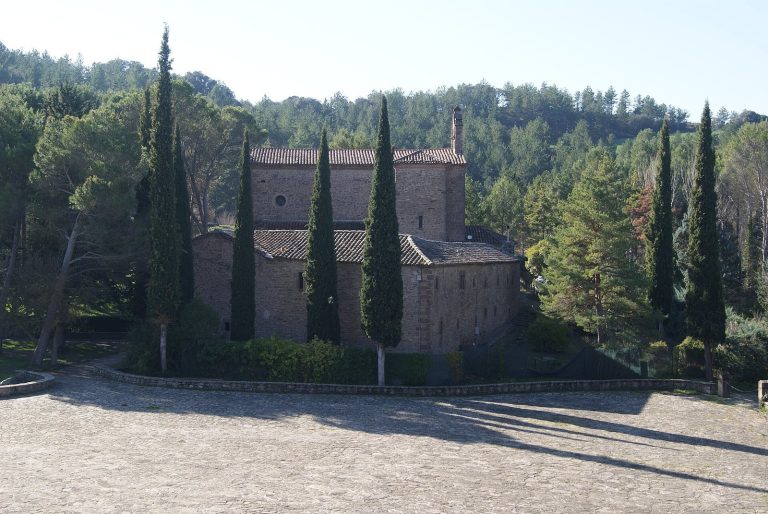
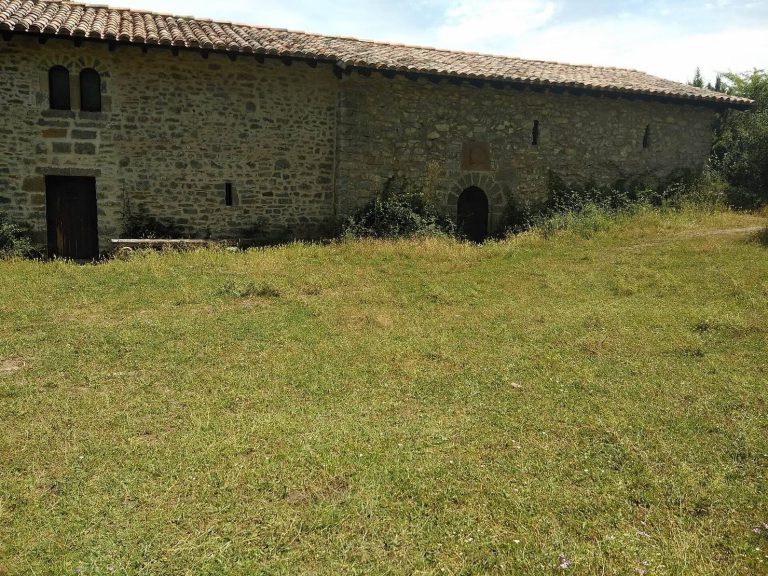
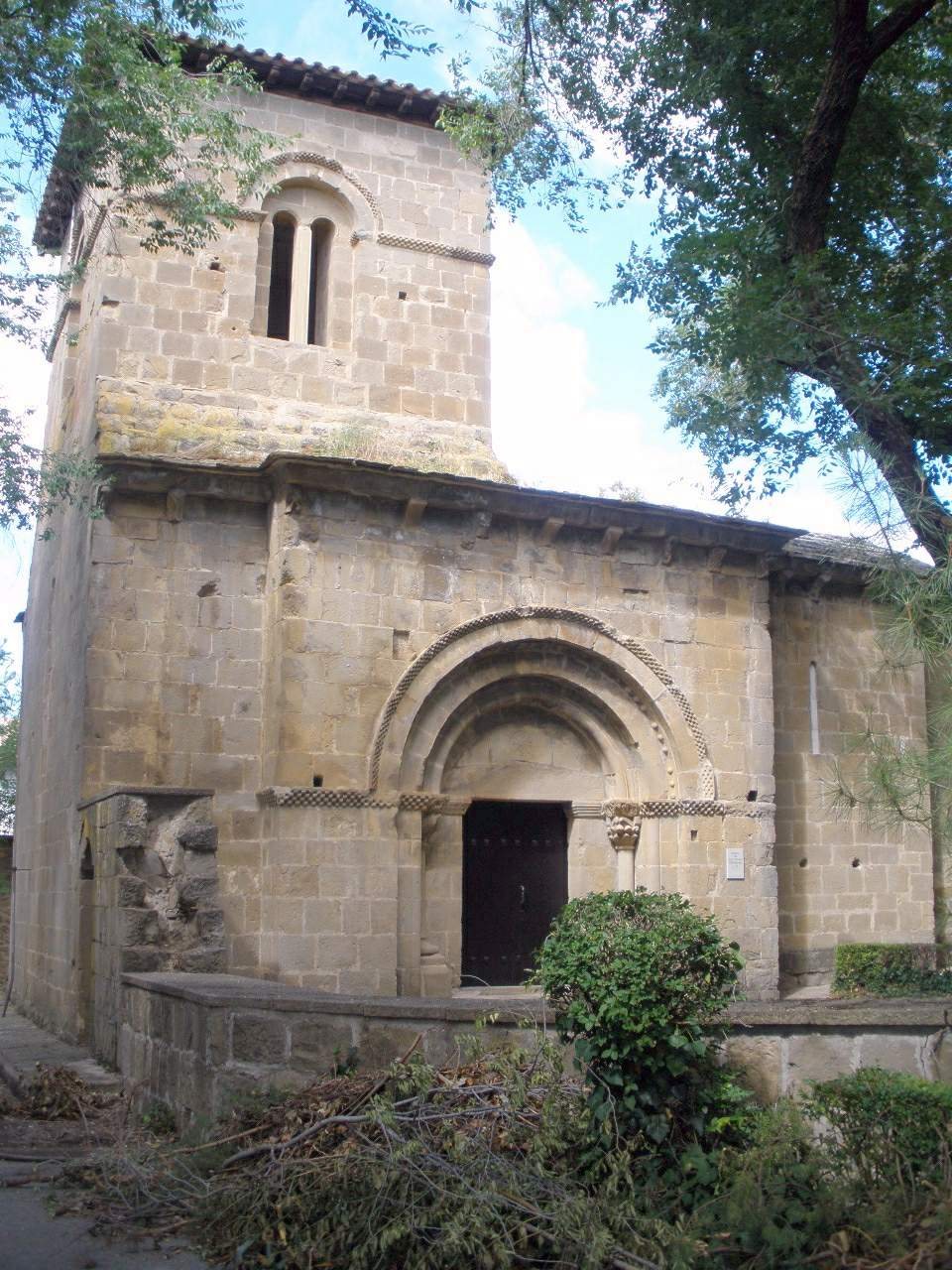
The church stands south of Sangüesa on the road toward Sos del Rey Católico, beside the Onsella River shortly before that river meets the Aragón River. It is a compact Romanesque building of regularly cut ashlar stone, with a single nave divided into two bays and covered by a barrel vault.
The church building
Portal and carved masonry
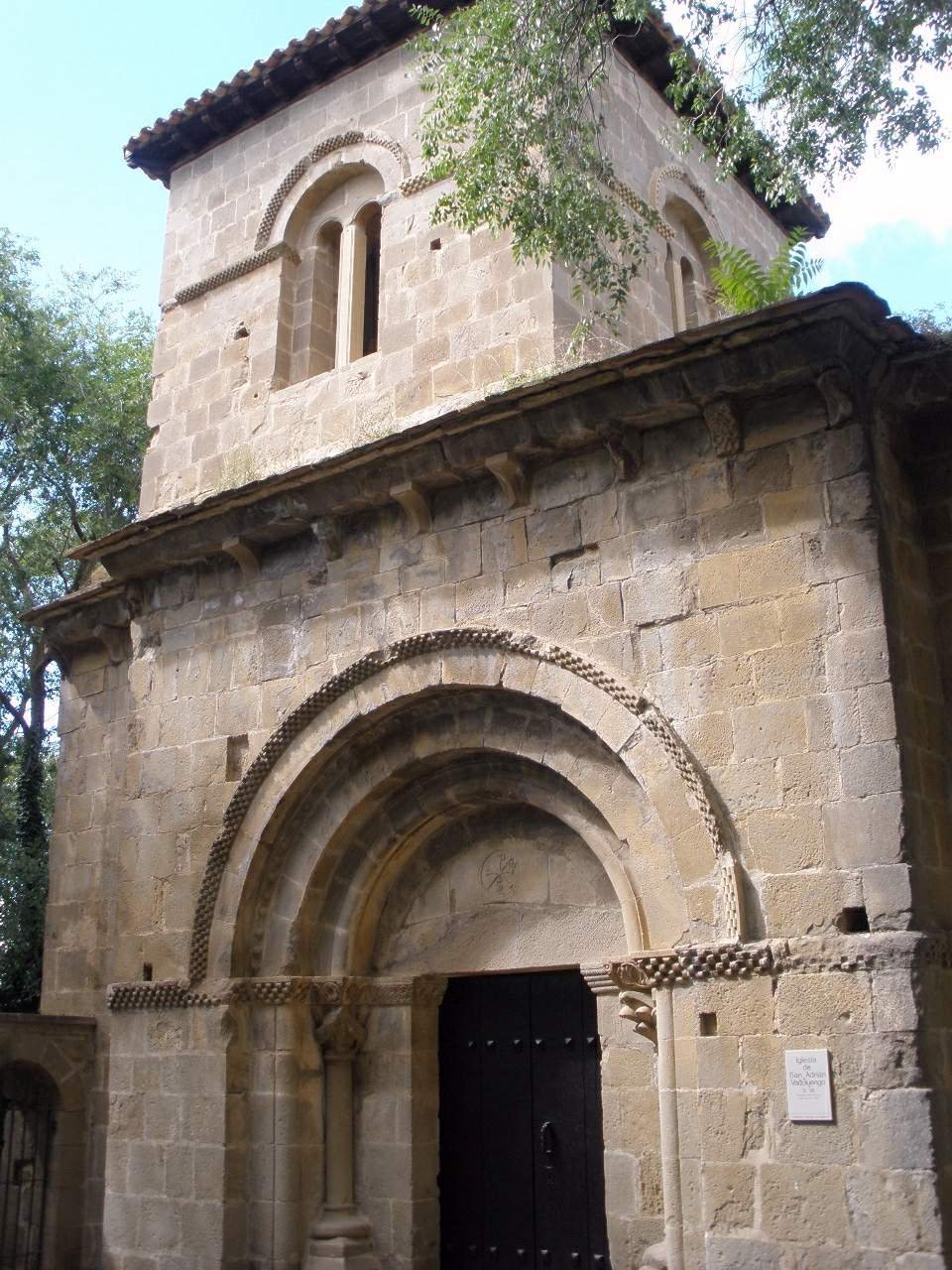
The Romanesque facade has a recessed entrance framed by a semicircular arch. Carved images decorate the masonry, including motifs with sexual meanings, among them a naked married woman. These sculptures form part of the building’s surviving Romanesque decoration.
Bell tower and interior
A solid square bell tower rises at the rear of the nave, toward the left side of the building. Its open belfry has double-arched windows on each face. Inside, the presbytery, the area around the main altar traditionally reserved for the clergy, preserves a seventeenth-century crucifix together with other later works.
Lost associated buildings
The palace connected with the church has disappeared, as has the nearby Hermitage of Saint Mary Magdalene. The pilgrims’ hospital that stood beside the latter hermitage has likewise left no surviving building, although its association with the Order of the Temple forms part of Vadoluengo’s historical setting.