Ermida de São Sebastião: A Historic Hermitage in Faro, Portugal
Site at a Glance
- Popularity
- Very Low
- Country
- Portugal
- Primary era
- Early Modern
- Eras represented
- Medieval, Early Modern
- Civilizations
- Portuguese
- Site type
- Religious
- Remains
- Chapel
On this page11 sections
History
Ermida de São Sebastião is a hermitage in Faro, Portugal, built outside the city walls in the late fifteenth or early sixteenth century. Dedicated to Saint Sebastian, it followed a tradition of placing shrines to the saint beyond town walls because he was believed to protect people from epidemics.
Early use and the Franciscan community
From 1516, members of a Franciscan community used the hermitage while planning a convent in Faro. The Capuchos Convent was later built nearby. A 1534 visitation record of the Order of Santiago, a medieval military-religious order, also notes a chapel inside the hermitage.
Damage and rebuilding
In 1596, English forces led by Robert Devereux, 2nd Earl of Essex, badly damaged the building. Bishop Fernando Martins de Mascarenhas then ordered repairs and paid for the work.
Expansion and religious life
Major expansion followed in the eighteenth century, probably under the direction of master mason Diogo Tavares, a skilled supervisor of masonry and building work. The changes substantially reshaped the earlier building. In 1789, a side chapel dedicated to Our Lady of Bethlehem, a title of the Virgin Mary, was added.
The hermitage served two religious confraternities, associations organized around shared devotion or charitable activity. One was a military confraternity dedicated to Saint Roch; the other, devoted to Saint Sebastian, was associated with Faro’s municipal council. The church was also linked to devotion to Our Lady of the Nativity, another title of the Virgin Mary. Its bells were rung when people sought prayers for women in childbirth.
Restoration and protection
Faro’s municipal council undertook repairs in the 1940s, including renewal of the stonework around the triumphal arch in 1943. A process to protect the hermitage began in 1998 after a proposal by the Association for the Defense of the Cultural and Natural Heritage of Faro Municipality. It received official protection as a Monument of Public Interest in 2013. In August 2023, the Faro Municipal Museum began restoring the main altarpiece to slow its deterioration and preserve its heritage value.
Remains
Layout and exterior
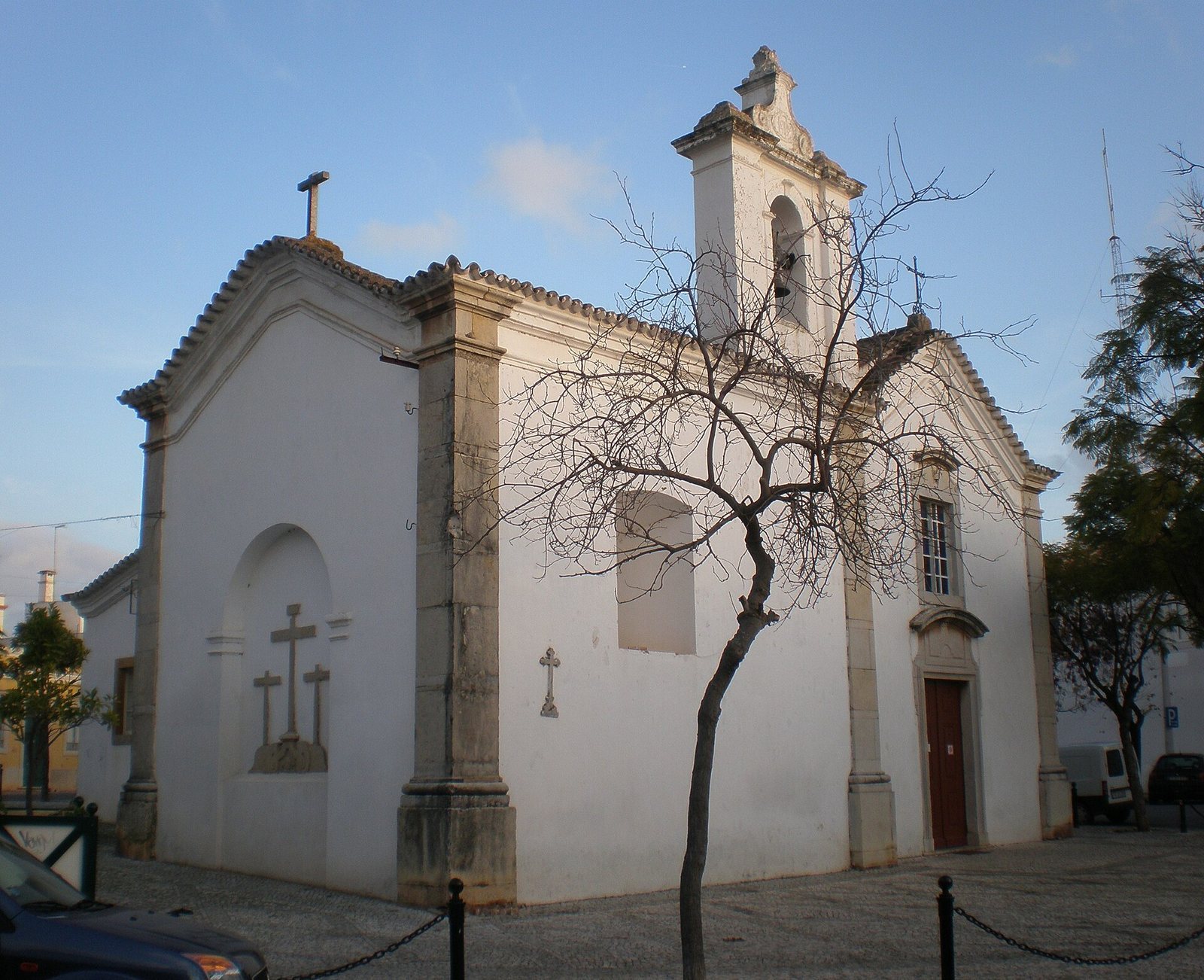
The surviving building has a plain exterior and a richly ornamented interior, with a nave, chancel and side chapels. Its fabric includes Baroque stone portals and a side chapel in the Manueline style, a Portuguese late Gothic style associated with the reign of King Manuel I.
Facade and chapel of Our Lady of Bethlehem
The main entrance has a dressed-stone portal with a semicircular pediment and a window directly above it. On the left side of the facade, the chapel dedicated to Our Lady of Bethlehem has a belfry above it. The exterior as a whole is simply decorated.
Interior
Nave and chancel
The nave, or main body of the church, has a lower band of seventeenth-century tiles. Patterned tiles line the chancel, the area around the main altar. Its altar is made of carved and gilded wood and was completed in 1720; an image of Saint Sebastian, the patron saint, is also present. Religious statues and further gilded Baroque woodcarving contribute to the interior’s ornament.
Chapel of Saint Roch
The side chapel dedicated to Saint Roch is considered the only surviving part of the original hermitage. It is partly lined with patterned seventeenth-century tiles. Its Manueline features include a ribbed vault and capitals decorated with rounded forms and rope-like motifs.