Dzivgis Cave Fortress: A Mountain Defensive Complex in Russia


Site at a Glance
- Rating
- 4.8
- Popularity
- Low
- Country
- Russia
- Primary era
- Unclassified
- Eras represented
- Unclassified
- Civilizations
- Unclassified
- Site type
- Military
- Remains
- Fort
On this page6 sections
History
Dzivgis Cave Fortress is a defensive complex in Russia, located in the nearly deserted village of Dzivgis in the Kurtat Gorge of North Ossetia–Alania. Its fortifications occupy natural limestone hollows and were adapted as a series of protected positions in the mountains. A local tradition connects the complex with resistance to Shah Abbas I, the Safavid ruler of Iran from 1588 to 1629, during the sixteenth and early seventeenth centuries.
Safavid-era tradition
The fortifications are traditionally said to have blocked Abbas I’s route into the Kurtat Gorge in the sixteenth century. In 1614, Abbas’s forces reached the mountainous part of Ossetia after passing through the Darial Gorge. Strong resistance reportedly compelled them to withdraw. The cave fortress is therefore associated with the defensive history of the gorge, although the tradition concerns the role of the fortifications in these events.
Twentieth-century record and protection
A group of researchers visited Dzivgis in 1912. Esaul F. S. Pankratov, an esaul, a senior military rank below colonel in Russian and Cossack traditions, left written notes about the visit under the pseudonym Grebenets. The fortress now has the status of a federally significant cultural-heritage site of the Russian Federation. Its surviving structures remain in ruins and are preserved to varying degrees.
Remains
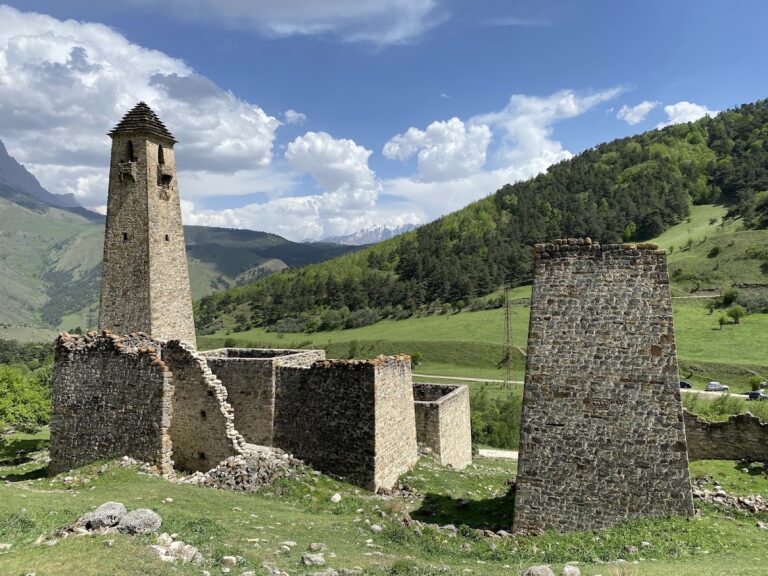
The complex is arranged along a single plane at different elevations on the limestone cliffs. Six caves of varying sizes are fitted with attached stone defenses, while six residential towers survive in front of the cave openings. Natural hollows formed by water and wind provided the original rock dwellings. Local stone walls, bonded with strong mortar, closed the caves and turned them into fortified spaces. Dense vegetation covers parts of the masonry, making sections of the construction appear closely integrated with Kariu-khokh mountain despite their artificial form. Some caves could hold at least one hundred people.
Fortifications and access
The principal fortification occupies the lowest level and is reached by a staircase built of stone. Other positions were approached from neighboring fortifications by paths cut into the rock and by suspended ladders that could be removed when needed. During combat, the fortifications could not be used to communicate with one another, so each position functioned as an autonomous defensive unit.
Deep cave passage
One cave extends into a deep pocket in the rock and ends at a dead end 65 meters above the surrounding level. Together with the towers, stairway, rock-cut paths, and movable ladders, this feature illustrates how the complex combined natural formations with constructed defenses. The fortress survives as a group of ruined positions, with the condition of its masonry differing from one structure to another.