Dürrenmungenau Castle: A Moated Manor in Bavaria
Site at a Glance
- Popularity
- Medium
- Country
- Germany
- Primary era
- Early Modern
- Eras represented
- Medieval, Early Modern, Modern
- Civilizations
- German, Holy Roman Empire, Kingdom of Bavaria
- Site type
- Domestic
- Remains
- Castle
On this page9 sections
History
Early records and changing ownership
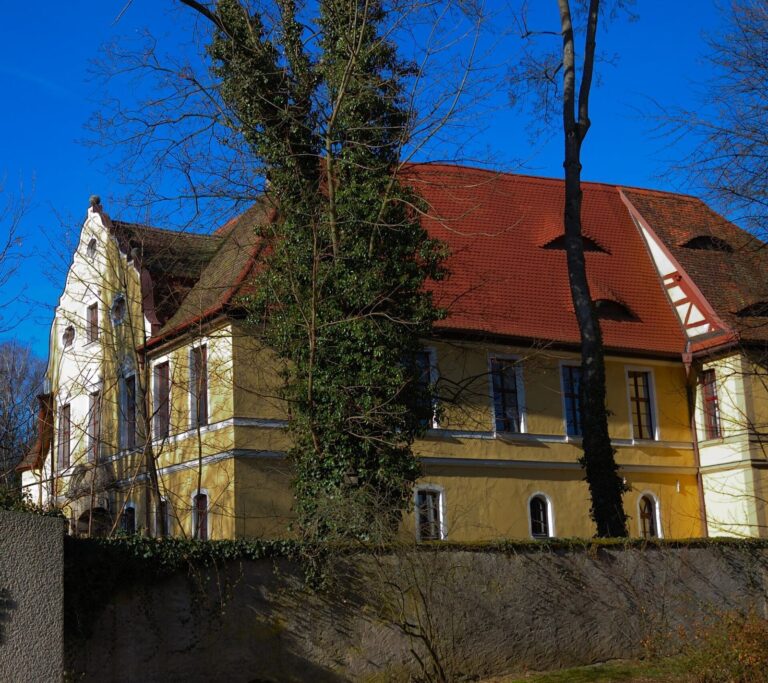
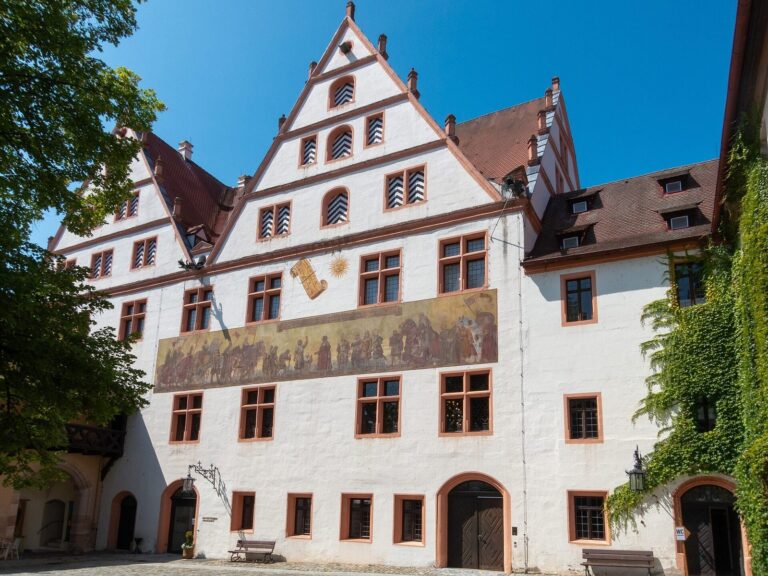
Dürrenmungenau Castle is a moated manor in Abenberg, Bavaria, Germany. The castle and village were destroyed during the Thirty Years’ War (1618–1648), a major European conflict. The castle was rebuilt between 1720 and 1725 in Baroque form, an architectural style prominent in the 17th and 18th centuries. It later served its owning family as a summer residence and belonged to a manor with local landholding and judicial rights.
The settlement of Mungenau appears in a record from 1278, while Lords of Mungenau are named in 1142 and 1295. A fortified house may have stood there to protect the road linking Nuremberg and Augsburg. The castle itself is first explicitly mentioned in 1390, when it was held in equal shares by the Burgraves of Nuremberg, noble officials who governed castles and nearby territory, and Konrad von Lentersheim.
In 1414 Heinrich von Seckendorff transferred the share he held from the burgraves to Jakob Zuckmandel, then sold the other half to Stephan von Absberg in 1415. By about 1419, the Absberg family had become sole owners and kept the property until 1507, when the Seckendorffs held it again. The von Pleinfeld family followed in 1516, selling the estate to the Schnöden von Defersdorf in 1554. In 1564–65, margravial councillor Endres Mussmann acquired the estate complex. Margraves were territorial rulers in the Holy Roman Empire.
Rebuilding and manor authority
The castle and village were destroyed during the Thirty Years’ War. In 1651, Jobst Christoph Kreß von Kressenstein of Nuremberg purchased the depopulated village and brought settlers back. The castle’s rebuilding followed between 1720 and 1725, after which its owners used it as a summer residence.
The manor paid tax to the Altmühl Knights’ Canton, a regional organization of the Imperial Knighthood. It held limited high-court jurisdiction, concerning serious criminal cases, over Dürrenmungenau, Hergersbach, and Weihermühle, as well as village and municipal lordship in those places. When required, offenders were handed over to the Brandenburg-Ansbach treasury and town-bailiff office at Windsbach, which combined revenue administration with bailiff duties.
The later estate
By the end of the 18th century, the manor held rights over 42 properties: 29 in Dürrenmungenau, 11 in Hergersbach, one in Beerbach, and one in Weihermühle. Since 1896, the estate has belonged to the Barons Leuckart von Weißdorf or their descendants. Around 1900, the castle was remodelled in the Historicist style, a 19th-century movement drawing on earlier architectural styles, and new farm buildings were added.
Remains
Castle complex
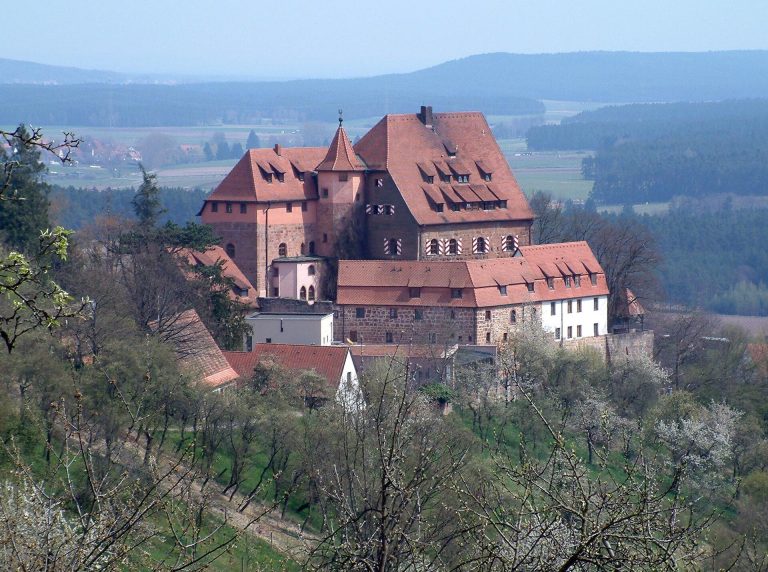
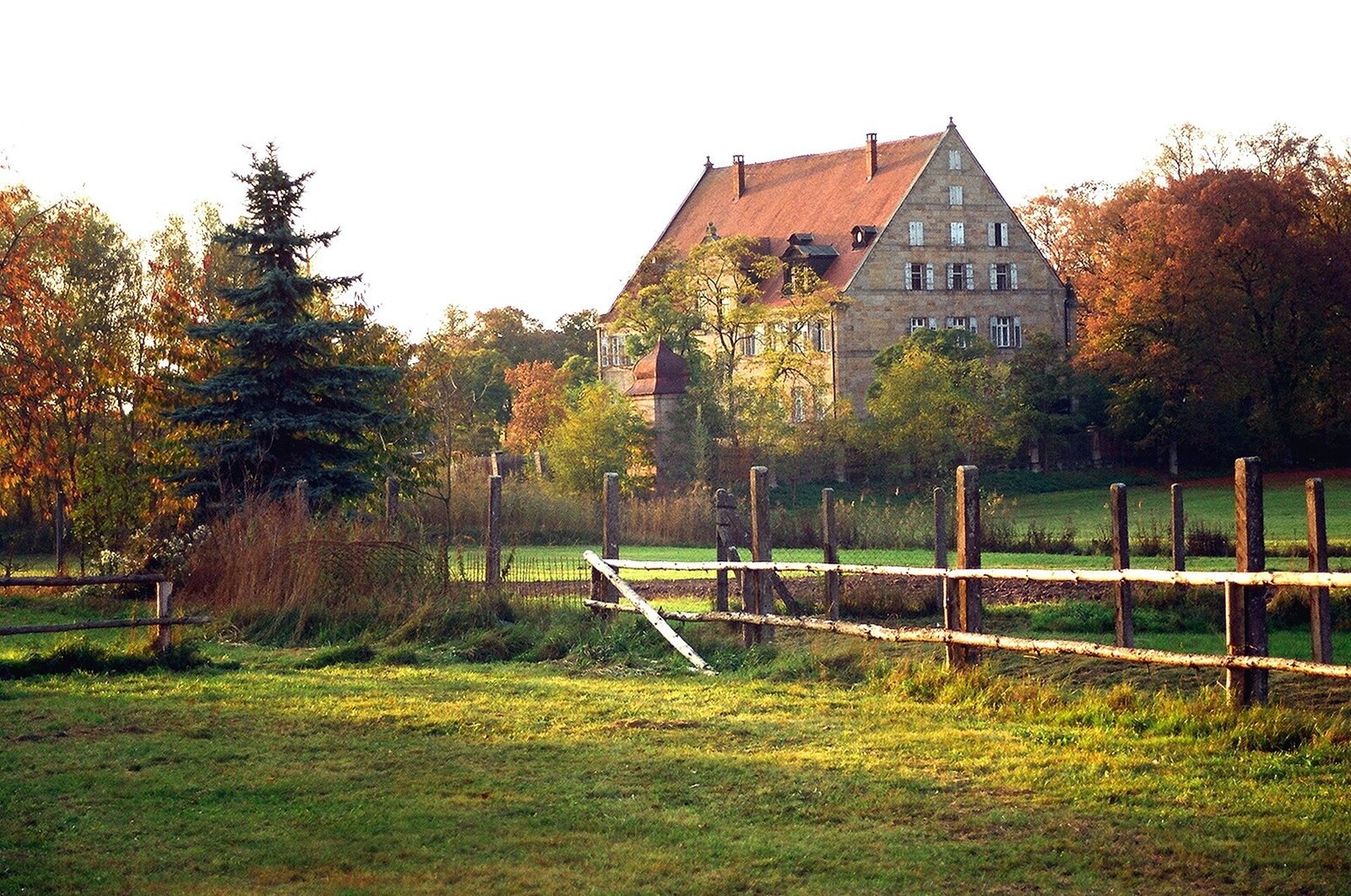
The complex includes the castle and its courtyard, with a moat around the building and a sandstone enclosure surrounding the castle, park, orchard, and farmyard.
Castle and moat
The two-storey castle has a tower-like projection at its center and cross-gables. Its fabric includes parts of a late-medieval building and a distinct 17th-century construction phase. An 18-metre-wide moat encircles the castle and has the appearance of a broad pond.
Courtyard buildings
A large hop barn dating to 1736 stands on the eastern side of the courtyard. Opposite it is a low washhouse built in the mid-19th century.
Enclosing wall
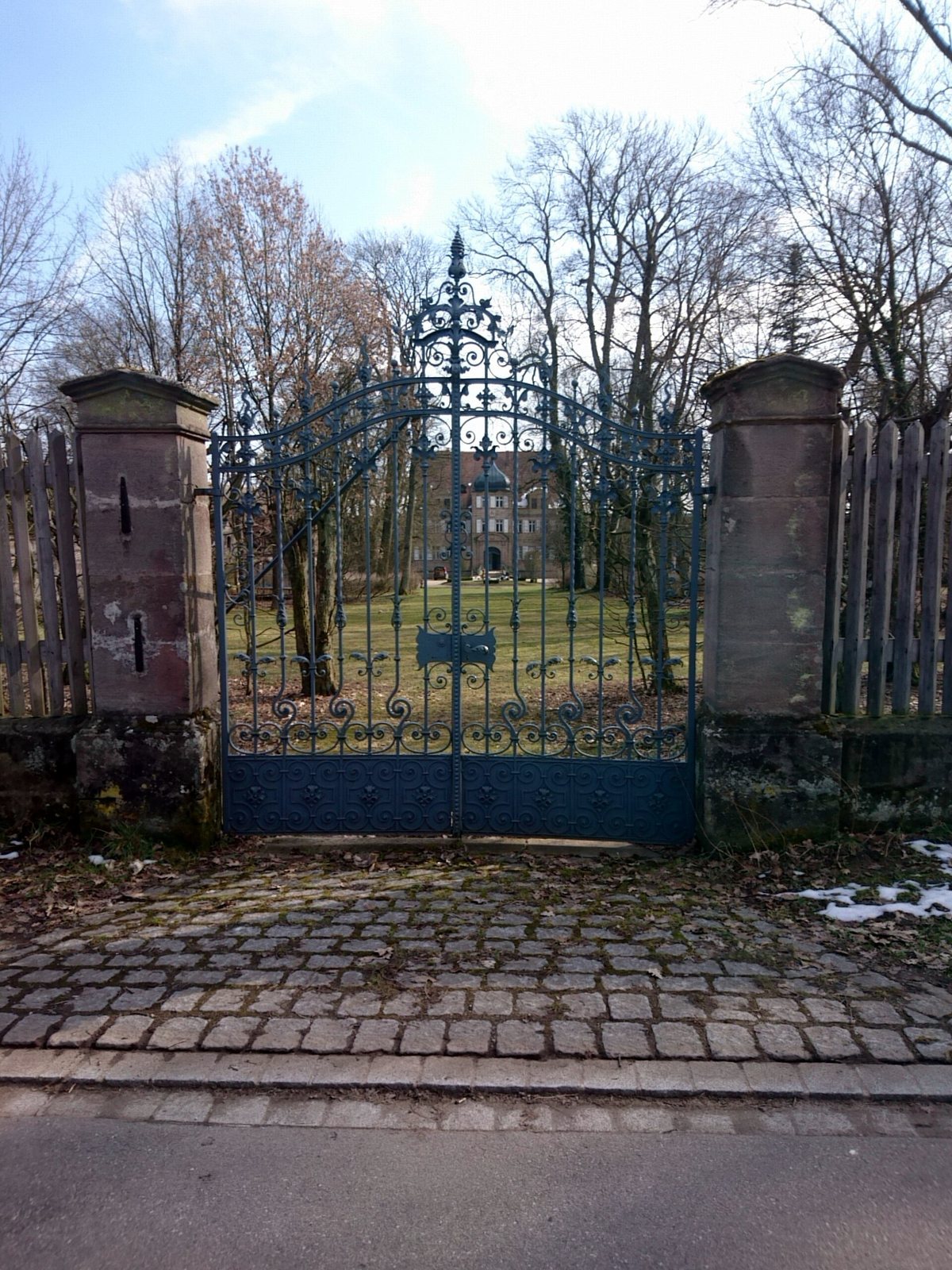
A sandstone wall with onion-domed towers encloses the castle grounds, including the park, orchard, and farmyard.