Saint Nicholas Church: A Medieval Orthodox Chapel in Sofia, Bulgaria


Site at a Glance
- Rating
- 4.8
- Popularity
- Very Low
- Country
- Bulgaria
- Primary era
- Medieval
- Eras represented
- Classical, Medieval
- Civilizations
- Roman, Second Bulgarian Empire
- Site type
- Religious
- Remains
- Church
On this page15 sections
History
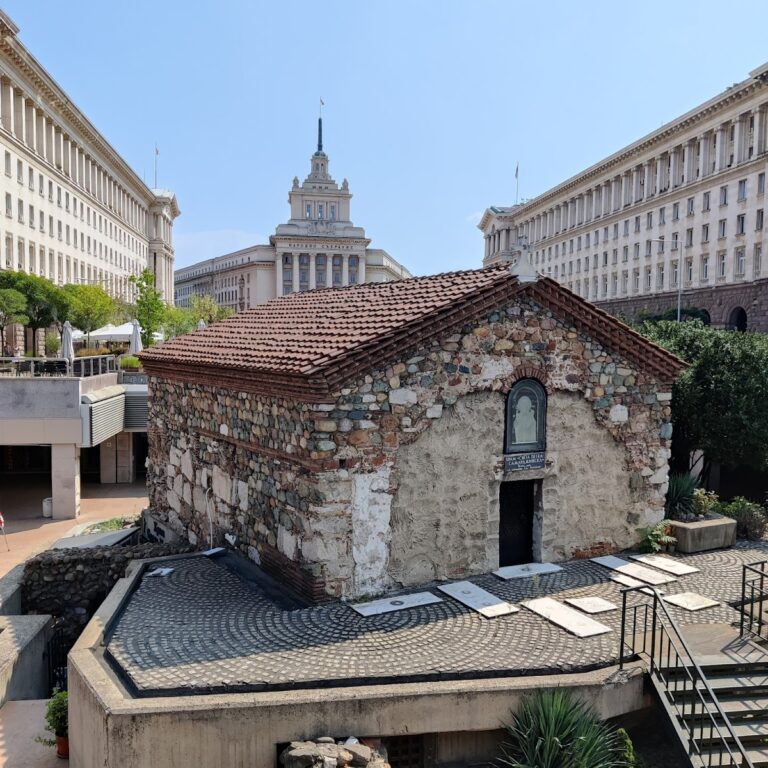
Saint Nicholas Church is an Eastern Orthodox church of the Bulgarian Orthodox Church in Sofia, Bulgaria, whose present form is rooted in a thirteenth-century medieval chapel. It stands in the city centre opposite the Sofia Metropolitanate and is among Sofia’s oldest churches, preserving links to the ancient palace complex associated with the Roman emperor Constantine the Great.
Roman and Early Bulgarian Foundations
The earliest walls beneath the church date from the fourth century, during the reign of Constantine the Great, the Roman emperor who openly supported Christianity and established Constantinople. A tradition connects an earlier church or chapel with Constantine’s palace residence in Sofia, although the surviving church principally belongs to the thirteenth century.
After Khan Krum captured Sofia in 809, parts of the imperial palace complex became the residence of the Bulgarian governor of the important Sredets district. From 971, during the reign of Tsar Samuel, Sredets served for a time as the seat of Patriarch Damian, a head of the medieval Bulgarian Church, while the Bulgarian patriarchate moved successively between different centres.
The Thirteenth-Century Chapel
Tsar Asen I ended Byzantine rule in Sofia in 1193. The palace was then repaired by the Bulgarian provincial governor, and Sebastocrator Kaloyan later established the present church as a small family chapel within his urban residence. A sebastocrator was a high court title generally held by a close relative of the ruler.
Ottoman and Revival-Era Changes
During the Ottoman period, the centuries when Bulgaria was under Ottoman rule, the church was called “Saint Nicholas the Great.” The name distinguished it from a smaller Saint Nicholas church and from Saint Petka the Old across the street. The sixteenth-century German traveler and Protestant theologian Stephan Gerlach described the church by this name.
During the Bulgarian National Revival, a period of cultural, religious, and political renewal before the modern Bulgarian state was established in 1878, the medieval chapel was repeatedly repaired and enlarged. The work produced a larger three-aisled church with a bell tower. The later tower appeared in early photographs but had disappeared before the Second World War.
War Damage and Reconstruction
In 1939, Saint Nicholas Church sheltered clergy expelled from the Russian Church of Saint Nicholas on Tsar Liberator Boulevard. Soviet diplomatic authorities had classified members of the Russian émigré community as White Guards. Archbishop Seraphim Sobolev was associated with this displaced Russian clergy, although his sarcophagus is in the crypt of the Russian church, not in Saint Nicholas Church.
Allied bombing of Sofia on 30 March 1944 caused severe destruction. Explosions and fire destroyed the roof and much of the building, and people connected with the Russian church community died when the church collapsed during the attack. The church was substantially rebuilt in the 1950s while the adjacent hotel was being constructed. Its preservation was promoted by Bulgarian Patriarch Kiril after the Bulgarian Patriarchate was restored in 1953.
Further interior painting and fitting-out continued into the early 1970s. The surviving church was designated a cultural monument of local significance in 1955 for its historical, architectural-constructional, and artistic value. Its wall paintings were restored in 2017 and 2018. The church remains active, and its annual feast on 6 December is associated with prayer and veneration of its miraculous icon of Saint Nicholas.
Remains
Saint Nicholas Church is a small, partly sunken single-aisled building that retains the old floor level of the church beneath new paving. Most of the visible fabric belongs to the twentieth-century reconstruction, while earlier palace and church remains survive in the underground structure and in carefully exposed interior sections.
Earlier Fabric and Main Structure
Fourth-Century Remains
A small chapel to the left of the entrance preserves fragments of fourth-century walls. Older masonry has been deliberately left visible inside the church, allowing the earlier palace and church remains to form part of the building’s present interior fabric.
Medieval Chapel
The present building resembles a Bulgarian medieval chapel and retains one medieval wall, identified as the northern wall. Its eastern end has an apse, while northern and eastern conches are incorporated into the structure. A modified niche in the southern facade may indicate that the original building had three conches, with the southern one removed during a later alteration.
Sanctuary and Liturgical Spaces
Northern Conch and Apse
The northern conch served as the choir, the area intended for liturgical singers. Its lower section is rectangular and changes above into a canopy vault. Five earthenware tubes were built into it to improve the acoustics. The eastern apse is higher and wider than the northern conch.
Prothesis and Diaconicon
A niche north of the apse served as the prothesis, the service space where the Eucharistic offerings were prepared. The altar containing the miraculous icon of Saint Nicholas, the prothesis, the diaconicon, and sections of adjoining walls survived the 1944 bombing to their full height. The roof and much of the remaining structure were destroyed by the explosions and fire.
Icons and Interior Decoration
Wall Paintings and Icons
The wall paintings were made by Karl Yordanov. Mikhail Maletsky, a Russian émigré icon painter and longtime employee of the National Museum of Military History, painted the icon of the Virgin Mary in the iconostasis and the icons on the gallery. He also restored icons at the Russian Church after the bombing.
The miraculous icon of Saint Nicholas survived the bombing and subsequent fire without damage. Another image of Saint Nicholas, painted on metal, retains the artist’s initials after restoration. The church also contains relatively recent signed icons, including one of Saint Blaise surrounded by animals, as well as a modern patronal icon above the entrance.
Icon Gallery and Iconostasis
The church has an unusual icon gallery. The present iconostasis may have come from one of the demolished palace chapels or from Vrana Park, although this attribution remains uncertain. Another tradition holds that an earlier iconostasis was transferred to Saint Andrew’s Church. The existing iconostasis includes sculpted figures of the apostles Peter and Paul beside the Royal Doors.
Nearby sites