National Archaeological Museum of Bulgaria: Sofia’s Archaeological Museum and Research Institute
Site at a Glance
- Rating
- 4.6
- Popularity
- Medium
- Country
- Bulgaria
- Primary era
- Classical
- External website
- Open
- Eras represented
- Stone Age, Bronze Age, Iron Age, Classical, Medieval
- Civilizations
- Ancient Greek, Roman, Thracian
- Site type
- Museum
On this page16 sections
History
From Antiquities Cabinet to National Museum
The National Archaeological Museum of Bulgaria is an archaeological museum and research institution in Sofia, Bulgaria, housed in the former Ottoman Buyuk Mosque, whose construction lasted from 1451 to 1494. The mosque was commissioned by Veli Mahmud Pasha, an Ottoman grand vizier, and is one of central Sofia’s oldest surviving monumental buildings. The museum’s own origins lie in a Bulgarian scholarly antiquities collection established in 1869.
After the Russo-Turkish War of 1877–1878, a museum department was formed from the earlier collection. The institution became independent in 1892 and was legally constituted as the National Museum in 1893. Its first director was the Czech archaeologist Václav Dobruský. The initial holdings included antiquities, coins, and ethnographic material, while natural-history collections were transferred to the university.
The museum opened formally to the public on 18 May 1905. Knyaz Ferdinand I, the monarch of Bulgaria from 1887 to 1918, attended the ceremony with Ivan Shishmanov, the scholar and education minister. Archaeological holdings that had been kept in several locations were brought together in the museum building, giving the institution a central role in preserving Bulgaria’s past.
Changing Collections and Expanding Research
The ethnographic collection became an independent ethnographic museum in 1906. In 1909 the institution received the name National Archaeological Museum and was organized into antiquities, medieval, numismatic, and artistic sections. A prehistoric section followed in 1920. The artistic collections separated in 1948 to form the National Art Gallery, and part of the icon collection was transferred to the Crypt in the 1960s.
From its early years, the museum worked with local administrative, military, and educational authorities to collect or purchase antiquities from across Bulgaria. It became a major center for archaeological research, conservation, and the evaluation of finds. From 1911 it also carried responsibility for creating an archaeological map of Bulgaria.
Museum archaeologists investigated Pliska and Preslav, the Roman cities of Nicopolis ad Istrum and Oescus, a Thracian sanctuary associated with Asclepius, the early Christian complex of Saint Sofia in Sofia, and prehistoric tells near Stara Zagora. A tell is a mound created by the accumulation of successive occupation layers. After the Second World War, expeditions extended their work from the Chalcolithic, or Copper Age, to the early Middle Ages.
The Archaeological Institute and Museum
The Bulgarian Archaeological Institute was founded as an independent research institution in November 1920. It succeeded the Bulgarian Archaeological Society, established in 1901, and was directed initially by Bogdan Filov, a Bulgarian archaeologist and museum director. A law establishing the institute was approved on 16 July 1921. The institute carried out archaeological research, publishing, library work, and international scholarly exchange.
In 1948 the Archaeological Institute and the National Archaeological Museum were merged during the reorganization of the Bulgarian Academy of Sciences, Bulgaria’s principal national institution for scholarly research. The resulting Archaeological Institute with Museum became part of the Academy and is now the National Archaeological Institute with Museum of the Bulgarian Academy of Sciences. In 1952, responsibility for conserving and restoring cultural monuments passed to a specialized state service, while the institute continued to concentrate mainly on research. Branches were established in Veliko Tarnovo and Shumen in 1974.
The Museum Building and Its Modern History
The former mosque was used as the National Library from 1880 to 1885, while a state printing office occupied part of the complex until 1887. The museum’s collections moved permanently into the renovated building between 1900 and 1905. Three new wings were added during the museum’s early expansion, followed by further buildings and administrative wings in the late 1930s.
The former mosque and museum were affected by the Sofia bombings of 1944. Documentation and part of the library burned, while the principal collections survived. The building was rebuilt by the end of 1946, and the museum reopened in 1948. Renovation campaigns followed in 1993–1994 and 2003–2005.
Archaeological investigations of the building and its grounds in 1939 and 1998 revealed remains from several historical periods. The institution now combines permanent collections covering prehistory, antiquity, and the Middle Ages with archaeological research conducted within the Bulgarian Academy of Sciences. Its numismatic collection, consisting of coins and related monetary objects, contains more than 300,000 coins.
Remains
The Former Buyuk Mosque
Plan and Domes
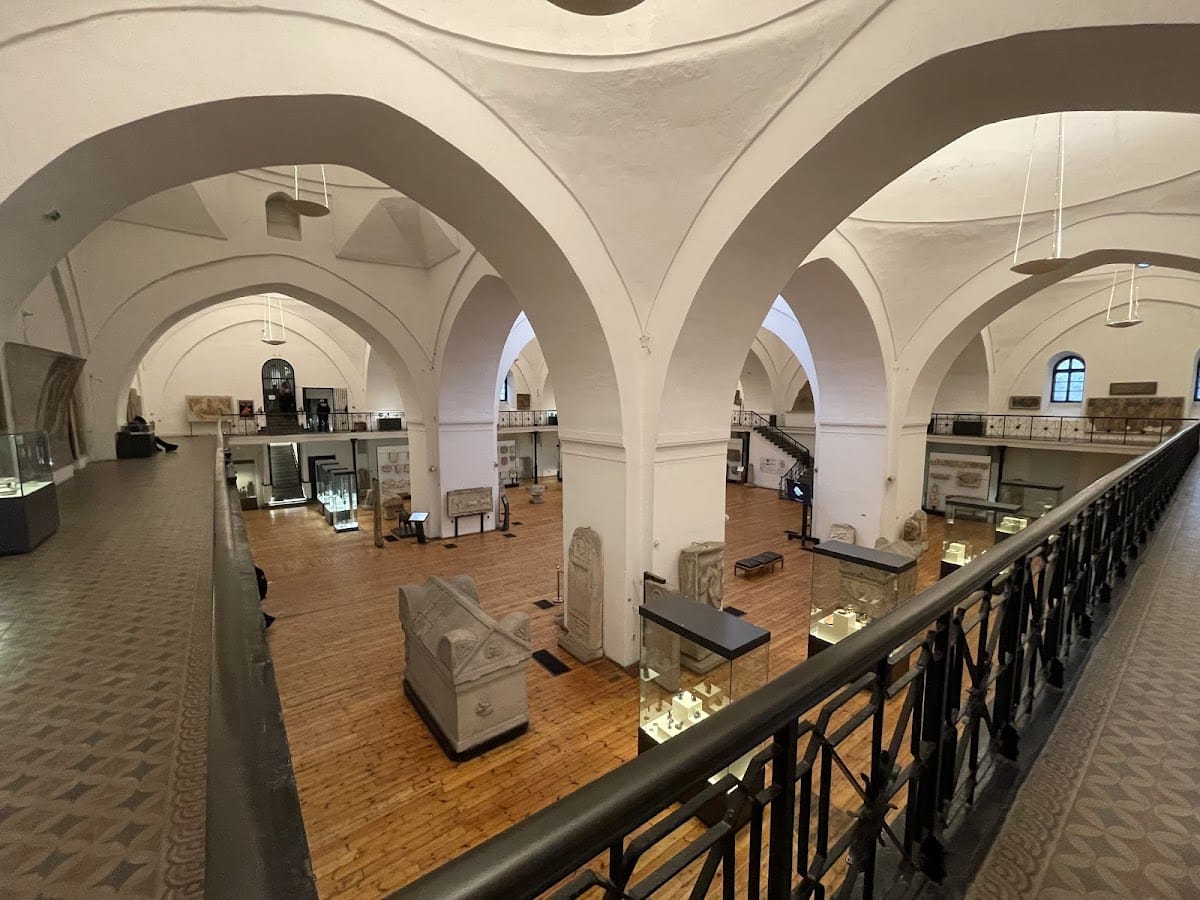
The museum occupies the former Buyuk Mosque, also called the Koca Mahmut Pasha Mosque. The Ottoman building has a low-domed square plan, approximately 36.6 metres on each side, aligned with the four cardinal directions. Four principal supports divide the interior into nine equal square bays, each covered by a dome. The domes have approximately equal diameters but differ in height, with the central examples rising higher than the others. Their roofs were protected with metal sheeting, and later repairs used lead sheets to limit rainwater penetration.
Walls and Alterations
The walls consist of small dressed-stone blocks framed or banded with brick. The interior was whitewashed, and traces of floral decoration remain in some vaulted areas. The mosque probably began with an arcaded entrance porch on the northern side, covered by five domes. Earthquakes in 1818 and 1858 destroyed that porch, after which it was replaced by a portal. The central dome’s windows were probably added during the 1938 reconstruction.
During the Russo-Turkish War of 1877–1878, the abandoned mosque served as a hospital. Its later use for library and museum purposes exposed problems caused by humidity and limited natural light, leading to repeated repairs. In 1938–1940 the mosque was renovated and connected with two additional buildings associated with the National Bank complex. The historic stone exterior was retained.
Exhibition Areas and Collections
Prehistory Hall
The Prehistory Hall occupies the lower floor of the northern wing. It presents material from approximately 1,600,000 BC to 1,600 BC in Early, Middle, and Late Paleolithic, Neolithic, Chalcolithic, and Bronze Age sections. Cave finds, early human tools, drawings, pottery, and ritual objects trace the long sequence of human activity represented in the collection.
Treasury
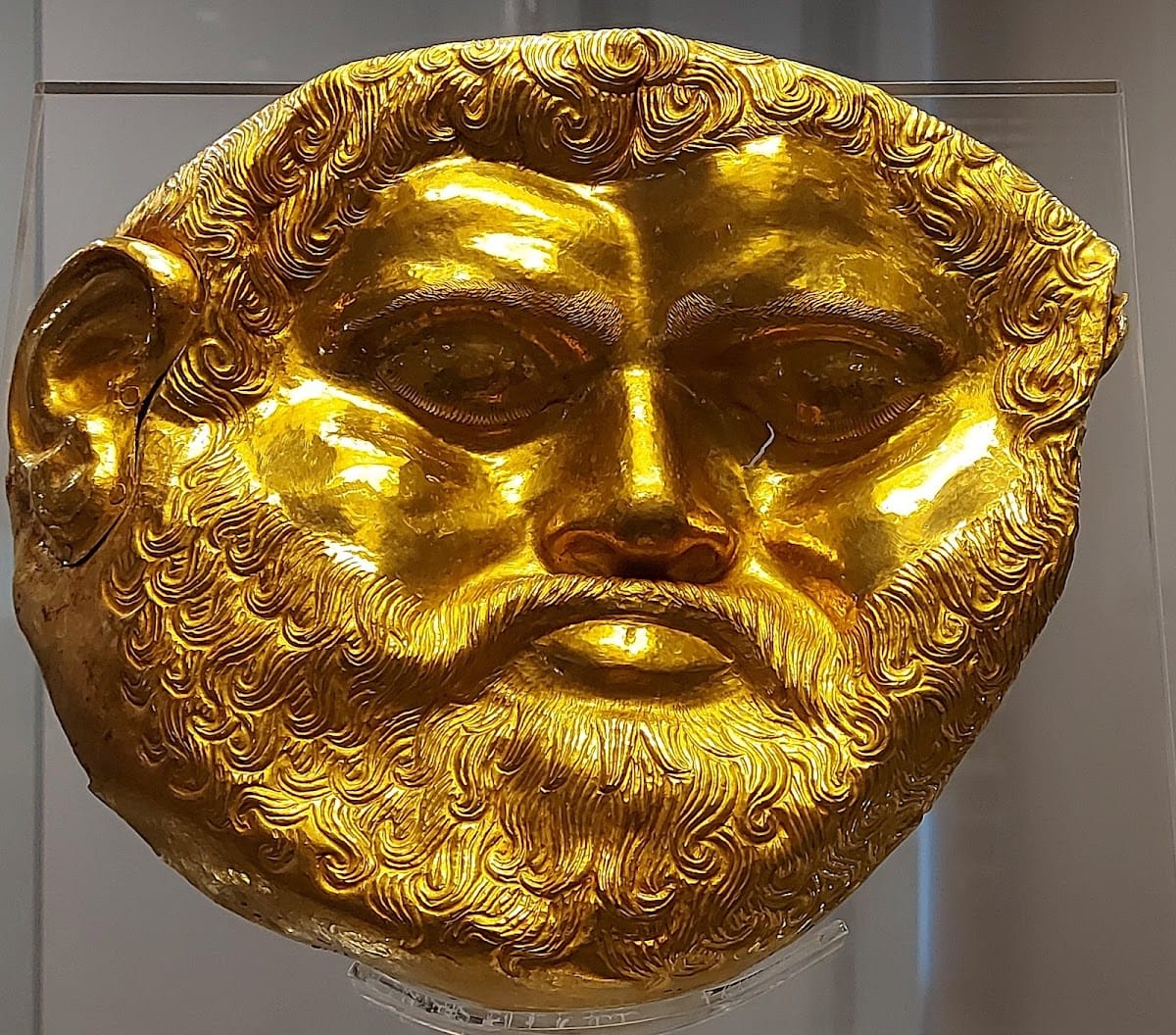
The Treasury is located in the eastern wing and contains grave inventories and other treasures dating from the Late Bronze Age to Late Antiquity, the later Roman and early Byzantine centuries before the medieval period. Among its best-known holdings is the Valchitran Treasure, found in 1924 and dated to approximately 1300 BC. It consists of thirteen unusual gold vessels weighing about 12.5 kilograms. They may have been used by a high priest during religious ceremonies and are kept in a specially protected room.
The Treasury also contains the Lukovit Treasure, found in 1953 and dated to the fourth century BC. Together with the other grave inventories and treasures, these objects represent the range of precious materials preserved in the eastern wing’s displays.
Main Hall
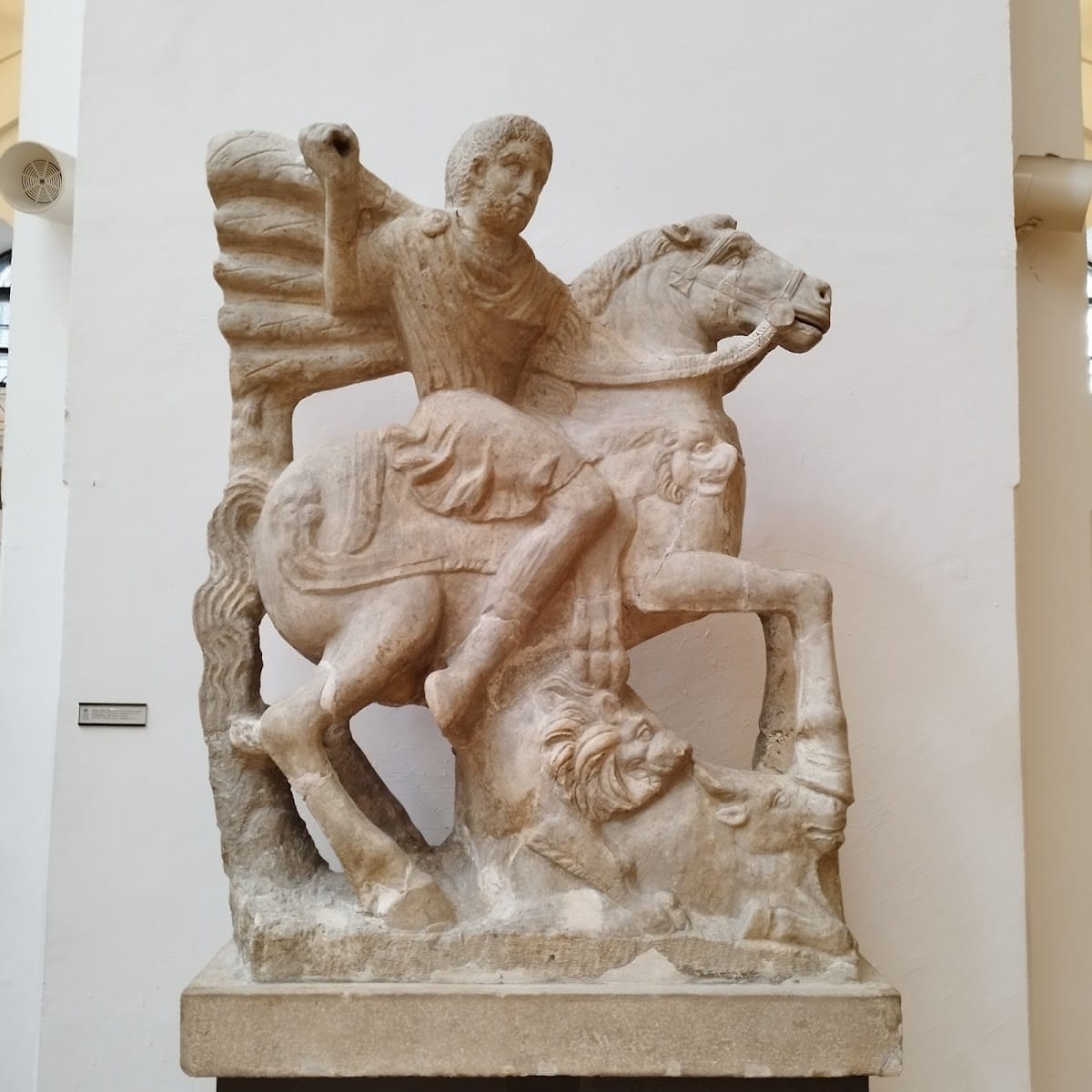
The Main Hall occupies the first floor of the principal building. Its displays cover ancient Thrace, Greece, and Rome through the late Middle Ages. Roman sarcophagi, which are stone coffins, stand alongside Roman gravestones, early Christian mosaics from Saint Sofia in Sofia, and a third-century plaque depicting animals that was found during excavations in Sofia.
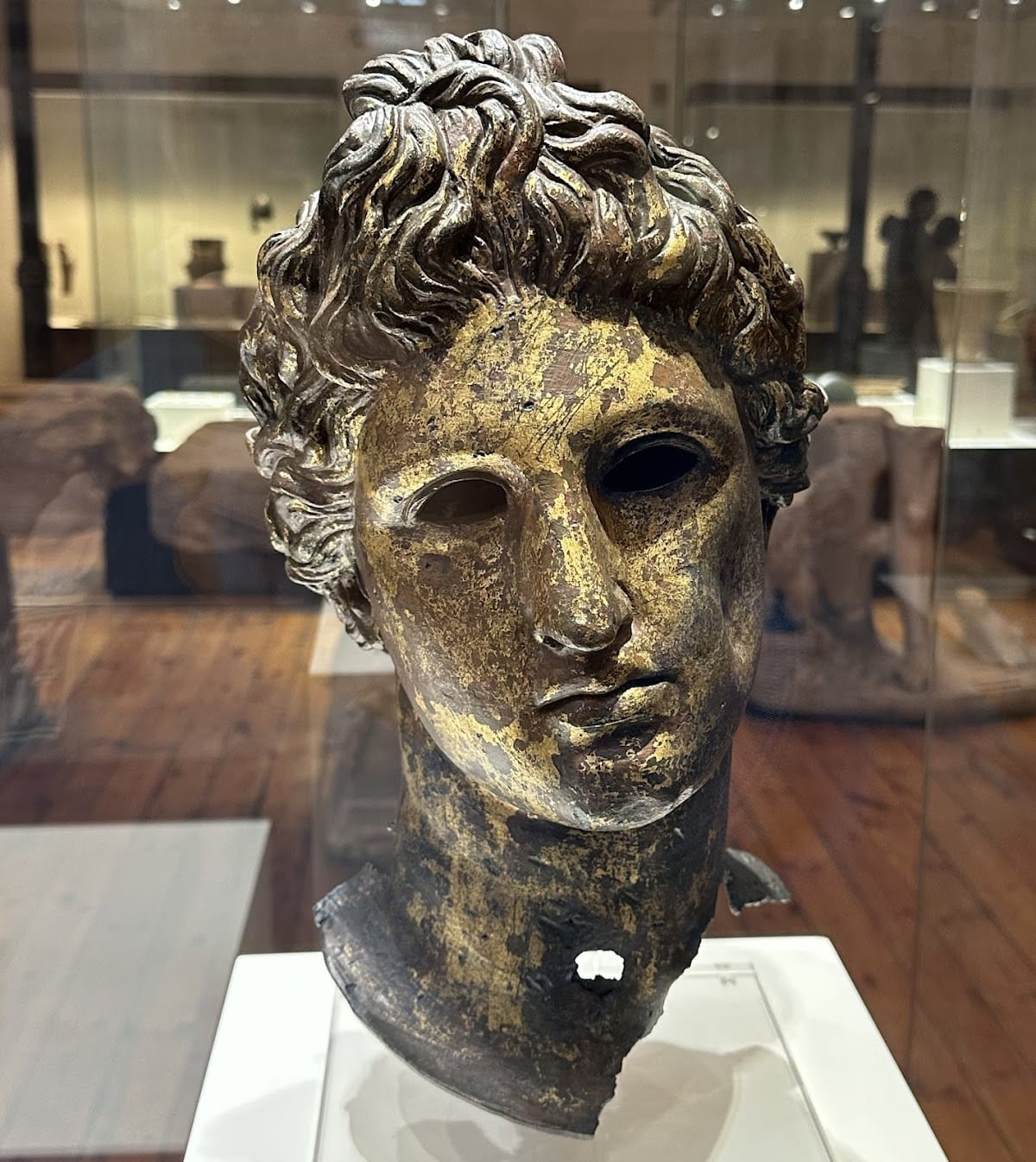
The hall also contains a gilded bronze statue of Apollo from Stara Zagora. Parts of the arms and legs are missing, and the surviving form suggests that Apollo may have held a lyre in his left hand. Its attribution to the school of Praxiteles remains a scholarly interpretation. Praxiteles was a major Greek sculptor of the fourth century BC, and the term Praxitelean refers to works associated with his style or workshop tradition.
Medieval Hall and Entrance Relief
The Medieval Hall occupies the second floor. It presents medieval books, woodwork, drawings, metal objects, icons, and frescoes from the churches of Nessebar and other Bulgarian sites. In front of the museum’s main entrance, a life-size copy of the Madara Rider rock relief is installed against the wall. The relief depicts a mounted horseman and is traditionally associated with the First Bulgarian Empire.
Other Sculptures and Objects
A statue known as the Resting Satyr, found near the village of Riben close to Pleven, is attributed to the Praxitelean tradition and considered a copy of one of Praxiteles’ works. Other displayed objects include an eighth-century BC bronze deer figurine and a Roman sarcophagus from the second or third century, found near Lovech.
Archaeology Beneath the Museum
Excavations beneath the southern dome in 1939 exposed corner walls made from river cobbles, separated by bands of five brick courses. The work also produced a statue of Artemis. Investigations in 1998 in the garden before the mosque and near the museum administration building revealed several archaeological layers. The earliest contained remains of a prehistoric settlement dated to the Early Iron Age, approximately the eighth to seventh centuries BC.