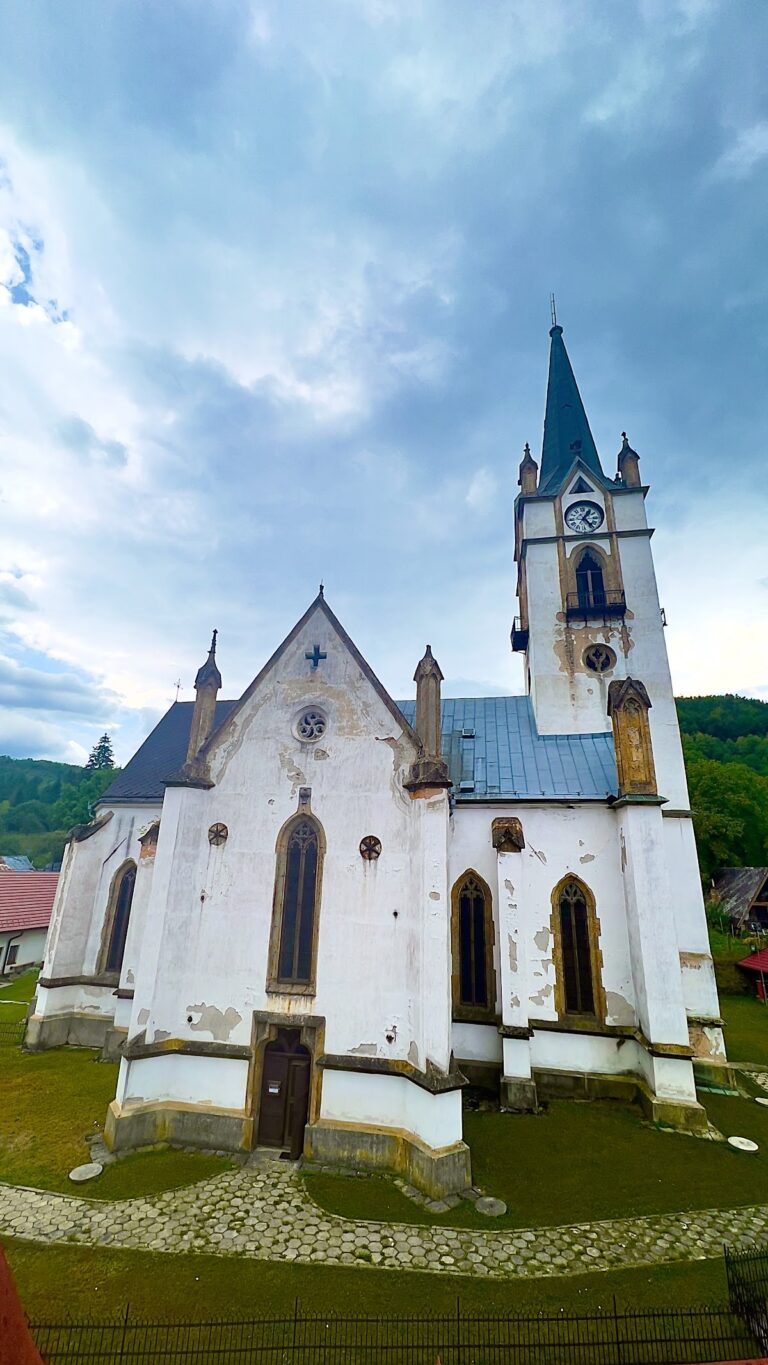
Lutheran Church in Roštár: A Medieval Church and Reformation Landmark


Site at a Glance
- Rating
- 4.2
- Popularity
- Very Low
- Country
- Slovakia
- Primary era
- Medieval
- Eras represented
- Medieval, Early Modern
- Civilizations
- Hungarian
- Site type
- Religious
- Remains
- Church
On this page10 sections
History
The Lutheran church in Roštár is a medieval church in Slovakia, probably built in the late thirteenth or early fourteenth century. It was originally dedicated to Saint Andrew and may have replaced an older building. During the sixteenth-century Reformation, the religious movement that produced Protestant churches including Lutheran communities, the church became Lutheran.
Medieval origins and Lutheran reform
In 1590, one of the earliest Lutheran congregations in the Gemer region was established at Roštár. The church was adapted to the requirements of Lutheran worship and became part of the developing Evangelical Church of the Augsburg Confession, the Lutheran tradition associated with the Augsburg Confession of 1530.
The church also became a place of institutional importance for the region’s Lutheran communities. In 1604, a seniorate assembly held there adopted the Gemer Lutherans’ first church law, known as the Roštár Articles. A seniorate was an administrative unit overseeing several congregations, and its assembly brought together representatives of those communities. The articles were later confirmed by Juraj Turzo, a Hungarian nobleman who served as palatine, a senior royal official in the Kingdom of Hungary.
Fire, rebuilding, and conservation
A major fire severely damaged the church in 1689. The building was subsequently rebuilt, and its Baroque furnishings were installed during this phase. The church underwent further restoration in 1935 and again during the 1950s. In 1977, surviving fragments of its medieval wall paintings were restored, while a new roof was provided in 2005.
The main altar was restored between 2012 and 2016 and returned to the church in 2016. The work was led by Alexandra Šulíková under the methodological supervision of Zuzana Benčeková Tahy. The Bratislava Regional Restoration Atelier received the 2016 Phoenix Award for Cultural Monument of the Year from the Slovak Ministry of Culture for the restoration.
The church was declared a national cultural monument of Slovakia on 6 May 1963 and is listed in the Central Register of the Monument Fund under number 549. It belongs to the Evangelical Church of the Augsburg Confession, Eastern District, Gemer Seniorate, and Roštár congregation.
Remains
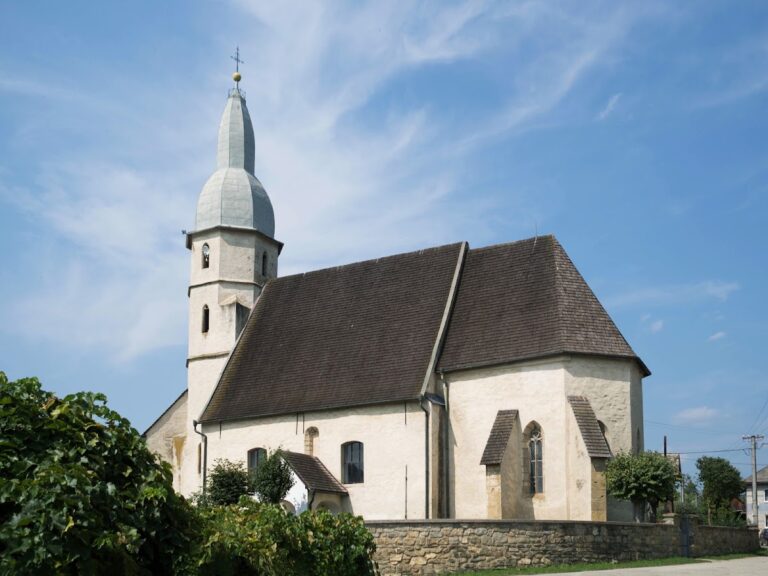
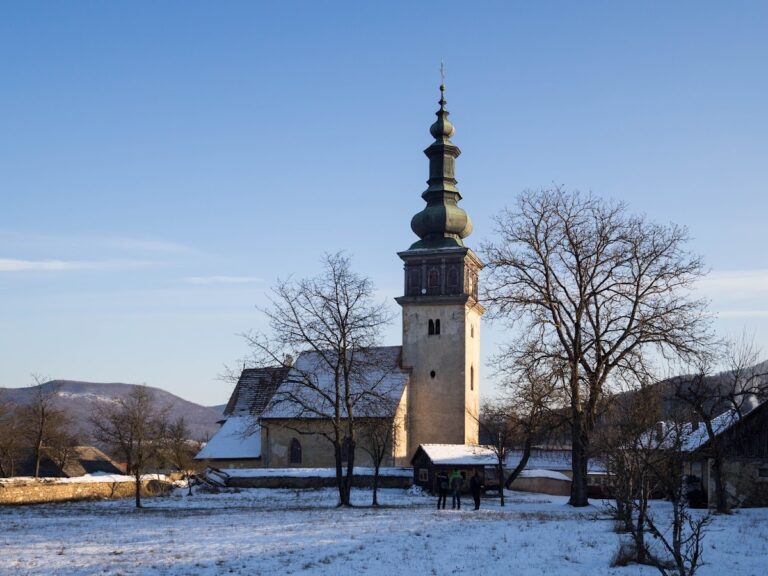
The church stands in the centre of Roštár within a fortified complex. It is a single-nave medieval rural church with a rectangular presbytery, the area around the main altar historically reserved for the clergy, a west tower, and a sacristy on the north side. Its surviving medieval fabric is combined with Gothic features, later Baroque alterations, and furnishings installed after the seventeenth-century fire.
Medieval structure
Nave and presbytery
The rectangular presbytery has a cross vault, a ceiling formed by intersecting curved sections, and is connected to the nave of the church. The pointed-arch portal is a surviving Gothic feature. During the Baroque rebuilding, the nave received a new vault and the shape of its windows was altered.
West tower and north sacristy
A tower projects from the west of the church, and all of its original Gothic windows have survived. The sacristy on the north side is a separate room used for storing vestments and liturgical equipment, forming part of the church’s medieval layout.
Paintings and Baroque furnishings
Medieval wall paintings
Investigative openings in the interior revealed fifteenth-century Gothic wall paintings. The surviving scenes include the Adoration of the Magi and Saint Elizabeth. The paintings use the secco technique, in which pigment is applied to dry plaster. After examination, the openings were covered with lime to protect the surviving material, and further discoveries remain possible.
Main altar and pulpit
The wooden main altar dates from 1724. Its central image is a painting of the Calvary with a sculpture of the crucified Christ, while the predella, the lower section of an altarpiece, carries a Last Supper painting. A figure of the Risen Christ stands at the top. The pulpit is stylistically associated with the altar and depicts Christ the Saviour together with the four Evangelists, Matthew, Mark, Luke, and John.
Nearby sites