Dormition Cathedral: The Orthodox Mother Church of Muscovite Russia


Site at a Glance
- Rating
- 4.8
- Popularity
- Medium
- Country
- Russia
- Primary era
- Medieval
- External website
- Open
- Eras represented
- Medieval, Early Modern, Modern
- Civilizations
- Russian
- Site type
- Religious
- Remains
- Cathedral
On this page15 sections
History
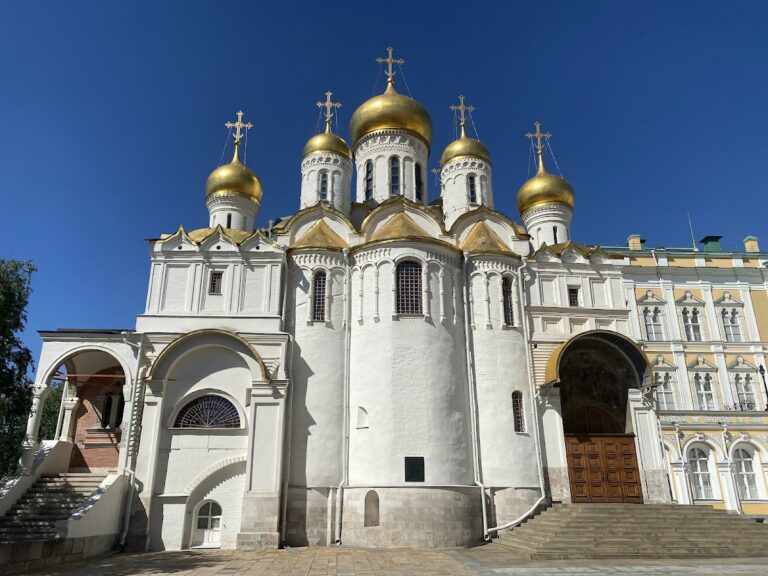
Dormition Cathedral is an Orthodox cathedral in Moscow, Russia, dedicated to the Dormition, or bodily assumption, of the Virgin Mary after her death. Standing in the Moscow Kremlin, it is regarded as the mother church of Muscovite Russia and as the oldest completely preserved building in Moscow. Its present form belongs to the late fifteenth-century period of Moscow’s political and ecclesiastical expansion, when established Russian church traditions were combined with Renaissance design and construction methods.
Early churches and the foundation of Moscow’s principal cathedral
Archaeological excavations in 1968 revealed a medieval cemetery with objects dating from the mid-twelfth century to the 1320s. This evidence supports the possibility that a wooden church occupied the site by the time the Kremlin was first mentioned in 1156, although the early building history remains disputed. Foundations, enclosure walls, brick flooring, pillars, and sculpted stones bearing animal forms were also found at the cathedral’s northwest corner. Vladimir Fedorov connected these remains with a limestone church probably erected in the 1280s or 1290s under Prince Daniil Alexandrovich, while other researchers assigned some of the remains, especially the sculpted stones, to later phases.
The first securely documented predecessor was built in 1326 and 1327 during the systematic expansion of the Kremlin under Ivan I Kalita, the fourteenth-century grand prince whose reign strengthened Moscow’s political position. Construction began on 4 August 1326, and the limestone cathedral was completed and consecrated on 4 August 1327. It became Moscow’s principal city church and the house church of the metropolitan, a senior bishop governing an important ecclesiastical province, after Ivan I secured the transfer of the metropolitan’s residence from Vladimir to Moscow in 1325.
The cathedral was associated with Metropolitan Peter, who died in 1326, and with his successor Feognost. Their burial places lay in its three eastern apses. In 1329, a Chapel of Saint Peter in Chains was added to the northern apse. By about 1470 or 1471, however, the earlier building had deteriorated severely. Metropolitan Filipp I proposed its replacement, and construction began in April 1472 under the Moscow builder Ivan Golova, with Ivan Myshkin and Krivtsov responsible for planning and supervision.
The failed cathedral of 1472 and Fioravanti’s rebuilding
The new cathedral was required to follow the Dormition Cathedral in Vladimir, the former metropolitan seat. This architectural model also expressed Moscow’s claim to have inherited the political and ecclesiastical authority of Vladimir-Suzdal. The project coincided with Moscow’s emergence as the center of Russian Orthodoxy, a position later described through the idea of Moscow as the “Third Rome” after the Ottoman conquest of Byzantium in 1453.
The four-pier, cross-domed church begun by Myshkin and Krivtsov collapsed during the night of 20 to 21 May 1474, shortly before completion. A Rostov chronicle attributed the disaster to an earthquake, while a later report by builders from Pskov blamed inadequate structural calculations and serious defects in the lime mortar and masonry. The failure was also understood as a consequence of the loss of experienced stone-building techniques during the Mongol period.
After the collapse, Ivan III, the grand prince who greatly expanded Moscow’s political power, sent the envoy Semyon Tolbusin to Italy to recruit a skilled builder, probably on the advice of his wife Sofia Palaiologa. Aristotele Fioravanti, a Bolognese Renaissance architect and engineer known for applying Italian building methods in Russia, arrived in Moscow in June 1475 with his son Andrea and several assistants. He cleared the ruins and built the present cathedral in four years. Metropolitan Geronti consecrated it on 15 August 1479, although its elaborate interior decoration continued into the second decade of the sixteenth century.
Fioravanti’s building became a model for numerous later churches throughout Russia, especially churches with five domes. From its first documented construction in 1326 and 1327 until its closure in 1918, the cathedral combined religious and representational roles. It served as the court and coronation church of Moscow’s grand princes and of the Russian tsars and emperors. Russian monarchs were crowned there from 1547 to 1896, including the emperors after the establishment of the Russian Empire in 1721. Ivan IV, commonly known as Ivan the Terrible, became the first Russian ruler crowned tsar there in 1547.
Cathedral, burial church, and ecclesiastical center
As the principal church of the Moscow eparchy, an ecclesiastical administrative province, and of Russian Orthodoxy, Dormition Cathedral hosted the installation of metropolitans and patriarchs. The Moscow Patriarchate, whose head is a senior bishop representing an autonomous church, was established in 1589. Moscow metropolitans and patriarchs were buried in the cathedral until the patriarchate was abolished in 1721, with the exception of Patriarch Nikon, who was buried at the New Jerusalem Monastery near Istra.
The cathedral also possessed extensive landholdings until church property was nationalized under Catherine the Great in 1765. Fires damaged the building in 1518, 1547, 1682, and 1737, and Polish-Lithuanian forces looted it during the Time of Troubles, the period of dynastic crisis and foreign intervention in the early seventeenth century. During Napoleon’s invasion of Russia, French forces plundered the cathedral and used it as a horse stable.
Restoration, closure, and renewed religious use
A major restoration directed by the Moscow architect Konstantin Bykovsky took place in 1894 and 1895. It sought to recover the building’s original appearance, including the original dimensions of the apse windows. The work also altered the profile of the raised base and removed later overpainting from the wall and ceiling murals. The original white coating on the facade was removed, producing the exterior appearance associated with the cathedral in later periods.
From 1910 until the 1917 Revolution, a special commission chaired by Prince Alexei Shirinsky-Shikhmatov oversaw maintenance. The level of Cathedral Square was lowered, and a thorough conservation investigation was carried out. In 1917, the cathedral hosted the installation of Tikhon Belavin, Metropolitan of Moscow, as the first patriarch of the restored Moscow Patriarchate.
After the Soviet government moved to Moscow in 1918, the Kremlin churches were closed for worship and Dormition Cathedral became a museum. The last Easter service for many years took place there on 5 May 1918 with special permission from Vladimir Lenin. Pavel Korin’s unfinished painting Farewell to Rus, begun in 1935 and continued until 1959, recorded the service. In 1922, most of the cathedral’s furnishings and treasury were confiscated. Much was transferred to the Kremlin Armoury and the Tretyakov Gallery, while some objects were sold abroad.
Further restoration took place in 1949 and 1950, in 1960, and in 1978. Services resumed periodically in 1989 and 1990, and the cathedral was returned to the Russian Orthodox Church in 1991. It also functions as part of the Moscow Kremlin Museums. Its long history as a church, coronation site, burial place, and ecclesiastical center has made it an important Russian cultural-heritage monument.
Remains
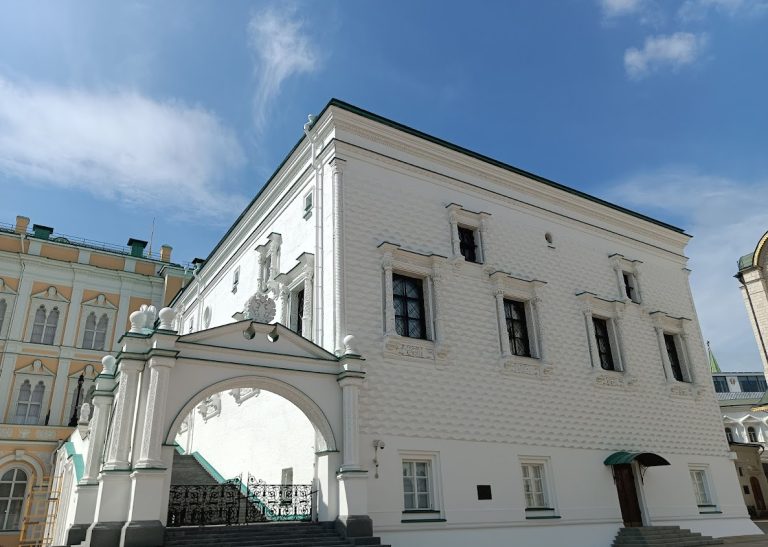
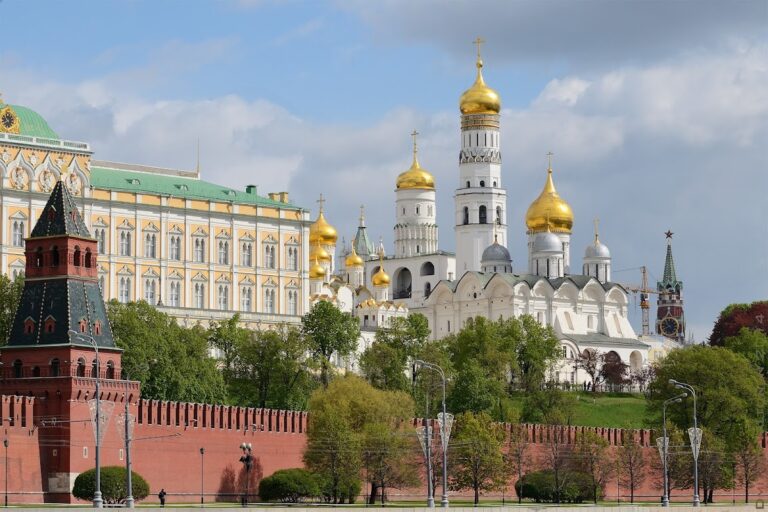
Dormition Cathedral stands independently at the highest point of the Kremlin, on Borovitsky Hill, on the north side of Cathedral Square. A narrow lane separates it from the Patriarch’s Palace and the Church of the Twelve Apostles to the north. The Ivan the Great Bell Tower rises to the southwest, the Archangel Michael Cathedral stands at the opposite southern end of the square, and the Faceted Palace lies southwest beyond a narrow passage. The cathedral is a three-aisled, cross-domed church with six supports, three apses, and five domes. The domes represent Christ and the four Evangelists.
Exterior and structural design
Limestone base and Vladimir traditions
The walls and sculpturally worked exterior elements are made of limestone. The building rests on a high limestone socle, or raised architectural base, supported by numerous oak piles driven approximately four metres into the ground. Its design follows the Dormition Cathedral in Vladimir through the use of limestone masonry, a high base, continuous blind arcades in the lower window zone, decorated portals, and semicircular zakomary, the gable-like elements that terminate the vaults of traditional Russian churches.
Brick supports and Renaissance construction
Fioravanti departed from prevailing Russian practice by constructing the piers, vaults, and dome drums in brick rather than limestone. Specially made bricks, larger than the Russian standard of the period, reduced the weight of the upper structure and allowed slimmer supports. The vaults are groin vaults, formed by the intersection of two barrel vaults, and are strengthened by transverse arches spanning across the main axis.
The eastern pair of supports in front of the apses consists of massive rectangular free-standing piers. The other four are column-like supports with bases, shafts, and capitals. Their original Corinthian capitals were later replaced by simpler cubical capitals. The slender supports contribute to the spacious interior. Renaissance influence also appears in the projections of the facade walls, which take the form of Tuscan pilasters rather than simple flat strips. The semicircular zakomary originally contained broad profiled bands, removed after the fire of 1682.
Murals and sanctuary screen
Frescoes
The oldest surviving frescoes are in the Chapel of the Praise of the Virgin Mary and date from 1479 to 1481. Their style is close to the frescoes associated with Dionissi at the Ferapontov Monastery. Viktor Lazarev considered that two different masters, possibly pupils of Dionissi, worked on them. Most of the remaining frescoes date from 1642 and 1643, although their compositions follow older mural schemes.
Iconostasis
The monumental five-tier iconostasis, the screen separating the sanctuary from the main body of an Eastern Orthodox church, stands before the central eastern apse. It is based on a structure made in 1547 and replaced a more modest screen produced in 1481 with the participation of Dionissi, Timofei, Jarez, and Konya. The upper two tiers were added in 1626 and in 1653 and 1654 during alterations carried out under Patriarch Nikon. Several masters from Yaroslavl, Kostroma, and Ostashkov painted their icons. Silver and bronze fittings were added in 1813 and in 1881 to 1883 after the cathedral’s plunder by Napoleon’s forces.
Beyond its liturgical purpose, the iconostasis displayed important icons taken from conquered cities and thus connected the cathedral’s sacred interior with Muscovite military victories. Ivan IV transferred a twelfth-century icon showing the bust of Saint George from Veliky Novgorod to Moscow in 1561. The Vladimir Mother of God, a Byzantine icon from the second quarter of the twelfth century, stood beside the Royal Doors from 1395 to 1919 after being brought from Vladimir. It has belonged to the Tretyakov Gallery since 1926.
Icons, royal furnishings, and burials
Important icons
Other important icons associated with the cathedral include a Savior icon known as “Not Made by Human Hands,” from the Vladimir-Suzdal school and dating from the second half of the twelfth century. A Deesis, a group of intercessory images from the late twelfth or early thirteenth century, formerly stood in the northern Royal Doors. Both works are now in the Tretyakov Gallery. The Annunciation of Ustyuzhna, from the Novgorod school and dated to the late twelfth or early thirteenth century, was transferred from the Yuriev Monastery near Novgorod in 1561.
The cathedral is also associated with an angel from a Trinity icon connected with the school of Andrei Rublev and dated to the late fourteenth century. Christ Emmanuel, also called Christ in the Golden Robe, came from Novgorod and dates from the fifteenth or sixteenth century. It was transferred from Novgorod’s Saint Sophia Cathedral in 1562.
Throne and burial places
Near the south portal stands the Throne of Ivan IV, made in 1551. Its reliefs depict the transfer of Byzantine imperial insignia to Vladimir Monomakh, grand prince of Kiev, and the transfer of the Cap of Monomakh to Ivan IV. Along the cathedral walls are the burial places of Moscow’s metropolitans and patriarchs, with the stated exception of Patriarch Nikon.
Nearby sites