Ivan the Great Bell Tower: The Kremlin’s Central Church-Belfry Ensemble
Site at a Glance
- Rating
- 4.7
- Popularity
- Low
- Country
- Russia
- Primary era
- Medieval
- External website
- Open
- Eras represented
- Medieval, Early Modern, Modern
- Civilizations
- Russian
- Site type
- Religious
- Remains
- Church
On this page13 sections
History
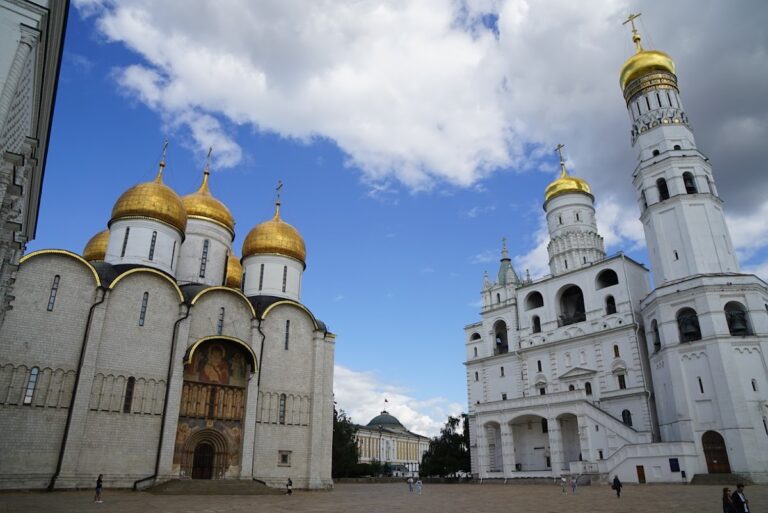
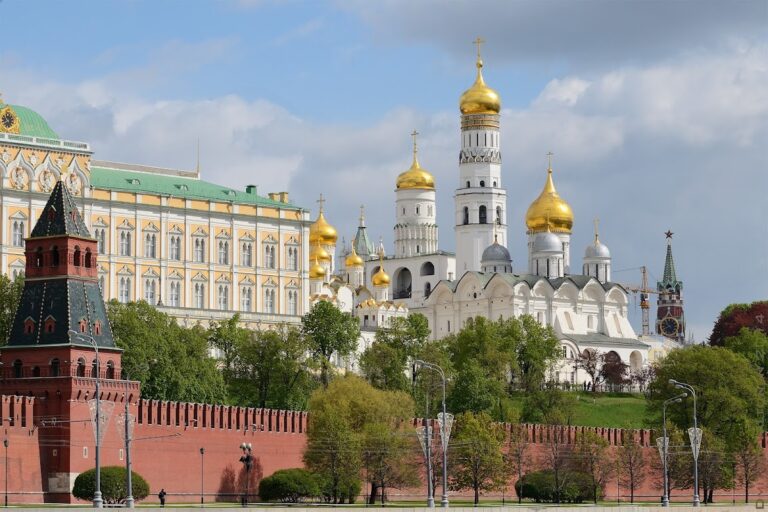
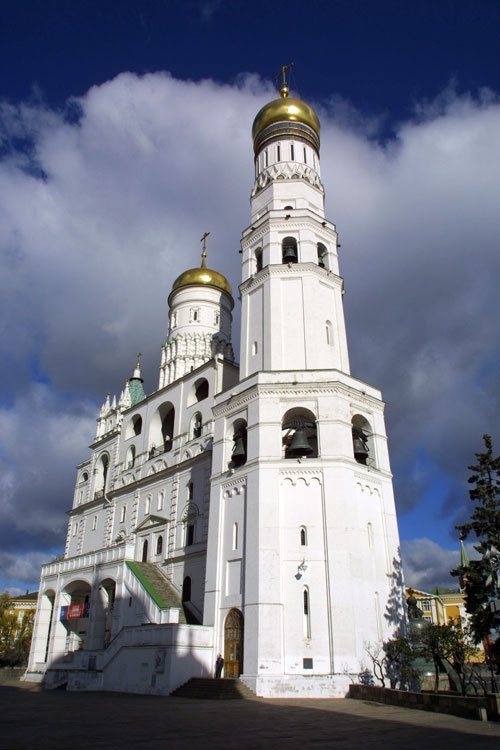
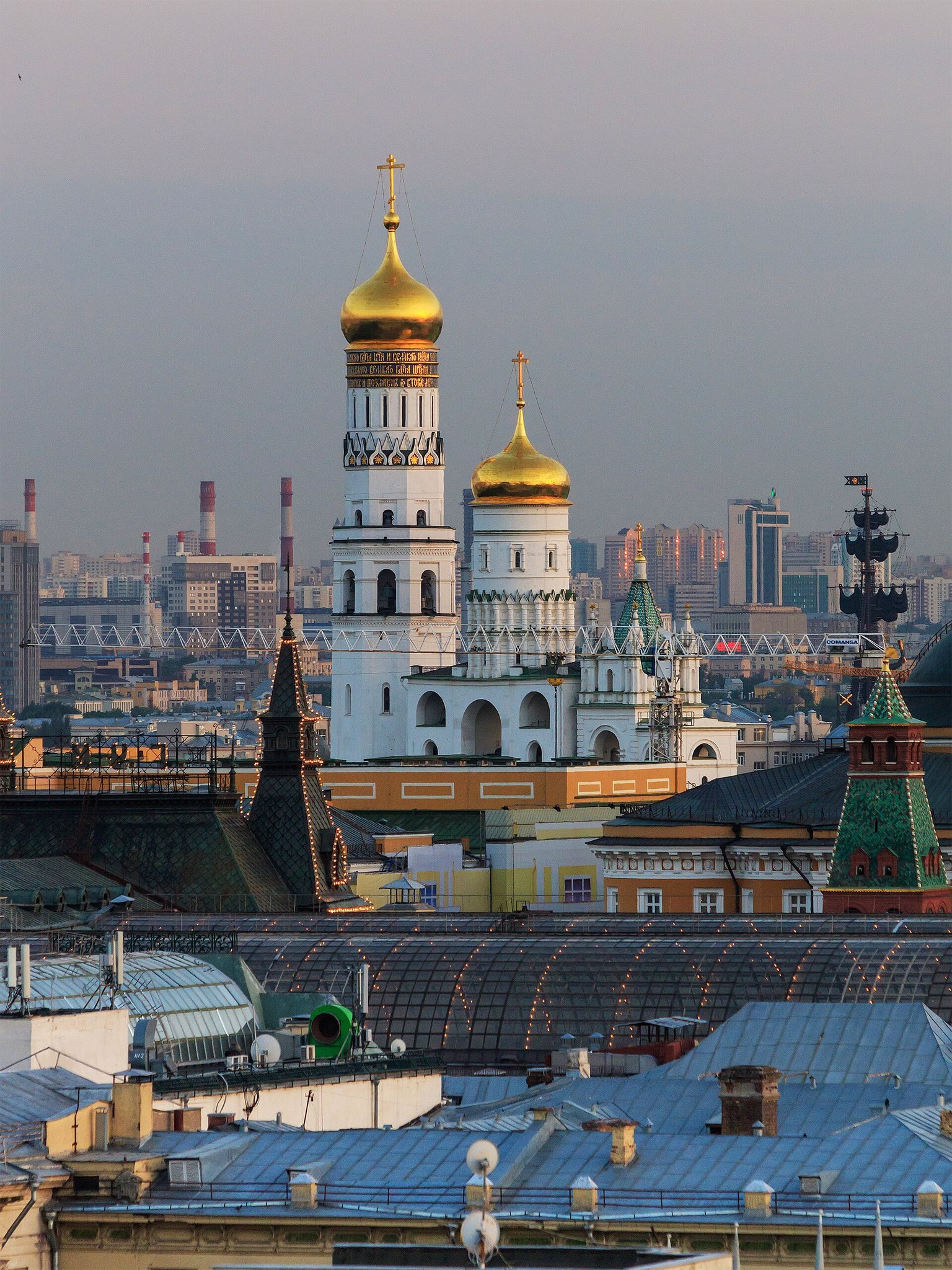
Ivan the Great Bell Tower is a Russian Orthodox church-belfry ensemble in Moscow, Russia, begun in the fourteenth century and developed through successive Kremlin rebuilding campaigns. It served the Assumption, Archangel, and Annunciation Cathedrals, which did not possess independent belfries, and became the compositional centre between Cathedral Square and Ivanovskaya Square.
The first church and the 1508 tower
In 1329, Grand Duke Ivan I Kalita ordered a stone church on Borovitsky Hill. Dedicated to Saint John Climacus, the sixth- to seventh-century Byzantine theologian associated with The Ladder of Divine Ascent, it was a church “under the bells,” meaning that the worship space stood beneath a bell-bearing structure. The building is described as Moscow’s first known stone church of this type, its first column-like church-belfry, and the first church built between two cathedrals. Chronicle tradition says that construction was completed in three months.
Some historians interpret the church as a votive foundation connected with Moscow’s successful campaign against Pskov, where the Tver prince Alexander Mikhailovich had taken refuge. This remains a historical hypothesis rather than an established explanation. The original church stood for more than 170 years. During the reign of Simeon the Proud, it was painted and received five bells.
The old church was dismantled in 1505 during the major rebuilding of the Kremlin begun under Grand Duke Ivan III. A new tower-church was started east of it by the Italian architect Bon Fryazin and completed in 1508 under Ivan III’s son and successor, Vasily III. Built on the earlier tower’s foundations as a monument to Ivan III, the new structure initially rose about 60 metres and had two bell tiers. Its height also made it useful as a lookout for fires and approaching enemies.
Expansion under the tsars
In the 1540s, a rectangular building was constructed north of the tower under the direction of the Italian architect Petrok Maly. Its completion is dated to 1552. It is traditionally identified as the Assumption Belfry, although the architectural historian Sergei Podyapolsky argued that it was originally the Church of the Resurrection. In 1554 and 1555, the altar of the Nativity Church was transferred there from the courtyard of the boyar Ivan Fyodorovich Mstislavsky, and the building consequently acquired the name Nativity Church. By the late seventeenth century, it had been converted from a church into a belfry.
Tsar Boris Godunov ordered the main tower heightened in 1599 and 1600 because its existing scale was considered inadequate for the grand church planned to unite the Kremlin cathedrals. The architect Fyodor Kon added the upper tier, bringing the tower to 81 metres and making it Moscow’s tallest building. It then acquired the name “Ivan the Great.” A gilded inscription commemorating Boris Godunov and his son Fyodor was later plastered over after their deaths and restored under Peter I.
The ensemble expanded again in 1624 with the Filaret Annex, designed by Bazhen Ogurtsov and named for Patriarch Filaret, the father of Tsar Michael Fyodorovich. Its tent roof was designed by the English architect John Thaler. By the end of the seventeenth century, the tower, Assumption Belfry, and Filaret Annex had reached the arrangement that established the ensemble’s enduring form and made it one of Moscow’s principal architectural symbols.
Observation, ceremony, and damage
The tower served as the Kremlin’s main observation post. Approaching enemy forces could reportedly be seen from it at a distance of about 30 kilometres. Its bells announced the births of heirs, royal coronations, military victories, and major religious occasions. Their loud sound also contributed to the Russian expression “to the whole Ivanovskaya,” meaning loudly or at full voice.
The ensemble was repaired in 1754 under Dmitry Ukhtomsky. A one-storey guardhouse with a gallery was later built beside the western facade of the belfry to a design by Matvey Kazakov. It was destroyed later and not rebuilt.
During the French occupation of Moscow in 1812, French troops looted the Kremlin, and General Lauriston’s headquarters occupied the tower’s lower tier. Napoleon ordered the gilded iron cross removed, reportedly intending to place it on the Invalides in Paris. The later story that the cross was carried away and sunk in a lake is contradicted by the discovery of its fragments near the Assumption Cathedral on 5 March 1813.
The fire of 1812 and the mining of the Kremlin destroyed the Assumption Belfry and Filaret Annex down to their foundations. The main tower survived but developed a crack in its upper tier. Domenico Gilardi, Luigi Rusca, and Ivan Egotov rebuilt the two damaged buildings in 1814 and 1815, preserving much of their earlier appearance and incorporating surviving fragments of the sixteenth- and seventeenth-century structures.
In 1817, the third tier of the rebuilt belfry received the altar from the demolished Church of Saint Nicholas of Gostun. Konstantin Ton designed a porch for the western facade, built between 1849 and 1852. Sergei Rodionov restored the main tower in 1895 and 1897.
Revolution, war, and museum use
Before 1917, services in the Church of Saint John Climacus were held daily. During the armed uprising in Moscow, shelling damaged Kremlin buildings, including the tower. Its eastern and southeastern sides received shell and bullet impacts, although the full extent of the damage remains undetermined.
In 1918, after the Revolution, the bells last sounded at Easter and the Feast of the Assumption, when the Kremlin cathedrals opened at the personal request of Patriarch Tikhon. Bell ringing was then prohibited, and residential quarters were established in the Kremlin, including within the tower.
From June to September 1941, during the Second World War, the Assumption Belfry housed the command post of the Kremlin Regiment. A communications station was installed nearby inside the Tsar Bell. After the war, the complex was adapted for museum use. The Assumption Belfry became an exhibition hall for the Moscow Kremlin Museums, displaying works from Kremlin collections and other museums.
Bell ringing resumed at Easter in 1992 after expert examination of the bells. The Assumption Bell sounded again in 1993 for the first time since 1918, although it is used infrequently because its clapper weighs about two tonnes. Bells are now rung during services in the Kremlin cathedrals and during the ceremonial changing of the Kremlin guards. The tower was restored between 2005 and 2007, after which its interiors were adapted for museum use.
The ensemble is protected as a state cultural heritage monument of federal significance. It forms part of the Moscow Kremlin and Red Square UNESCO World Heritage property, inscribed in 1990 under criteria (i), (ii), (iv), and (vi). It continues to combine an exhibition function with an Orthodox religious role.
Remains
The central tower
Foundation and lower church
The main tower rises 81 metres including its cross and is built chiefly of brick with white-stone elements. Its foundation rests on closely packed oak piles driven approximately 4.3 metres into the ground and covered with white stone. The piles remain preserved in groundwater. The foundation area is about 25 metres in diameter, and the base extends approximately 5.2 to 5.5 metres below the modern paving of Cathedral Square.
A stepped white-stone stylobate, or raised supporting platform, rises above the foundation. The lower tier has walls up to 5 metres thick, while the middle tier has walls about 2.5 metres thick. This substantial construction leaves the internal rooms unusually small.
The lower octagonal tier is divided into two storeys. The taller lower room contained the Church of Saint John Climacus, while the upper room served a service function. The church has a central octaconch plan, organized around eight curved recesses or projections. The western side has three straight faces, and the northern exedra, a recessed curved space, lacks a window. The exedrae contained the altar, a deacon’s room, and a preparation room.
Both lower rooms have octagonal vaults pierced by central white-stone rosettes and bordered by white-stone cornices. Small vaulted chambers are set within the wall thickness. Two stairways begin in the lower chamber. A spiral stair in the southwestern face leads to the bell tier of the middle octagon, while a straight stair within the northern wall reaches the gallery of the lower bell tier. The suggestion that the straight stair was intended for moving treasury chests during a Kremlin fire remains conjectural.
Bell tiers and summit
The tower consists of three successively narrower octagonal tiers with open bell arcades. The middle octagon supports the second bell tier, situated more than 40 metres above the ground. A spiral stair rises within its wall, and a central stone pillar carries another spiral stair to the upper bell tier. The middle level probably originally had a wooden floor dividing it into two storeys. Its lower room contained watch-duty spaces with round observation windows.
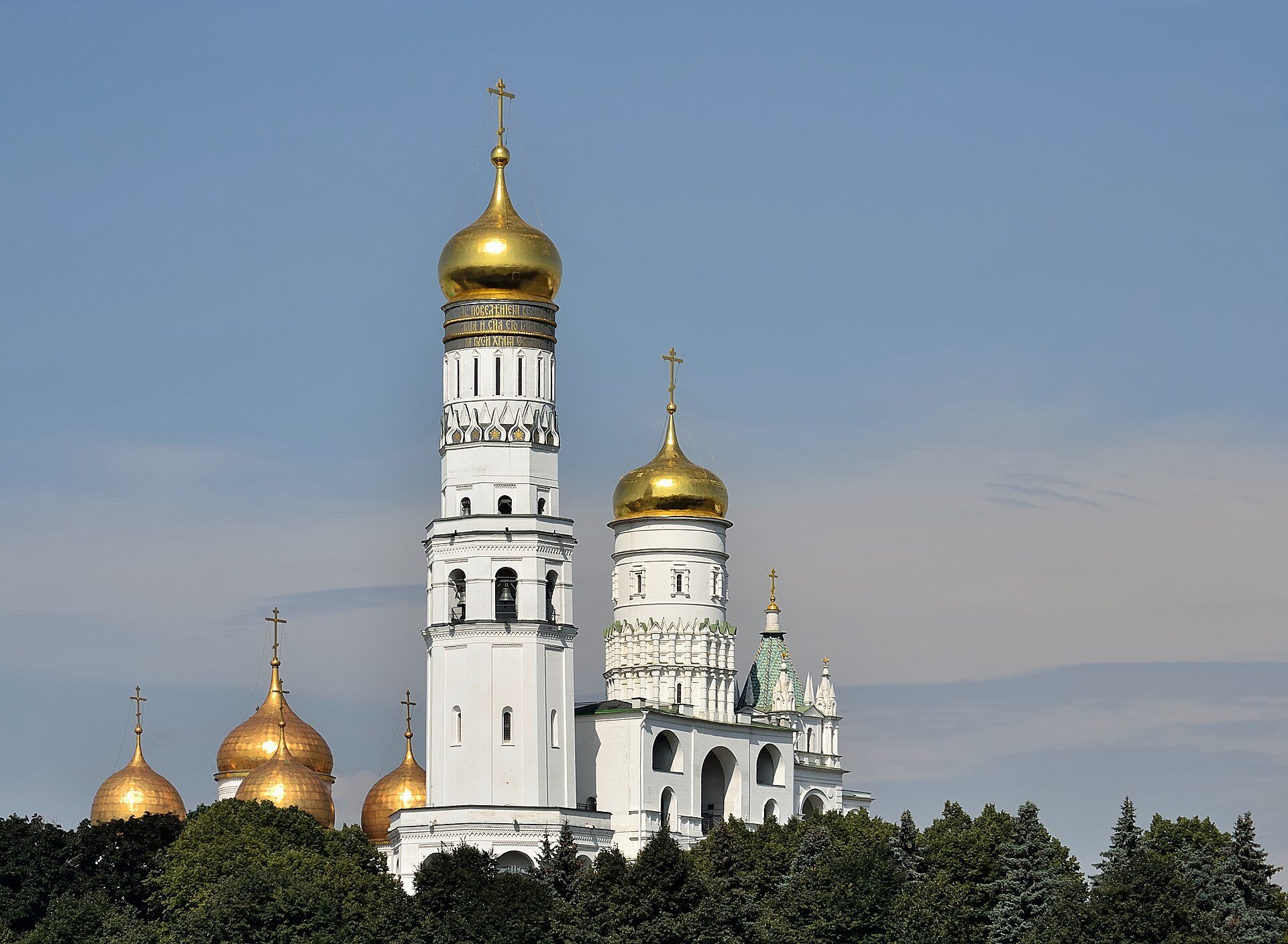
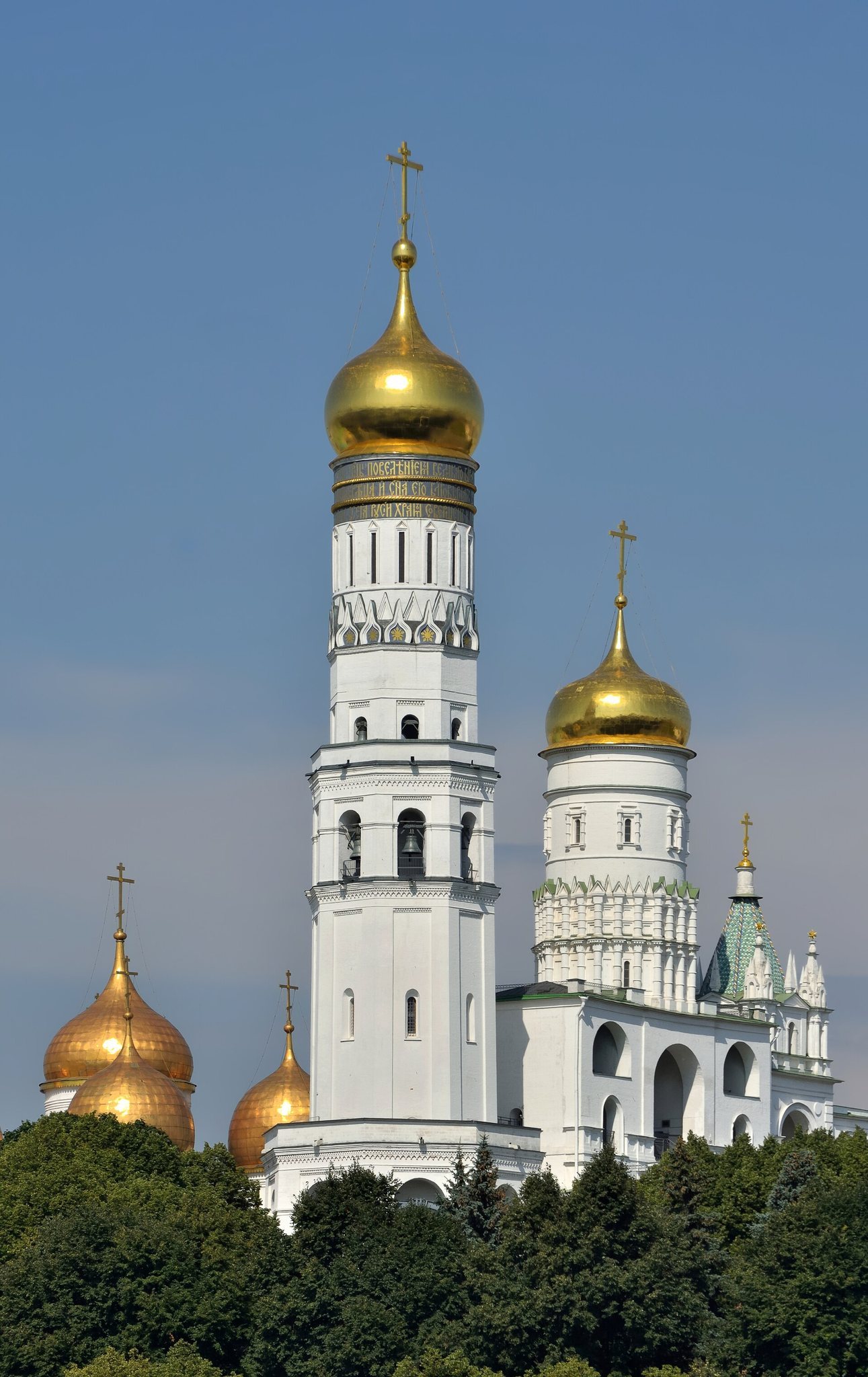
The upper bell tier was intended for smaller ringing bells and remains open up to the base of the cupola. The interior staircase contains 329 steps leading toward the highest viewing level. The tower is crowned by a cylindrical drum erected in 1600, an onion dome of gilded copper, and a cross approximately 7 metres high. The drum has eight slit windows with pedimented tops. Two rows of keel-shaped kokoshniks, ornamental Russian motifs resembling stylized arches or gables, surround its base, and the gilded lower row bears gold stars.
A gold inscription on copper sheets runs around the drum against a blue ground. Twisted white-stone bands divide its three registers, and the bands were originally gilded. The tower retains a strong vertical emphasis through its tiers, arcades, cornices, and bracketed arcature. Classical details, including pendant ornaments and dentils, appear alongside Gothicizing three-lobed arches.
The tower was originally painted to resemble exposed brick. It is now whitewashed, matching the surrounding buildings of Cathedral Square. During the reign of Ivan the Terrible, it was described as a red tower, probably because its brickwork was left unplastered.
The associated belfries
Assumption Belfry
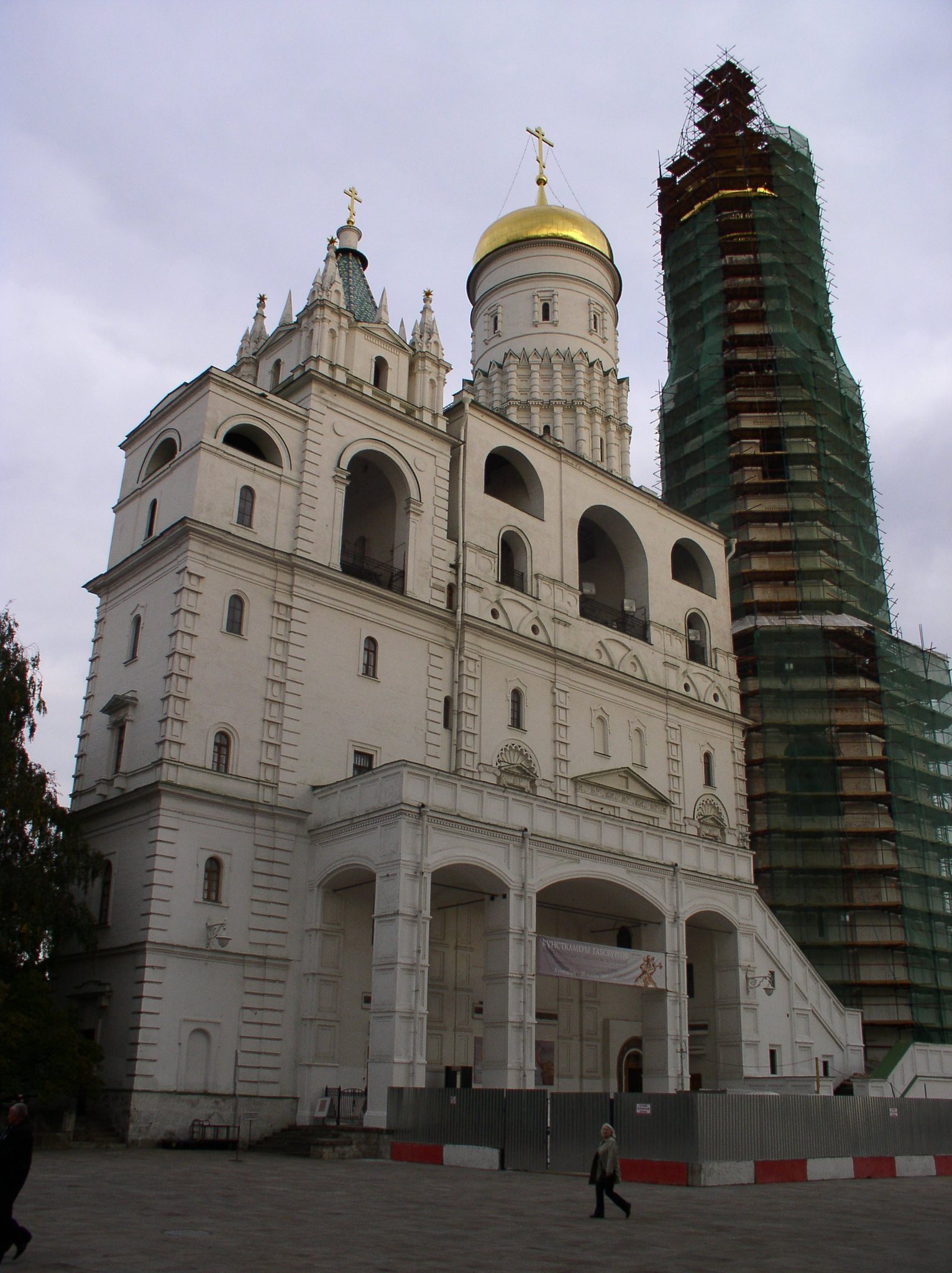
The Assumption Belfry was rebuilt in 1814 and 1815 on the foundations of the sixteenth-century structure destroyed in 1812. Fragments of its earlier walls were incorporated into the new building. Its elongated plan runs from north to south, and a four-tiered base supports a three-bay bell tier.
Smooth walls pierced by bell arches contrast with a richly decorated upper light drum and gilded-copper cupola. The decoration includes a Gothicizing frieze of pointed recesses, shell motifs above the windows, two levels of colonnettes and pointed arches, and columned window surrounds. The bell tier occupies the western part of the building, leaving a roof gallery with a parapet over the eastern part. The side bays have flat ceilings, while the central bay opens into the cupola drum.
The former altar of the Church of Saint Nicholas of Gostun occupied the third tier until 1918. A high open porch adjoins the western facade. Designed by Konstantin Ton and built between 1849 and 1852, it has restrained decoration formed by recessed ornamental panels.
Filaret Annex
The Filaret Annex was rebuilt in 1814 and 1815 on the site of the 1624 structure destroyed in 1812. Fragments of the earlier walls survive in its first tier. Its facade treatment resembles that of the Assumption Belfry, while its characteristic feature is a tent-shaped roof. Its internal tiers are similar in volume and communicate with the belfry and its adjoining stairwell.
The bells
The ensemble contains 34 bells distributed among the main tower, the Assumption Belfry, and the Filaret Annex. Three bells in the latter two buildings remain in active use. Nearly all have been recast while retaining their historical names, preserving a connection between the present soundscape and earlier phases of the Kremlin’s history.
The Assumption Bell weighs approximately 65.3 tonnes. Yakov Zavyalov and a caster identified by the surname Rusinov recast it between 1817 and 1819 from a 1760 bell weighing 58.165 tonnes, which had been damaged in the 1812 explosions. Its surface bears six high-relief portraits of members of the imperial family and relief icons.
The Reut, or Revun, weighs approximately 32.76 tonnes and was cast in 1622 by Andrei Chokhov, who also made the Tsar Cannon. The 1812 explosion broke away its ears, but the repair did not alter its sound. In 1855, during ceremonial ringing for the accession of Alexander II, it fell from its support, broke through five floors, and killed several people before being raised and rehung.
The Great Lent Bell, also called the Seven-Hundred Bell, weighs approximately 13.071 tonnes. Cast in the eighteenth century by Ivan Motorin, it hangs in the Filaret Annex and carries Baroque ornament with sculpted angel heads. The Bear Bell weighs approximately 7.223 tonnes. Cast by Ivan Alekseev in 1501 and recast by Semyon Mozzhukhin in 1775, it is described as the oldest surviving bell in the ensemble.
The Swan Bell weighs approximately 7.371 tonnes. First cast in the sixteenth century during the reign of Vasily III, it was recast by Semyon Mozzhukhin in 1775 while retaining its earlier form and inscription. The Novgorod Bell weighs approximately 6.88 tonnes. It was first cast for the Saint Sophia Cathedral in Novgorod during the reign of Ivan the Terrible, later brought to Moscow, and recast by Ivan Motorin during the reign of Empress Anna Ioannovna. Its ornament shows the Apostles Peter and Paul holding a scroll depicting the Peter and Paul Fortress.
The Broad Bell weighs about 5 tonnes and was cast in 1679 by Vasily and Yakov Leontiev, whose ornament resembles filigree. The Sloboda Bell weighs slightly more than 5 tonnes and was cast in 1641 by an unidentified maker. The Rostov Bell weighs approximately 3.276 tonnes. Cast in 1687 for the Belogostitsky Monastery near Rostov, it is decorated with winged creatures and carries an inscription referring to the simultaneous rule of Ivan V, Peter I, and Sophia.
Other bells include the Korsun Bell of 1554 by Nestor Pskovitinov, brought from Cherson; the Nemchin Bell of 1550 by a European maker, brought to Moscow during the Livonian War; the New Assumption Bell of 1679 by Fyodor Motorin; and the Danilovsky Bell of 1678 by Fyodor Motorin, originally cast for the Trinity Cathedral of the Danilov Monastery in Pereslavl-Zalessky. The collection also includes the Lyapunov Bell of 1698, the Maryinsky Bell of 1668, and the Deaf Bell of 1621 by Andrei Chokhov and Ignaty Maksimov.
Several further bells preserve links to the seventeenth century. These include an anonymous sixteenth-century bell sometimes attributed to Nestor Pskovitinov, an anonymous bell of 1687 by Philip Andreyev, a Rodionovsky Bell of 1647, and smaller bells cast by Andrei Chokhov in 1621 and Philip Andreyev in 1687. An Archangel Bell from the seventeenth century and an anonymous bell tentatively dated to the eighteenth century do not participate in ringing.