Dorfkirche Schönborn: An Evangelical Lutheran Parish Church in Dresden
Site at a Glance
- Popularity
- Very Low
- Country
- Germany
- Primary era
- Early Modern
- Eras represented
- Medieval, Early Modern, Modern
- Civilizations
- Electorate of Saxony, German, Holy Roman Empire, Kingdom of Saxony, Margraviate of Meissen
- Site type
- Religious
- Remains
- Church
On this page15 sections
History
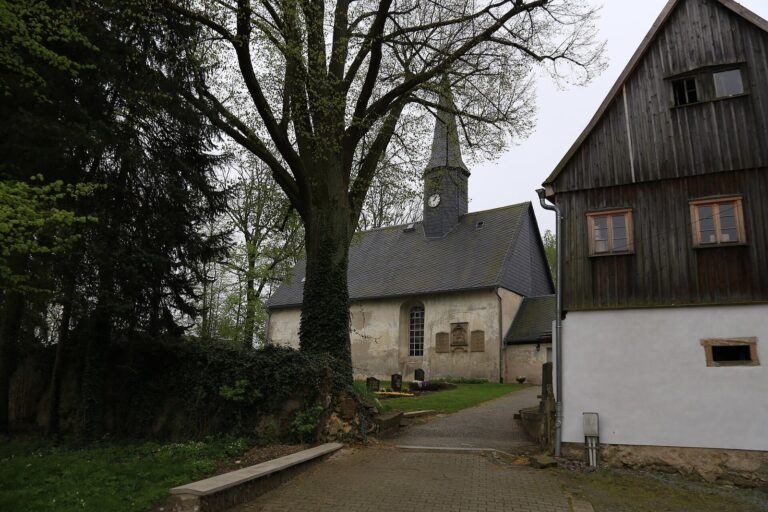
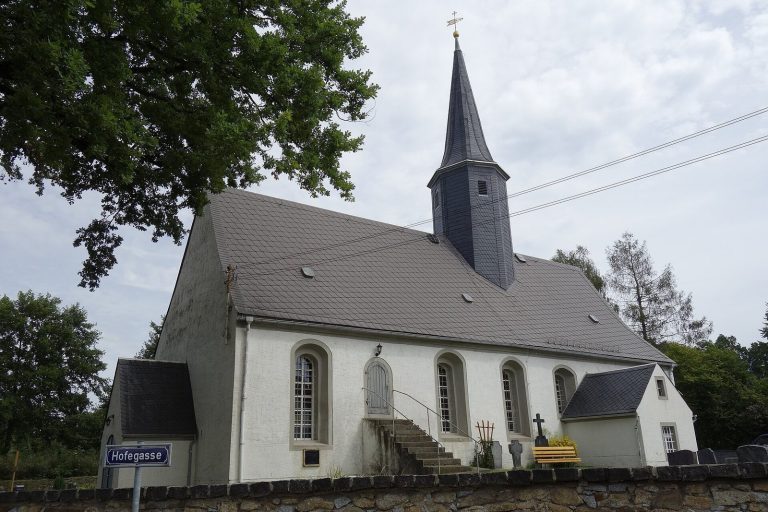
Dorfkirche Schönborn is an Evangelical Lutheran parish church in Schönborn, northeast of Dresden, Germany. A stone Romanesque chapel, in a medieval style marked by rounded arches and heavy masonry, probably stood on the site by the mid-13th century; the present church dates to 1653–1664.
Medieval origins and rebuilding
A church erected at Schönborn in 1607 was destroyed in 1652 when lightning caused a fire. The replacement reused elements from earlier buildings.
Later changes
Andreas Herold cast a bell for the church in 1653, followed by one made by Michael Weinhold in 1701. Both bells were surrendered for wartime metal collection during the First World War. Three new bronze bells were cast in Dresden in 1925 by the Bruno Pietzel foundry; two were surrendered for armaments in 1942. The remaining bell was later joined by another, cast in 1990 at the Metz foundry in Karlsruhe and added in 1992.
Friedrich Jahn built the organ in 1832, and Wilhelm Rühle restored it in 2018. On Pentecost Monday in 2010, a tornado damaged the upper part of the roof turret; it was reset in 2012. The church, a shed, and the churchyard wall are protected monuments.
Remains
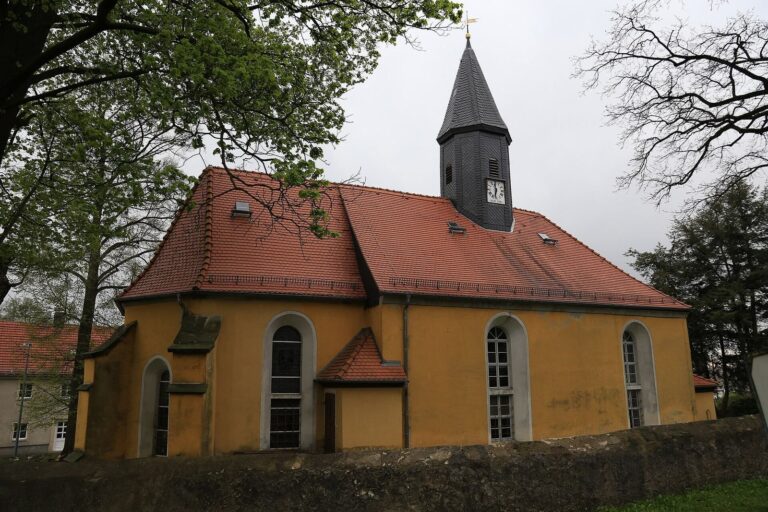
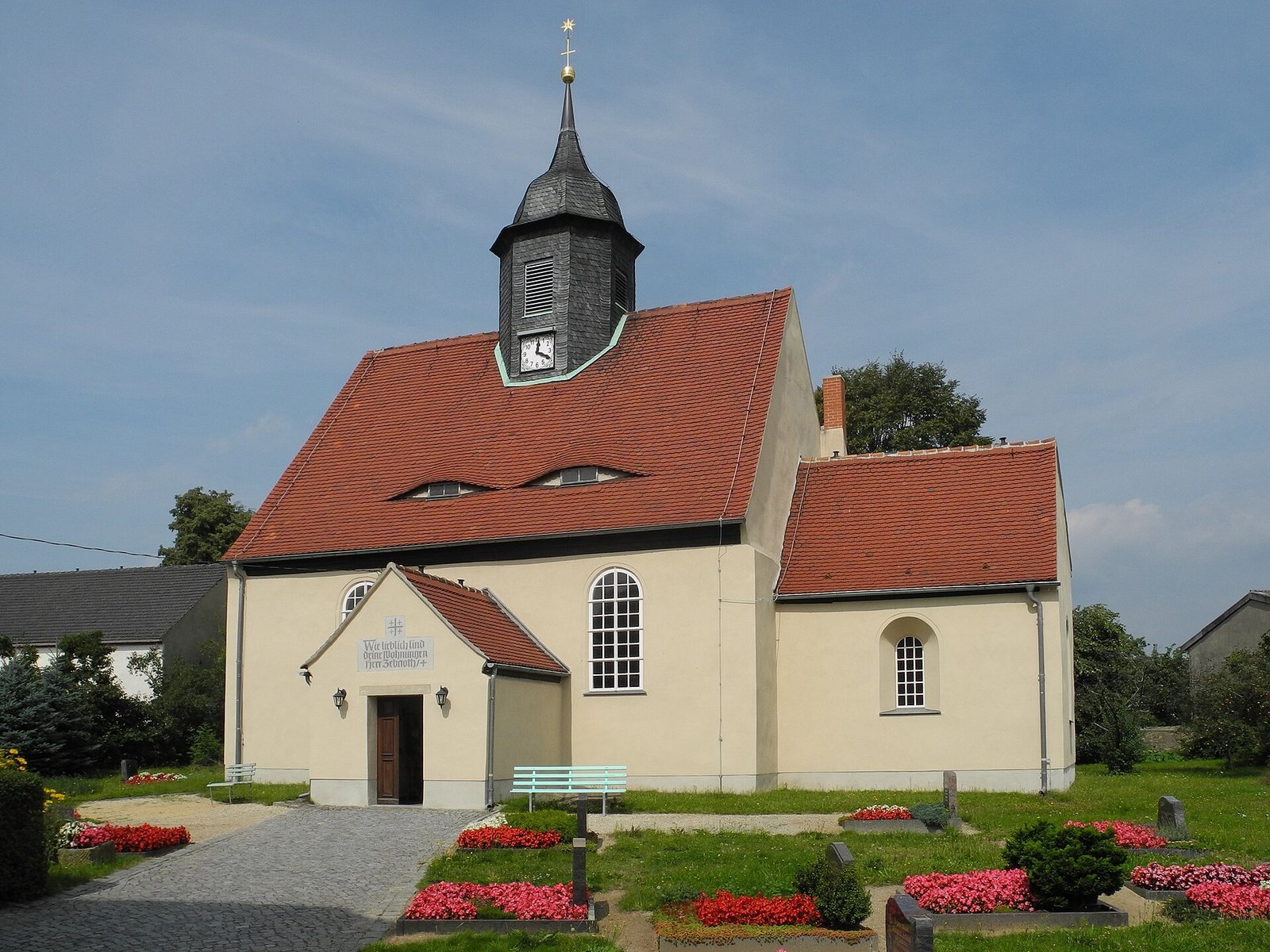
The church is a simple masonry building with a gabled roof, and its surrounding churchyard is enclosed by a wall.
Church fabric
Nave and chancel
The rectangular nave has thick rubble-stone walls that probably date to around the mid-13th century. Its flat ceiling rests on a substantial crossbeam. A square chancel was added at the east end after the 1652 fire, and its windows belong to the earlier Romanesque building phase.
Sacristy
A sacristy adjoins the nave on the northeast. Its ribless groin vault, a ceiling formed by the intersection of two barrel-shaped vaults, is associated with the work of Arnold of Westphalia, a 15th-century German master builder. This feature points to a date around the mid-15th century.
Roof and openings
Small, deeply splayed, round-arched windows pierce the church. An octagonal roof turret, covered in slate and topped by a curved hood, rises from the center of the gabled roof. The entrance is on the south side.
Interior and furnishings
Gallery, pulpit, and paintings
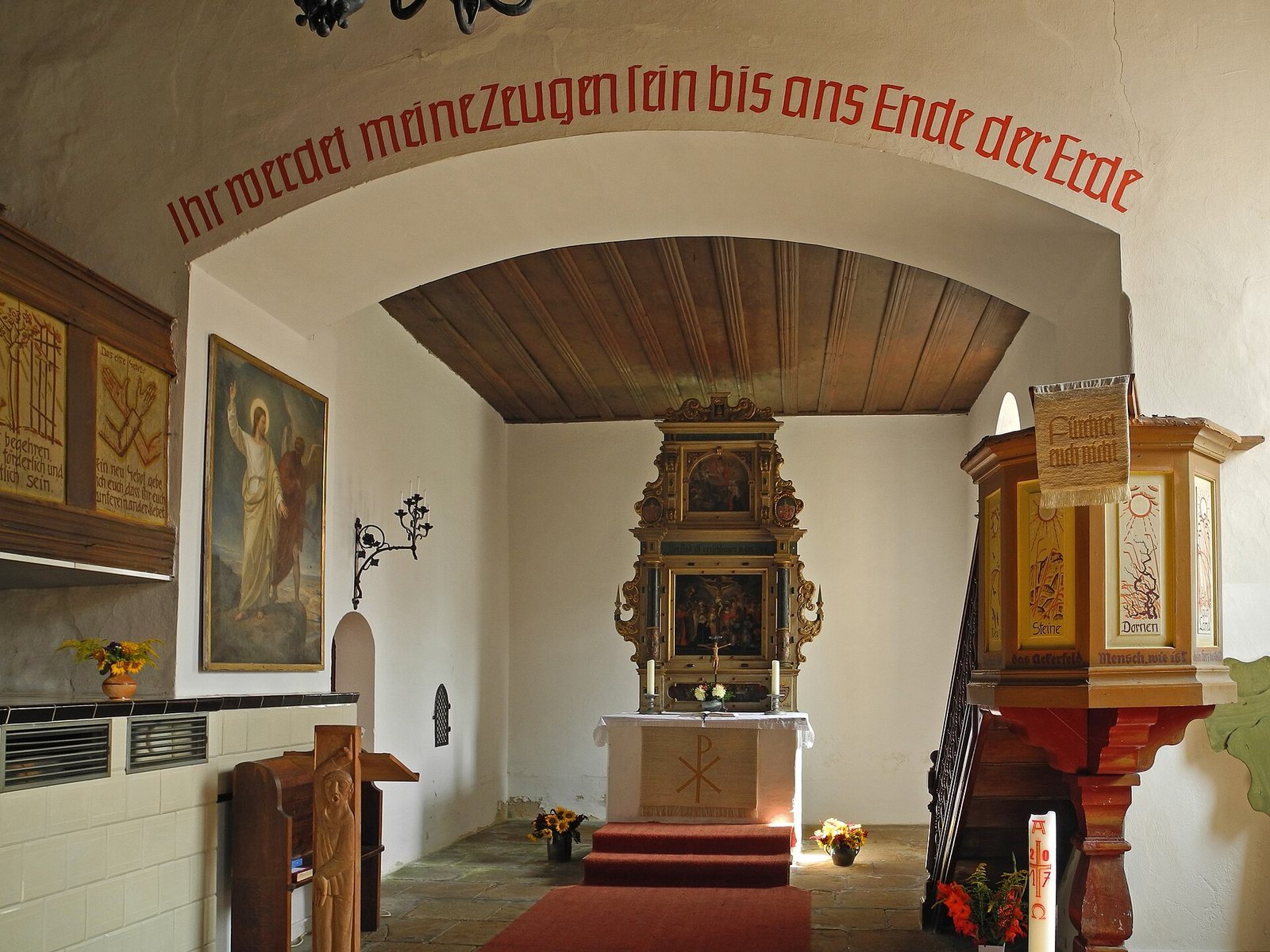
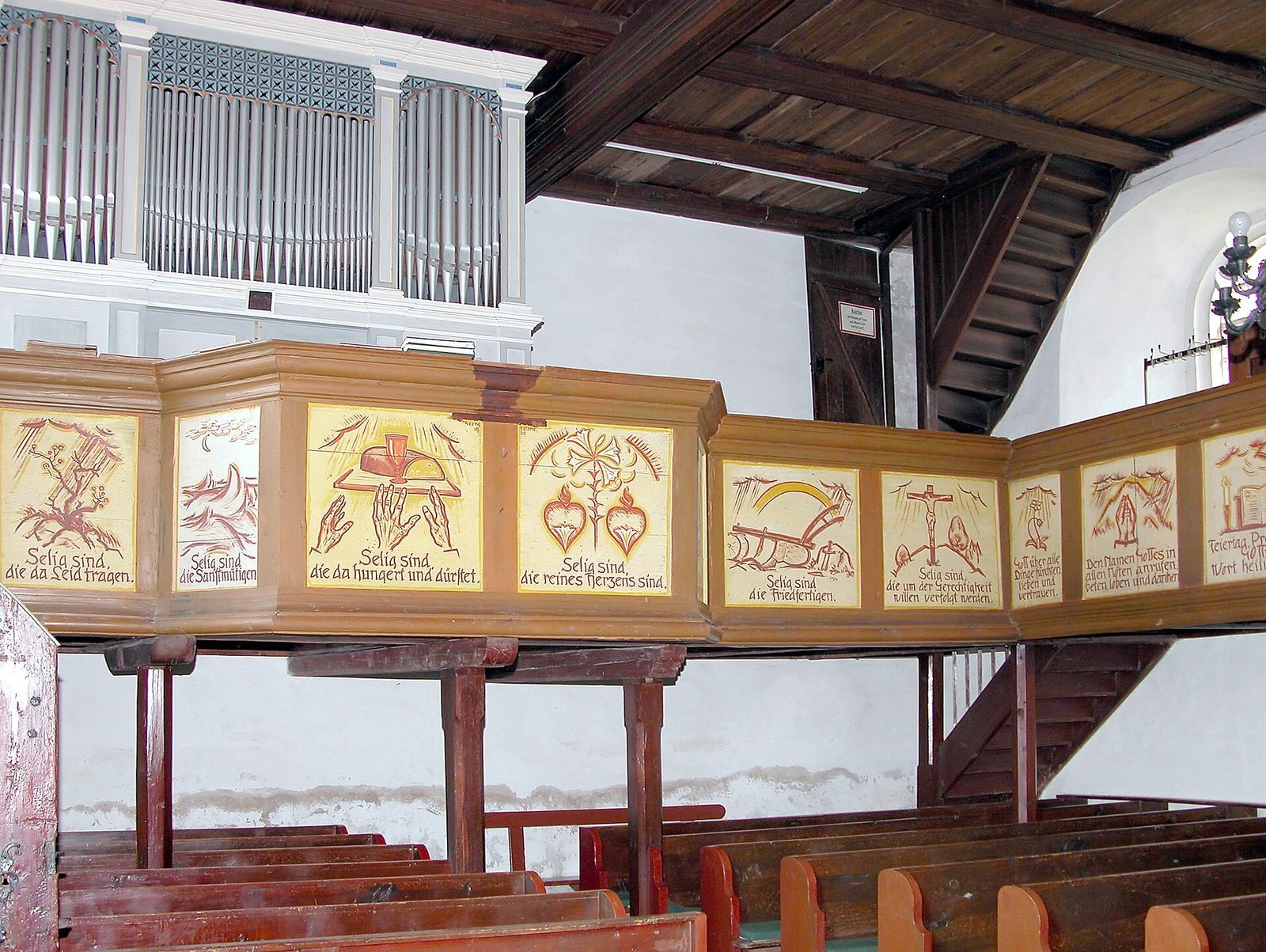
A gallery built in 1653 runs along the west and north sides of the nave, with a pulpit of the same period opposite it. Carl Bertling painted The Temptation of Christ in 1902. In 1928, during the Weimar Republic, Germany’s republican government from 1918 to 1933, Georg Gelbke painted the gallery panels, including the Ten Commandments, and an image of Martin Luther, the 16th-century theologian whose reforms gave rise to Lutheranism. Gelbke based the panels on suggestions from Karl Josef Friedrich, a pastor in Seifersdorf with whom he often stayed.
A panel at the chancel end, also painted in 1928, is headed “The Eleventh Commandment.” It refers to Christ’s instruction to love one another in John 13:34. The Ten Commandments among the gallery paintings and this additional panel explain the church’s alternate name, the Eleven Commandments Church.
Altar
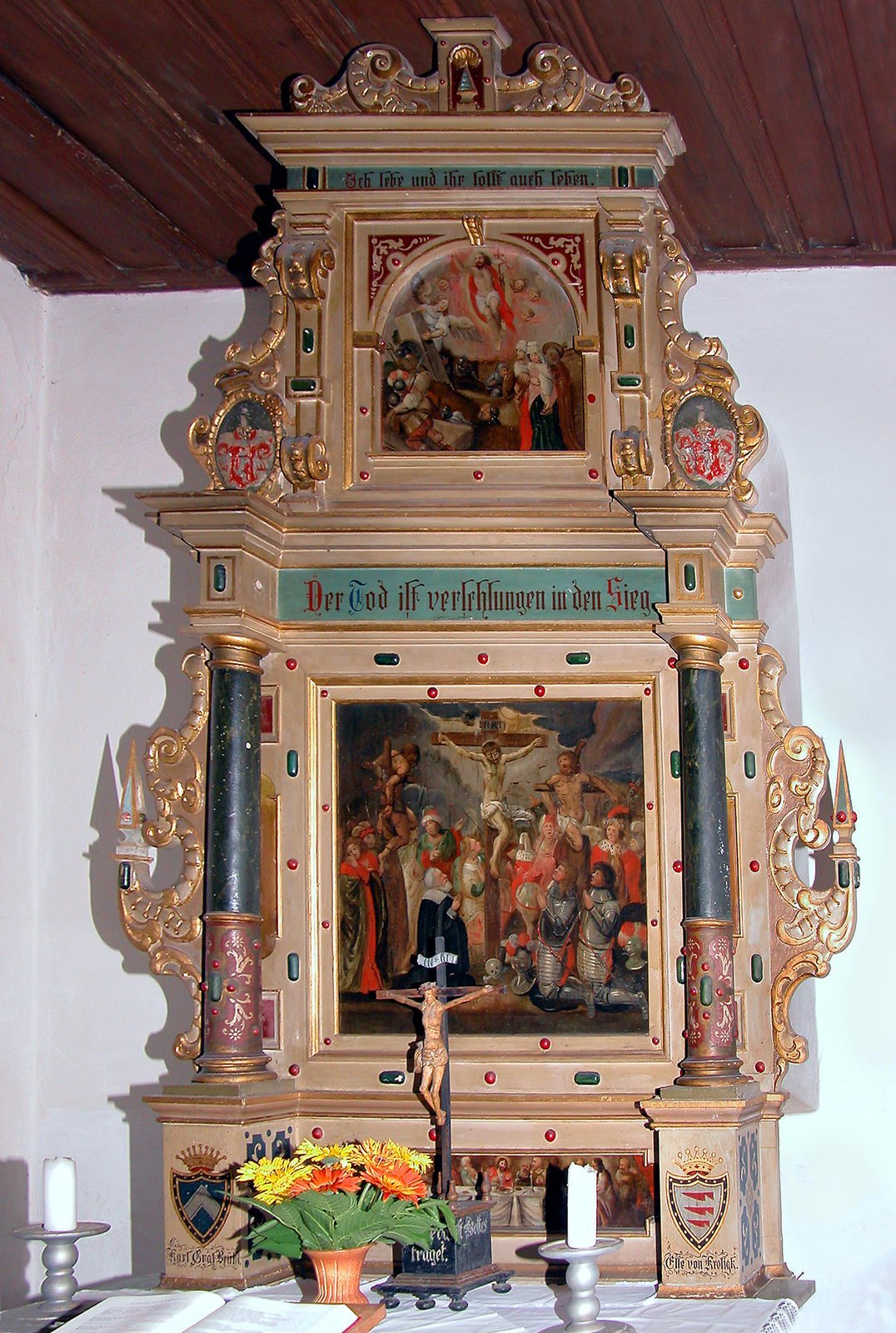
The altar’s column-supported structure dates to 1664. Its lower section depicts the Last Supper, the central panel shows the Crucifixion, and the upper section represents the Resurrection.
Organ
The mechanical organ stands at the south end of the west gallery. Sliding plates direct air to its pipes; it has one keyboard and ten stops, which select groups of pipes. Its façade dates to 1860 and has a late Neoclassical, or classical-inspired, design.
Bells and churchyard
Bells
The church has two bells. The surviving bell from the 1925 set has the strike note h′, while the bell added in 1992 has the strike note d″.
Churchyard
The churchyard surrounds the church and covers 1,560 square metres. It is among the smallest cemeteries in Dresden.