Dome of the Ascension: An Islamic Monument in Jerusalem
Site at a Glance
- Rating
- 4.5
- Popularity
- Very Low
- Country
- Israel
- Primary era
- Medieval
- Eras represented
- Medieval, Early Modern
- Civilizations
- Ayyubid, Ottoman
- Site type
- Religious
- Remains
- Sanctuary
On this page7 sections
History
The Dome of the Ascension is a historic Islamic monument in Jerusalem, Israel, within the al-Aqsa compound. Associated with the Mi’raj, the Islamic tradition of Muhammad’s ascent to heaven after his night journey to Jerusalem, it forms part of the Muslim prayer route. Its surviving architecture is an Ayyubid reconstruction from 1200 or 1201, traditionally retaining Umayyad or Abbasid characteristics and incorporating reused Crusader materials.
Early Origins and Crusader Destruction
The date and founder of the first structure are uncertain. It was probably built during either the Umayyad or Abbasid period, between the seventh and tenth centuries. Descriptions of Jerusalem from 903 and 985 mention the structure, placing it within the city’s early Islamic landscape.
The earlier dome was apparently destroyed during the Crusader occupation of Jerusalem. The Crusaders were Latin Christian forces who captured the city and held it for part of the medieval period. Later rebuilding incorporated some materials from their construction.
Ayyubid Reconstruction
The present monument was completely rebuilt in 1200 or 1201, during the reign of Sultan al-Adil I, an Ayyubid ruler and brother of Saladin. Izz ad-Din az-Zanjili, the Ayyubid governor of Jerusalem, directed the work. An Arabic inscription from the rebuilding records the monument’s rededication as a waqf, a religious or charitable endowment whose property and income are assigned permanently to a specified public or religious purpose.
During the Ayyubid period the building was also called the Dome of the Prophet. The name Dome of the Ascension was in use by no later than 1225, and it remained the name used during the Mamluk period.
Ottoman Care and Later Uses
The monument received care and repairs under Ottoman rule. In 1781, its mihrab, a prayer niche indicating the direction of Mecca, was decorated with Ottoman faience, a glazed ceramic material. An inscription relating to the Isra, Muhammad’s preceding night journey to Jerusalem, was placed above it.
For centuries, the dome served for meditation, individual prayer, and Sufi retreat. It was later used for a period to store documents from the sharia court and historical records of al-Aqsa Mosque. Today, it serves as an administrative and religious-guidance office operated by female preachers and religious guides, who provide instruction and devotional lessons for women worshippers and visitors within al-Aqsa. Its administration belongs to the Jerusalem Awqaf and al-Aqsa Affairs Administration, under Jordan’s Ministry of Awqaf, Islamic Affairs and Holy Places.
Remains
Octagonal Structure and Dome
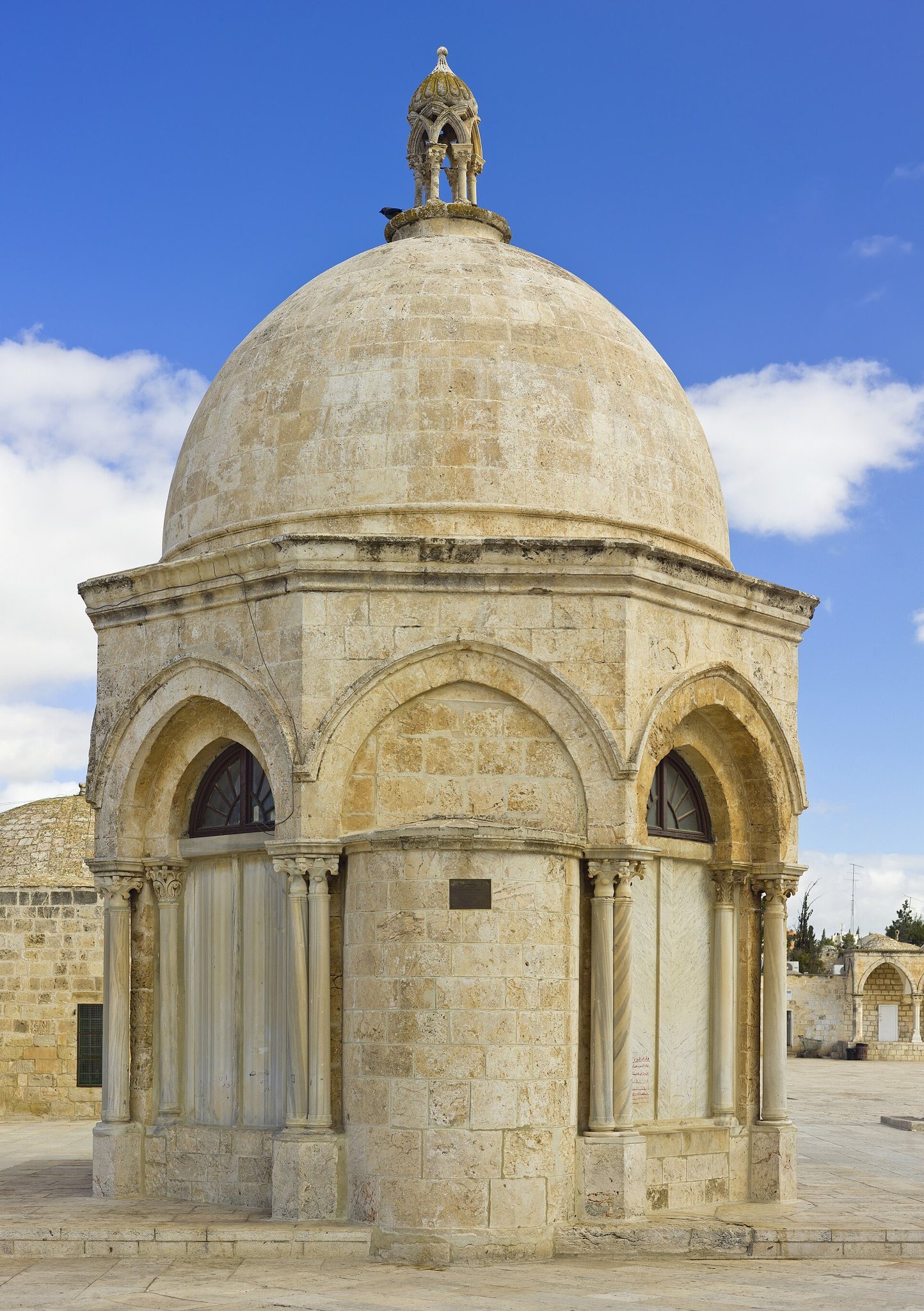
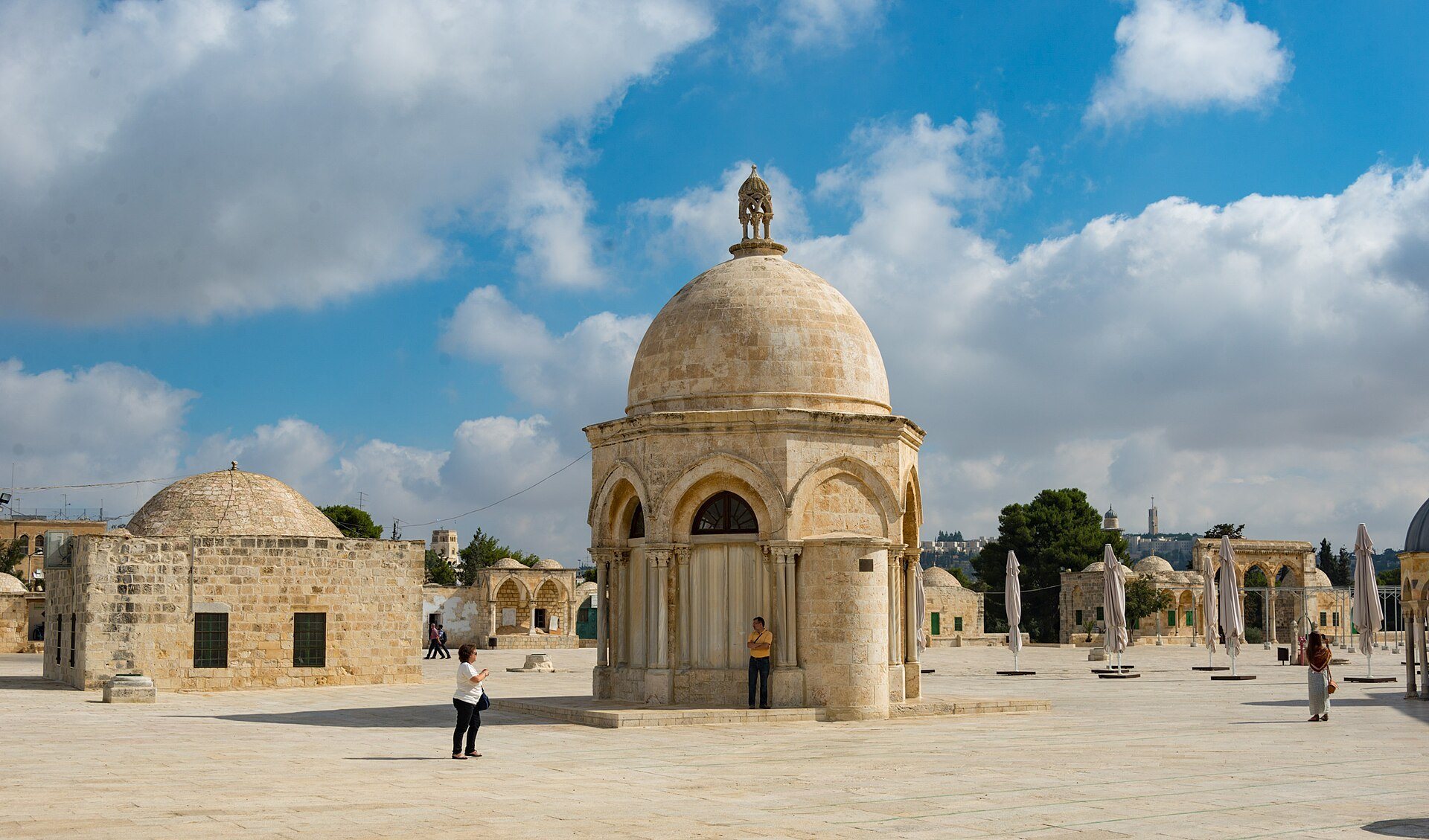
The Dome of the Ascension is a small, free-standing octagonal building directly northwest of the Dome of the Rock, within the Dome of the Rock plaza in the al-Aqsa compound. Thirty marble columns support the structure, arranged in groups of three or four. Above them are eight pointed arches. The spaces between the arches were originally open and were later closed with white marble slabs.
The main dome was formerly covered with lead sheets and was later faced with white stone plates. A small, crown-like cupola rises above it on six columns. The surviving building combines a traditionally Umayyad or Abbasid architectural character with the Ayyubid rebuilding and reused Crusader materials.
Entrance, Prayer Niche, and Reused Details
The entrance is on the north side of the monument. A stone mihrab faced with coloured faience occupies the southern side. Its column capitals and some construction details follow a Frankish style, reflecting the use of materials and elements associated with the Crusader period in the Ayyubid reconstruction.