Domaine de Grammont: A Former Priory and Municipal Estate in Montpellier



Site at a Glance
- Rating
- 4.5
- Popularity
- Low
- Country
- France
- Primary era
- Medieval
- External website
- Open
- Eras represented
- Medieval, Modern
- Civilizations
- French
- Site type
- Civic
- Remains
- Park
On this page17 sections
History
Domaine de Grammont is a historic estate in Montpellier, France, that began as the Grandmontine priory of Notre-Dame-de-Montaubérou. The Order of Grandmont, a religious community founded in Limousin whose members lived as hermits in community, received the land from the chapter of Maguelone Cathedral, and construction of the priory began in 1174.
The Grandmontine priory
The priory’s chapel and conventual buildings were erected around 1180, while the eastern end of the church, known as the chevet, was rebuilt in 1225. By the 1220s, the complex contained religious cells and a chapel. Pope John XXII later established Notre-Dame-de-Montaubérou as a priory for 17 religious and placed three smaller monasteries under it: Le Sauvage in the Diocese of Rodez, Le Peyroux in the Diocese of Cahors, and Montézargues in the Diocese of Avignon.
Wars, confiscation, and the wine estate
The priory suffered severe damage during the sixteenth-century Wars of Religion in Languedoc, a period of conflict between Catholics and Protestants in France. From 1701 to 1790, the estate belonged to the Montpellier seminary. In 1790, during the French Revolution, it was confiscated and sold as national property, a category that allowed the revolutionary state to dispose of seized ecclesiastical and aristocratic estates.
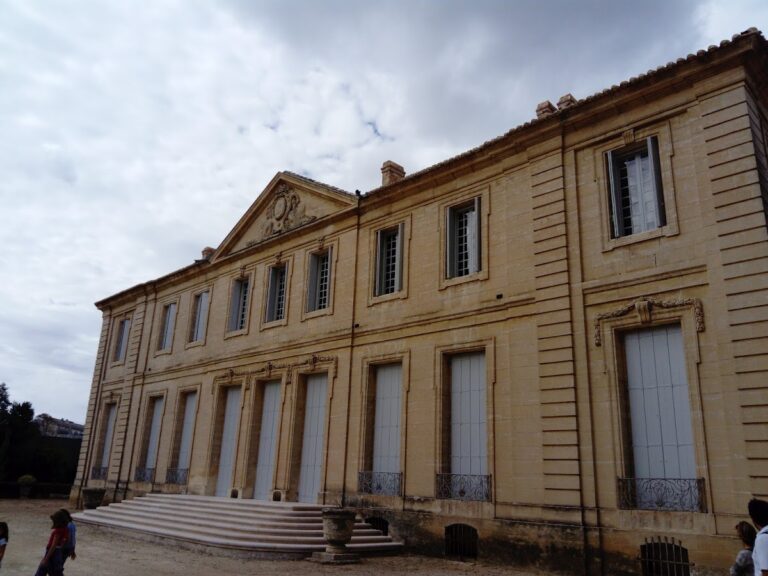
General Charles de Frégeville owned the estate from 1796 to 1821, after which it passed to his son-in-law, Ambroise-Jacques Bricogne. The west wing was rebuilt during the first quarter of the nineteenth century, and the former priory was developed as a wine estate called Château de Grammont.
The Bouisson-Bertrand institute
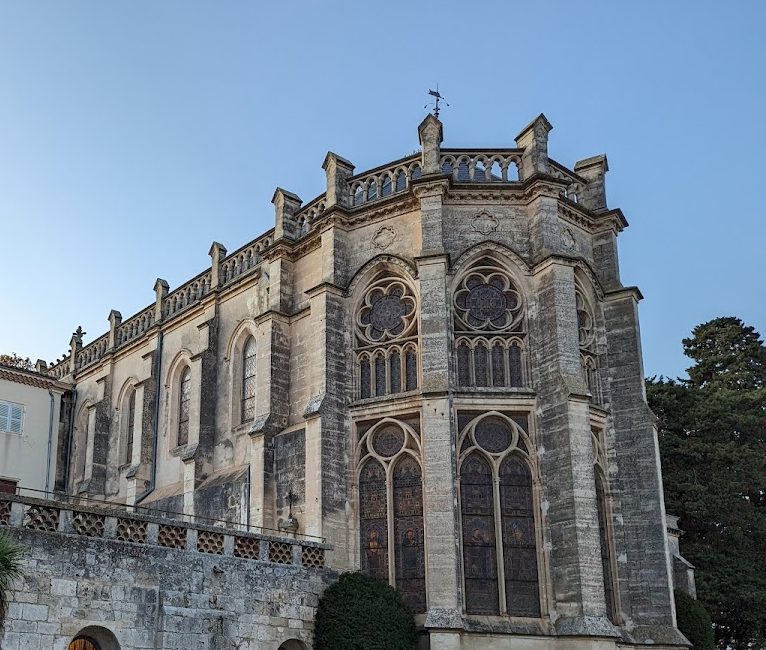
Professor Etienne Bouisson acquired the château and its vineyards in 1867. Following his death, his widow, Amélie Bertrand, bequeathed the estate to the Faculty of Medicine of the University of Montpellier in 1893. The property was then converted into the Bouisson-Bertrand research institute. A new chapel was built on the site of the ruined earlier chapel between 1895 and 1897.
Municipal development
During the twentieth century, the City of Montpellier progressively acquired Domaine de Grammont, ended viticulture, and developed the property as a municipal park for sporting and cultural activities. The estate now forms part of the “Sites d’exception en Languedoc” network, while the château and park are included in France’s General Inventory of Cultural Heritage.
The chapel, now called Sainte-Philothée, was assigned to the Orthodox Church of Constantinople and serves Orthodox Christian worship through the Greek Orthodox Metropolis of France, an Orthodox ecclesiastical jurisdiction under that church. The château also functions as an auxiliary town hall and is used for civil wedding ceremonies.
Cultural and civic uses
Zénith Sud opened on 6 February 1986 as the first concert hall of the Zénith model built outside Paris. This French venue type was designed for large-scale popular-music performances. Since the early 1990s, the Espace Grammont has hosted major rock and electronic-music concerts, taking over this role from the former Richter stadium. The Théâtre des Treize Vents also operates at the estate.
A marble statue titled Hecate and Cerberus was created in 1866 by Marcello, the artistic name of the sculptor Adèle d’Affry, on commission from Napoleon III, emperor of the French from 1852 to 1870. The work was transferred from Paris to Montpellier in 1889. It stood on the Promenade du Peyrou, moved to Place Renaudel in Celleneuve in 1956, was classified in 1981, and was installed at Grammont in 1986.
Remains
Domaine de Grammont extends across 90 hectares east of Montpellier, on the bank of the Lez near the boundary with Saint-Aunès. The estate combines Mediterranean vegetation, wooded areas, broad flower meadows, former vineyard land, and preserved gardens around the central château. Its historic buildings occupy the centre, while cultural venues, sports grounds, municipal horticultural facilities, and other public-service areas extend across the wider park.
The former priory and château
Chapter house
The original priory included a chapel, conventual buildings, religious cells, and a chapter house, a room where members of a religious community met for communal business and readings. The chapter house is the principal surviving element of the original complex and is used for wedding ceremonies.
Sainte-Philothée Chapel
Sainte-Philothée occupies the site of the earlier priory chapel. Its reconstruction between 1895 and 1897 incorporated sculptures by Auguste Baussan and stained glass by Louis-Charles-Marie Champigneulle. The chapel remains in religious use by the Greek Orthodox community connected with the Metropolis of France.
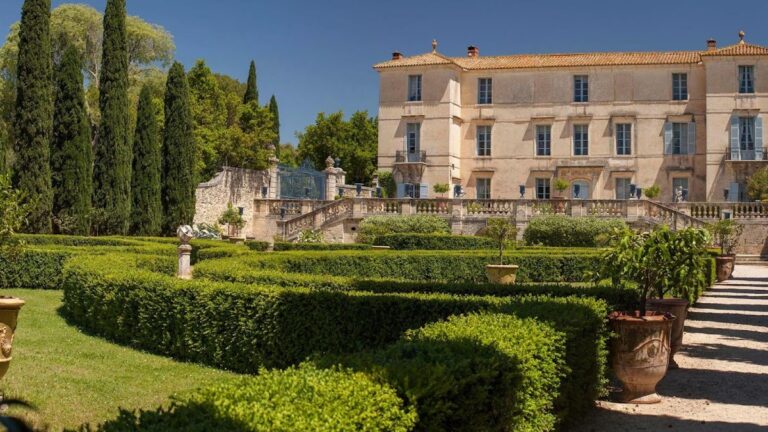
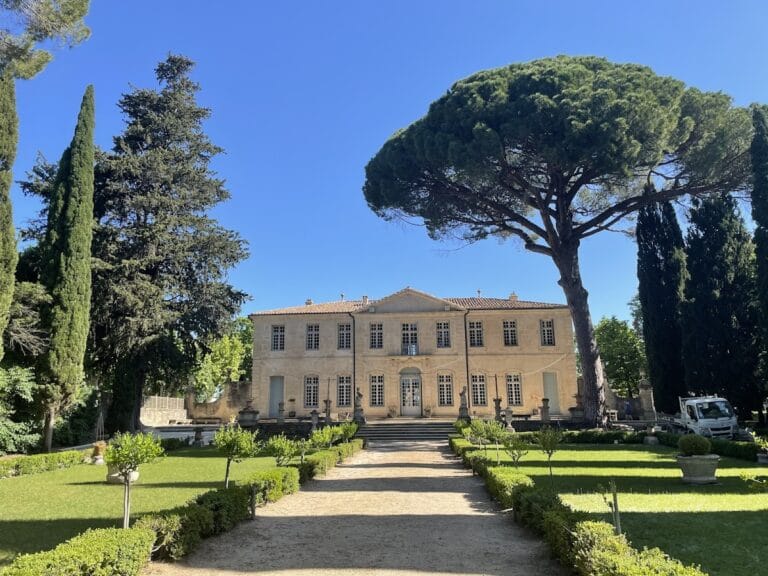
Château de Grammont
The château stands at the centre of the estate. Its west wing was rebuilt in the early nineteenth century, when the former priory buildings were partly adapted for the wine estate known as Château de Grammont. The complex later housed the Bouisson-Bertrand research institute and now includes the auxiliary town hall.
Gardens and horticultural facilities
The château is surrounded by preserved gardens within the larger park. A municipal horticultural centre and municipal greenhouses were established at Grammont in 1984. The estate also retains a century-old cedar planted during the imperial period.
Concert and theatre venues
Zénith Sud
Zénith Sud occupies 5,000 square metres and can accommodate up to 6,300 spectators. Its original metal-grey fabric covering was replaced by yellow fabric during renovation in 2000.
Espace Grammont and Théâtre des Treize Vents
The Espace Grammont is a large open area in the northern part of the estate, used for concerts and festivals attended by several thousand people. The Théâtre des Treize Vents lies between the château and the area used for rock concerts.
Sports and public facilities
Sports facilities occupy the western half of the estate and several areas east of Zénith Sud. They include a fitness trail with exercise stations in a pine wood, an equestrian centre, a model-car racing track, a skatepark, a BMX park, tennis and basketball courts, and grass football pitches. Montpellier Hérault Sport Club has its headquarters at Grammont and uses the estate for team training.
A cemetery and funeral complex were established east of the estate in response to the expansion difficulties of the Saint-Lazare cemetery. A composting centre lies between the football pitches and the fitness trail.
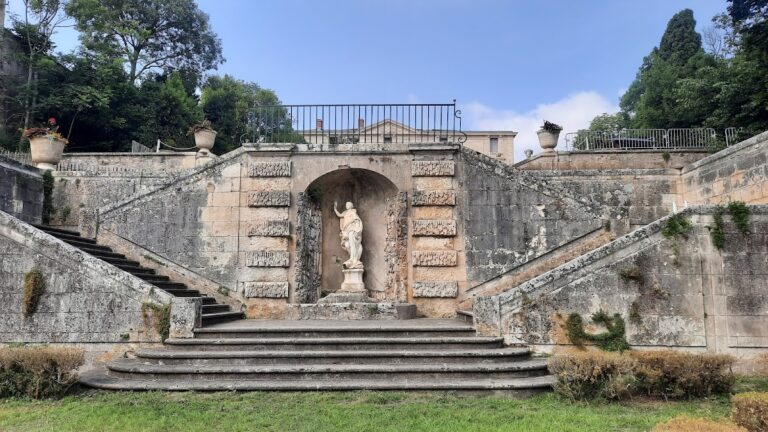
Statue of Hecate and Cerberus
The marble Hecate and Cerberus stands at the highest point of the park’s fitness-trail area. Hecate was a goddess associated in ancient Greek religion with crossroads, magic, and the night, while Cerberus was the multi-headed hound believed to guard the entrance to the Greek underworld. The statue remains visible but is mutilated.