Pierre Martine: A Neolithic Funerary Dolmen in France
Site at a Glance
- Popularity
- Low
- Country
- France
- Primary era
- Stone Age
- Eras represented
- Stone Age, Modern
- Civilizations
- Unclassified
- Site type
- Burial
- Remains
- Tomb
On this page6 sections
History
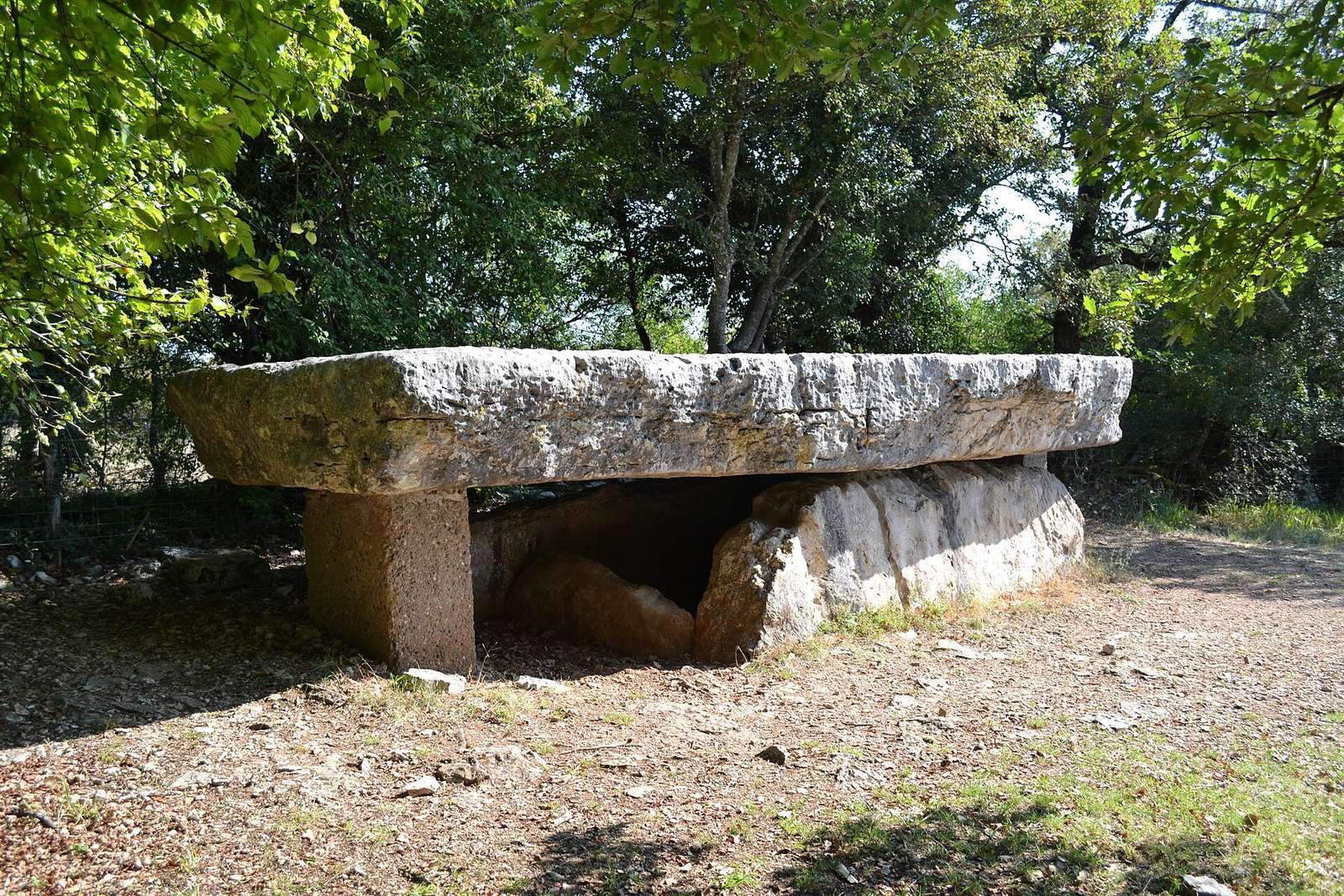
Pierre Martine is a Neolithic funerary dolmen at Livernon in France and was part of the Boyme group of megalithic monuments. It is described as the largest dolmen in the Lot and among the dolmens of Quercy, and is probably the best-known dolmen in the Lot.
Records and local traditions
The monument’s name appears in land records from at least 1397, when a document refers to land in the territory of Martina. A 1489 sale uses a related form as a landmark. The name has endured for more than six centuries, though possible origins have been proposed in Latin, Gaulish, and Celto-Scythian words.
In the seventeenth century, the cleric Abbé de Foulhac dug beneath and around the dolmen and found bones. Local tradition also attributed a copper dagger to the site. A legend tells that devils held a full-moon gathering at the monument and frightened nearby residents. Saint Martin of Tours, a fourth-century bishop and missionary in Gaul, asked Saint Eutrope, traditionally a Christian missionary associated with Saintes, to intervene. Eutrope sent holy water down as rain, and the devils fled to hell and never returned.
By the end of the seventeenth century, local peasants still treated the dolmen with great reverence. One belief held that secretly placing flowers on it brought a year’s protection from fever; another said that a sick person could recover by lying on its capstone.
Modern interpretations and protection
Prehistorian Jean Clottes interpreted the monument’s elevated position as important to the religious beliefs of the megalith builders. Local water diviner Louis Merle claimed that the two Boyme dolmens stood above the meeting point of underground watercourses linked to streams that disappear underground at Thémines and Théminettes. Modern understanding of the region’s water systems contradicts that claim: Livernon lies outside those streams’ watershed, and they belong to the Ouysse basin. Pierre Martine has been classified as a historic monument in France since 1889.
Remains
In Livernon, in the Lot department of Occitanie, the dolmen stands at about 340 m elevation on a rise near a high point of 355 m. Its long, narrow burial chamber is aligned at a compass bearing of 80 degrees and was once covered by an elongated mound.
Burial chamber and capstone
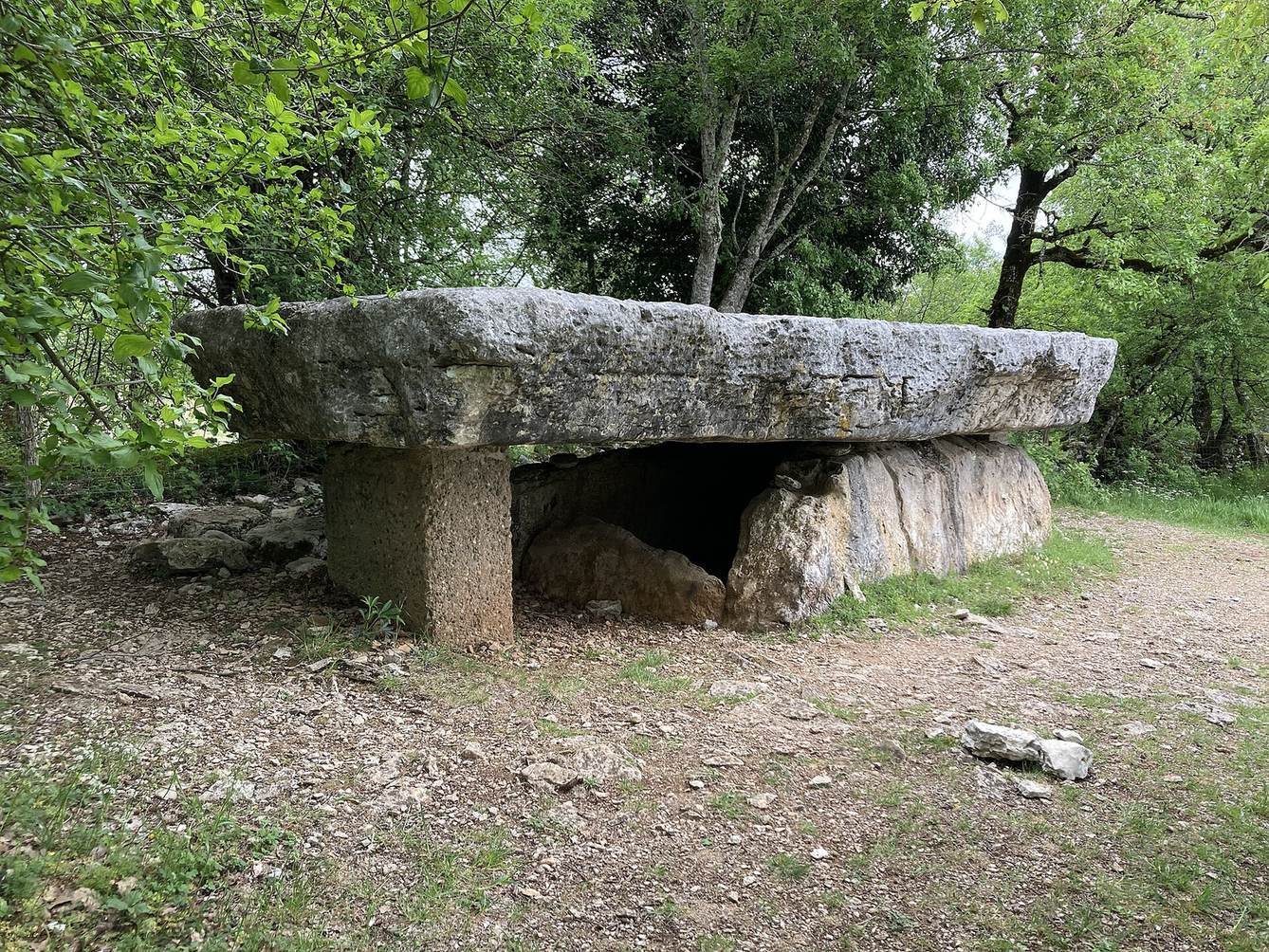
The rectangular chamber measures about 5 m long and 0.60 m wide. Its two large upright stones measure 4.90 m and 4.25 m in length, and a thin slab closes the western end. The capstone, made of Bathonian limestone, a stage of the Middle Jurassic, originally measured about 7.10 m by 2.30 m and was 0.55 m thick. It weighed an estimated 22 tonnes and has a deeply furrowed surface from erosion. Before it broke, the slab could rock under slight pressure because it projected beyond its supports. It fractured in 1948 and now consists of two pieces. A restoration in 1966 added concrete pillars to support it at both ends.
Mound and surrounding landscape
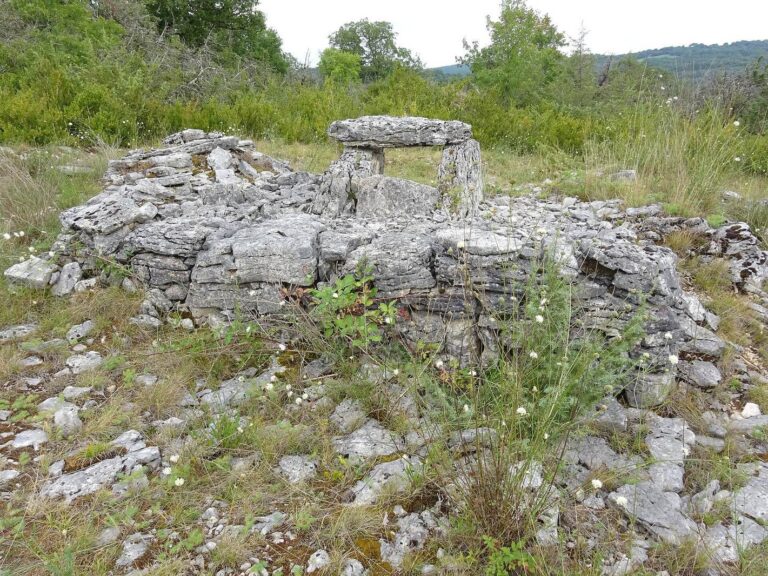
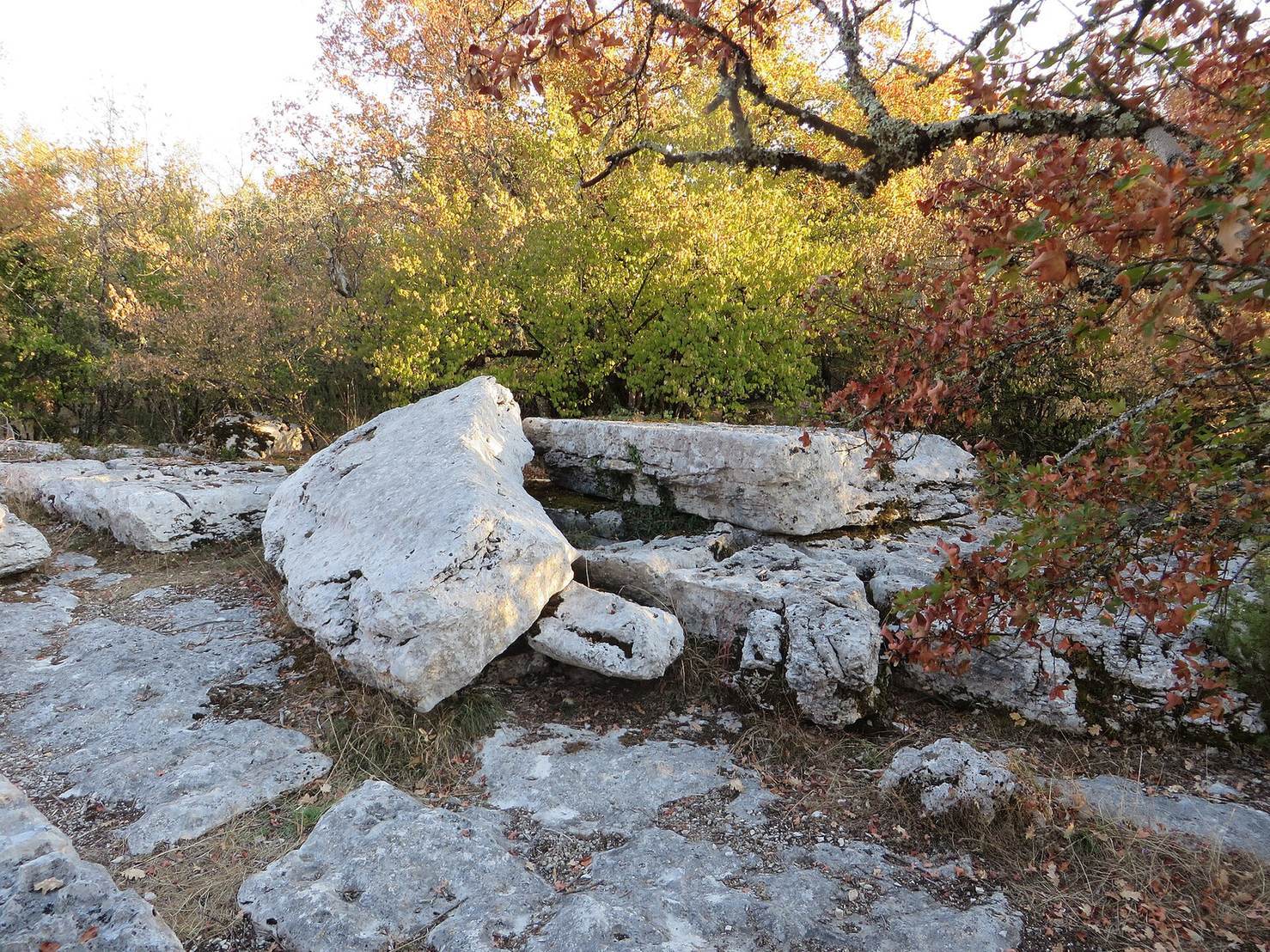
A mound probably measuring about 30 by 15 m once covered the dolmen. Its elongated shape may have developed when a smaller mound was added, and little of it survives. Another dolmen stood 7 m to the north; it shared Pierre Martine’s alignment but has been destroyed. Its supporting stones measured 3 to 3.5 m, and its capstone had broken into six pieces. About 200 m south, at a lower elevation, a limestone quarry supplied slabs for the dolmens. The rock layers form nearly regular rectangles, while blocks near the capstone extraction area are of similar thickness and have irregularities corresponding to those of the monument. A karst landscape lies nearby, where erosion has cut deep grooves into limestone and dolomite.