Dolmen del prado de Lácara: A Neolithic Passage Tomb in Spain
Site at a Glance
- Popularity
- Medium
- Country
- Spain
- Primary era
- Stone Age
- Eras represented
- Stone Age
- Civilizations
- Unclassified
- Site type
- Burial
- Remains
- Tomb
On this page11 sections
History
Late Neolithic and Copper Age
Built by Late Neolithic communities, the Dolmen del prado de Lácara is a collective burial monument in the municipality of La Nava de Santiago, Badajoz province, Spain. It is a passage tomb, a burial monument reached through an entrance passage, and the largest documented dolmen in Extremadura. Its construction probably dates to the end of the fourth millennium BCE or the beginning of the third.
Burials continued during the Chalcolithic, or Copper Age, throughout the third millennium BCE, and finds indicate later use as well. The monument may have served purposes beyond burial: it has been interpreted as a marker of community identity or territory, or as a landmark in the prehistoric landscape. Its position has also prompted suggestions of links to routes and crossing places. Continued use and repeated looting have made it impossible to establish how many people were buried there or to reconstruct the complete sets of grave goods.
The dolmen stands relatively far from other known tombs, complicating the idea that it belonged to an organized group of collective burials. Dolmens near Mérida have sometimes been interpreted as an eastern extension of the dense concentration around Alburquerque, Villar del Rey, and La Roca de la Sierra.
Later occupation and modern study
The tomb was reused as a dwelling in Roman and medieval times. This occupation irreversibly disturbed its earlier burials and grave goods. In the late nineteenth century, parts of the stone structure were quarried and blasted. Vicente Barrantes made the earliest known written reference to the dolmen in 1875. José Ramón Mélida visited in 1908 and 1912 and recorded the blasting in his catalogue.
The dolmen received Spain’s Asset of Cultural Interest designation on 13 December 1912, a formal recognition for culturally important properties. Mélida later secured its designation as a National Monument in 1931. Geologists mentioned it in a regional study in 1950, and a dolmen catalogue included it in 1956. Systematic excavation followed in 1957–1958 under archaeologist Martín Almagro Basch.
Remains
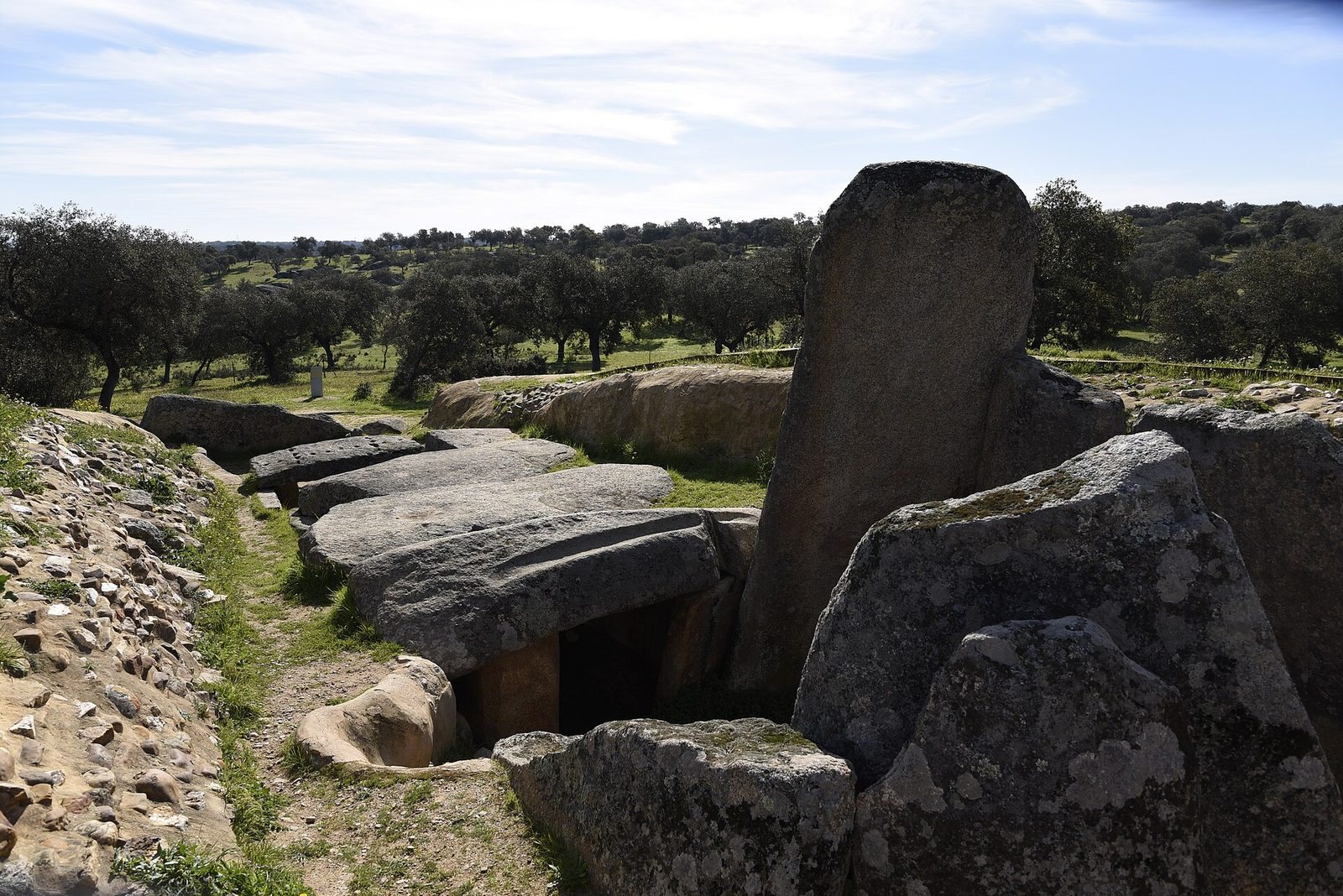
The tomb is an east–west passage monument built from large granite stones. Its chamber and access passage together extend almost 20 metres, and an elliptical mound of earth and rounded stones once covered nearly the entire structure. It occupies a slight rise in gently rolling holm-oak pasture near several watercourses, with the Lácara River to the east. Granite outcrops in the surrounding area provided building stone.
Chamber and access passage
Burial chamber
The chamber has a polygonal plan that approaches a circle and measures about 5 metres across. Seven large upright granite slabs formed its walls, set at an inward angle; the tallest central slab helped support the structure. The sole intact upright slab is 5.2 metres high and stands just left of the entrance. The large roof slab is lost, while fragments of other blocks that once lay on the chamber floor now rest several metres outside the tomb.
Passage and entrance
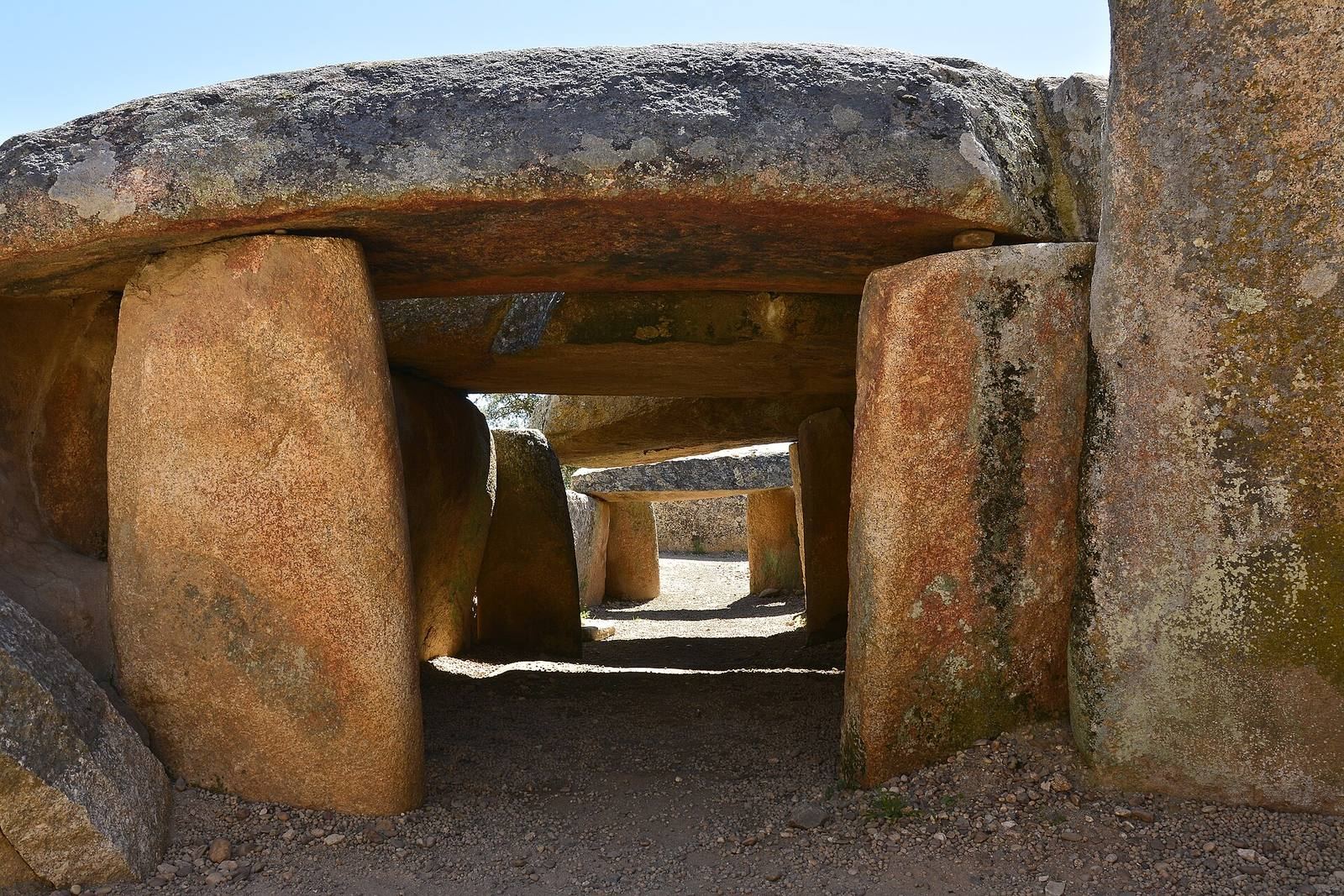
The access passage consists of an atrium followed by two antechambers, with pairs of upright slabs narrowing the way between sections. The trapezoidal atrium beside the entrance probably had no roof. It served as an access ramp to the first antechamber and may also have been used for ceremonial offerings. The two antechambers have horizontal stones spanning their openings, stand 1.1 to 1.6 metres high, and narrow slightly toward the chamber.
Earthen mound and stone damage
The mound has an elliptical plan and measures about 28 to 35 metres across. It now rises 3.5 metres, though it was probably considerably taller originally. Some stones from its outer retaining ring remain visible. Several cover stones bear holes made during blasting or for inserting wedges to split the stone.
Excavated finds
Bone fragments and ochre
Finds include small bone fragments charred by later fires and numerous pieces of ochre, probably used in funerary rites.
Pottery, tools, and ornaments
Objects found outside their original context include spherical and hemispherical ceramic vessels, chipped-stone tools such as flint knives and halberds, about one hundred arrowheads made from different materials, pendants, necklace beads, and two copper points. Other finds include Beaker pottery, a prehistoric ceramic tradition associated with bell-shaped vessels, and Palmela-type points, a kind of prehistoric copper point. A rectangular slate plaque idol, a flat decorated object interpreted as an idol, has rounded edges, incised decoration on its front, and three perforations at the top. Beaker pottery and Palmela-type points indicate later occupation.