Dolmen de Pierre-Fade: A Prehistoric Megalithic Tomb in France
Site at a Glance
- Popularity
- Very Low
- Country
- France
- Primary era
- Stone Age
- Eras represented
- Stone Age
- Civilizations
- Unclassified
- Site type
- Burial
- Remains
- Tomb
On this page9 sections
History
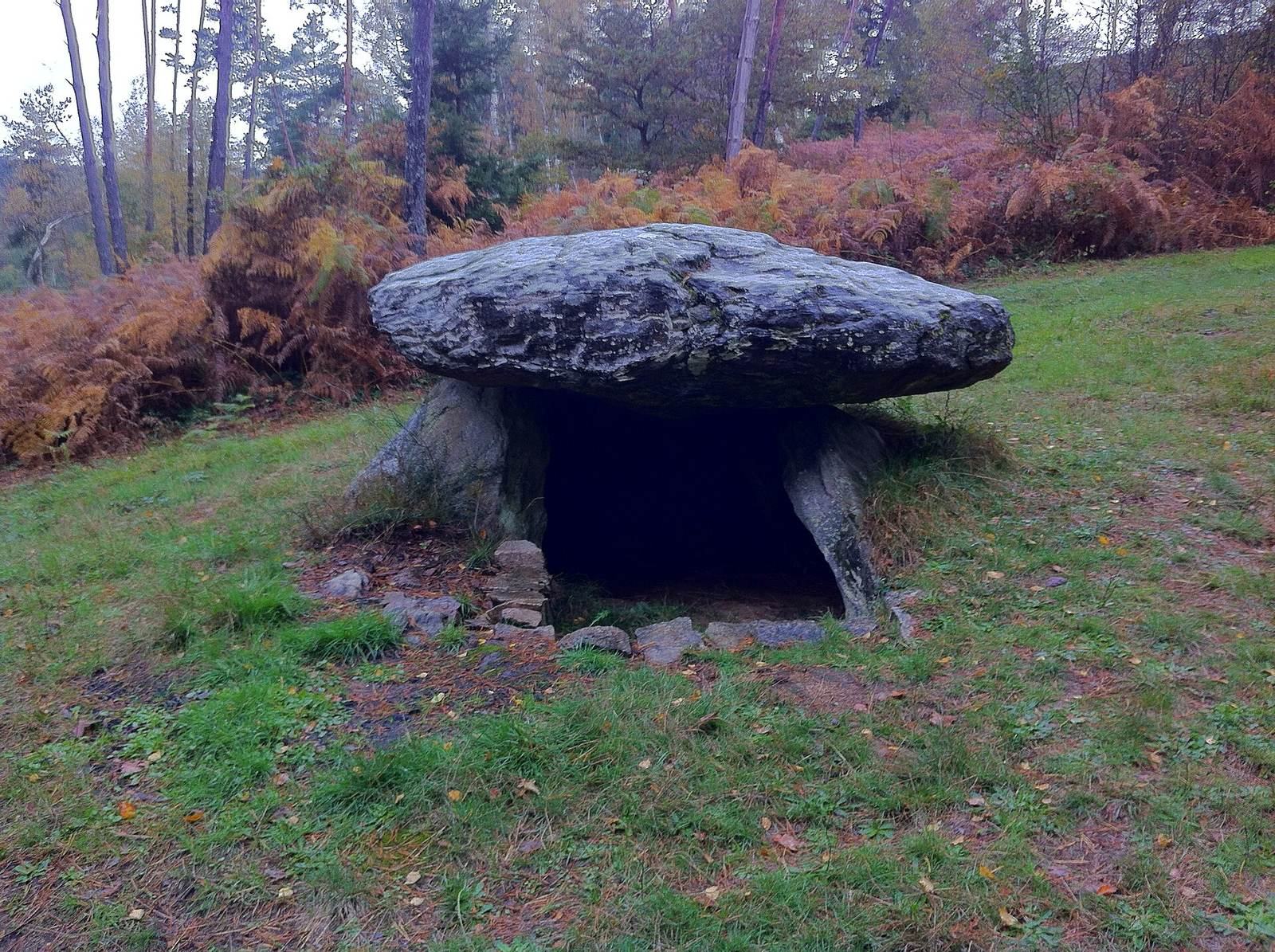
The Dolmen de Pierre-Fade is a prehistoric tomb formed from upright stones supporting a capstone, at Saint-Étienne-des-Champs in France. It was built around 2200 to 2000 BCE, during the Final Neolithic or Copper Age, the period between the Neolithic and Bronze Age. Later activity took place during the Bronze Age and the Gallo-Roman period, the era of Roman rule in Gaul. The monument is sometimes called the Fairy Stone, a name derived from the Occitan word fada, meaning fairy.
Early use and later activity
The dolmen’s construction dates to the Final Neolithic or Copper Age. Finds indicate that people also used the site during the Bronze Age and the Gallo-Roman period.
Study and conservation
Nineteenth-century historians Jean-Baptiste Bouillet and Louis Leguay made the earliest known written references to the monument. A preliminary excavation may have taken place in 1910; a small stone axe and a terracotta bowl recovered then have since been lost. In July 1975, Claire Gautrand-Moser led a rescue excavation that enabled detailed study of the dolmen’s construction. Earlier unauthorized digging had disturbed the deposit inside the chamber to a depth of about one metre. The monument was classified as a historic monument in 1989, a statutory heritage-protection status in France. In April 2001, archaeologist Jean-Pierre Lagasquie restored it because it was at risk of collapse.
Remains
The dolmen is a simple Type B form, a category of simple dolmen designs, with a polygonal base. It stands slightly north of the centre of its oval burial mound. The site lies at an elevation of 674 metres, at a break in the slope at Les Brousses. The Sioulet flows below; pebbles found in the monument probably came from the river and may have influenced the choice of location.
Tumulus and landscape
The oval mound measures 8.50 metres along its long axis and 6.60 metres across. To build it on sloping ground, coarse blocks first levelled the surface, leaving a central hollow for the chamber; smaller stones were then packed around the supports. Most of the mound’s blocks came from nearby sources, but not from the immediate site, where weathered ground did not provide usable stone. Some basalt blocks came from an outcrop about three kilometres away. Basalt pebbles occur in the mound, while small quartz and mica-schist pebbles came from the chamber’s archaeological deposit. The mound’s southern side has collapsed, spreading its footprint. Among three particularly well-preserved megalithic monuments in Puy-de-Dôme, Pierre-Fade is the one that retains its mound.
Chamber and stone construction
The monument measures about 3 metres long, 1.65 metres wide, and up to 2.40 metres high. Its roughly circular chamber is 2.75 metres long and 2.45 metres wide, with a maximum height of 1.94 metres, and opens to the southeast through an entrance that is not original. Four inward-leaning supports and an end slab hold a single reshaped, oval capstone measuring 2.6 by 2.2 metres and weighing more than six tonnes. Two supports stand on each side in a scale-like arrangement. Their inner faces are flat and their outer faces irregular, except for the end slab; dry-stacked stones fill the gaps. The stone is described as local orthogneiss, a metamorphic rock derived from igneous rock, and the slabs are also identified as embrechite, a rock type. Two supports are made of quartzite and rhyolite.
Excavated finds
Stone artifacts
The 1975 excavation recovered stone artifacts in front of the entrance. The flint finds include three kinds of arrowhead, with barbs, leaf-shaped, and with a transverse cutting edge, along with five complete blades, six blade fragments, a scraper worked on two edges, and a worked flint flake. The flint came from outside the region; the nearest sedimentary deposits lie about 200 kilometres to the northeast. A worked quartz pebble was also recovered.
Pottery fragments
Most pottery fragments from the site are Gallo-Roman and were scattered across the mound. A few small pieces of funerary urns from the Late and Final Bronze Age came from northeast of the entrance.