Mané-Kerioned Dolmens: Neolithic Passage Tombs in Carnac, France
Site at a Glance
- Popularity
- Low
- Country
- France
- Primary era
- Stone Age
- Eras represented
- Stone Age
- Civilizations
- Unclassified
- Site type
- Burial
- Remains
- Tomb
On this page9 sections
History
Neolithic origins and local tradition
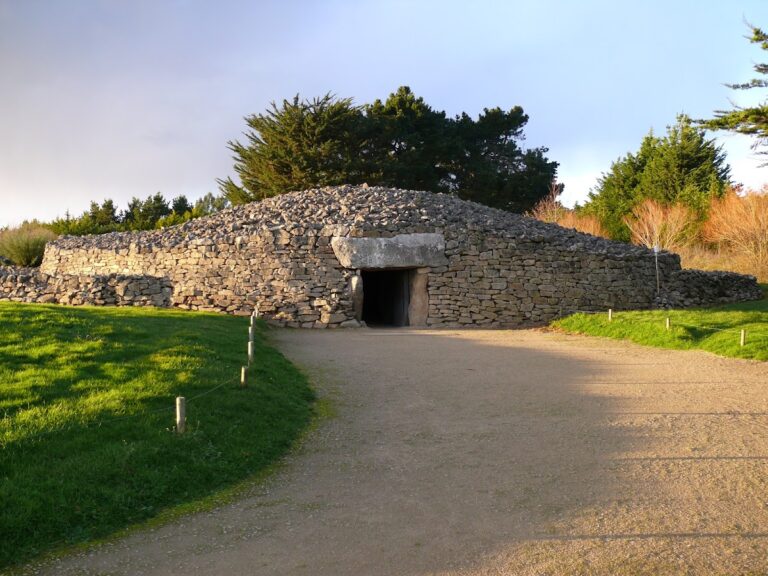
The Mané-Kerioned dolmens are three Neolithic megalithic tombs in Carnac, France, dating to about 3500–3300 BC. Each is a passage tomb, with an entrance passage leading to a burial chamber. Prehistorian Pierre-Roland Giot regarded their architectural form as among the oldest in Brittany.
The name Mané-Kerioned means “hill of the korrigans.” In Breton folklore, korrigans are small supernatural beings associated with dolmens as their homes; in this part of Morbihan, they were called Kerions.
Excavation and restoration
The site was excavated in 1866 for the Société polymathique du Morbihan, a learned society concerned with the region’s history and antiquities. At that time, the tombs were called Kiaval A, B, and C, and the group was investigated several times between 1866 and 1901. In 1889, it was classified as a Historic Monument both on its own and in a separate grouping with the neighboring dolmen of Kériaval.
Breton archaeologist Zacharie Le Rouzic restored the site in 1899 and 1901. Further restoration followed in the early 1920s. During work in 1922, Le Rouzic found a stone within the mound bearing two incised images of axes with handles.
Remains
Overall layout and construction
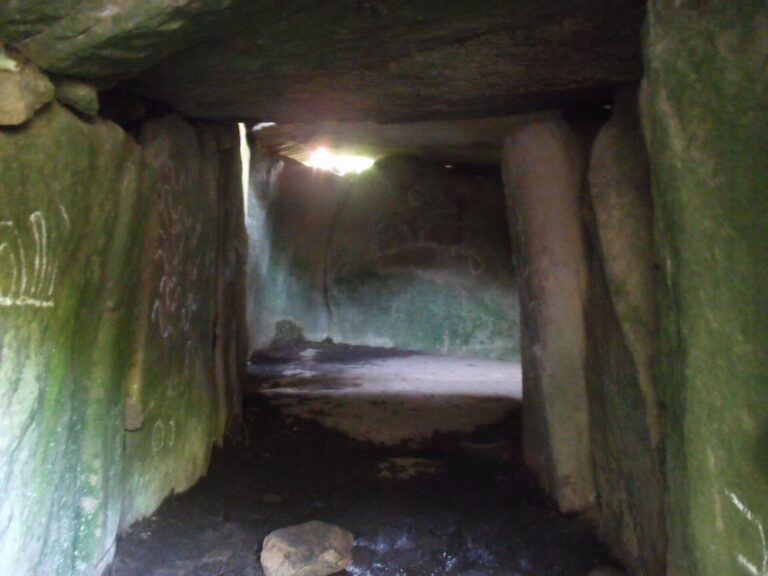
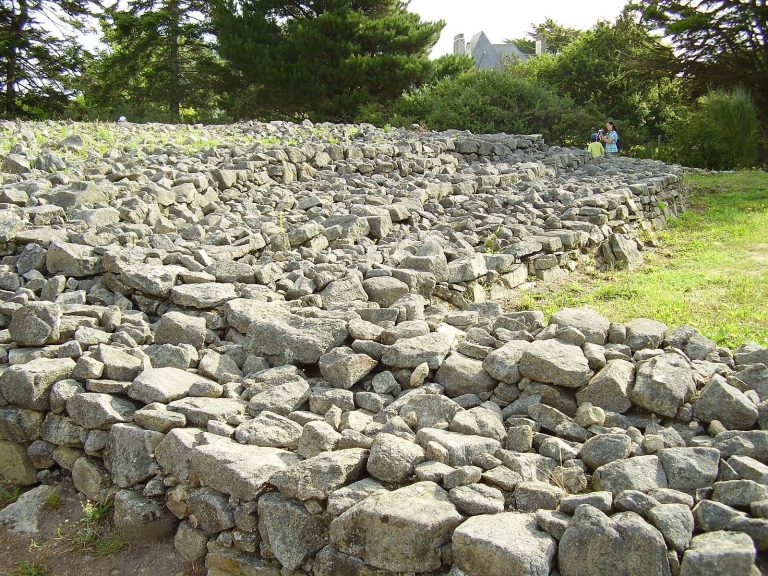
The three passage tombs were originally incorporated into one elongated tumulus, a mound raised over a burial or monument, whose base was bounded by large blocks. Before excavation, the tombs were almost entirely covered up to their capstones, the large stones laid across upright supports. Inside, the passage widens into a chamber without a sharply defined boundary, producing a roughly pear-shaped plan.
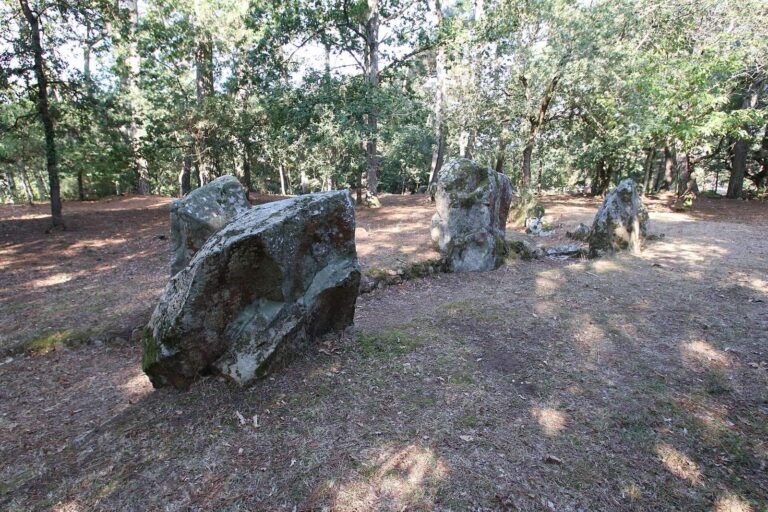
Dolmens A and B lie parallel to one another and open south. Dolmen C stands between them at right angles, with its entrance facing east. Three small standing stones are positioned west of the group. The eastern tomb is deeply sunk into the ground, while the western one rises above ground. The stones include pot-shaped forms and zigzag decoration, with comparisons made to the capstone at Table des Marchand and the carvings at Kercado.
Individual dolmens
Dolmen A
Dolmen A is built entirely of granite slabs. Thirteen upright stones support four capstones. The structure is 8.50 metres long, including a passage more than 6 metres long and averaging 1.60 metres wide. Its chamber is 2.30 metres wide and reaches 2 metres beneath the capstone. Rough paving of flat stones covers a bed of pebbles. Finds from A include abundant charcoal mixed with a thick layer of earth, pottery fragments, two pierced fired-clay beads shaped like spindle whorls, or weighted tools for spinning thread, and a small fibrolite axe. Other objects include five worked flints, an arrowhead, a quartz fragment, and a limestone stone containing fossil shells.
Dolmen B
Dolmen B is the largest of the three. It measures 10 metres long and has 24 upright stones supporting four capstones. Its roughly square chamber is about 3.35 metres on each side and 2 metres high beneath the capstone. Like A, its floor consists of flat stones laid over pebbles. Eight upright stones bear engravings. Bone fragments, a red quartz nodule, and two fired-clay beads were found here: one is pierced and reddish, while the other is polished and blackish.
Yellow and white coloring was noted in recesses of upright stones 16 and 17 in 1868. Chemical analyses in 2004 found that the coloring contained lead, zinc, and barium from modern materials. Abel Maître made casts of the engravings in 1866 for the National Archaeology Museum.
Dolmen C
Dolmen C has nine upright stones and three capstones. It is 6 metres long and 2.20 metres wide, with a height of 0.70 metres beneath the capstones. Three broad slabs cover its floor. Finds from this tomb include a few pottery fragments and a flint knife. The archaeological finds from the group are held in the collections of the Société polymathique du Morbihan.