Dolmen de la Pierre Godon: A Prehistoric Burial Monument in France
Site at a Glance
- Popularity
- Very Low
- Country
- France
- Primary era
- Stone Age
- Eras represented
- Stone Age
- Civilizations
- Unclassified
- Site type
- Burial
- Remains
- Tomb
On this page9 sections
History
Neolithic use
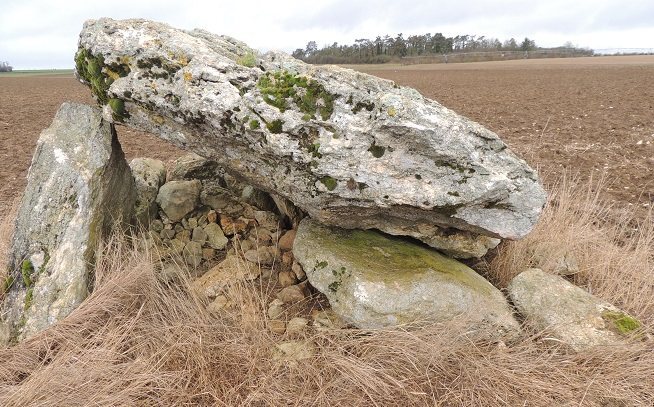
The Dolmen de la Pierre Godon is a prehistoric tomb in France, built from upright stones supporting a large capstone. Human remains and grave goods indicate that people used it from the Middle through the Final Neolithic, the later Stone Age associated with farming and settled communities. This use included the Bell Beaker phase, a prehistoric culture recognized partly through bell-shaped pottery and related objects. Bone fragments found outside the chamber produced an uncalibrated radiocarbon age of 2600 ± 150 BC, a raw estimate not adjusted using calibration data.
Discovery and protection
An archaeological survey of Eure-et-Loir described the dolmen in 1864. In 1975, its owner began leveling the mound and clearing the chamber, which was filled with stones. The discovery of human bones led to a rescue excavation beginning in 1976, followed by excavation work in 1976–1977. France classified the dolmen as a historic monument on 10 December 1979, providing formal legal heritage protection.
Remains
The tomb stands at the bottom of a small valley on a limestone plateau. An oval mound surrounds its slightly off-center chamber, which faces south-southeast. The chamber slabs are made of limestone and millstone; they may have come from the plateau edge about 50 metres to the northeast.
Chamber and mound
Burial chamber
The quadrangular chamber measures 2.10 metres long by 1.40 metres wide. Four upright slabs form its sides, with another at the rear, and a single large stone covers it. A sixth slab was found outside the structure, within the stone mound to the northeast.
Stone mound and construction
The oval mound measures 11.50 by 10 metres. Its stone-built cairn uses fairly large, squared blocks about 0.40–0.50 metres across, arranged in overlapping courses. Smaller stones fill the spaces, and small slabs cover the surface. Builders removed the loamy soil down to gravel and dug the settings for the upright slabs to the bedrock. The upright on the east-northeast side later collapsed inward, and frost fractured a slab on that side. These failures tilted the capstone and opened a gap beside the rear slab. A later feature was made east of the dolmen.
Burial remains and grave goods
Stones filled the chamber to a height of about 1.20 metres. Human bones were recovered both inside and outside it; most were broken, and few remained joined in their original anatomical positions. Long bones lay near the rear uprights, while two skulls rested side by side against the rear slab. The disordered arrangement suggests that bones were pushed aside to make space. The grave goods include flint arrowheads, blades, scrapers, a core and flakes; bone tools and worked animal remains; and ornaments such as a curved pendant, perforated canid teeth, mother-of-pearl beads, shells, and an amulet made from part of a human upper jaw. Pottery was also recovered, in small, fragmentary pieces.
Nearby prehistoric monuments
Other prehistoric monuments in the vicinity include the destroyed dolmens Pierre Cocharde and Pierre Peyrolle, and the Menainville burial mound. Two standing stones, or menhirs, were situated about 60 metres away, one to the northwest and one to the northeast. One has been destroyed; the other was moved to a neighboring hamlet.