Château de Beauclair: An Eighteenth-Century Estate in France


Site at a Glance
- Rating
- 5
- Popularity
- Very Low
- Country
- France
- Primary era
- Early Modern
- External website
- Open
- Eras represented
- Early Modern, Modern
- Civilizations
- French
- Site type
- Domestic
- Remains
- Elite Residence
On this page9 sections
History
Château de Beauclair is an eighteenth-century aristocratic estate in France, at Bezonville in the commune of Morville-en-Beauce, on the site of an earlier Gallo-Roman villa. Its principal construction was initiated by René-Charles-François de La Tour du Pin Chambly de La Charce and is dated to 1780.
From the Gallo-Roman site to the Chambly inheritance
The estate entered a documented line of noble ownership in 1558, when Jacques de La Barre, lord of Arbouville and an ordinary gentleman of the King’s Household, transferred it to Claude Bourdin, controller of the stables of King Henri II. Bourdin’s daughter Élisabeth married Édouard Le Coigneux, a councillor of the Parliament of Rouen. Through this marriage, the fief of Bezonville passed to the counts of Chambly, who also held the title of counts of Bosmont.
In 1741, Jacqueline-Louise, daughter and heiress of the last count of Chambly, married René-François-André de La Tour du Pin La Charce. Their marriage contract required their eldest son to take the Chambly family name and arms. Their only son, René-Charles-François, was born in 1746 and later began the principal building campaign that produced the present château.
Revolution and Restoration
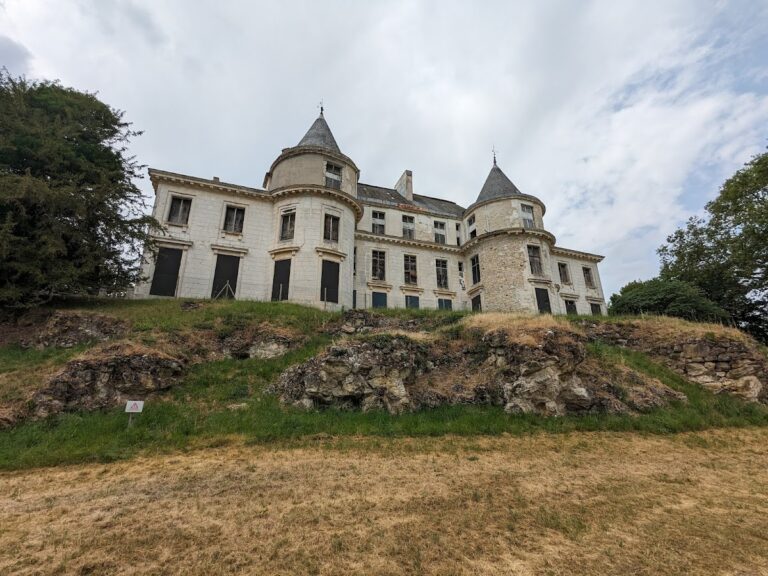
The French Revolution, the political and social upheaval that began in 1789, brought a violent interruption to the family’s possession. René-Charles-François was guillotined on 7 July 1794 during the Terror, the Revolution’s most violent phase, when revolutionary tribunals and executions were widespread. His son survived this period, but the château was partly burned.
Henry de La Tour du Pin Chambly de La Charce succeeded his executed father and rebuilt the estate’s service buildings, stables, and farm buildings during the Restoration, the period from 1814 to 1830 when the Bourbon monarchy returned after Napoleon’s fall. His son Berlion inherited the property, followed by Berlion’s son Henry in 1866. As Henry had no children, his brother Humbert later became the heir.
The Clermont-Tonnerre and Hadelin families
Humbert and his sister were connected by marriage to the Clermont-Tonnerre family. Their sister married Aynard de Clermont-Tonnerre, son of Gaspard de Clermont-Tonnerre, 5th Duke of Clermont-Tonnerre. Aynard later became a general and died at Bezonville in 1884.
Their daughter Gabrielle de Clermont-Tonnerre inherited the property in 1903. She had married Humbert Hadelin, Marquis of La Tour du Pin-Gouvernet, in 1883. Château de Beauclair remained among the descendants of this family until 2018.
Restoration and twentieth-century cultural history
In 2018, the château was transferred to Count de Rougé d’Aligre while it was in relatively deteriorated condition, and he began a large-scale restoration of the estate. On 7 April 2019, a fire engulfed the entire roof and burned approximately 300 square metres. By the end of 2022, the roof frameworks, all roof coverings, and façades had been reconstructed, and new gardens had been created. Under Count Aymeric de Rougé d’Aligre, the owner, the château was transferred to an events company in 2025.
Château de Beauclair also became associated with the French singer Johnny Hallyday, a major performer linked with French rock music. It was one of his regular residences in the late 1960s and early 1970s. A musician from his group rented the property from its owner so that Hallyday could work in seclusion, and a recording studio was installed in the dovecote. Songs including “Que je t’aime,” “Jésus-Christ,” and “La Musique que j’aime” were worked on there.
Remains
Château de Beauclair forms the central element of an estate at Bezonville in the Beauce natural region. The property combines the principal château with service buildings, a farm, stables, an orangery, barns, and a dovecote. The main building dates from the construction campaign associated with René-Charles-François de La Tour du Pin Chambly de La Charce in 1780, while many of the surrounding buildings were added during the Restoration.
The principal château
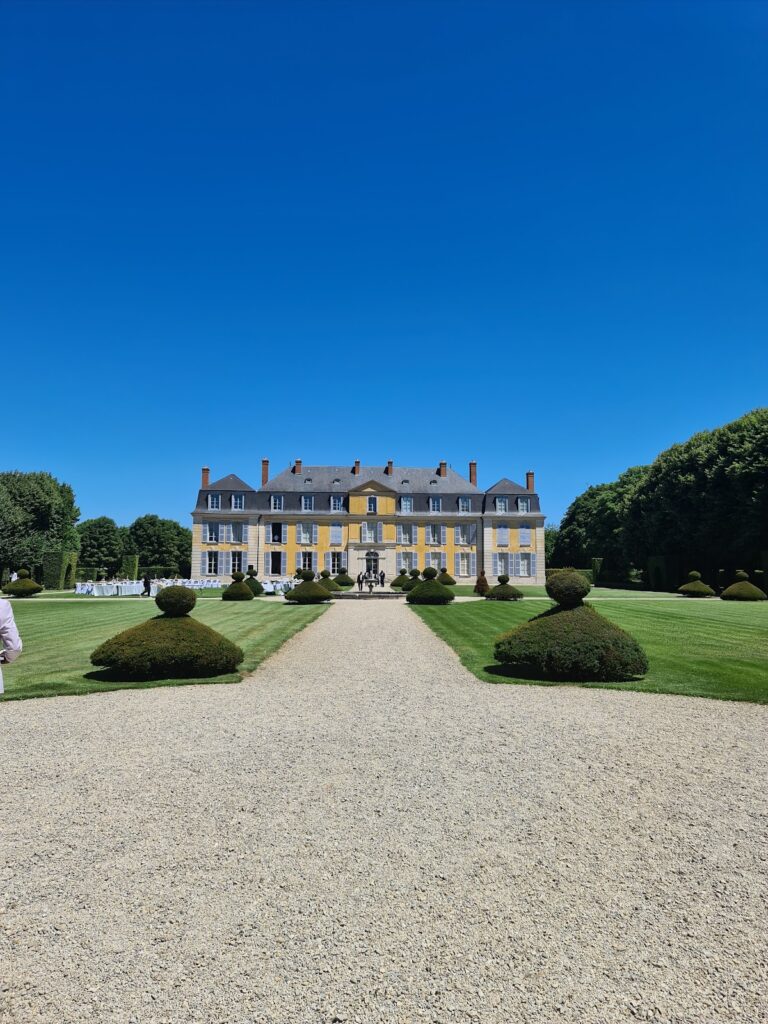
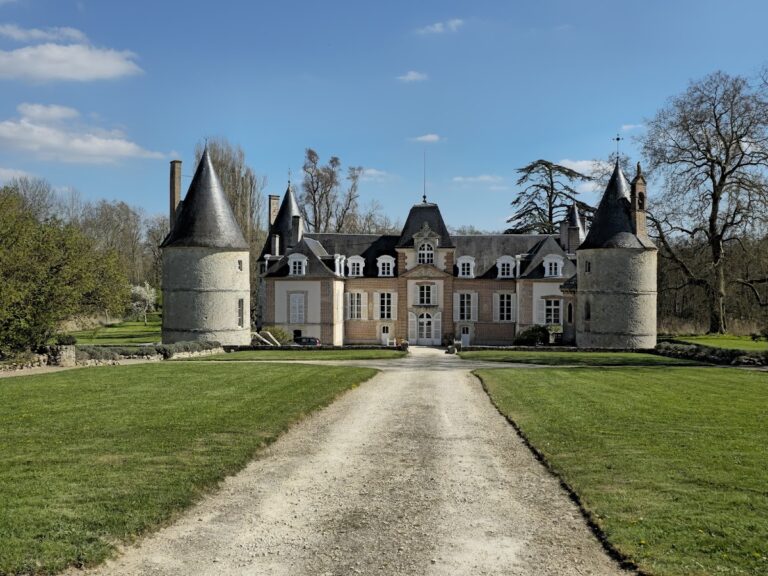
The château is the principal eighteenth-century structure of the estate. Its roof was rebuilt after the 2019 fire, which destroyed approximately 300 square metres of roofing. Reconstruction of the roof frameworks, roof coverings, and façades was completed by the end of 2022, restoring the principal exterior fabric.
Service buildings and agricultural dependencies
The service buildings, farm, stables, orangery, and barns were erected around 1820 during the Restoration. Their architecture displays a distinctly Italian influence, distinguishing these dependencies from the main eighteenth-century construction. The estate also includes a dovecote, a building designed to house pigeons. During Johnny Hallyday’s periods of residence, it was fitted out as a recording studio.
Formal and English-style gardens
The grounds contain a formal French garden on the north side and an English-style garden on the south side. Both were designed to correspond to the architecture of the monument, forming distinct landscaped settings on the two sides of the château.