Dolmen D45: A Funnel Beaker Passage Grave in Emmen
Site at a Glance
- Popularity
- Medium
- Country
- Netherlands
- Primary era
- Stone Age
- Eras represented
- Stone Age, Modern
- Civilizations
- Dutch
- Site type
- Burial
- Remains
- Tomb
On this page12 sections
History
Dolmen D45 is a passage grave in the Emmerdennen woodland east of Emmen, in the Netherlands. Built by the western group of the Funnel Beaker culture, a Neolithic culture named for its funnel-shaped pottery, it dates to 3470–2760 BCE. D45 is described as the third-largest dolmen in the country. A passage grave is a burial chamber reached through a narrower passage.
Nineteenth-century records and visits
D45 appears on a map made by Hottinger between 1788 and 1792. In 1809, King Louis Napoleon, ruler of Holland from 1806 to 1810, visited the grave with Petrus Hofstede, Drenthe’s landdrost, a regional administrative official. Hofstede hoped the visit would encourage the king to protect the province’s megalithic graves. A local tradition says Louis Napoleon stood on horseback on the largest capstone. Other folk explanations attribute dents in the stones to a giant’s fingers or thumb. The preacher Jacobus Craandijk recorded the horseback story in 1880. During the nineteenth century, Drenthe Province acquired D45 from people who held shared rights in Emmen’s common land.
Antiquities curator and scholar Leonhardt Johannes Friedrich Janssen visited in 1847 and included D45 in an overview of Dutch megalithic graves published the following year, with descriptions and schematic plans. In 1874, Willem Pleyte and photographer Jan Goedeljee made a systematic photographic record of surviving graves, including D45; Pleyte produced printed illustrations from the photographs. Three years later, Conrad Leemans visited Drenthe and commissioned plans from Jan Ernst Henric Hooft van Iddekinge, but Leemans’s report remained unpublished.
An inexpert restoration in 1870 and damage caused by demolition work in 1885 formed part of growing concern that restoration could alter the graves’ original appearance. The Society of Antiquaries in London, a learned society devoted to antiquarian and historical study, requested detailed records. In 1878, British antiquarians William Collings Lukis and Henry Dryden surveyed 40 graves, including D45, recording measurements, plans, sections, and watercolours. Their report was not published at the time. Drenthe archaeologist Wijnand van der Sanden published their work in 2015, alongside an introduction and an account of later research.
Archaeology and protection
Willem Johannes de Wilde recorded surviving Dutch megalithic graves between 1904 and 1906, but his records for D45 have been lost. Albert Egges van Giffen included the grave in his atlas in 1918 and investigated and restored it in 1957. D45 became a National Monument in 1983, a formal heritage-protection designation. In 2017, the Province of Drenthe and the University of Groningen, working with the Gratama Foundation, used photogrammetry, the creation of measurements and 3D models from photographs, to record D45 and the other surviving Dutch megalithic graves for a three-dimensional atlas.
Remains
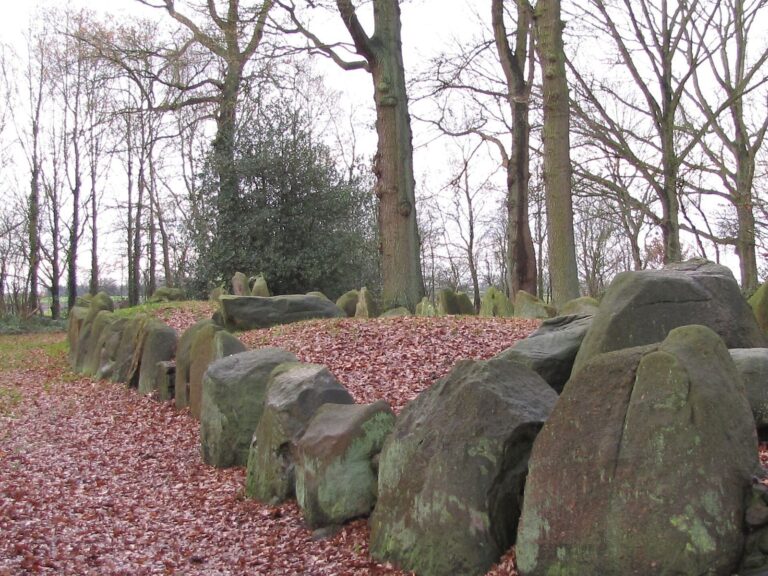
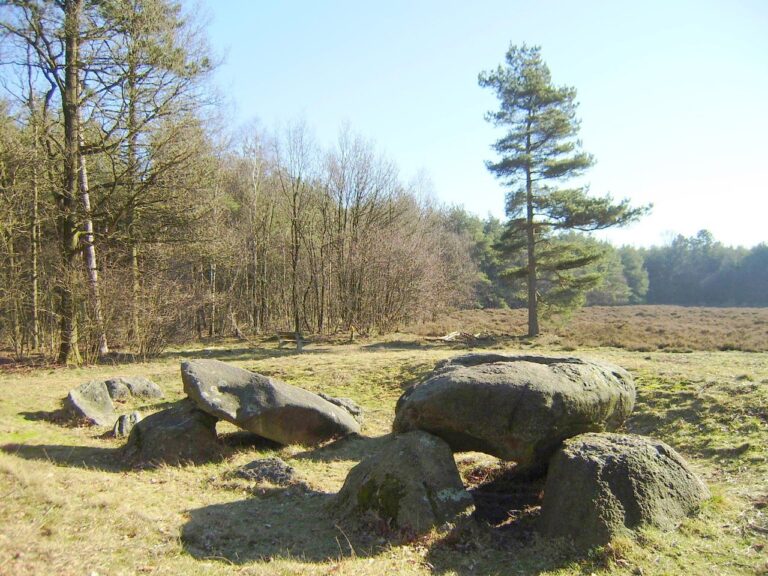
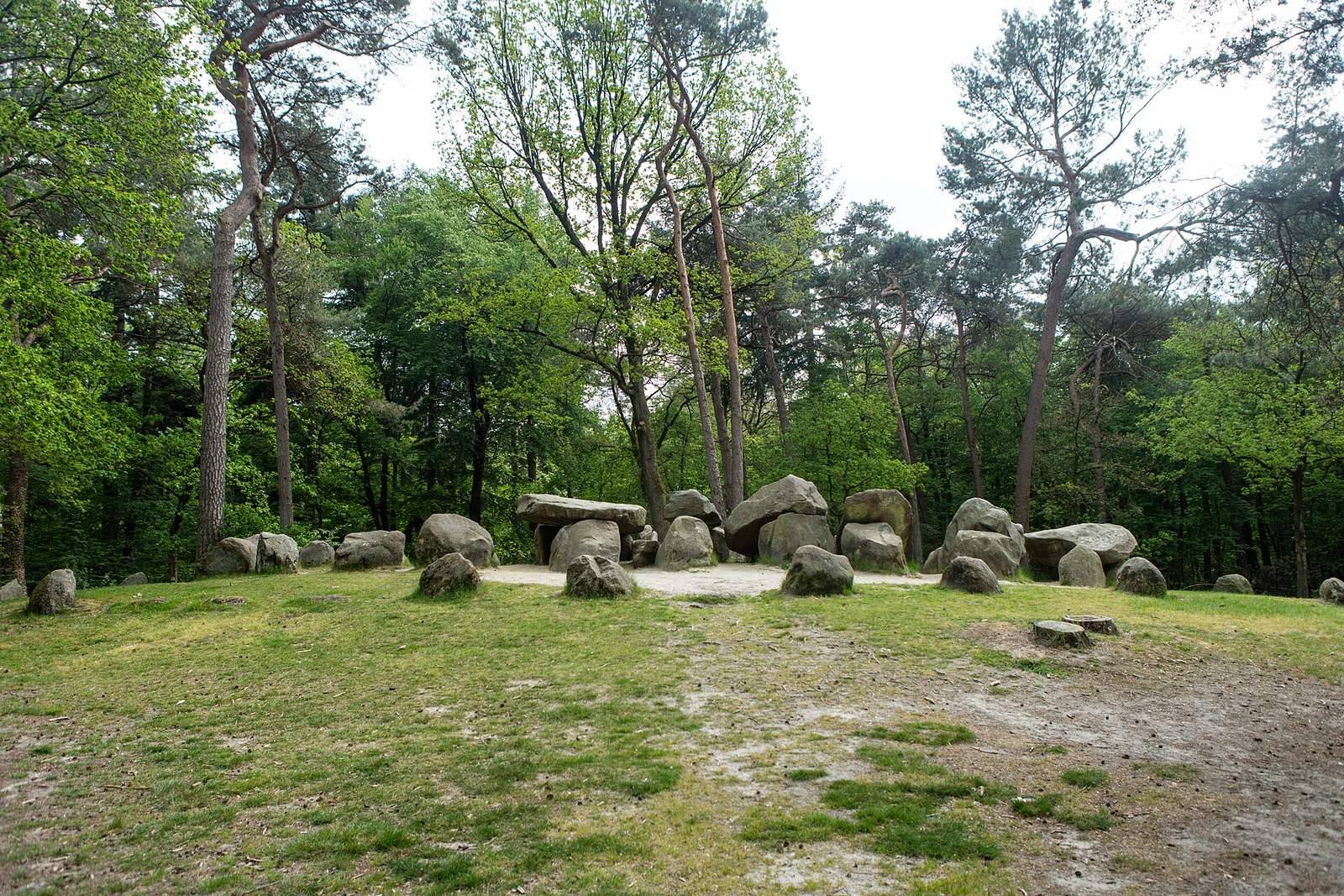
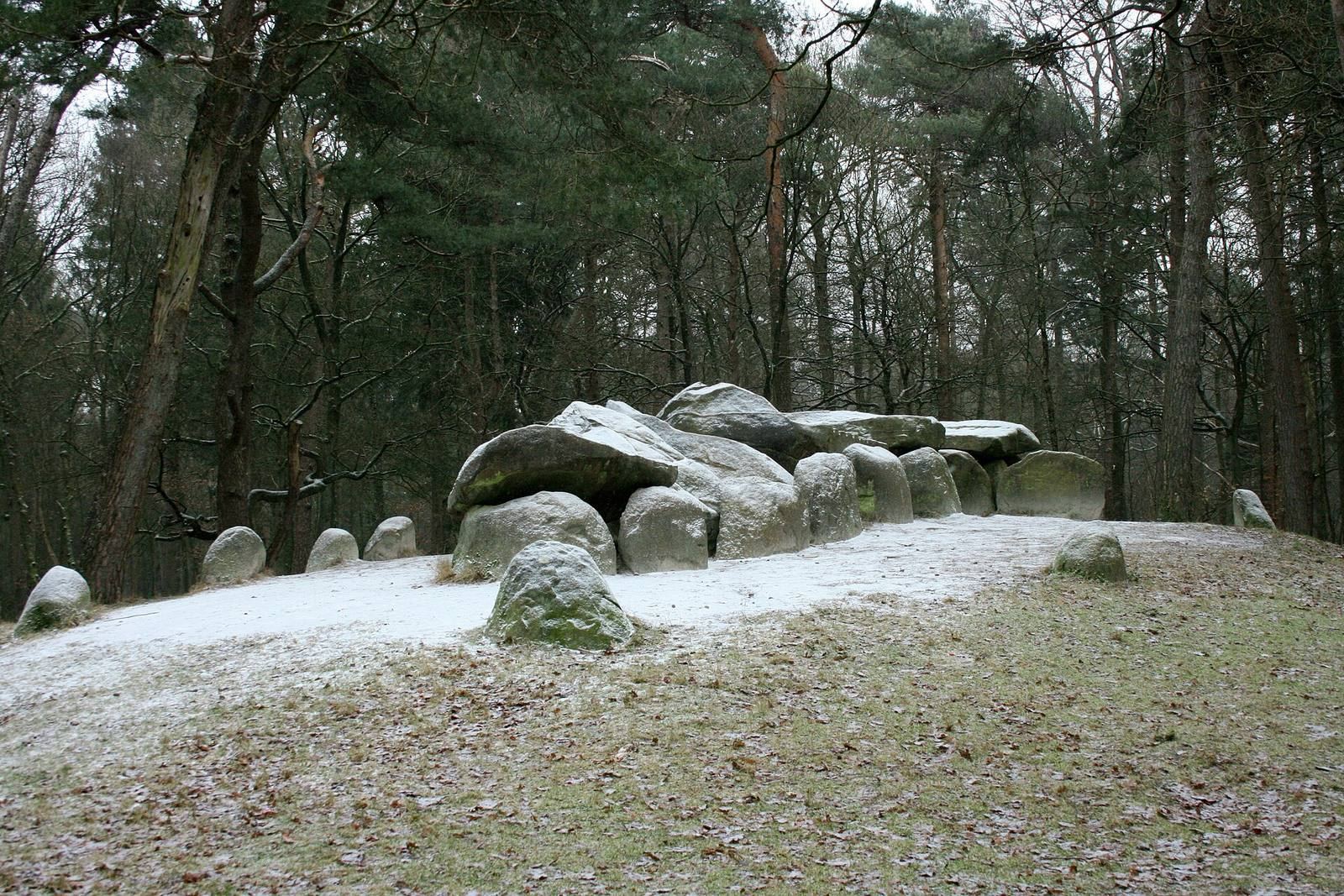
D45 is a large stone burial monument on a natural sand ridge that rises above the surrounding ground in the Emmerdennen woodland. Its long axis runs east-northeast to west-southwest. An oval arrangement of stones surrounds the elongated burial chamber, which had a narrower entrance passage on its southern side.
The surrounding group
D45 lies among other megalithic graves. D43 is 1.4 kilometres to the west and D41 is 1.8 kilometres west-northwest. D46 and D47 lie 2.1 and 2.3 kilometres east-southeast, while D44 and D42 are 2.5 and 2.6 kilometres west. D38–D40 are 2.5 kilometres to the north-northeast.
The chamber and entrance
Burial chamber
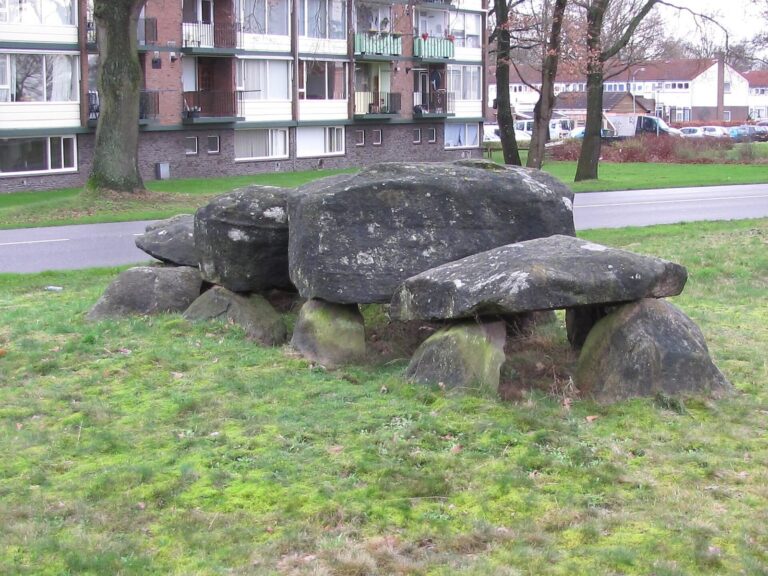
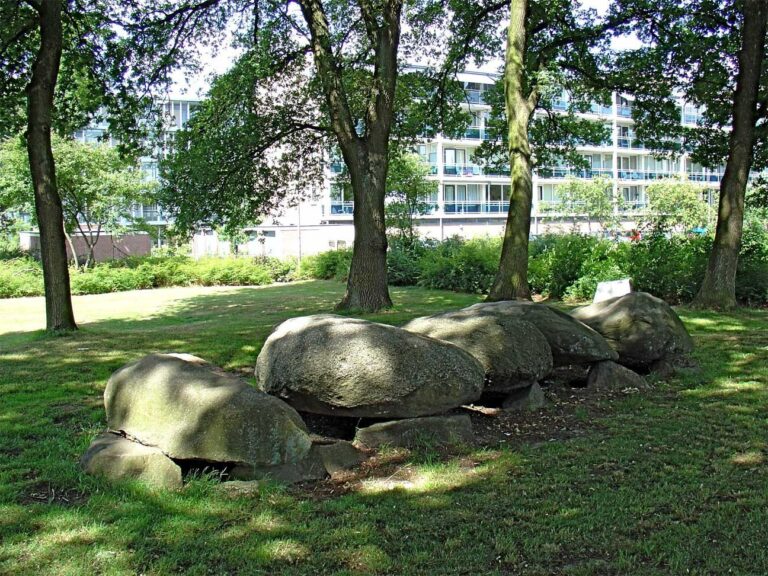
The oval chamber measures 18.5 metres long and 4.5 metres wide. Its north side has nine wall stones and its south side eleven; a separate count records 19 of the original 20 supporting stones as remaining. An end stone closes each short side, and both survive. Nine capstones originally covered the chamber. Six remain, while the three eastern capstones are missing. One surviving capstone has a line of holes. In 2011, a fire lit beneath a capstone the previous night split the stone; it was later repaired. The same capstone was found split again in 2025.
Entrance passage
The entrance stands at the centre of the chamber’s southern long side. It was probably approached through a passage formed by two pairs of wall stones. One passage stone survives, and concrete now fills the foundation hole for the opposite stone.
Oval setting and mound
Surrounding stones
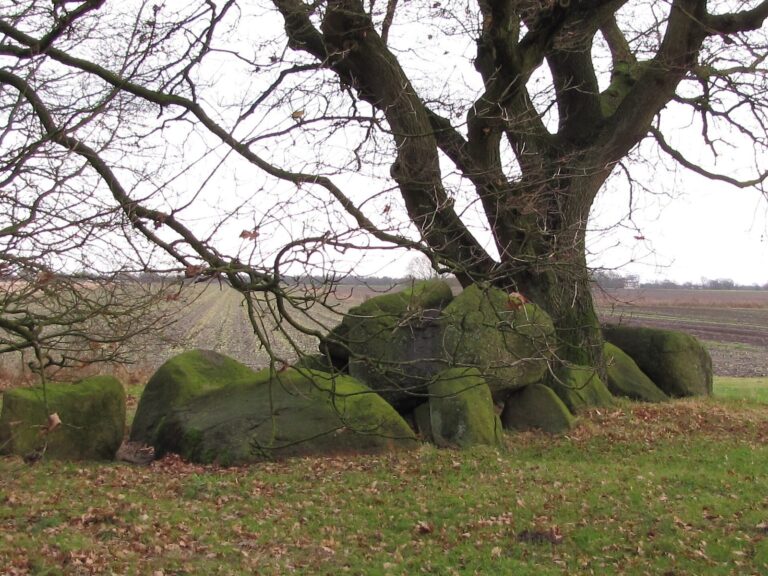
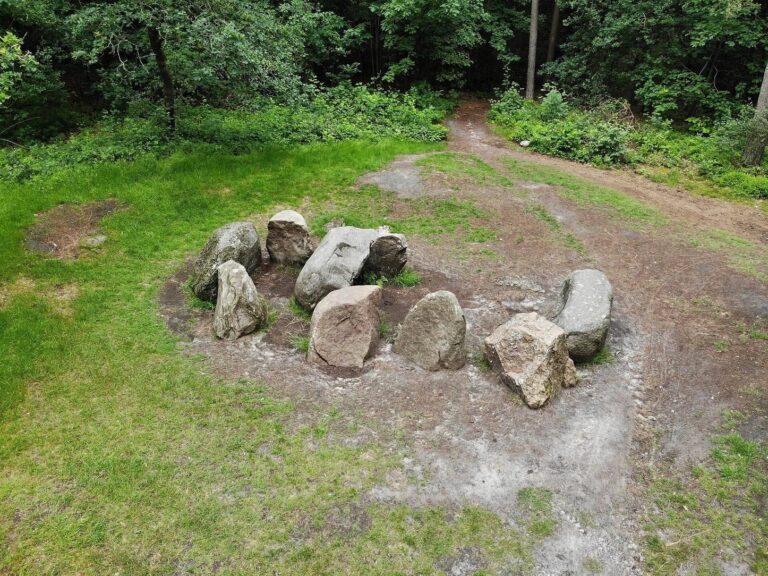
Thirteen stones remain in the oval arrangement, with 25 missing. During the 1957 restoration, the surviving stones were set upright again, and concrete was poured into the foundation holes of missing stones. Van Giffen’s reconstruction was disputed because some stones were stood upright in places where he had found no foundation holes.
Earlier condition
The 1878 survey described D45 as disturbed by stone quarrying. It noted that the three eastern capstones and the seventh capstone were missing; only the fourth capstone remained in its original position, and the other capstones had been moved. Many stones from the surrounding arrangement had also been taken away. The covering mound had recently been lowered, and stones had been gathered on the western side, probably for later transport.
Excavated remains
By Van Giffen’s investigation in 1957, the chamber had been completely emptied and its floor had disappeared. Recovered human cremation remains weighed 28.2 grams and belonged to one person whose age at death and sex could not be determined. Animal remains weighed 20 grams and included small quantities of burnt bone and an unburnt cattle bone. One fragment may have been used as a chisel.