Dolmen D43: A Neolithic Long-Grave Tomb in Emmen, Netherlands
Site at a Glance
- Popularity
- Low
- Country
- Netherlands
- Primary era
- Stone Age
- Eras represented
- Stone Age
- Civilizations
- Unclassified
- Site type
- Burial
- Remains
- Tomb
On this page15 sections
History
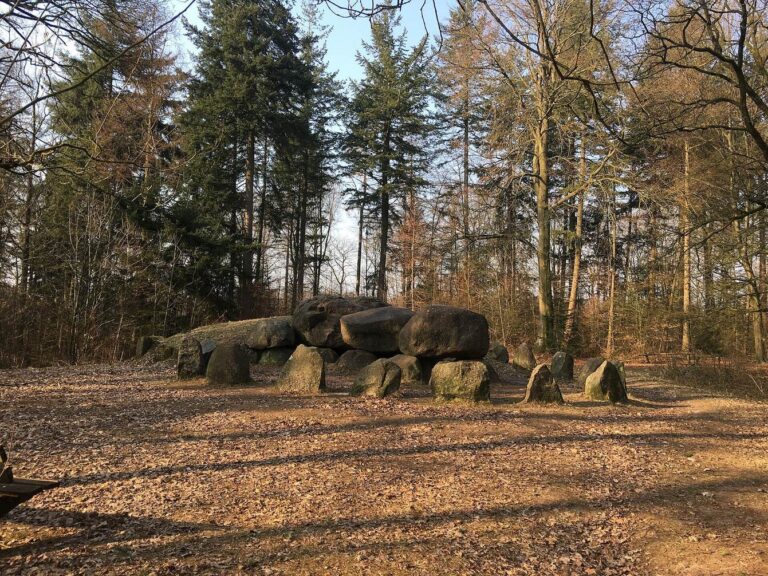
Dolmen D43 is a Neolithic long-grave tomb in Emmen, Netherlands, attributed to the western group of the Funnel Beaker culture. A long grave is an elongated megalithic burial monument built with large stones. D43 dates broadly to around 3000 BCE, with a more specific estimate placing it between 3470 and 2760 BCE. The Neolithic was the later part of the Stone Age, and the Funnel Beaker culture takes its name from its distinctive funnel-shaped pottery. D43 is the Netherlands’ only long-grave-type megalithic tomb.
Neolithic construction and use
The tomb developed in stages. After investigating it in 1913, Jan Hendrik Holwerda concluded that the northern chamber was built first, followed by the southern chamber and an enlargement of the surrounding stone ring. He also proposed a later extension of the ring several metres south. Albert Egges van Giffen later interpreted the ring as having begun on a smaller scale before being enlarged during a subsequent Neolithic phase.
Holwerda considered the ring’s southern end a later addition and thought some ring stones may once have served as chamber capstones. He also attributed an extension of the tomb by several metres to a restoration in 1850. Van Giffen disagreed that the entire southern end was modern, identifying only two stones as definite modern additions. Janssen proposed that a third dolmen stood within the ring, but Holwerda rejected that interpretation after his investigation. Burials continued occasionally into the Bronze Age, a later prehistoric period marked by the use of bronze.
Records, damage, and investigation
The monument appears on a map made between 1788 and 1792 and in bailiff reports from 1818. Janssen visited it in 1847 and included it in an overview of Dutch megalithic tombs published the following year. Earlier names for D43 included Bruyn Stien and De Grafkelders.
A nineteenth-century restoration was carried out poorly and may have contributed to the loss of nearby tomb D43a. In 1869, much of D43’s mound was removed without detailed recording. By then the tomb had become overgrown and farmers used it as a rubbish dump. Clearing the vegetation and debris also shifted stones, making their earlier positions difficult to determine. The Dutch state acquired the monument in 1870.
In 1878, William Collings Lukis and Henry Dryden surveyed D43 as part of a project prompted by concern that restorations were obscuring the original appearance of Dutch megalithic tombs. Their plan and watercolours recorded the monument’s condition. Drenthe archaeologist Wijnand van der Sanden published their work in 2015 and judged it to be of high quality.
Holwerda investigated D43 systematically in 1913. Van Giffen documented it in 1918 and excavated it in 1960; partial restorations followed in 1960 and 1997. His 1960 work identified three pits he interpreted as possible offering places, although their function remains uncertain. D43 became a Dutch National Monument, a protected heritage designation, in 1983. In 2017, photographs were used to create a three-dimensional record for an atlas of surviving Dutch megalithic tombs.
Remains
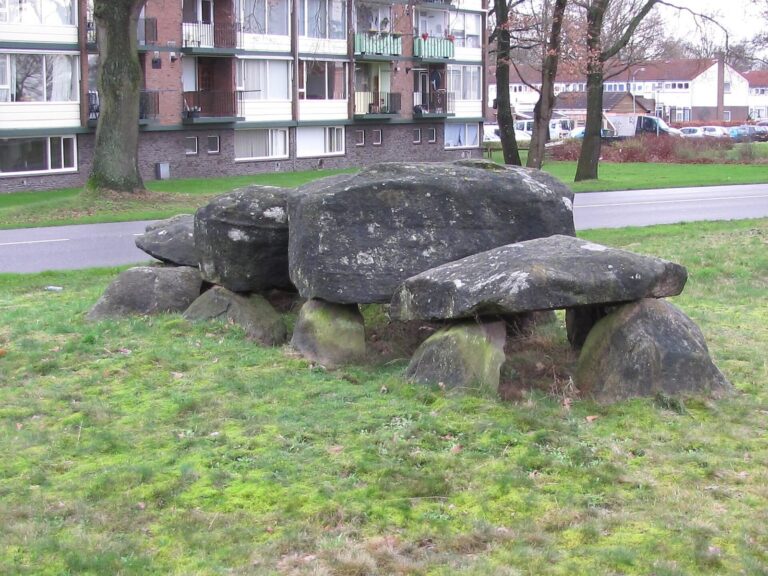
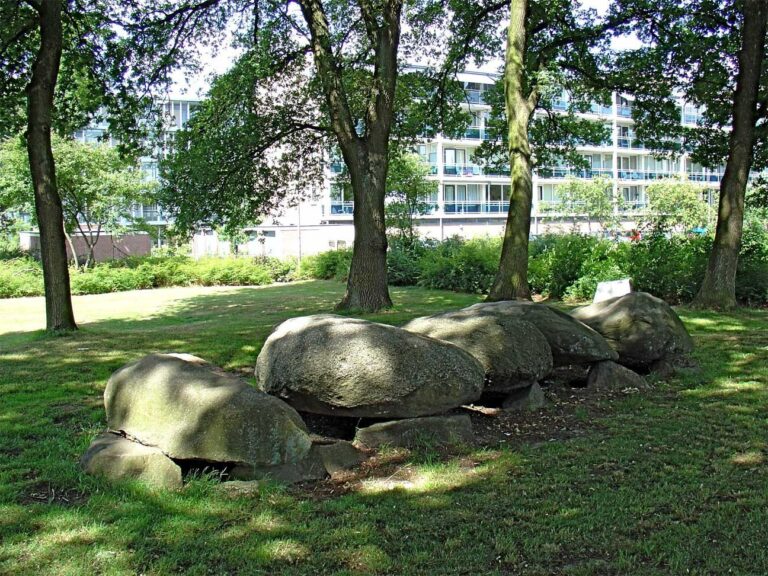
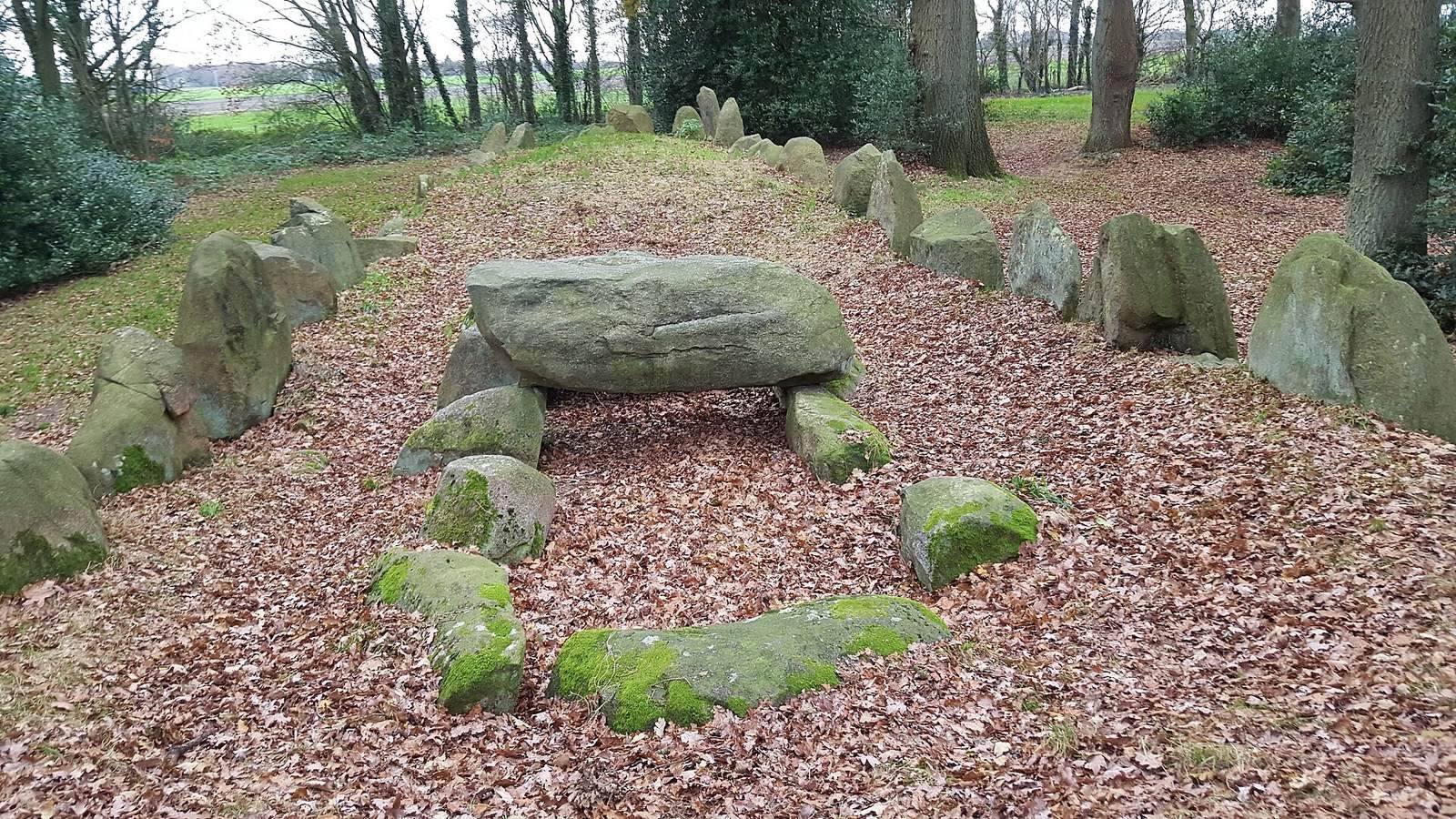
D43 lies behind the Nabershof museum farm in Emmen. Its elongated plan runs broadly from north-northeast to south-southwest. The slightly trapezoidal monument has rounded short ends and narrows from 7 metres across at the north end to 5 metres at the south.
Barrow and stone ring
Long barrow
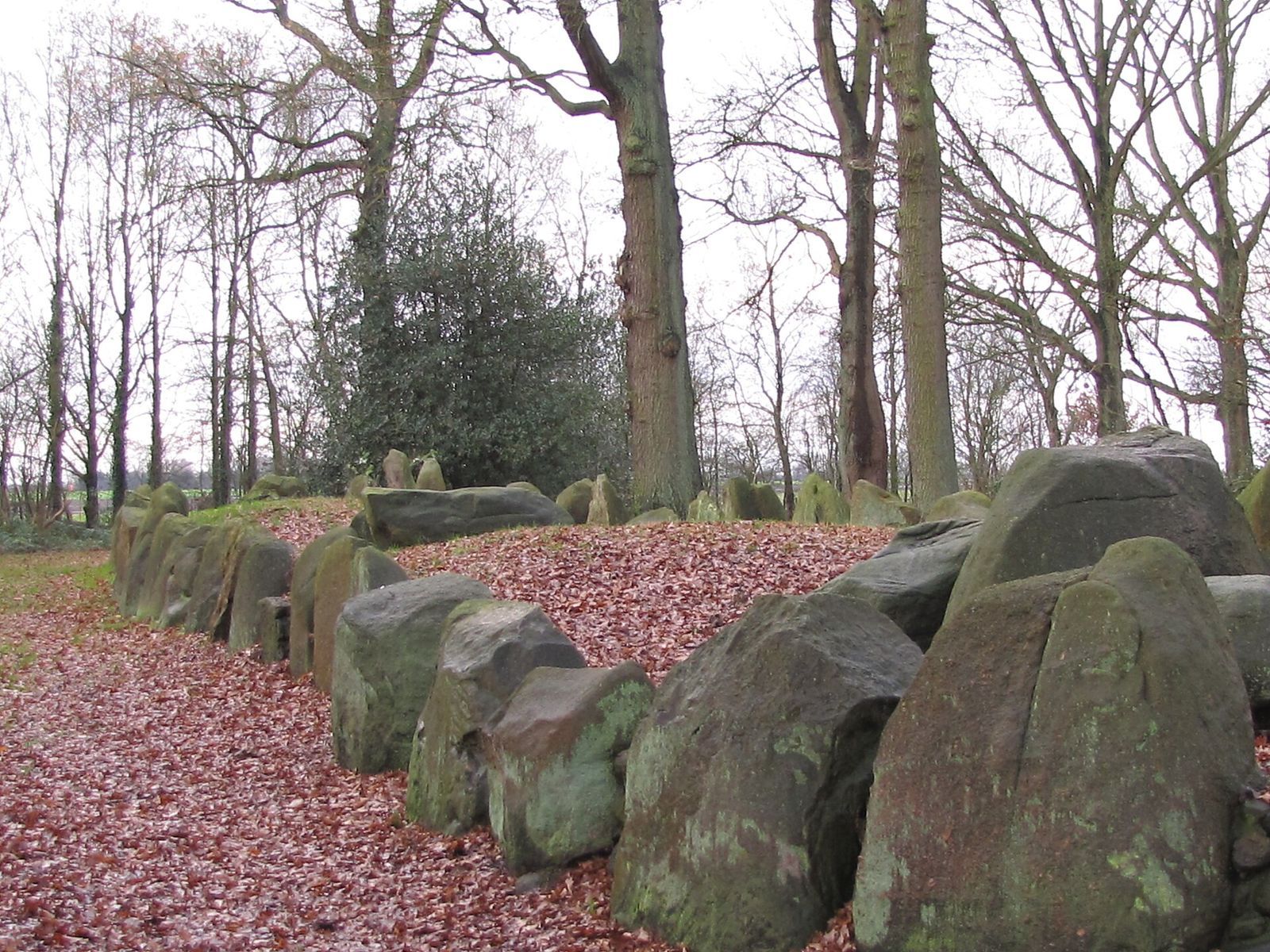
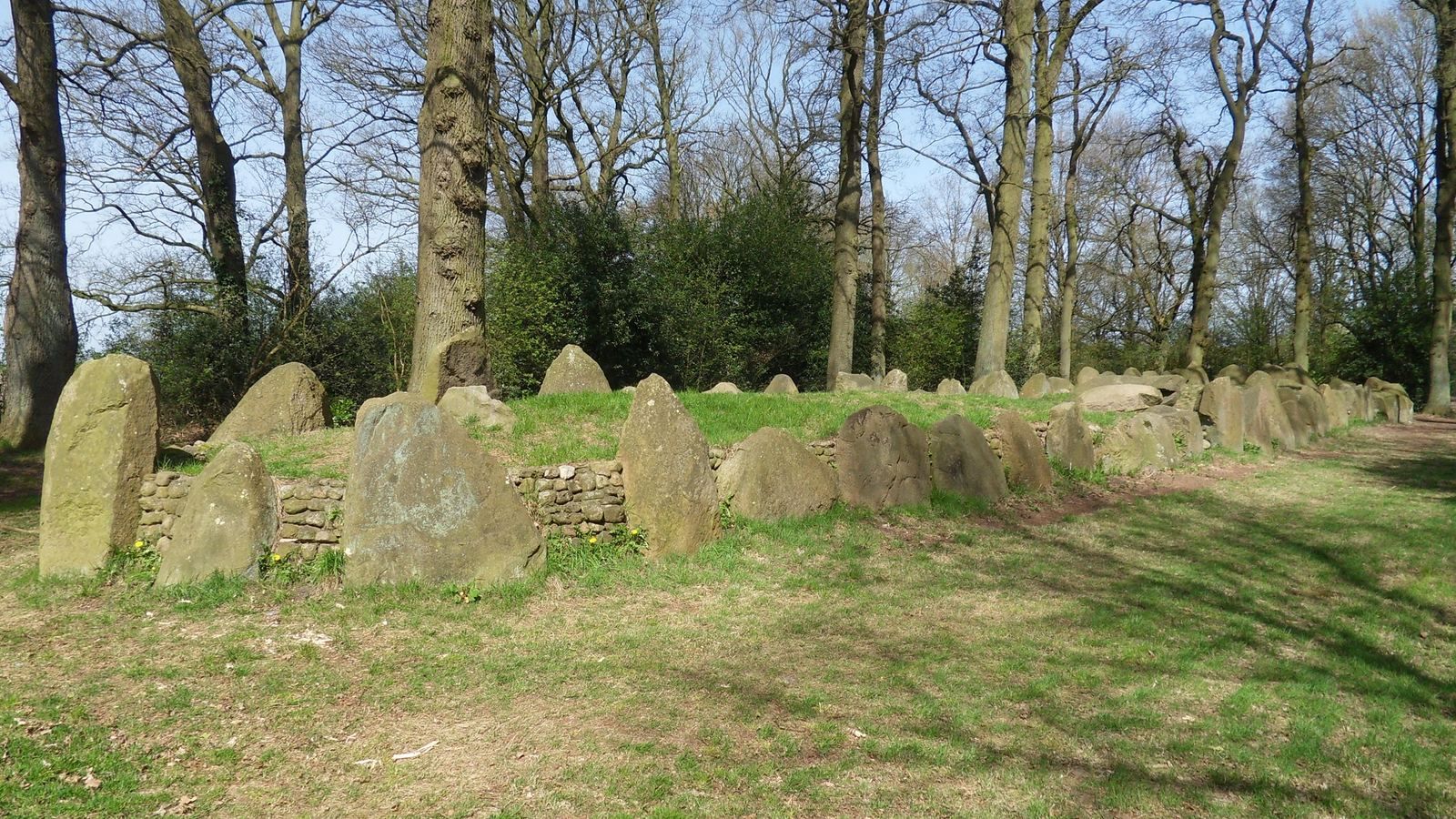
The long barrow measures about 40.3 metres in length. A mound once covered it, but the mound visible today was reconstructed in the twentieth century. Lukis and Dryden described a mound measuring 62 metres long and 14.5 metres wide.
Stone ring
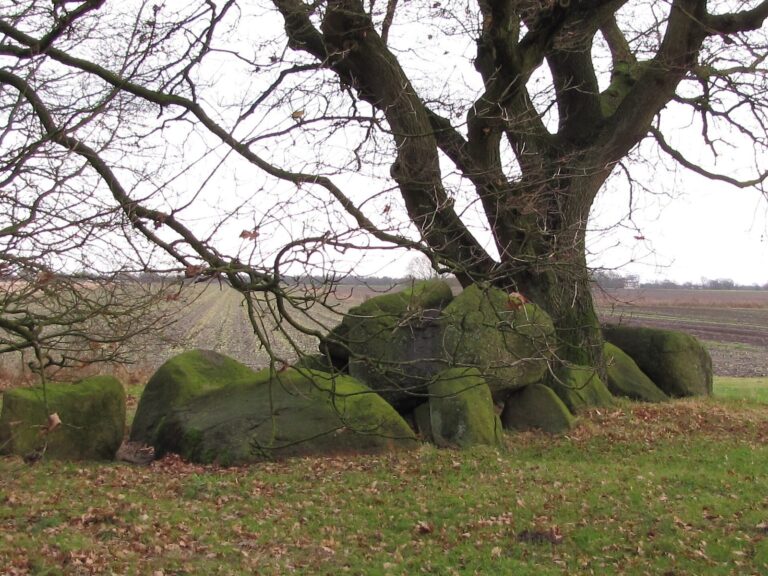
A ring of 53 stones surrounds the tomb, with the stones’ flatter faces turned outward. Small packing stones remain visible between them. The original gaps were filled with stonework laid without mortar, reconstructed after the 1960 investigation. Holwerda estimated that the ring originally rose about 1.5 metres above the surrounding ground. In places, the ring stones stand higher than the chamber floors.
Burial chambers
Northern chamber
The northern chamber measures 4.6 metres long, 3 metres wide, and about 1.5 metres high. Three pairs of stones form its long sides, with an end stone at each short end and three capstones above. During the 1960 restoration, the middle and northern capstones, which had been shifted northward, were reset on the chamber stones. The floor is paved with stone.
The entrance is on the eastern long side, between the first and second wall stones counted from the south. Two upright stones form a paved passage, 0.55 metres wide and 0.85 metres high, set about 0.6 metres above the chamber floor. A threshold stone marks the passage into the chamber. In their 1878 survey, Lukis and Dryden recorded one northern capstone in place and the other two displaced to the north.
Southern chamber
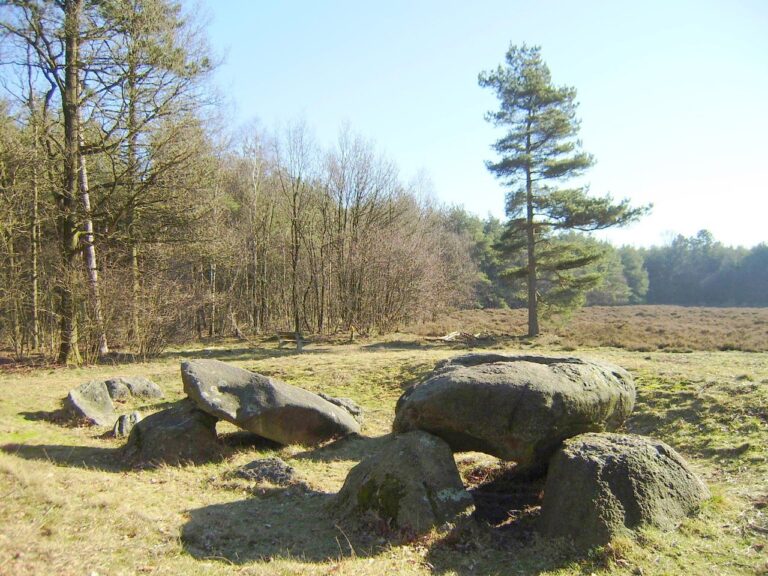
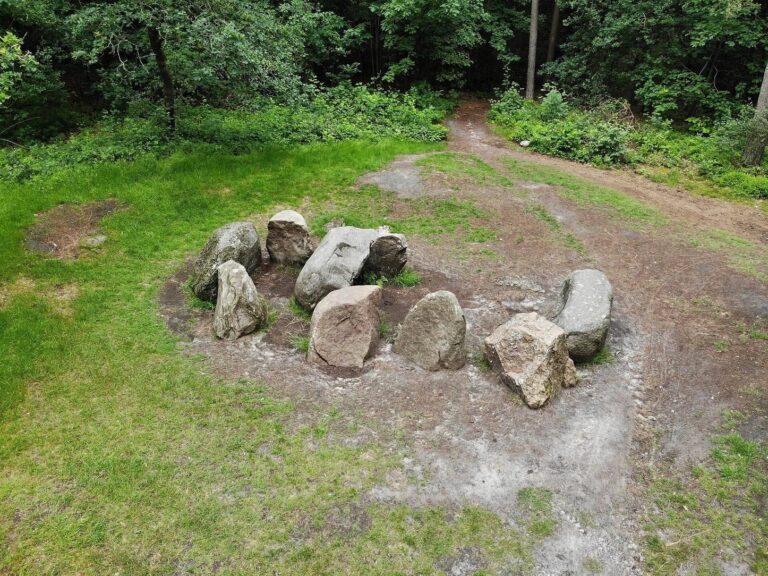
The southern chamber is 8.1 metres long and 2.9 metres wide. Five pairs of stones form its long sides, with an end stone at either end. Two of its five original capstones remain, and its floor was paved with stone. The entrance lies between the second and third wall stones counted from the south. Van Giffen discovered its passage, formed by two upright stones, in 1960. The chambers also have pairs of upright stones marking their entrances. Lukis and Dryden recorded the chambers as emptied; at their visit, one southern capstone remained in position and another lay inside the chamber.
Pits and finds
Pits
Holwerda investigated two pits measuring 2.2 by 1.65 metres and 3 by 1.4 metres. The first contained a few pottery fragments and possible pieces of burnt bone; the second was empty. Van Giffen found a third pit containing a few pottery fragments and a worked flint piece. Two pits lay outside the ring and were covered by pear-shaped stones taken from it. Those stones had already fallen in prehistoric times. The third pit is inside the ring as it stands today but outside its earlier boundary.
Northern chamber finds
Objects from the northern chamber included mainly large bulbous and cylindrical vessels, alongside fewer cups and bowls. Other pottery included fragments of a collared bottle, a vessel with a loop, a small pot, and a spouted bowl. The finds also included flint fragments, an unfinished axe, and an amulet made from a perforated fossil.
Southern chamber finds
The southern chamber yielded mainly bowls, cylindrical vessels, and funnel beakers with tall, flaring rims. Other pottery included small vessels with straight rims, bulbous pots, a collared bottle, and a small pointed pot with a straight rim and loops. Flint fragments and a small, narrow chisel were also found.
Other finds and collections
Other objects associated with the tomb include a stone hammer, fragments of a steep-sided beaker, an undecorated beaker, and a perforated trilobite fossil. Finds from Holwerda’s excavation are held at the National Museum of Antiquities in Leiden.