Dolm Church: A Romanesque Parish Church in Norway


Site at a Glance
- Rating
- 4.9
- Popularity
- Very Low
- Country
- Norway
- Primary era
- Medieval
- Eras represented
- Medieval
- Civilizations
- Norwegian
- Site type
- Religious
- Remains
- Church
On this page6 sections
History
Origins and parish role
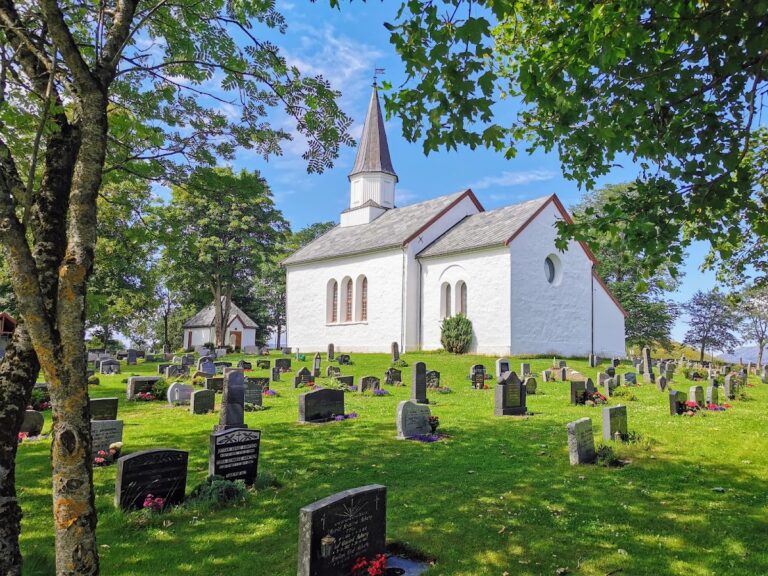
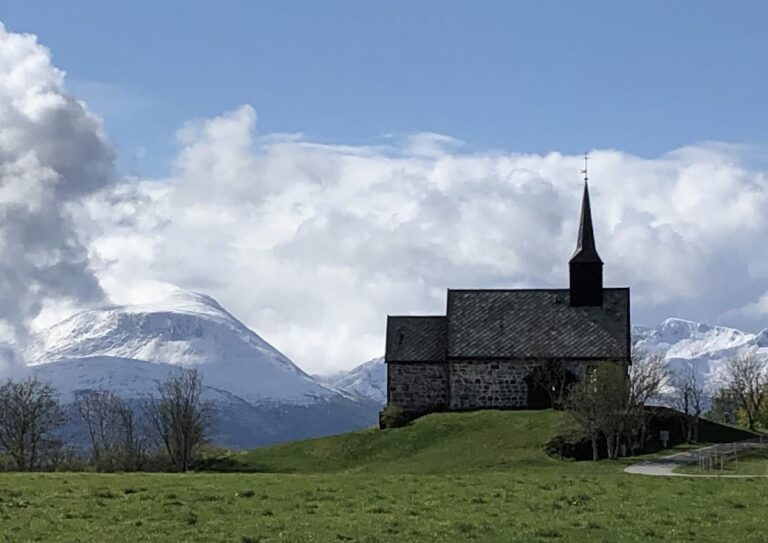
Dolm Church is a historic parish church in Norway, located at Dolmvarden on the southwestern coast of Dolmøya in Hitra Municipality. It is a white stone long church in the Romanesque style, a medieval architectural tradition known for massive masonry and rounded arches. The church is traditionally dated to around 1188 and is listed as having been consecrated at about that time, although its construction date remains uncertain. Another proposed dating places its construction in the late fifteenth century.
The church was formerly Catholic and is now Evangelical Lutheran within the Church of Norway. Local tradition attributes its construction to monks from Ireland, while the architect is unknown. For centuries, Dolm Church served as the main church of the Hitra parish district. The earliest surviving historical record of the building dates from 1774.
Fires and the change of parish centre
Dolm Church suffered fires in 1709, 1772, 1848, and 1920, and it was rebuilt after each event. The fire of 3 February 1920 led to a major change in the parish’s organization. Because most parishioners lived on the larger island of Hitra, the parish decided to establish a new main church across the strait at Melandsjøen, on Hitra’s north shore, about one kilometre away.
The decision was controversial. The parish agreed to rebuild Dolm Church and maintain it in exchange for the new church. Hitra Church was completed in 1927 and became the parish’s main church, while Dolm Church became an annex church, a secondary parish church used less regularly. Dolm Church is now part of Hitra og Fillan Parish in the Orkdal Deanery and Diocese of Nidaros, successive levels of the Church of Norway’s administration. It is also an automatically protected Norwegian cultural-heritage site.
The 1814 election
In 1814, Dolm Church served as an election church and polling station. An election church was a parish church where electors were chosen. These electors helped select representatives to the Norwegian Constituent Assembly, which met at Eidsvoll Manor and drafted the Constitution of Norway. Dolm Church therefore formed part of the local electoral process during the constitutional events of that year.
Remains
Stone church layout
Dolm Church has the form of a rectangular nave and a narrower chancel, arranged as a traditional long church. The nave measures approximately 19 by 14 metres, while the chancel measures about 9 by 10 metres and has a lower roof line. The building can accommodate about 200 people. Its Romanesque character is expressed through rounded arches and thick masonry walls, which are approximately 1.2 to 1.3 metres thick. These walls are thinner than those of many churches from the same period, a feature that has been cited in support of a later construction date.
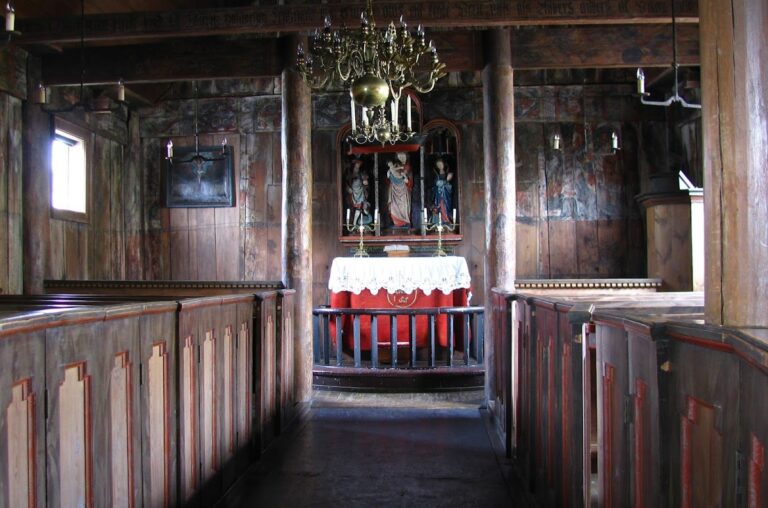
Although the main structure is built of stone, all of the gable walls are constructed of wood. The surviving building embodies the repeated rebuilding that followed the fires of 1709, 1772, 1848, and 1920, while retaining its stone long-church form and its relationship between nave and chancel.