Church San Lazzaro: A Lombard Romanesque Pilgrimage Church in Pavia, Italy


Site at a Glance
- Rating
- 4.2
- Popularity
- Very Low
- Country
- Italy
- Primary era
- Medieval
- Eras represented
- Medieval
- Civilizations
- Holy Roman Empire, Italian
- Site type
- Religious
- Remains
- Church
On this page11 sections
History
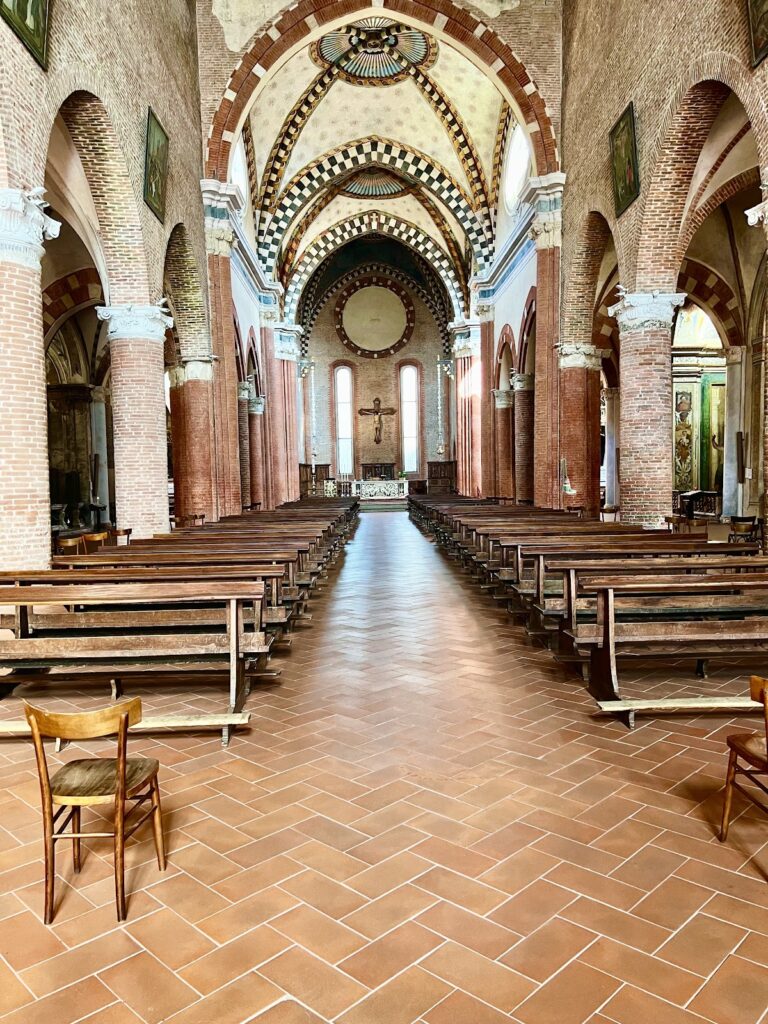
Church San Lazzaro is a Roman Catholic church in Pavia, Italy, built by the twelfth century in the Lombard Romanesque tradition beside the Via Francigena, the major medieval pilgrimage route linking western Europe with Rome. It served a hospital for pilgrims travelling to or from Rome and for people with leprosy, giving the church a religious and charitable role on the eastern outskirts of the city.
Foundation and Medieval Hospital
The church first appears in records in 1157, when the nobleman Gislenzone Salimbene and his sons, Siro and Malastrava, donated extensive lands to the church and the nearby hospital. In 1216, Folco Scotti, bishop of Pavia, established statutes for the hospital and defined its institutional organization.
The foundation continued to receive protection and privileges during the later Middle Ages. Gian Galeazzo Visconti granted it privileges and immunities in 1376, while Pope Martin V issued further privileges in 1426 and Pope Paul II did so in 1466. A pastoral visitation in 1460 noted that the hospital had four beds, with two reserved for people with leprosy.
War, Commandery, and Parish
The complex was caught up in the siege and Battle of Pavia in 1525, when the troops of Francis I, king of France, occupied it and caused considerable damage. In 1565, Pope Pius IV made the hospital a commandery of the Order of Saint Lazarus of Jerusalem. A commandery was an endowed administrative establishment of a religious or military order, headed by a commander. Giuseppe Salimbene became its first commander.
In 1572, the Order of Saint Lazarus was united with the Order of Saint Maurice, forming the Order of Saints Maurice and Lazarus. The church became a parish in 1571, but Bishop Ippolito de’ Rossi suppressed that status in 1581 and united the church with the parish of San Pietro in Verzolo. Church San Lazzaro remains dependent on that parish.
Remains
Exterior Architecture
Facade and North Side
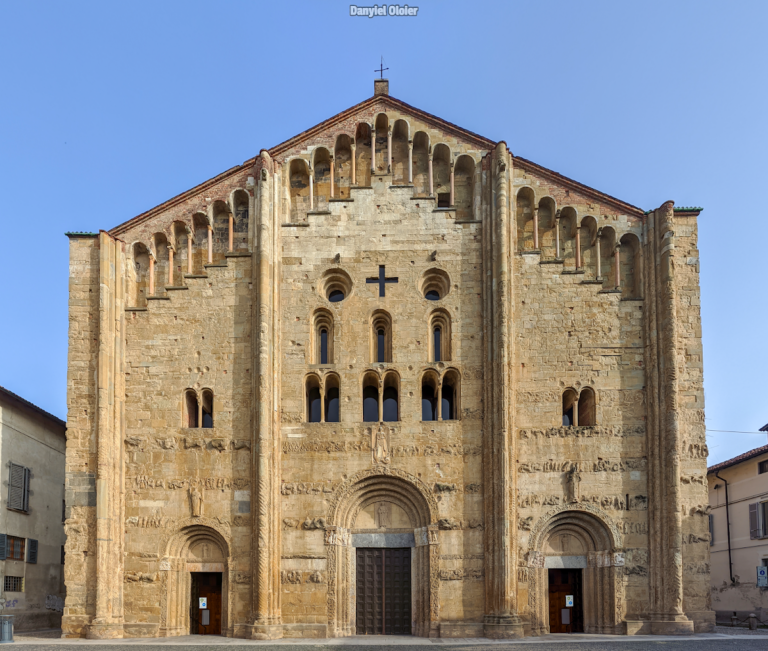
The small church is a unified brick building and a single-nave example of Lombard Romanesque architecture, the northern Italian Romanesque tradition known for brick construction and arcaded decoration. Its facade includes a blind loggia, an arcade whose openings do not lead to an accessible gallery, carried by small columns. A small gallery rises along the gable, while thirteenth-century Byzantine ceramic dishes decorate the facade.
Some capitals of the mullioned window above the portal date from the Carolingian period, the era of the Carolingian dynasty between the eighth and tenth centuries. A mullioned window is divided by vertical supports called mullions. The decoration of the blind loggia continues along the north side, where a second portal opens.
Roof Structure
The roof is covered with tiles and supported by a wooden frame. Restoration work in 1932 replaced part of this frame, leaving the building’s medieval brick construction combined with a partly renewed structural element.
Interior and Artworks
Apse Frescoes
Fragments of frescoes survive inside the church, especially in the apse, the usually semicircular or polygonal end of a church behind the altar. The paintings date from the first half of the thirteenth century and preserve evidence of the interior’s medieval decoration.
Altarpiece
The original altarpiece was a triptych made in 1576, measuring 245 centimetres high and 195 centimetres wide. A triptych is an artwork formed from three adjoining or hinged panels. Its central panel shows the Madonna and Child enthroned, while the side panels depict Saint Lazarus as a bishop and Saint Maurice in armour holding a banner. The work is now held by the Musei Civici del Castello Visconteo in Pavia.
Archaeological Evidence
Nineteenth-century discoveries in the area revealed Roman-period remains, including a granite altar dedicated to Jupiter and dated to the second century AD. The altar is preserved at the Pavia seminary, linking the setting of the medieval church with earlier religious activity in the surrounding area.