Diedrichsburg: A Nineteenth-Century Castle Revival in Germany


Site at a Glance
- Rating
- 3.9
- Popularity
- Very Low
- Country
- Germany
- Primary era
- Modern
- Eras represented
- Iron Age, Modern
- Civilizations
- German
- Site type
- Domestic
- Remains
- Castle
On this page7 sections
History
Diedrichsburg is a nineteenth-century castle imitation in Melle, Germany, built from 1844 to 1860 in Neo-Gothic and Neo-Romanesque forms during the Historicist revival of medieval architecture. General Ernst Freiherr von Vincke commissioned the building, and his son-in-law, Count Werner von der Schulenburg-Wolfsburg, oversaw its completion. The architect was Emanuel Quaet-Faslem, a royal Hanoverian building councillor from Belgium who worked in Nienburg/Weser.
Construction and nineteenth-century use
The building reflected Historicism, a nineteenth-century movement that revived and combined forms associated with earlier periods. Its medieval appearance made it a popular excursion destination even during the nineteenth century. The von Vincke family, which commissioned the building, held and continues to hold a seat at the nearby Ostenwalde estate.
On 16 May 1909, a fire destroyed the timberwork and staircase inside the tower. Diedrichsburg was not inhabited or operated again until 1954.
Legend and the earlier fortification
An Iron Age fortification stood on the summit of the Meller Berg before Diedrichsburg was built. Its remains had long been known, but they were not investigated until a later change to the woodland made examination possible. In 2007, the storm Kyrill felled much of the forest on the summit. Soil exposed in the root plates of uprooted trees enabled archaeologists to study the ancient remains.
Local tradition connects the name Diedrichsburg with Dietrich von Ringelheim, also called Diedrich, Thiadrich, or Theoderich. He was a Saxon-Westphalian count of the Immedinger family and a great-grandson of Widukind. The same tradition identifies the site with a fortress called a “Teutoburg,” described as a people’s fortress and regarded as the source of the name Teutoburg Forest. Dietrich is said either to have founded the fortress or to have lived there.
According to this tradition, Dietrich’s daughter Mathilde may have been born at the fortress around 892 and spent her childhood there. She later became the wife of the German king Henry I and the mother of Otto the Great, who became emperor. The historical basis of these traditions remains uncertain, and they may have been created as a pseudo-historical background for the nineteenth-century building.
Twentieth-century damage and later use
In 1963, the von Vincke family established a game enclosure around Diedrichsburg. The resulting Diedrichsburg Wildlife Park covered more than 200 hectares and included the prehistoric fortification within its grounds. The wildlife park was dissolved in 2021, while the surrounding grounds remain an excursion destination in the region and form part of the TERRA.vita Nature Park, which encompasses natural and cultural landscapes in northwestern Germany.
Severe vandalism damaged Diedrichsburg in 1983. From that year, renovation and subsequent operation, beginning on 1 July 1985, were undertaken by the Melle-Mitte Beautification and Transport Association.
Remains
Diedrichsburg stands at an elevation of 219 metres on the summit of the Meller Berg in the Meller Hills, in Osnabrück district, Lower Saxony. The building is arranged around a tall central tower with two low side wings, creating a nineteenth-century interpretation of a medieval fortified residence. The nearby Iron Age enclosure survives in the surrounding ground as an archaeological earthwork.
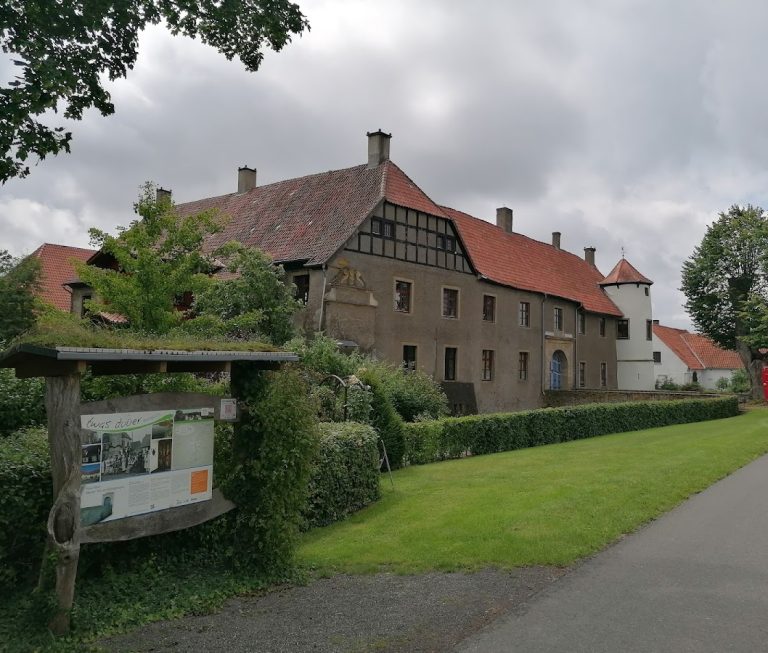
Diedrichsburg
The central tower rises 26 metres and imitates a bergfried, the main defensive tower of a medieval castle. It is crowned by a battlemented viewing platform. Two single-storey wings flank the tower and are modeled on a palas, a castle’s principal residential or representative hall. Together, these elements express the Neo-Gothic and Neo-Romanesque design of the building.
The tower platform is accessible and offers views across the city of Melle and the surrounding countryside. After Kyrill broke or uprooted much of the woodland in 2007, the extent of the view increased. The building now contains a restaurant for excursion visitors and is used for occasional events. A room in the tower contains an exhibition about native animal and plant life in the region.
Iron Age fortification
The prehistoric enclosure occupies 3.4 hectares on the Meller Berg. Its ring wall, a defensive boundary formed by a continuous bank or comparable enclosure, survives as an embankment and a terrace edge. The fortification extends for approximately 300 metres and measures between 100 and 125 metres in width.
Radiocarbon dating of grain kernels places the fortification around 300 BC. Ceramic sherds associate it with the pre-Roman Iron Age, the period of iron-working societies before Roman conquest or direct Roman presence in the region, especially during the second and third centuries BC. Red-fired stones found in the ground, including stones exposed earlier by wild boar, suggest that the enclosure may have been destroyed by fire.
The evidence has been compared with the nearby Schnippenburg and other fortifications in the Teutoburg Forest. On that basis, the Meller enclosure may have used timber and earth with an unmortared stone frontage. This proposed arrangement is an analogy-based interpretation rather than a directly documented reconstruction.