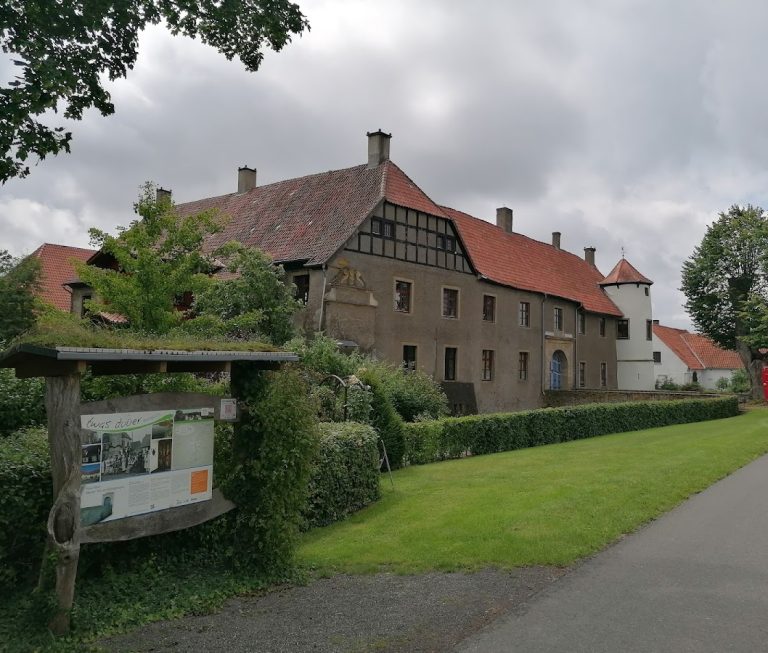
Gut Ostenwalde: A Late-Medieval Knightly Estate and Water Castle in Germany


Site at a Glance
- Rating
- 4.8
- Popularity
- Low
- Country
- Germany
- Primary era
- Early Modern
- External website
- Open
- Eras represented
- Medieval, Early Modern, Modern
- Civilizations
- Holy Roman Empire
- Site type
- Domestic
- Remains
- Castle
On this page12 sections
History
Gut Ostenwalde is a late-medieval knightly estate and lowland water castle in Germany, north of Melle in Lower Saxony, in the historical region of Westphalia. It probably began as a defensive stronghold protecting an older fortified settlement on a hilltop. The estate became the ancestral seat of the noble von Vincke family and developed into the three-wing manor complex seen today.
Medieval origins and the von Vincke family
Members of the von Vincke family served the bishop of Osnabrück as ministeriales from 1223. A ministerialis was a medieval service noble who carried out administrative or military duties for a territorial or ecclesiastical ruler and could rise to noble status. Ostenwalde was recorded in 1343 as the seat of Omer Vincke, a member of the family associated with the estate.
The von Vinckes remained closely connected with regional government and were continuously represented in the state parliament. The family still owns Gut Ostenwalde, preserving the estate’s role as its ancestral seat.
Building phases
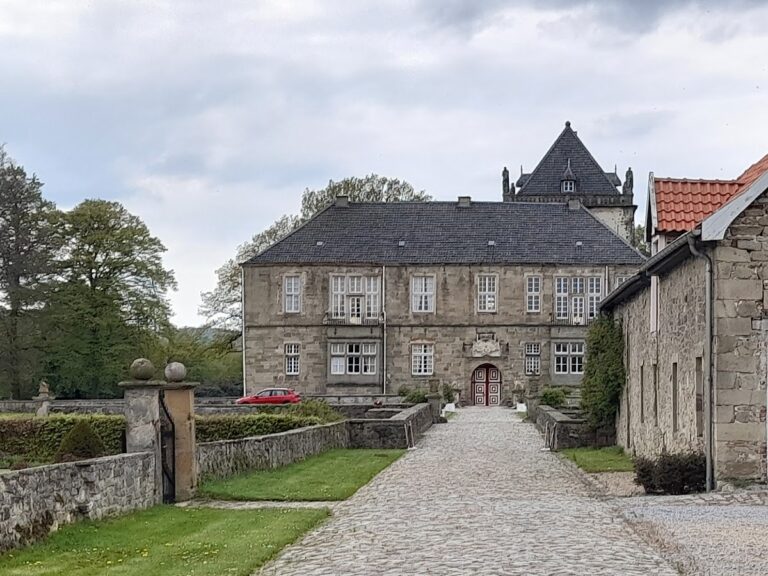
The present manor house emerged through several stages. The west wing dates from 1698, while the central section was completed in 1780. The east wing was restored between 1906 and 1908. During that work, the foundations of an earlier building and an adjoining tower were uncovered, and a tower was added at the bend of the building.
Postwar political role
From the summer of 1945 until 1949, the manor house served as the official residence of the British military governor of the British Zone, the part of occupied postwar Germany administered by the United Kingdom. Field Marshal Bernard Montgomery lived there until May 1946. General Brian Robertson occupied the residence from November 1947 for approximately two years.
The British occupation also had a lasting cost for the estate: a substantial part of the family archive kept at Gut Ostenwalde was lost. On 9 May 1949, the day after the Basic Law was adopted, British Foreign Secretary Ernest Bevin met at Gut Ostenwalde with Konrad Adenauer, Kurt Schumacher, and Karl Arnold. Adenauer later became the first Federal Chancellor of West Germany, while Schumacher was a leading Social Democratic politician and Arnold was a Christian Democratic politician and minister-president of North Rhine-Westphalia. Bevin served as Britain’s Foreign Secretary from 1945 to 1951.
Remains
Main castle
Moats and bailey
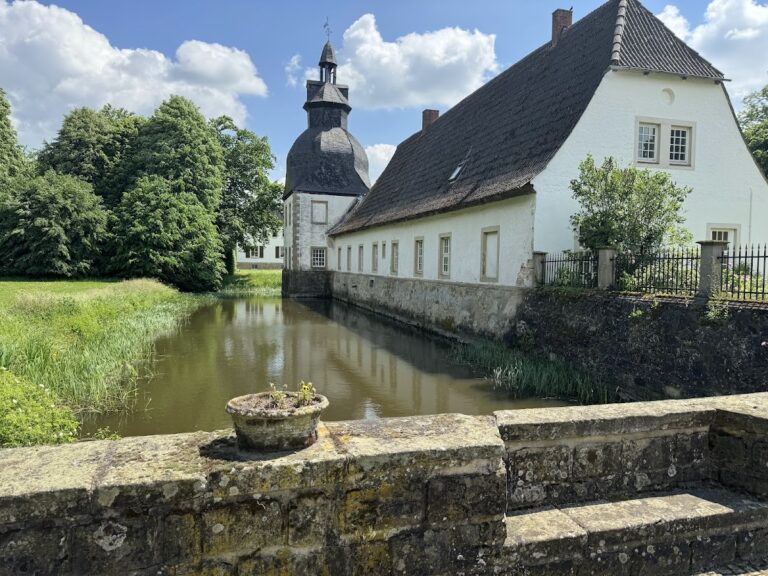
Gut Ostenwalde is arranged as a lowland water castle, a fortified residence in relatively flat terrain protected partly by water or moats. The complex consists of a square main castle and a bailey extending to the south. Parts of the moat around the main castle survive from an earlier double ring of moats, preserving evidence of the estate’s defensive layout.
Three-wing manor house
The two-storey west wing is the oldest surviving part of the three-wing complex and forms the present main building. Its gable is decorated with pyramids characteristic of Weser Renaissance architecture, a regional Renaissance style known for elaborate gables and formal decorative elements. The east wing was restored between 1906 and 1908, when the tower at the bend of the building was added, probably as an allusion to this regional architectural tradition.
Park and estate buildings
Library and orangery
The manor house contains a private library of more than 15,000 books assembled by Idel Jobst II von Vincke. Behind the house, the park includes a nineteenth-century orangery, forming part of the later estate landscape.
Well house
A Gothic well house has stood at Gut Ostenwalde since 1839. It formerly stood in the marketplace of Herford before being brought to the estate.
Oil mill
An oil mill belonging to the estate stands near the Oldendorfer Mühlenbach. The water-powered mill dates from the fifteenth century and was completely restored in 1988. It continues to operate on designated mill days.