Dianaburg: A Romantic Hunting Lodge in Greifenstein, Germany
Site at a Glance
- Popularity
- Medium
- Country
- Germany
- Primary era
- Modern
- Eras represented
- Modern
- Civilizations
- Kingdom of Prussia
- Site type
- Domestic
- Remains
- Castle
On this page6 sections
History
Dianaburg is a former hunting lodge on Kesselberg in Greifenstein, Germany. Ferdinand, Prince of Solms-Braunfels, had it built in 1842–43 near Braunfels Castle, in a Romantic design shaped by the nineteenth-century movement’s interest in historical and medieval forms. Ferdinand, a keen hunter, commissioned the lodge from a master builder.
From Hunting Lodge to Inn
After Ferdinand’s death in 1873, the building became the home of a district forester. It was converted into an excursion inn in 1898, then enlarged with an additional storey in 1903. The inn flourished in the early twentieth century. Hunting writer Hermann Huttel of Ehringshausen praised it as a model inn, and university student associations probably visited Kesselberg during traditional holidays.
Forestry and Later Use
A blockhouse on the estate was used for timber auctions and held Russian prisoners during the First World War. After the war, the forestry-working Schweizer family lived at Dianaburg until 1956. Another tenant remained until 1969. Hospitality use continued afterward, with a tenant from Ulm staying until 2011. The property is now owned by Count Johannes von Oppersdorf-Solms-Braunfels.
Remains
The Tower Building
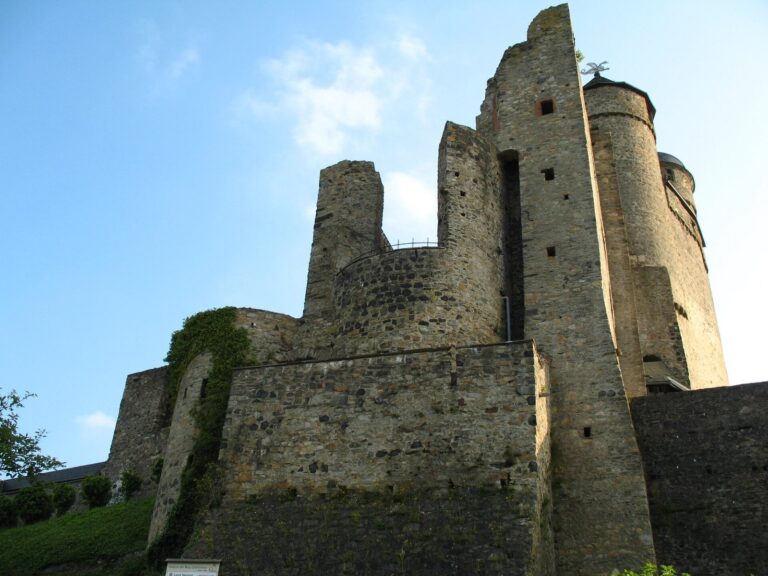
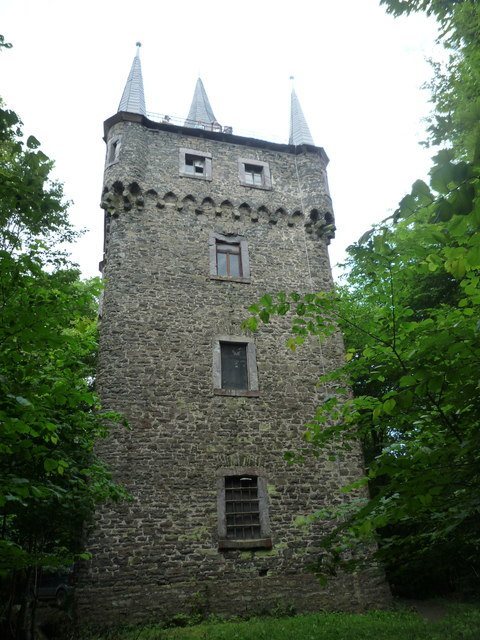
Dianaburg stands in woodland on the 412-metre basalt summit of Kesselberg. The surviving lodge has a tower-castle-like form, inspired by the towers of Prague’s Charles Bridge. Its main tower is accompanied by four corner towers, whose roofs were re-covered with natural slate during repairs in 2008. The tower building is the sole part of the original complex still standing at the site; the residential and agricultural outbuildings were demolished after 1969. A memorial plaque to builder E. Stefan is set into the ground-floor wall just behind and to the right of the entrance.
The Relocated Blockhouse
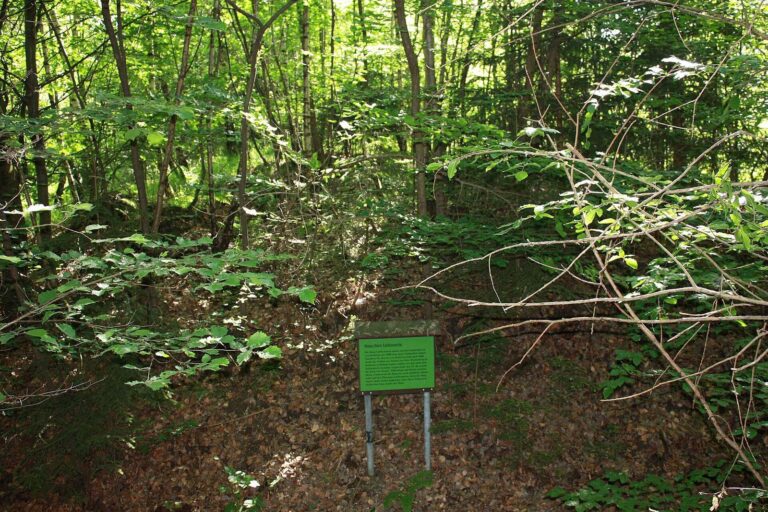
After 1969, the blockhouse was dismantled and reassembled in Leun as a grill hut called the Eintrachthütte. It remains in use there.