Diana Fountain: A Royal Garden Sculpture and Water Feature in Bushy Park
Site at a Glance
- Popularity
- High
- Country
- United Kingdom
- Primary era
- Early Modern
- Eras represented
- Early Modern
- Civilizations
- British, English
- Site type
- Civic
- Remains
- Fountain
On this page11 sections
History
The Diana Fountain is a seventeenth-century bronze sculpture and water feature at Bushy Park in the United Kingdom, later set within an eighteenth-century landscape. Charles I commissioned it in the 1630s for Queen Henrietta Maria’s garden at Somerset House. Preparations began in 1633–34, and the work was probably completed by 1637.
Commission at Somerset House
Inigo Jones is credited with the design. Hubert Le Sueur made the gilded figure at the summit, while the other metal figures have been attributed both to Le Sueur and to Francesco Fanelli. In 1662, the diarist John Evelyn assigned the whole fountain to Fanelli, but historians generally favor Le Sueur’s documented involvement. Nicholas Stone was paid for work on the stone elements.
Move to Hampton Court
During the English Commonwealth, the republican government established after Charles I’s execution, Oliver Cromwell had the fountain moved to Hampton Court Palace’s privy garden. Some Puritan critics objected to its figures, and one urged that they be demolished.
Chestnut Avenue and installation at Bushy Park
After 1689, William III and Mary II commissioned Christopher Wren to rebuild and enlarge Hampton Court Palace. The work included Chestnut Avenue, a tree-lined ceremonial approach through Bushy Park, with the fountain as its centerpiece. Wren supervised William Talman, and this part of the project was completed in 1713, during Queen Anne’s reign.
Edward Pierce redesigned the upper pedestal and rearranged the figures around 1690, while the fountain was still at Hampton Court. It was removed from the garden and put into storage in 1701. For its 1713 installation at Bushy Park, builders added a much taller lower pedestal. The central figure was apparently gilded for the first time then. Charles I had the Longford River dug from the River Colne to supply the palace’s water features; in 1713, Wren used its water to feed the fountain’s outlets by gravity.
War and conservation
During the Second World War, the pool was drained, and part of Chestnut Avenue became Camp Griffiss. It served as the first headquarters of the Supreme Headquarters Allied Expeditionary Force, the Allied command directing operations in western Europe, and as the base where plans for the D-Day landings in Normandy on 6 June 1944 were made. The base closed in the 1950s, after which Chestnut Avenue was restored. The fountain complex was renovated in 2010. It received Grade II listing in 1952 and was upgraded to Grade I in 2011.
Remains
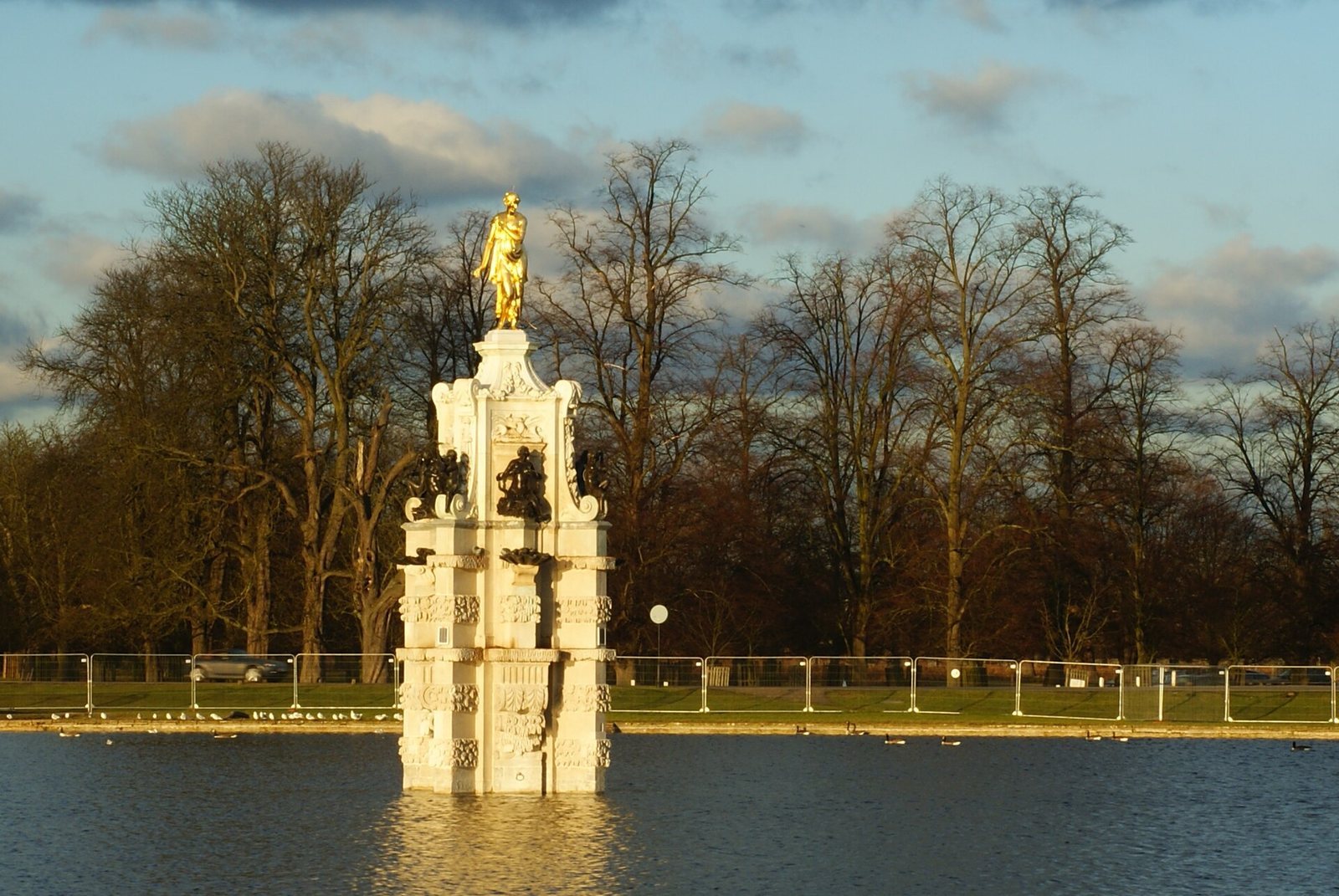
The surviving ensemble combines seventeenth-century metal sculpture with an eighteenth-century landscape setting. A tall pedestal and statue stand at the center of a circular pool, while lawns border the water. The pool and fountain form a circular traffic island within Bushy Park.
Setting and pool
The pool measures about 400 feet (120 metres) across. The fountain is the focal point of two major vistas designed by Wren, including Chestnut Avenue, the ceremonial approach to Hampton Court Palace. These tree-lined views extend for about a mile.
Pedestal and sculptural group
Pedestal
The present stone pedestal joins Pierce’s upper section, decorated with scroll-shaped forms and made around 1690, to the much taller lower section added for the Bushy Park installation. This lower part is built of rough-faced stone. At Somerset House, the pedestal was lower and the surrounding pool smaller, so the figures could be viewed from closer at hand.
Figures and recorded designs
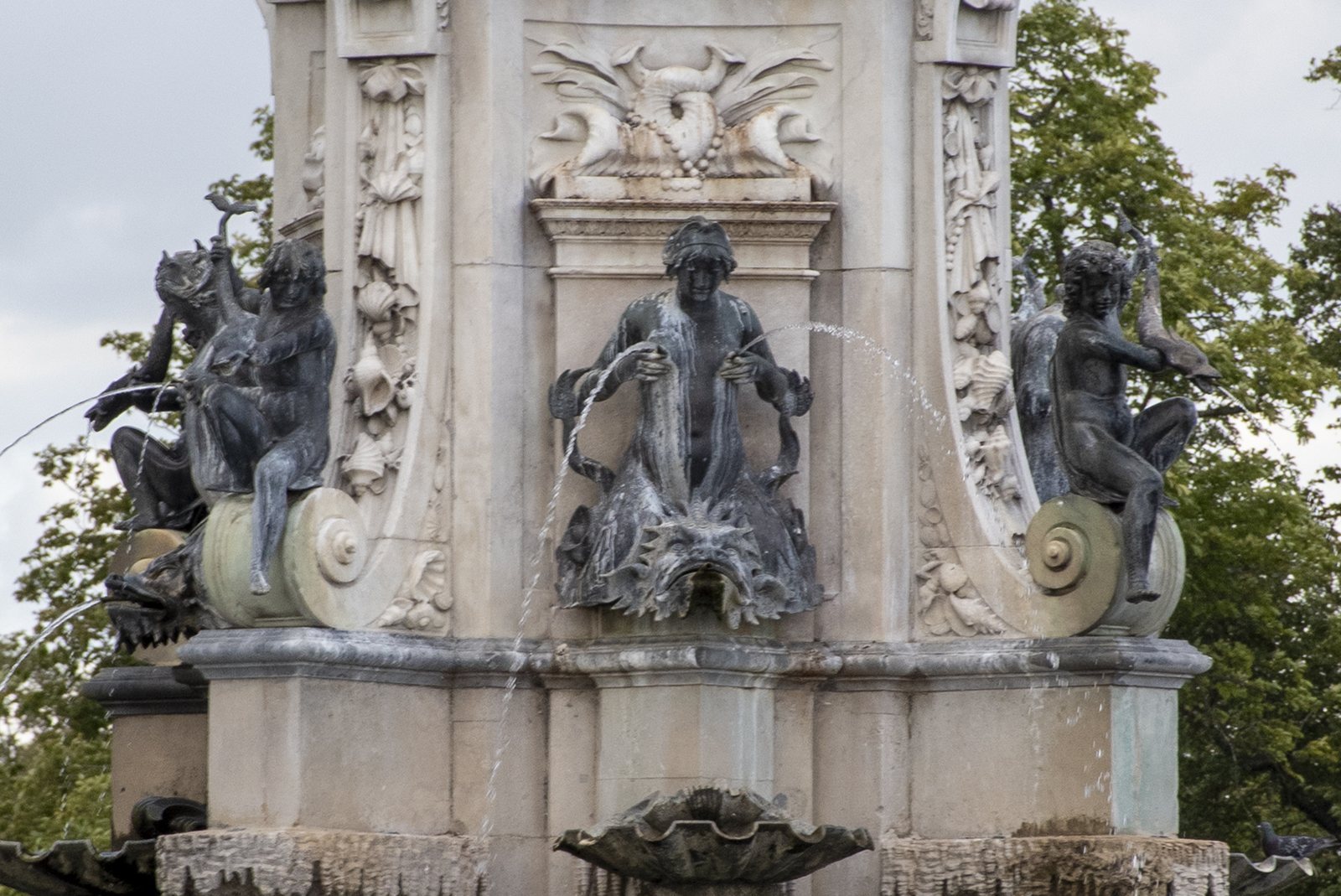
The central figure is gilded, while the surrounding metal sculptures are not. An inventory from 1659 identifies the central figure as Arethusa, a figure from Greek mythology. The fountain is still widely called the Diana Fountain, although the figure has also been identified as Diana, Venus, or Proserpina, Roman goddesses. Jones’s surviving design sketch, now at Chatsworth House, shows recognizable figures in a different arrangement against different stonework. It depicts the central woman nude, and features of the design echo engravings of earlier fountains in Bologna and Augsburg. A drawing probably dating to the 1670s shows an earlier grouping: the boys now at the corners stood higher, between the central figure and sea monsters carrying women. Scallop shells occupied the corners at the level of four female figures’ breasts, catching water from fish held by the boys.
Water outlets
Before the 2009–10 renovation, many of the fountain’s outlets had become clogged, and only four were working.