Ponte Vecchio: Florence’s Medieval Bridge and Commercial Street
Site at a Glance
- Popularity
- Very High
- Country
- Italy
- Primary era
- Medieval
- Eras represented
- Classical, Medieval, Early Modern, Modern
- Civilizations
- Grand Duchy of Tuscany, Italian, Kingdom of Sardinia, Republic of Florence, Roman
- Site type
- Infrastructure
- Remains
- Bridge
On this page15 sections
History
Ponte Vecchio is a stone bridge over the Arno in Florence, Italy, rebuilt in its present medieval form around 1339–1345. A river crossing here has served the city for centuries, and the bridge’s roadway has also functioned as a commercial street.
Roman and early medieval crossings
A bridge may have stood near the present site before Roman times, with an early crossing tentatively dated to the middle of the first century BC. Under Roman rule, the crossing connected Florentia, the settlement that preceded Florence, with the Via Cassia Nova, a Roman road advanced during Emperor Hadrian’s reign around AD 123. The bridge may have been strengthened and widened, perhaps using stone supports beneath a wooden roadway. It was probably lost in the sixth or seventh century, amid neglect, conflict and possible flood damage.
Records place the church of Santa Felicita near a bridgehead in 972, and a document from 996 refers to the bridge itself. The chronicler Giovanni Villani later associated a bridge with Charlemagne, although the crossing may instead have shifted to its current position during the ninth or tenth century. A flood destroyed the bridge in 1117, after which it was rebuilt in stone.
Floods, rebuilding, and the present bridge
A major flood accompanied the collapse of the bridge in 1177, and a new crossing followed at the present location. Further floods damaged it in 1200 and 1250; fires struck in 1222, 1322 and 1331. In 1333, floodwaters swept the bridge away, leaving two central supports. A fragment of an equestrian statue, found after the 1177 disaster and lost in 1333, was traditionally said to represent Mars, though it may have depicted a barbarian ruler. Florentines regarded the statue as a protector of their city.
The name Ponte Vecchio, meaning “Old Bridge,” distinguished this crossing from the nearby Ponte alla Carraia, established in 1218 and known as the “New Bridge.” Ponte Rubaconte was nearly a century older than Ponte Vecchio. After major rebuilding in the nineteenth century and its destruction in 1944, Ponte Vecchio became Florence’s oldest bridge. The present structure was built around 1339–1345, with plaques marking its completion in 1345.
Shops and the Medici corridor
The bridge’s shops were part of its role in everyday commerce. In 1442, the city allocated them to greengrocers and butchers, whose refuse could be discarded in the river. In 1495, the municipality sold 48 shops to private owners and religious and lay institutions; many were extended over the water. A 1594 decree by Ferdinando I replaced the butchers with goldsmiths and jewelers, partly to address the smells below the Vasari Corridor. The uncertain term bancorotto may refer to guards breaking a trader’s counter after unpaid debts, preventing further sales. Its proposed connection to banca rotta, or “broken bank,” is also uncertain.
In 1565, Cosimo I de’ Medici commissioned Giorgio Vasari to build an elevated passage between Palazzo Vecchio, the seat of political administration, and the Medici residence at Palazzo Pitti. Completed in five months, the Vasari Corridor is about 760 metres long and crosses above the bridge’s eastern side. It enabled the ruler to travel between the two palaces without passing through the market. In the eighteenth century, shop displays projected over the roadway.
The corridor’s broad openings are sometimes linked to Adolf Hitler’s 1938 visit with Benito Mussolini, and the two leaders did look out from them. They had, however, been created in 1860 to reach a temporary terrace from which King Vittorio Emanuele II could watch the San Giovanni fireworks.
Modern plans, war, and repair
During the nineteenth century, proposals aimed to turn the bridge’s street into a covered gallery. A scheme developed in 1856–1857 and revived in 1862 called for an iron-and-glass roof, shops arranged in a regular line with Corinthian-style wall supports, and a continuous terrace. The proposed covered route would have extended from the Vasari Corridor’s riverside gallery along Via Guicciardini toward Palazzo Pitti and the Museum of Physics. The plan was approved but never carried out.
During the German retreat on the night of 3–4 August 1944, Ponte Vecchio was the only bridge in Florence not blown up. The decision is generally attributed to German command, possibly on Hitler’s order, with intervention by German consul Gerhard Wolf. A witness later offered a different possibility: Burgassi, an assistant to the goldsmiths, may have identified the mine connections so they could be disabled. Neither account is conclusive, though the German-command explanation is more widely accepted. Explosions destroyed the approaches and many nearby buildings, leaving the bridge unusable. The surviving passage through the Vasari Corridor became almost the city’s only north–south crossing, a situation shown in Roberto Rossellini’s film Paisà.
A plaque installed in 2007 recognizes Wolf’s role in the bridge’s survival and his efforts to secure the release of political prisoners and Jews during the Nazi occupation. The dates of his birth and death on that plaque, as well as on an earlier one, were wrong; an added insert later corrected the 2007 inscription.
Engineers began structural studies in 1949, and a consolidation campaign followed in 1960. The 1966 flood damaged the bridge, including its jewelry shops. Repairs took place in 1967–1968, followed by further work to strengthen the supports and riverbed foundations in 1978–1979. Ponte Vecchio appeared in Italy’s 1901 list of monumental buildings regarded as part of the national artistic heritage.
Remains
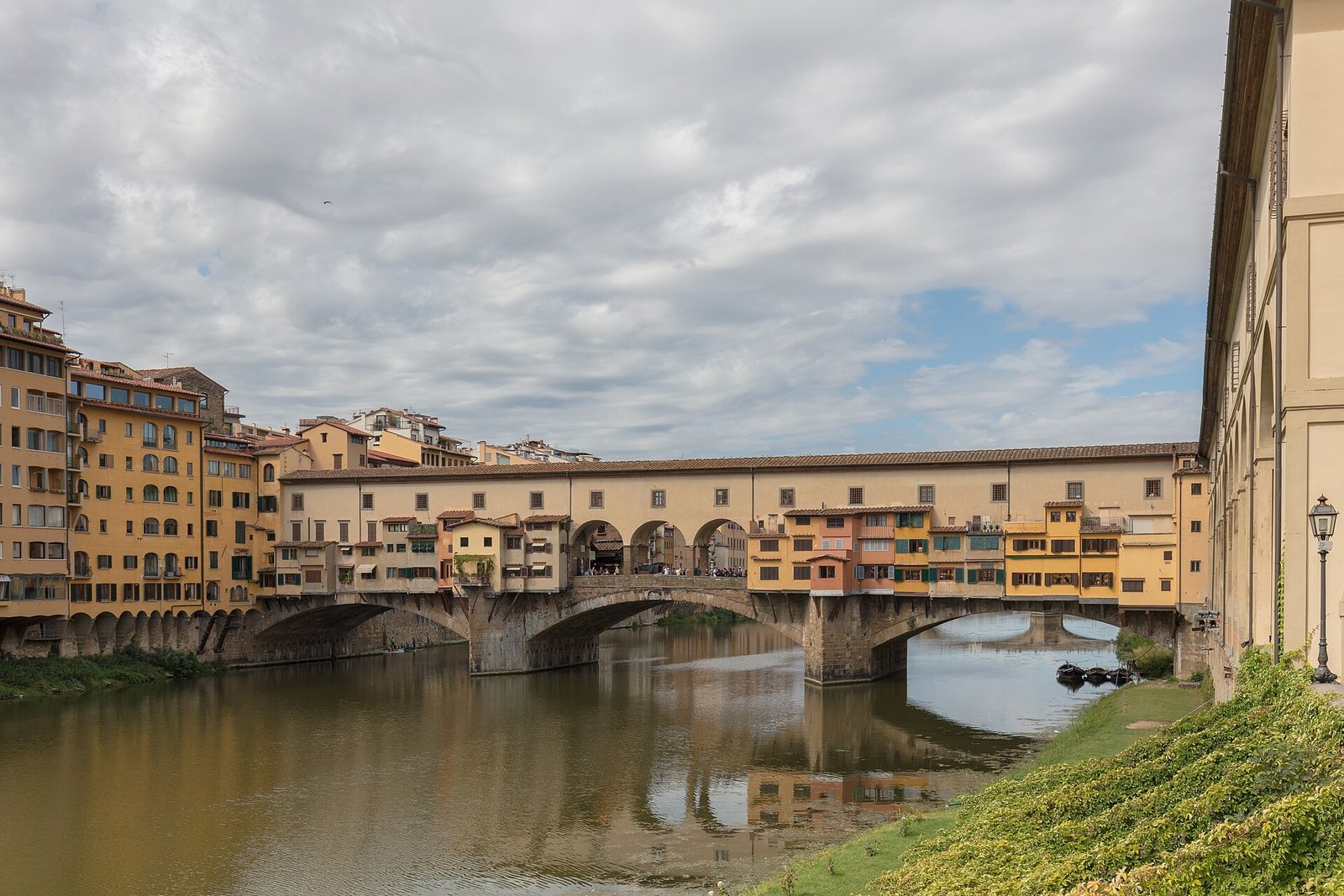
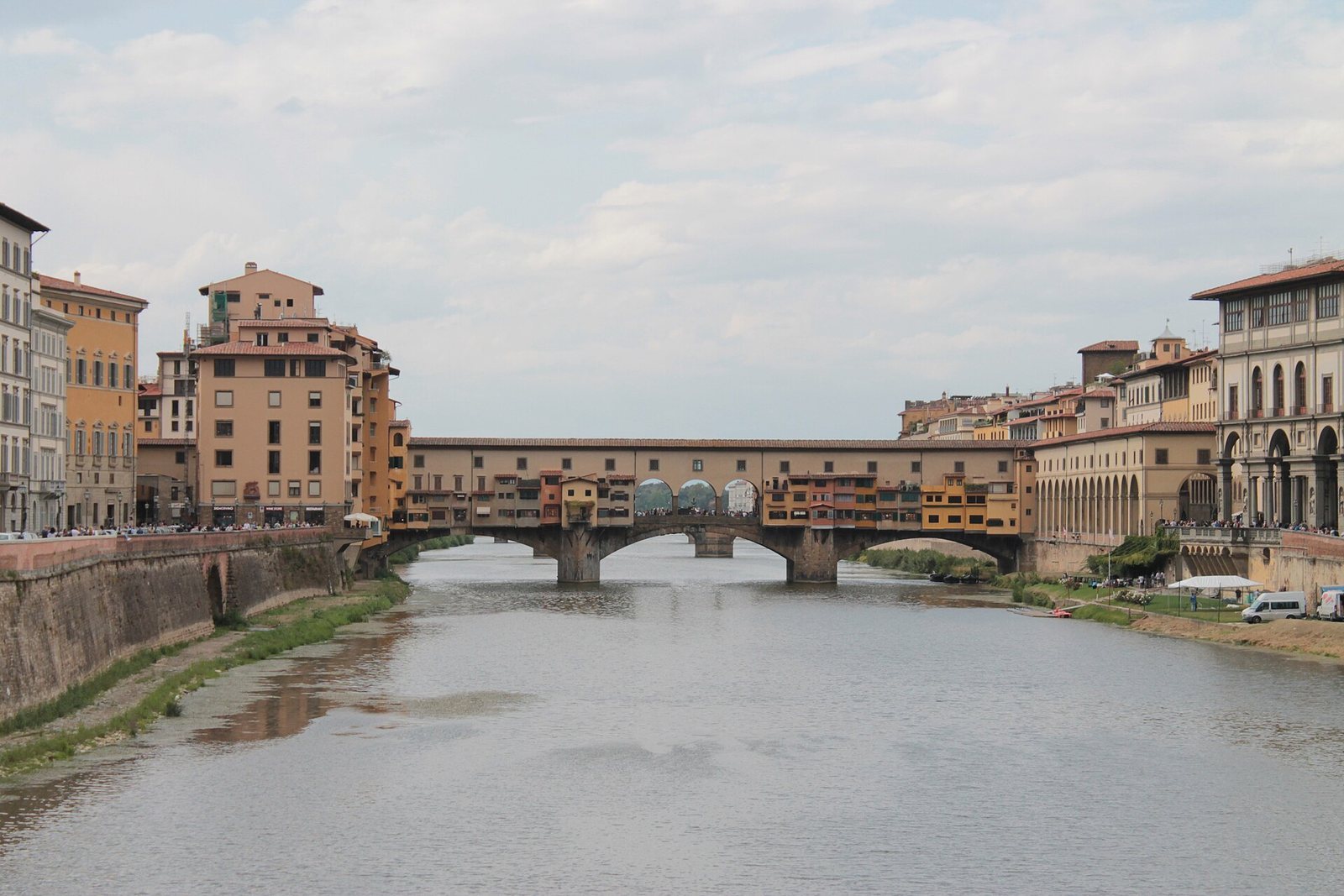
Ponte Vecchio spans a narrow section of the Arno and links Via Por Santa Maria with Via de’ Guicciardini. It measures about 95 metres long and 20 metres wide. Three shallow arches, flatter than semicircles, carry the stone bridge: the central opening spans 30 metres, and each side opening spans 27 metres. Their rise is about 3.5–4.4 metres, making each span roughly 6.5 times its rise. This low profile was an innovation in Western bridge building; compared with semicircular arches, it required fewer supports and left more clearance for passage beneath. The bridge is built of local sandstone.
Shops line both sides of the stone-paved roadway, arranged in four blocks with open views of the river at the center. Each shop faces the street through a single window closed by thick wooden doors. Many rear sections project over the water on corbels, or projecting supports. At the central opening, an open-sided covered gallery, called a loggia, carries the Vasari Corridor on the upstream side. Opposite, an open space contains the monument to Benvenuto Cellini. The bridge remains in use as a pedestrian route lined with shops.
Evidence of earlier bridges
Possible Roman foundations
The earliest crossing is thought to have stood slightly upstream, near present-day Piazza del Pesce, along the continuation of the Roman city’s main north–south street. It may have crossed the river at an angle to withstand flood pressure. A survey of the riverbed in the late 1950s found two broad concrete foundations considered likely, though not certain, to belong to a Roman bridge.
Medieval bridge remains
Studies of the bridge rebuilt after the 1177 collapse found older oak beams beneath its remains, probably dating to the second half of the tenth century. That earlier bridge had five arches.
Bridge buildings and structures
Shop blocks and river openings
The commercial buildings now form two blocks on each side of the roadway. On the western side, open views interrupt the shops between Lungarno degli Acciaiuoli and the Cellini monument, and again between the monument and Borgo San Jacopo. On the eastern side, the blocks extend from Lungarno degli Archibusieri and Piazza del Pesce to the opening beneath the corridor, then from that opening to Via de’ Bardi. The Palazzo della Commenda del Santo Sepolcro can be reached from shop number 2, and a shop occupies part of the Mannelli tower.
Vasari Corridor and corner towers
The Vasari Corridor runs above the eastern row of shops. Its large central openings overlook the bridge. Four towers once controlled access at the corners. The Mannelli tower survives at the southeast corner; the Rossi-Cerchi and Consorti towers were rebuilt. At the south end, the bridge buildings adjoined the Mannelli houses and tower on the Via de’ Bardi side, and buildings later known as the Commenda del Santo Sepolcro on the Borgo San Jacopo side.
The medieval arrangement also included four crenellated buildings at the ends and a small square near the center. Their battlements formed balconies reached through gates at the square and additional gates at the Por Santa Maria end. The present bridge retains a clearly legible medieval character despite changes to individual buildings.
Cellini monument and fountains
A bronze bust of the Florentine goldsmith and sculptor Benvenuto Cellini stands at the central opening. Raffaello Romanelli made the bust for a monument commissioned in 1900 and unveiled in 1901. Egisto Orlandini designed its base, which includes a fountain decorated in a late Renaissance manner of deliberate stylization. Water flows from four masks at the pedestal’s corners into shell-shaped basins. A simpler fountain on the opposite side supplies drinking water and remains operational.
Inscriptions and plaques
Near Piazza del Pesce, an inscription associated with the 1865 Dante commemorations marks the place linked to the 1215 murder of Buondelmonte de’ Buondelmonti by the Amidei family. The killing became associated with conflict between the Guelphs and Ghibellines, rival factions often aligned with the papacy and the Holy Roman Empire. Another inscription beneath the corridor quotes Dante’s Inferno. Two fourteenth-century plaques survive, one in partly illegible Gothic lettering and the other in Latin, with a winged figure whose meaning is uncertain. Inscriptions at shop number 16 recall a reordering of the shopfronts in 1857 and dedicate an image to Cellini.
Religious shrine above shop 52
Above shop number 52, a small late-seventeenth-century shrine has an interrupted pediment supported by shallow wall projections in the Tuscan style. Its arched niche is decorated with angel heads and plant forms around an image of the Madonna and Child with the young Saint John the Baptist. The painting was once attributed to Giovanni da San Giovanni. Later attributions have instead connected it with Domenico Puligo or Giovanni Antonio Sogliani, while noting the influence of Andrea del Sarto. Repainting during repairs has made the image difficult to distinguish.