Cwmhir Abbey: A Cistercian Monastery in Wales
Site at a Glance
- Rating
- 4.5
- Popularity
- Very Low
- Country
- United Kingdom
- Primary era
- Medieval
- External website
- Open
- Eras represented
- Medieval
- Civilizations
- Unclassified
- Site type
- Religious
- Remains
- Monastery
On this page9 sections
History
Cwmhir Abbey is a Cistercian monastery in the United Kingdom, established through a disputed sequence of foundations in the twelfth century and developed as a major medieval religious house in Wales. The Cistercians were a reforming Catholic order whose monasteries combined communal worship with manual work and an austere way of life. Cwmhir was affiliated with Whitland Abbey and, through Whitland, with Clairvaux, a senior Cistercian foundation in France.
Foundation and Cistercian connections
The abbey’s origins are uncertain. One tradition places the first Cistercian community at Ty-faenor in 1143, while the abbey at Cwmhir is generally associated with a refoundation or relocation in 1176 under Cadwallon ap Madog, the Welsh prince and lord of Maelienydd. The relationship between the earlier community and the later abbey remains disputed, as does the claim that the first foundation was established by Meredudd ap Maelgwn, a later ruler of Maelienydd.
The monks came from Whitland, but Ty-faenor proved unsuitable. After roughly thirty years, they moved to the more isolated site at Cwmhir. Cadwallon was killed by Roger Mortimer of Wigmore in 1179. Mortimer, an English nobleman and lord of Wigmore, later became a benefactor of the abbey and issued a charter as lord of Maelienydd in 1200. Cwmhir also founded Cymer Abbey as a daughter house in 1198, extending its place within the Cistercian network.
The remote location restricted the size of the community. Cwmhir was initially intended to house sixty monks, but it probably never reached that number. By 1535, only three people remained, and the abbey’s annual income had fallen to twenty-five pounds.
Patronage, conflict, and monastic life
A very large church began to rise in the early thirteenth century, probably with the patronage of Llywelyn ab Iorwerth, known as Llywelyn the Great. The project was abandoned after the fourteen-bay nave had been completed in fragmentary form. Political and social instability, together with declining patronage, reduced the resources available for construction. The Mortimers favored their other foundation at Wigmore, while the abbey’s Welsh and English patrons placed it between competing political interests.
Cwmhir appears to have been expected to acknowledge the authority of the English king. During the campaigns of 1231 to 1234, English forces burned one of its agricultural estates, or granges, and imposed a fine of two hundred pounds on the abbot. The penalty was connected with support for the Welsh cause, including assistance associated with Llywelyn ab Iorwerth’s destruction of an English force near Hay-on-Wye.
The community also experienced internal disputes. In 1195, the lay brothers, who generally carried out manual and agricultural work rather than following the full routine of choir monks, revolted after the abbot prohibited them from drinking beer. Their penance required them to travel on foot to Clairvaux and submit to the judgment of its abbot, Guy of France. In 1232, Pope Gregory IX allowed the Cistercian abbot to hear the confessions of the abbey’s servants and household members and to administer the sacraments to them.
Burial, destruction, and dissolution
Llywelyn ap Gruffudd, the last native Prince of Wales by direct descent before the English conquest of Wales, was buried at Cwmhir after his death in 1282. The abbey later suffered serious damage during the Welsh uprising led by Owain Glyndŵr in 1401 and 1402. Its poverty and shrinking community helped bring about an early closure during the dissolution of the monasteries. Cwmhir closed in 1536 and was dissolved by 1537.
After the dissolution, the estate passed to the Fowler family, which built a house on the site. The family supported Charles I during the English Civil War. In 1644, forces commanded by Thomas Myddelton stormed Cwmhir, wrecking the house and the remaining monastic structures and probably destroying them.
Interest in the ruins became increasingly archaeological and heritage-oriented during the nineteenth century. Thomas Wilson, who had acquired the estate, explored the remains in 1824 and 1825. Cwmhir is now protected as a Grade II* listed structure.
Remains
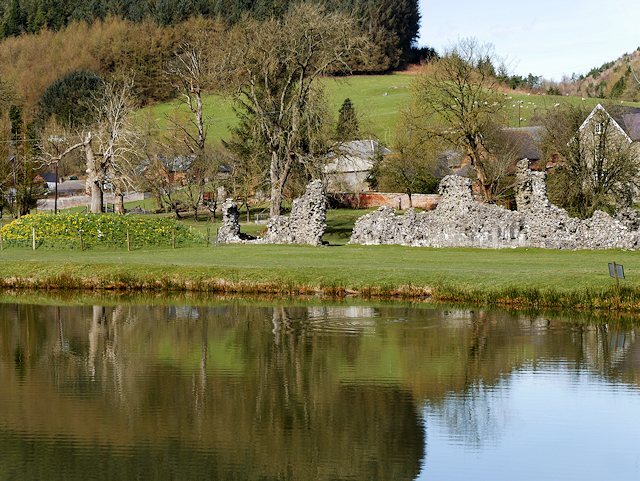
Cwmhir Abbey stands beside the village of Abbeycwmhir on the northern, or left, bank of Clywedog Brook, a small tributary of the Wye. The surviving site is dominated by the fragmentary remains of its exceptionally ambitious church. The building was planned as a fourteen-bay Early English church, using the pointed-arch architectural style associated with English Gothic buildings of the late twelfth and thirteenth centuries. Construction unusually began at the western facade rather than at the choir.
The abbey church
Nave and transepts
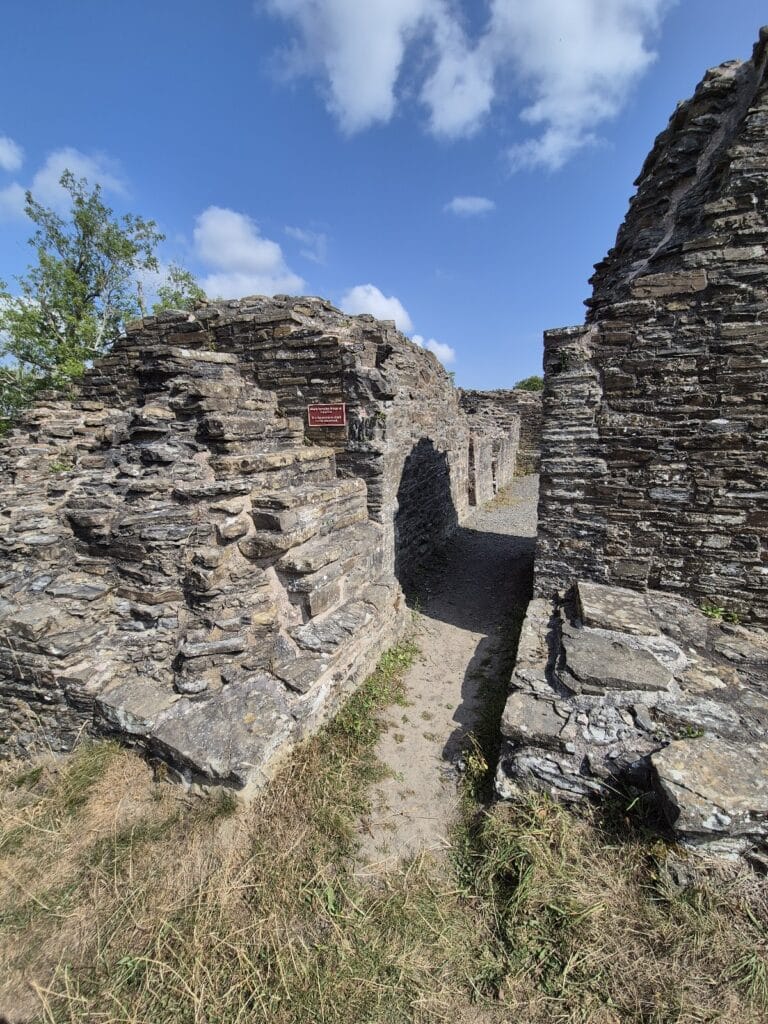
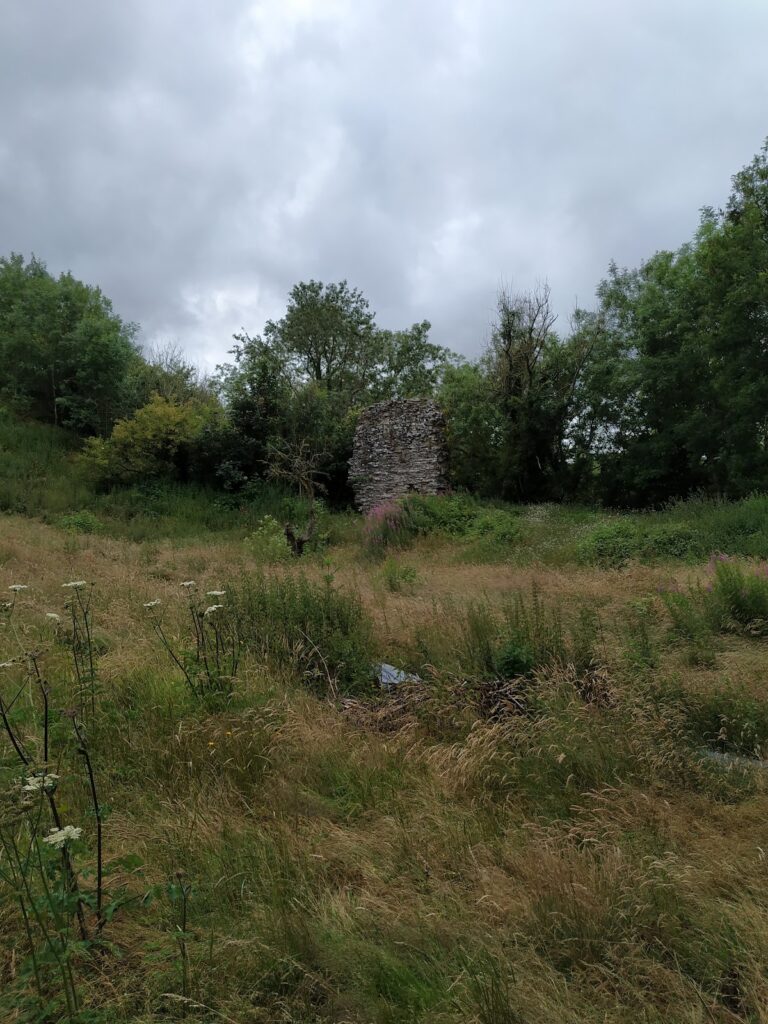
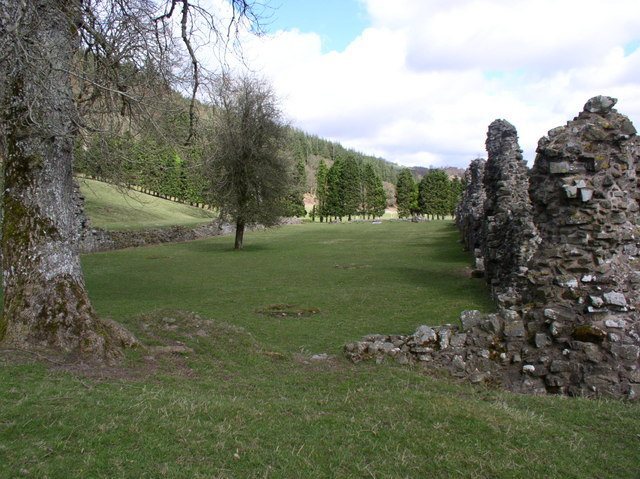
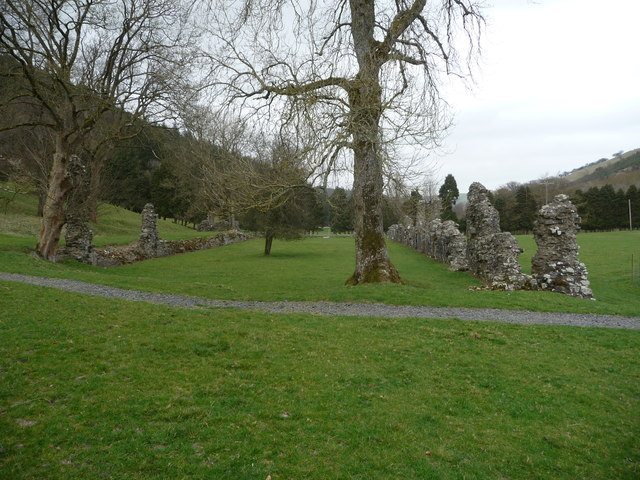
The church nave was designed with fourteen bays, but the surviving fabric consists chiefly of sections of nave wall and the west walls of the transepts. Three bases of arcade piers remain visible inside the nave. Some fragments of the southern nave wall reach about five metres in height, while the surviving northern sections are less substantial. These remains reflect both the incomplete medieval building campaign and the later dismantling and destruction of the abbey.
The thirteenth-century church replaced an earlier cruciform church. Five bays of its Early English nave arcade were dismantled and re-erected in St Idloes parish church at Llanidloes in 1542. Other arches and architectural elements from Cwmhir are also believed to have been reused there. No substantial remains of the cloister buildings south of the church are preserved.
Royal memorial
A modern grave slab within the surviving church commemorates Llywelyn ap Gruffudd, who was buried in the abbey church after his death in 1282. The memorial preserves the connection between the ruined church and the burial of the final native Prince of Wales by direct descent.
Excavated architectural and funerary elements
Thomas Wilson’s excavations in 1824 and 1825 recovered a funerary slab belonging to an abbot. The slab was placed in the parish church. A tympanum, the decorated field within or above an architectural arch, was also recovered. It depicts the Ascension and was installed in the garden wall of Home Farm.
The surviving ruins are therefore the result of several stages of change. The medieval church was left incomplete, parts of its fabric were dismantled and reused after the dissolution, and the remaining structures were damaged during the fighting of 1644. The fragmentary walls, surviving pier bases, reused architectural pieces, and recovered memorial elements together preserve the physical history of Cwmhir’s monastic foundation.