Builth Castle: A Medieval Fortress in Wales


Site at a Glance
- Rating
- 2.9
- Popularity
- Very Low
- Country
- United Kingdom
- Primary era
- Medieval
- External website
- Open
- Eras represented
- Medieval
- Civilizations
- Norman
- Site type
- Military
- Remains
- Castle
On this page9 sections
History
Builth Castle is a former medieval castle in the United Kingdom, at Builth Wells in Wales. An Anglo-Norman baron established the first fortress around 1100, and the site later became a repeatedly contested stronghold during the conflicts between Welsh rulers and the English Crown. Edward I began replacing the earlier fortification with a powerful stone castle in 1277, but the work remained unfinished and the masonry was eventually removed.
Anglo-Norman foundation and Welsh conflicts
Around 1100, Philip de Braose conquered the medieval Welsh territory of Builth, known as a cantref, and established a wooden castle strengthened by earthworks. Its position beside a strategic crossing of the River Wye placed it where roads towards Brecon and the Irfon valley met. Rhys ap Gruffydd captured and destroyed the castle around 1168. Although it was rebuilt, the site continued to be fought over by the de Braose barons and Welsh forces.
King John confiscated William de Braose’s territories in 1208, but William’s son Reginald recovered Builth in 1215 with the support of Llywelyn ap Iorwerth, the powerful prince of Gwynedd later known as Llywelyn the Great. Reginald’s nephews Owain ap Gruffydd and Rhys Ieuanc attacked the castle for Llywelyn in 1217 but did not take it. Llywelyn’s own siege in 1223 was relieved by an English army led by Hubert de Burgh.
During Henry III’s campaign in Ceri, another medieval Welsh territory, Llywelyn ap Gruffydd captured Reginald’s son William, 7th Baron of Bramber, in 1228. William was released on the condition that Builth formed part of the marriage settlement for his daughter Isabell, who married Llywelyn’s son Dafydd ap Llywelyn. Llywelyn ap Iorwerth probably demolished the castle to its foundations during the 1230s.
The thirteenth-century stone castle
After Llywelyn ap Iorwerth died in 1240, the English Crown claimed Builth, and John de Monmouth began building a new stone castle. From December 1256, Llywelyn ap Gruffydd, the leading Welsh prince in the final thirteenth-century conflict with Edward I’s government, repeatedly attacked it. He captured the castle on 17 July 1260 and again ordered its destruction.
Edward I began rebuilding Builth Castle in 1277 as part of his campaigns to consolidate English rule in Wales. It was the first castle Edward built in Wales, although it occupied an earlier motte-and-bailey site. A motte-and-bailey combined a raised mound carrying a tower or keep with enclosed courtyards called baileys. Construction began in May 1277 and continued until August 1282, when the castle was still incomplete. Work probably stopped because of financial pressures and Edward’s decision to concentrate on his invasion of Gwynedd after Llywelyn ap Gruffydd’s death.
In 1282, while rebelling against English rule, Llywelyn ap Gruffydd came to Builth. His precise purpose there is uncertain. On his return to his forces at Cilmeri, about 3 kilometres west of Builth, English soldiers ambushed and killed him. Construction of the castle ceased after this English victory.
Later medieval ownership and warfare
The castle was besieged during the revolt of Madog ap Llywelyn in 1294. The rebels did not immediately capture it, and an English army commanded by John Giffard eventually relieved the garrison. Builth was still described as unfinished in 1343. It was sometimes held by the Mortimer family, the earls of March, and Edmund Mortimer, 2nd Baron Wigmore, died in a nearby engagement in 1304.
Edward I granted Builth Castle to his son Edward on 7 February 1301. Roger Mortimer served as castellan, the officer responsible for governing and defending a castle, from 1310 to 1315. After Edward became king, he granted the castle to his wife Isabella. With his consent, Isabella leased it back to Mortimer for 170 marks every half-year, payable at Michaelmas and Easter. Mortimer later secured an agreement that the castle would pass to him outright after Isabella’s death.
In 1330, after Edward III reached adulthood, Mortimer and Isabella were captured. Mortimer was executed for treason and his property was seized. Gilbert Talbot, 1st Baron Talbot and Justiciar of South Wales, took possession of Builth. Edward III then granted the castle for life to Alice de Lacy and her second husband, Eubulus le Strange, who had helped him against Mortimer. After Eubulus died in 1335, Alice’s subsequent husband, Hugh de Freyne, was recognized by the king as lord of Builth. Alice died childless in 1348.
Edward III later granted Builth to his son Edward of Woodstock, the Black Prince. In 1359, the Black Prince renewed the Mortimer family’s rental arrangement at 170 marks per half-year, while retaining the right to garrison the castle during wartime. During the revolt of Owain Glyndwr in the early fifteenth century, a garrison commanded by Sir John Oldcastle occupied Builth. A siege badly damaged the castle, but the rebels failed to capture it, and repairs were completed in 1409 at a cost of £400.
Decline and later reuse
The rental arrangement ended during the Wars of the Roses after Richard of York, who inherited the Mortimer claim through Philippa of Clarence, claimed the crown. The conflict ended when Richard’s heir, Elizabeth of York, married Henry VII. In November 1493, Builth, including the castle, was re-established as a Marcher lordship, a semi-autonomous lordship along the Anglo-Welsh border, for Henry VII’s son Arthur. Arthur died childless in 1502. During the reign of his younger brother Henry VIII, the castle burned down.
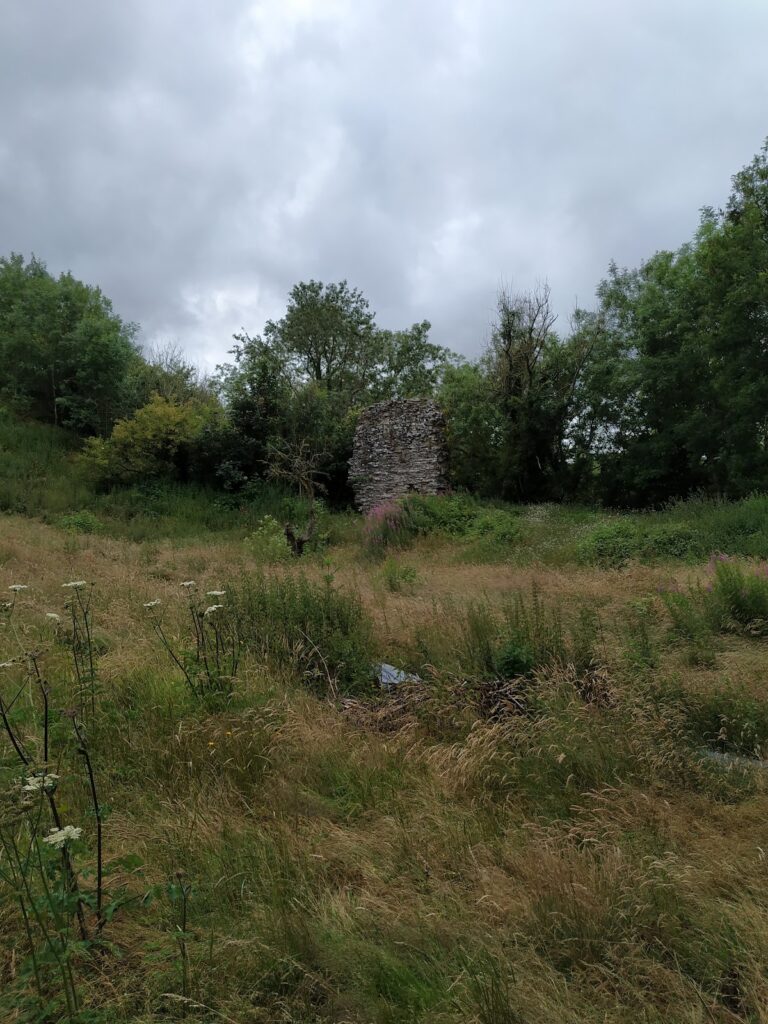
Builth Castle deteriorated during the late Middle Ages and became a source of building stone from the sixteenth century onward. After a major fire at Builth around 1690, many local houses were probably rebuilt with stone taken from the castle. This process removed the surviving masonry and left the earthworks as the principal physical evidence of the fortress.
Remains
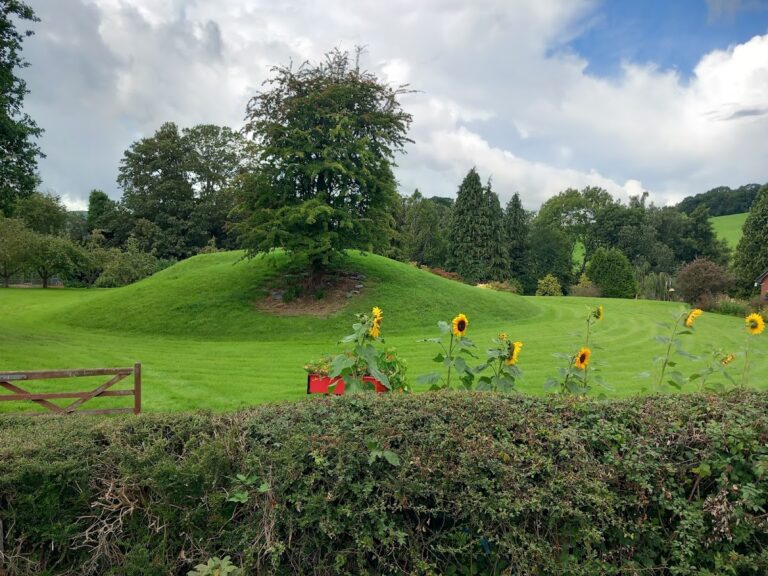
Builth Castle occupies a hill south of the River Wye at the eastern end of Builth Wells, south of the bridge over the river. The original fortification consisted of a motte with two baileys. Edward I’s planned replacement added a central stone enclosure on the mound, a second enclosure outside it, and substantial defensive walls and towers. Today the site is a ruin of banks, ditches, and a large motte rather than standing stone structures.
The early earthwork castle
The first castle occupied a motte-and-bailey layout, with a raised mound and two enclosed courtyards. Its initial defenses combined timber construction with earthworks, a common arrangement before more permanent stone fortifications were built. The motte formed the central high point of the site, while the baileys provided enclosed areas around it. The surviving earthworks preserve the form of this earlier arrangement, although the later removal of masonry altered the appearance of the whole complex.
Edward I’s planned fortress
Edward I’s castle was designed as a powerful stone fortress, probably following plans associated with his master builder James of St George. The central enclosure was intended to contain a round keep on the motte and a curtain wall, a defensive wall enclosing the castle, with six towers. A second wall formed the outer bailey, entered through a strong gatehouse flanked by two towers. The outer enclosure also contained a hall, service and residential buildings, and a chapel.
Construction first enclosed the site with a wooden palisade, a defensive fence made from wooden stakes, approximately 270 yards long, as at the contemporary castle of Flint. The recorded total cost was relatively modest at £1,666, probably because existing earthworks could be incorporated into the design. Despite the strength of its planned defenses, the complex was the smallest of Edward I’s castles built to secure English rule in Wales. Its incomplete state and later destruction mean that the planned stone buildings survive chiefly through the earthworks that supported them.
Surviving earthworks
The principal remains are an approximately 18-metre-high motte, the bank encircling the castle, and the surrounding ditches. These features define the elevated central mound and the outer limits of the fortified site. All masonry has been removed, leaving the earthworks as the visible remains of both the earlier castle and Edward I’s unfinished reconstruction.