Cuicuilco: A Preclassic Mesoamerican Ceremonial Center in Mexico City
Site at a Glance
- Rating
- 4.6
- Popularity
- Medium
- Country
- Mexico
- Primary era
- Iron Age
- Eras represented
- Iron Age
- Civilizations
- Unclassified
- Site type
- City
On this page16 sections
History
Cuicuilco is a major Mesoamerican archaeological center in Mexico City, Mexico, developed by communities of the Preclassic period as an agricultural settlement and later civic and ceremonial city. Its earliest occupation is uncertain, with estimates ranging from about 1200 to 800 BCE. Located in the southern Valley of Mexico near former lakes, springs, rivers, and routes toward the valleys of Toluca and Morelos, it became one of the earliest important religious and political centers of the Mexican Highlands.
From village to regional center
Cuicuilco began as a farming village and grew into an urban center with public architecture, residential areas, agricultural installations, and water systems. Farmers, artisans, priests, and rulers lived there, indicating several levels of social organization characteristic of later Mesoamerican city-states. During its prosperous period, the settlement may have had about 20,000 inhabitants and controlled a territory approaching 400 hectares.
Its position supported contact with communities across the Basin of Mexico and with more distant regions. Cuicuilco interacted with Chupícuaro to the west, communities in Morelos, and areas around Monte Albán. Between approximately 600 and 200 BCE, it produced a distinctive ceramic tradition. Its development was broadly contemporary with early Teotihuacan and possibly with the Olmec societies of the Gulf Coast, whose heartland lay in present-day Veracruz and Tabasco.
Decline and volcanic destruction
Cuicuilco began to decline before or during the early centuries CE as Teotihuacan grew into the dominant cultural and religious center of the Basin of Mexico. Some chronologies place a limited revival between approximately 1 and 150 CE, with evidence connected to fire deities. The volcanic eruption of Xitle, near Ajusco, then sent ash and extensive lava flows across the settlement. The final destruction and burial are generally placed around 250 CE.
The eruption ended Cuicuilco’s role as a major ceremonial center, displaced its population, and altered settlement patterns across the region. Cuicuilca groups appear to have moved toward Toluca and Teotihuacan, where elements of their culture were incorporated. Offerings continued while lava covered the settlement, and later communities reoccupied parts of the territory. Archaeological materials indicate settlements or villages above or beside the lava from approximately 200 to 950 CE, followed by activity during the Classic, Epiclassic, Postclassic, Colonial, and modern periods.
Later deposits reflect interaction with regions under Teotihuacan influence, political developments associated with the Toltec state, and occupation during the Tepanec-Aztec period. Colonial materials and nineteenth-century European fine earthenware also show that activity continued in the broader area after the pre-Hispanic city had declined.
Archaeological investigation and modern change
Modern archaeological research began with Manuel Gamio’s surface investigations between 1915 and 1920, when he located and marked the main pyramid. Byron Cummings carried out formal investigations from 1922 to 1925 with support from the University of Arizona and the National Geographic Society. Eduardo Noguera directed excavations in the 1930s, studying burials and other remains around the pyramid and helping establish Cuicuilco as a densely populated urban settlement.
Excavations from 1966 to 1968, prompted partly by construction of the Olympic Village, exposed important architectural complexes in the area later called Cuicuilco B. More than 300,000 ceramic vessels were recovered, and the work demonstrated that occupation continued after the Xitle eruption even though the settlement’s population and regional importance had sharply diminished. The same research documented about 183 burials and a substantial residential building that was destroyed during Olympic Village construction before excavation was complete.
Investigations between 1984 and 1987 examined areas around the archaeological zone and recorded burials, water basins, houses, rooms, and a semicircular structure. A 1984 effort to prevent construction of the Perisur commercial complex did not succeed after legal proceedings, and much of Cuicuilco B consequently remained unavailable for archaeological study. Urban construction damaged or destroyed additional portions of the settlement.
Mario Pérez Campa directed a 1996 investigation in Cuicuilco A that uncovered a carved column possibly related to astronomical observations. Since 2011, work directed by Felipe Ramírez has concentrated on conserving the pre-Hispanic buildings and continuing archaeological research. Mexico’s National Institute of Anthropology and History, known as INAH, administers and maintains the site. Research divides it into Cuicuilco A, the principal archaeological zone, Cuicuilco B, west of A and partly beneath the Olympic Village and commercial development, and Cuicuilco C, associated with later investigations and modern construction.
Remains
Cuicuilco’s surviving remains form part of a larger civic and ceremonial settlement that included pyramids, plazas, avenues, terraces, houses, water installations, and agricultural infrastructure. The ancient city lies beneath the Pedregal de San Ángel lava field, which covers an area estimated at approximately 70 to 80 square kilometers and reaches more than 10 meters in depth in places. Uneven lava deposits buried and preserved ancient surfaces, buildings, burials, ceramics, and waterlogged layers, while also making the original layout difficult to excavate.
Principal ceremonial architecture
Main circular pyramid
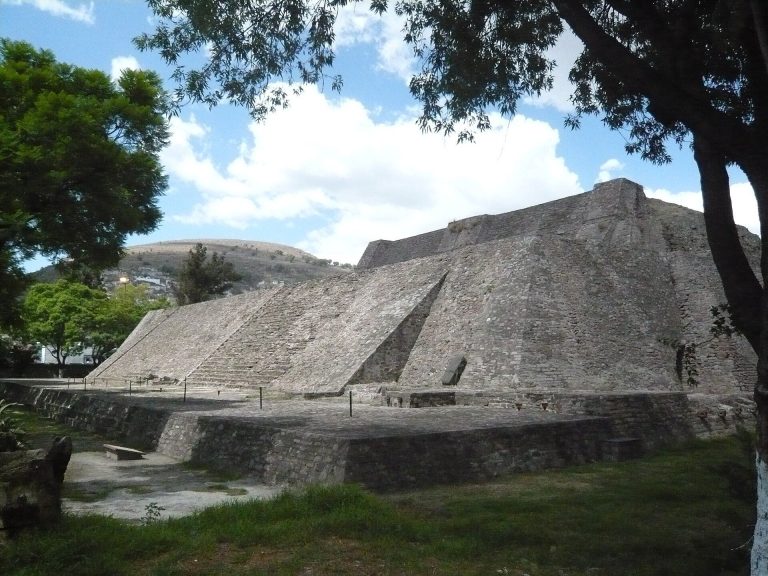
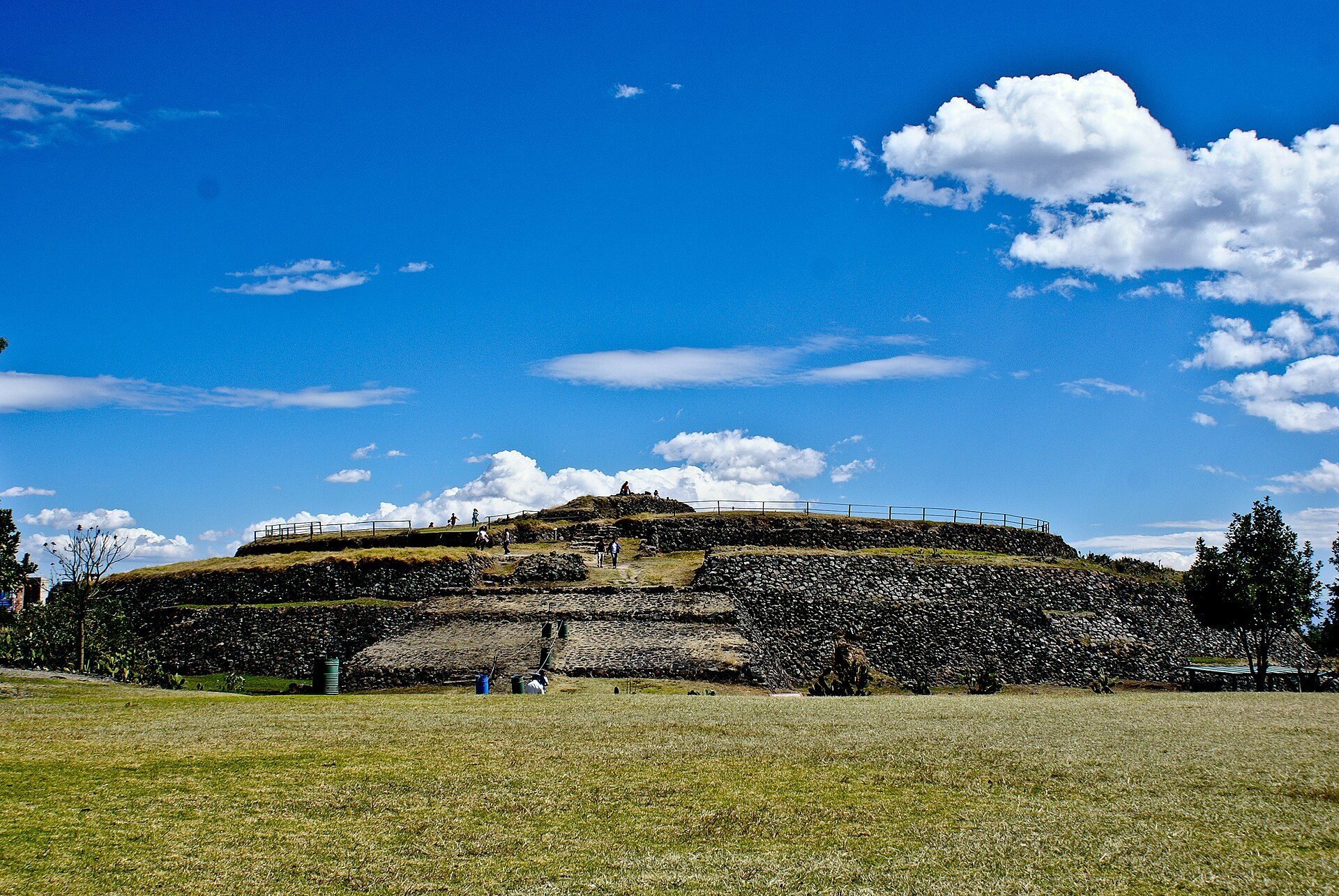
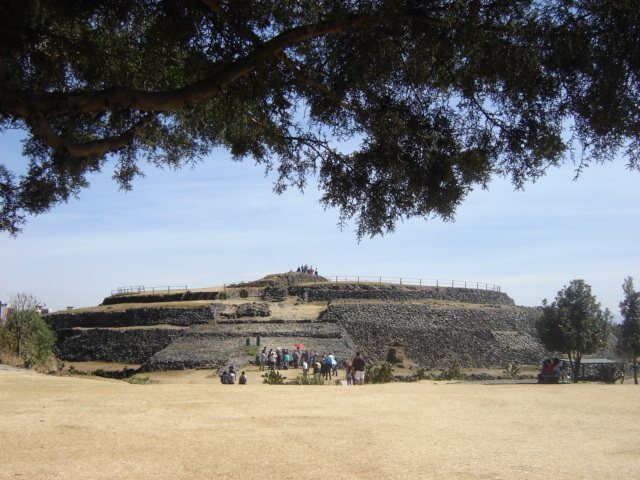
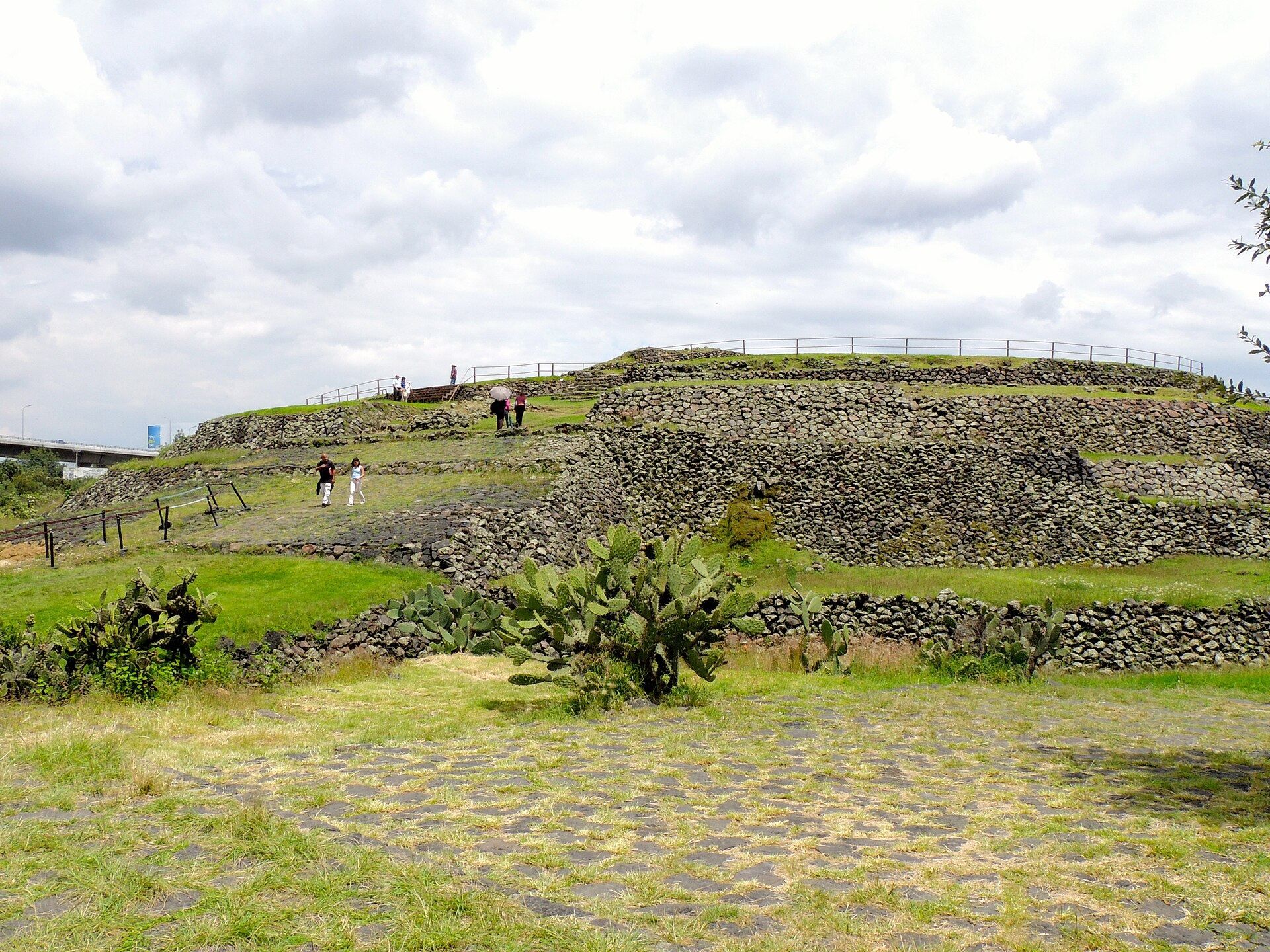
The principal monument is a large circular or elliptical platform, often described as a truncated cone, built during the Preclassic period from basaltic stone. Its position and form have been interpreted as an early effort to connect religious ideas with cosmic events through monumental architecture. Byron Cummings’s investigations established the pyramid’s elliptical plan. An altar at the summit was rebuilt after an initial ash eruption, and a lower structure made from painted stone slabs was also identified.
Subterranean chambers and carved column
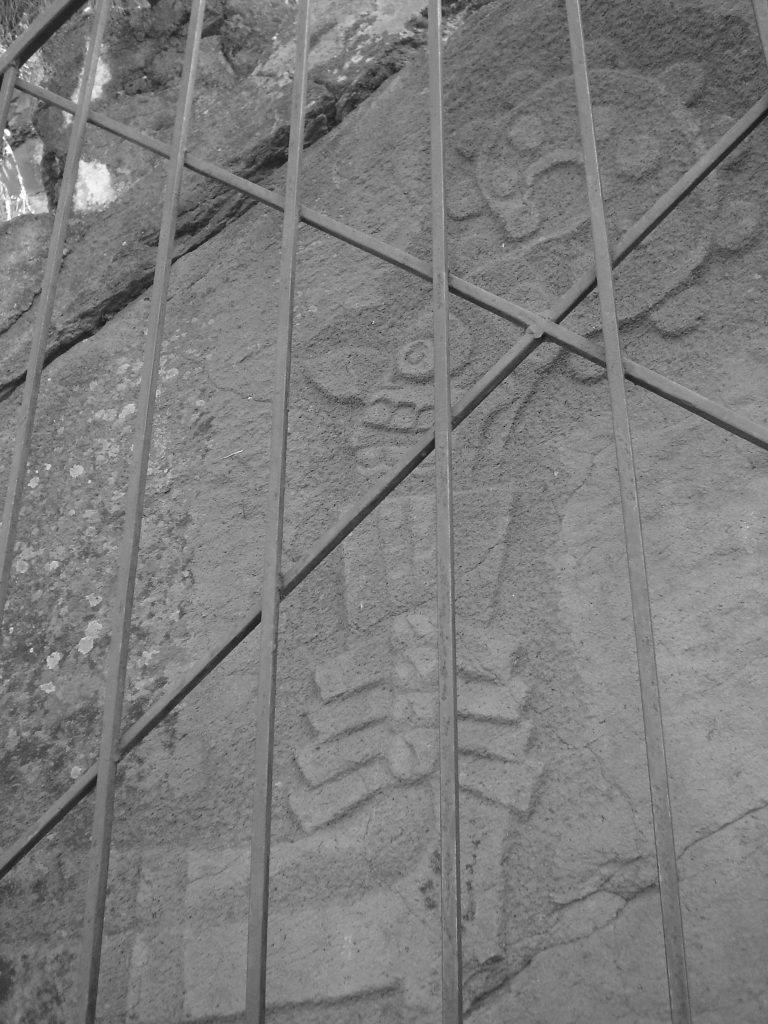
Chambers sealed beneath volcanic lava near the pyramidal sector contained skeletons and ceramic objects. Their function is uncertain, since they have been interpreted both as possible tombs and as altars. South of the main pyramid, a carved column found in 1996 measures approximately 3.90 meters in height. Its carvings may represent the earliest known graphic records of astronomical events in Mexico.
Other circular and semicircular structures
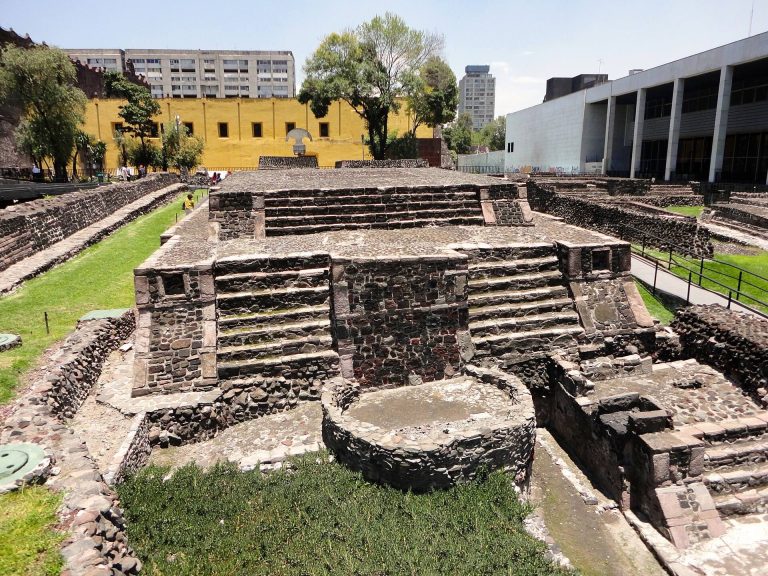
Cuicuilco preserves eight religious and residential buildings from the larger number that once existed. A partly buried circular chamber was called a “kiva” by Byron Cummings because of its resemblance to chambers in the southwestern United States, although its ritual function remains unknown. A separate semicircular structure was identified in the area of the Loreto and Peña Pobre park.
Urban, residential, and water systems
Plazas, streets, and reservoirs
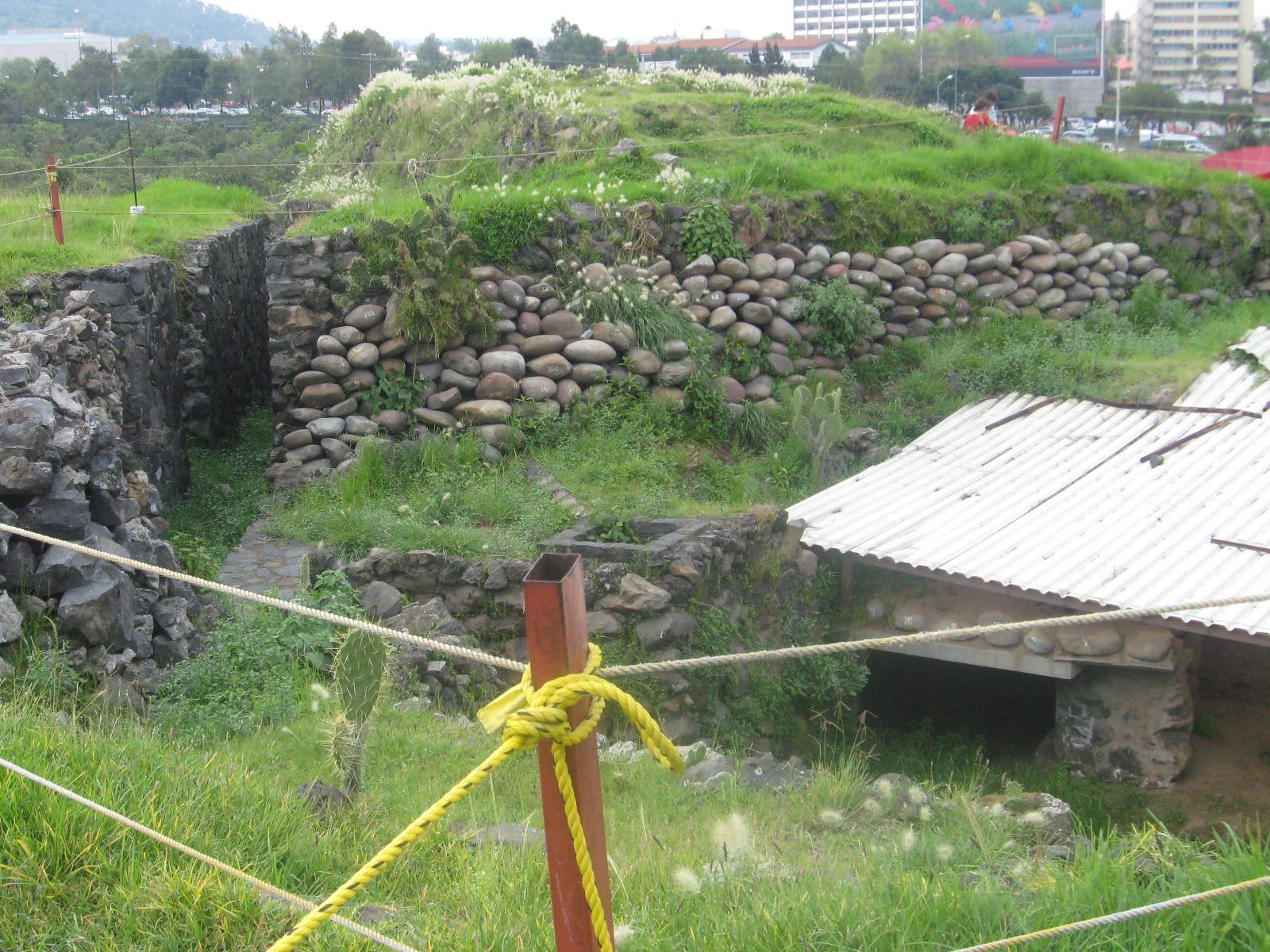
Plazas and streets bordered small, shallow reservoirs supplied by runoff from the nearby Zacayuca and Zacaltepetl hills. The settlement also contained irrigation ditches and canals. Some basins may have been natural rather than constructed, so their exact function is uncertain. Terraces, agricultural installations, conical formations, fortifications, and residential areas together show the combination of public, domestic, and productive spaces within the settlement.
Cuicuilco B complexes
Investigations in Cuicuilco B revealed numerous architectural complexes and conical structures. One circular pyramid stood within a plaza beside smaller structures associated with an agricultural system. This group was later destroyed to make way for a multistory office complex. Other structures in Cuicuilco B were destroyed in 1968, and a circular building was reportedly removed for construction of the Elektra Towers.
Residential building
A residential building examined during the 1966 to 1968 investigations measured approximately 12.5 meters across its front and 23 meters in depth. It had a tightly compressed tepetate foundation, mud-finished walls, five rooms, and an altar. Tepetate is a hard volcanic or hardpan material commonly used for foundations in central Mexico. The arrangement led to the interpretation that the building may have housed priests, but it was demolished before excavation could be completed.
Burials, deposits, and material remains
Lava-sealed deposits
The lava sealed a body of water and helped create marshy, peat-rich deposits containing volcanic ash, organic remains, and materials associated with a former lakeshore. Ceramics recovered from water and lava layers include domestic pans, pots, pitchers, dishes, boxes, and comales, which are flat earthenware griddles. Some vessels were discarded as refuse, while fragments of braziers, miniature objects, and Tláloc vessels indicate offerings placed in the water.
The ceramic assemblage includes local wares, imported objects, and traditions associated with Chupícuaro, Teotihuacan, Coyotlatelco, and Tula-related phases. It includes utilitarian vessels, funerary offerings, tripod plates, polychrome wares, red and brown wares, negative-painted pottery, and forms with stylized bird bodies or grotesque leg-like and handle-like supports.
Burials and ritual objects
Burials include simple and multiple interments, often with bodies placed in flexed lateral positions. Some skeletons were deformed by the weight and pressure of overlying lava, while others were too damaged to retain their original position. The inhabitants practiced direct or oblique tubular cranial deformation and dental mutilation.
Other finds include stone sculptures, ceramics, jewelry, tools, figurines, mortars, blades, bowls, and metates, which are stone grinding surfaces used especially for processing maize. A stone sculpture found at the base of the main pyramid has been dated to the Classic period. Cuicuilco is also associated with early representations or development of Huehuetéotl, the Mesoamerican Old God of fire and the hearth, and Tláloc, a deity connected with rain, water, fertility, and agricultural abundance.
The surviving archaeological zone, especially Cuicuilco A, represents only part of the ancient settlement. Lava, roads, commercial and institutional construction, the Olympic Village, and other modern development have covered or destroyed portions of the city. These conditions leave the settlement’s original extent, layout, and architectural complexity only partly understood.