Bítov Castle: A Medieval Frontier Fortress in Czechia


Site at a Glance
- Rating
- 4.6
- Popularity
- Medium
- Country
- Czechia
- Primary era
- Medieval
- External website
- Open
- Eras represented
- Medieval, Early Modern, Modern
- Civilizations
- Habsburg, Holy Roman Empire
- Site type
- Military
- Remains
- Castle
On this page22 sections
History
Bítov Castle in Czechia was founded in the eleventh century, probably by Bohemian Duke Břetislav I, as part of a defensive system along the Bohemian-Austrian frontier. It developed through medieval, Baroque, Romantic, and neo-Gothic phases, serving both as a military stronghold and an administrative center in Moravia.
Early settlement and Přemyslid administration
A Slavic settlement stood at the confluence of the Želetavka and Dyje rivers between the eighth and tenth centuries. Its emergence was probably connected with population movements following the collapse of Great Moravia, an early medieval state centered in the Moravian and Slovak regions. Around 1019, the territory became part of the Přemyslid state, ruled by the dynasty that established the political framework of medieval Bohemia.
Bítov was founded during the eleventh century, probably under Břetislav I. Its first written reference dates from the middle of that century. The castle became an administrative center in the Brno appanage and, from 1101, in the Znojmo appanage. An appanage was a territorial division assigned to a member of a ruling dynasty, usually with considerable local authority. During the twelfth century, Bítov also served as a base for the colonization of the sparsely settled forests of the Bohemian-Moravian Highlands. The nearby settlement of Bítovec became a stopping point for merchants and pilgrims traveling between Austria and Prague.
Wars and royal authority
In 1185, troops of the Bohemian Duke Břetislav attacked the area during his conflict with Conrad II Otto, the prince of Znojmo. Bítov resisted the assault, and nuns from the Premonstratensian monastery at Dolní Kounice found refuge inside the castle. The Premonstratensians were a Catholic religious order founded in the twelfth century. In 1194, however, the Bohemian Duke Henry Břetislav captured Bítov.
King Ottokar I made Bítov the center of Bítov County in 1222. The county was one of six administrative districts of the Margraviate of Moravia. During the first half of the thirteenth century, the castle was also an important strongpoint in the Bohemian kings’ conflicts with the Austrian Babenbergs, the ruling dynasty of Austria.
Duke Frederick II led Austrian troops against Bítov in 1233. The royal castellan Ben, an official responsible for administering and defending a castle, initially held the fortress successfully. The defenders surrendered after the besiegers brought up siege engines. Shortly before 1240, the Margrave of Moravia strengthened Bítov with a stone bergfried, the principal defensive tower of a medieval Central European castle, and a surrounding stone wall. King Ottokar II later rebuilt much of the castle in stone. Smil of Bítov served as burgrave during this period, followed later by Jaroslav of Šternberk under King Wenceslas II.
The Lichtenburg domain
Wenceslas II pledged Bítov to the Moravian provincial governor Raimund of Lichtenburg around 1295 or 1298. As a result, the administrative center of Bítov County moved to Jemnice. In 1307, Bítov and its domain passed to the Lichtenburg family as a hereditary fief. From 1319, it became the principal center of Raimund’s extensive estates.
Raimund rebuilt Bítov in the early Gothic style and shifted its core to the higher eastern part of the promontory. His descendants, known as the Bítov branch of the Lichtenburgs, enlarged the palace and maintained their residence at the castle. Their military involvement in conflicts from the late fourteenth through the first half of the fifteenth century led to further strengthening of the defenses.
The castle church of the Assumption of the Virgin Mary was built in the courtyard in 1334. In 1447, Smil the Younger of Lichtenburg added a timber-and-earth tower to the outer defenses. During the conflict between Hynek of Lichtenburg and King George of Poděbrady in 1463–1465, the royal army besieged and almost completely destroyed the related castle of Zornstein but did not attack Bítov. In 1491, King Vladislaus II converted Bítov from a feudal holding into the hereditary private possession of the Bítov Lichtenburgs.
Late medieval rebuilding and later owners
During the late fifteenth and early sixteenth centuries, Henry the Elder of Lichtenburg undertook a major rebuilding campaign. The work connected previously separate fortified structures, strengthened the castle, and made Bítov one of the kingdom’s strongest frontier fortresses. The Lichtenburg line at Bítov died out during the sixteenth century. The castle and its domain then passed to the Strein family, probably in 1576.
The Streins remodeled Bítov around 1600 and sold it to the Lords of Vlašim in 1617. The Jankovský family of Vlašim held the castle during the seventeenth century, when it was converted into a fortified Baroque castle. The Daun family acquired the estate in the eighteenth century. A column and statue in the castle park commemorate the traditional belief that Bítov was spared by Swedish troops during the Thirty Years’ War, the European conflict of 1618–1648 that involved religious and dynastic struggles across the Holy Roman Empire and neighboring lands. This tradition gave the statue its name, the “Swedish Madonna.”
Between 1811 and 1863, the Dauns transformed Bítov in a Romantic, Gothicizing, and later neo-Gothic manner. In 1846, Heinrich Daun rebuilt and enlarged the castle chapel, commissioned a new altarpiece from the Viennese painter Anton Ziegler, and created a family crypt beneath its mosaic floor. After the Daun family became extinct in 1906, the estate passed to the Haugwitz family and was later sold. The industrialist Georg Haas of Hasenfels acquired Bítov in 1912. His family was expropriated in 1945, after which the castle became state property.
Collections and heritage status
From the late seventeenth century, probably from 1691, until about 1890, a side room at Bítov housed the Bibliotheca Zriniana. The library was then sold to the Viennese antiquarian Samuel Kende and eventually returned to Croatia, where it is held by the National and University Library in Zagreb.
Bítov was recognized as a cultural monument during the twentieth century and became a National Cultural Monument of the Czech Republic in 2001. This designation is a high-level Czech heritage status for sites regarded as especially important to the country’s cultural heritage. The castle is state-owned and administered by the National Heritage Institute.
Remains
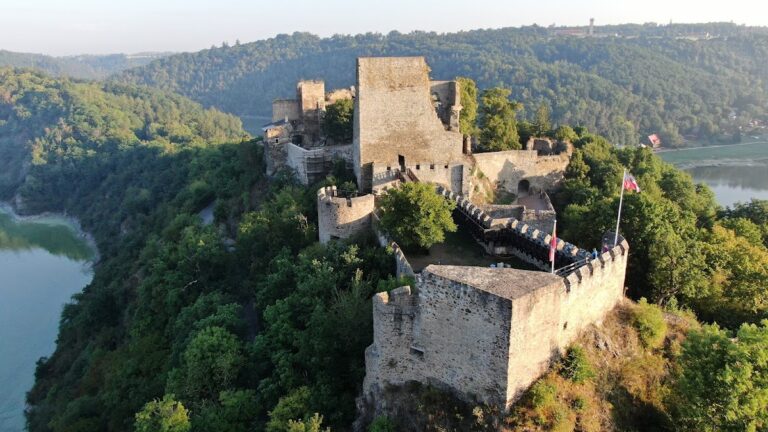
Bítov occupies a rocky promontory on the left bank of the Želetavka, about 70 meters above the river and near its confluence with the Dyje. The castle’s layout developed from an early hillfort-like plan into a complex of stone fortifications, palaces, towers, chapels, and service buildings. Its surviving fabric combines medieval structures with later Baroque, Romantic, and neo-Gothic alterations.
Early fortifications and the medieval core
Early settlement defenses
The earliest castle was divided into three sections by ramparts. Timber-and-earth defenses and ditches protected its eastern and western sides, preserving the general appearance of an older hillfort. Before the thirteenth-century rebuilding, the Chapel of the Virgin Mary was the only stone building, while the rest of the defensive system was built mainly from wood and earth.
Stone tower and enclosing wall
The stone bergfried erected shortly before 1240 stood in the northwestern part of the castle. Its outer wall facing the approach route had a wedge-shaped projection, which provided additional protection against stone missiles. A stone wall enclosed the tower and formed part of the strengthened thirteenth-century defenses.
Gothic castle and Lichtenburg defenses
Eastern castle core
During the early Gothic rebuilding, the castle’s core moved to the higher eastern part of the promontory. New defenses with three towers and a new palace replaced the older, lower core farther west. The earlier chapel was rebuilt, another chapel was incorporated directly into the palace, and service buildings were arranged along the southern side of the courtyard.
Approach defenses and towers
The Lichtenburg defenses included a polygonal tower attached to the chapel and a stone tower on the palace complex’s outer wall toward the southeastern approach. A neck ditch cut across the approach, while a strong wall on the outer rampart protected the castle from fire originating on Trumpelberk Hill above the confluence. On the side facing the valley settlement, additional fortifications descended along the ridge as the garrison expanded. Another tower with a wedge-shaped outer projection protected Bítov from artillery fire coming from the opposite slopes.
Late Gothic entrance and surviving medieval fabric
Fortified approach
The late fifteenth- and early sixteenth-century rebuilding joined previously separate defensive structures and added a new principal polygonal tower. The approach route was moved from the northern to the southern end of the isthmus. The southeastern defensive wall continued into the surviving entrance gate, behind which a tall polygonal gate tower rose at the southwestern corner of the palace complex. This tower became the dominant feature of the castle.
Medieval towers and palace remains
Medieval fabric survives within the late Gothic buildings surrounding the irregular courtyard. It includes the remains of a cylindrical tower with a wedge-shaped projection and part of the castle palace. Of the thirteenth-century structures, the western cemetery tower is the surviving tower.
Chapel and interior collections
Chapel of the Assumption
The Chapel of the Assumption of the Virgin Mary was enlarged and heightened in 1846. Its mosaic floor covers a family crypt, and its interior contains the altarpiece painting commissioned from Anton Ziegler. The chapel also preserves a Gothic Madonna from the first half of the fourteenth century. The Christ Child holds a bird. The sculpture originally stood in the chapel of nearby Zornstein Castle and was given to Bítov as penance for the drowning of a priest in a pond below Zornstein.
Paintings and zoological collections
The castle interiors contain paintings by German and Austrian Romantic artists, including works by Julius Schnorr von Carolsfeld. They also preserve zoological collections assembled by Baron Georg Haas of Hasenfels, among them a collection of stuffed dogs.
Park and former brewery
Ghost figures
The former castle brewery contains a collection of castle and forest ghost figures dating from the seventeenth century.
Romantic park
The Romantic landscaping included an English-style wooded park with small structures and sculptures. A column in the park supports the sculpture known as the “Swedish Madonna.” The original extensive park complex was substantially damaged during the construction of the Vranov reservoir in the 1930s.