Convent Bosco ai Frati: A Franciscan Monastery in Tuscany
Site at a Glance
- Rating
- 4.5
- Popularity
- Medium
- Country
- Italy
- Primary era
- Medieval
- Eras represented
- Medieval, Early Modern, Modern
- Civilizations
- Duchy of Florence, Grand Duchy of Tuscany, Holy Roman Empire, Italian, Republic of Florence
- Site type
- Religious
- Remains
- Monastery
On this page15 sections
History
Early religious foundations
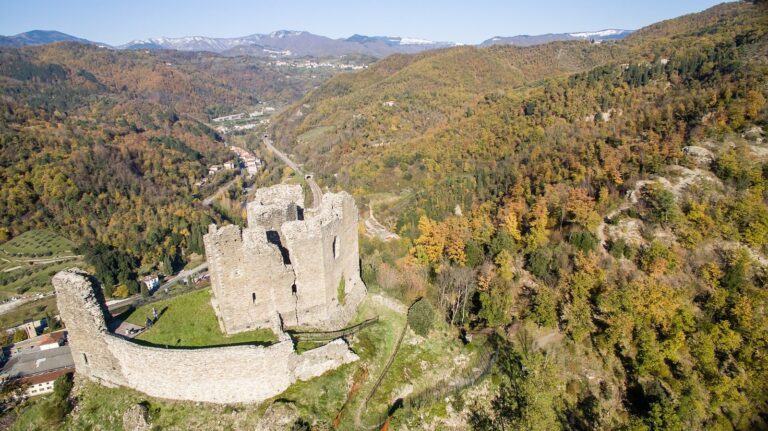
The Convent Bosco ai Frati is a religious complex in the municipality of Scarperia e San Piero, Italy, probably founded in the sixth century by the Ubaldini, a local noble family. Its buildings combine Renaissance design with elements of medieval architecture. The community became a Basilian monastery in the ninth century; the Basilians followed a monastic tradition associated with Basil of Caesarea. Its monks left around 1010–1012, and hermits later occupied the site.
Around 1206–1209, the Ubaldini gave the site and much of its surrounding woodland to Francis of Assisi, founder of the Franciscan movement. Franciscan friars took up residence in 1212. Giovanni da Perugia, a senior official of the order during Francis’s lifetime, and Father Benedetto da Gavorraccio were among those associated with the convent. Cardinal Ottaviano also lived there under Ubaldini protection.
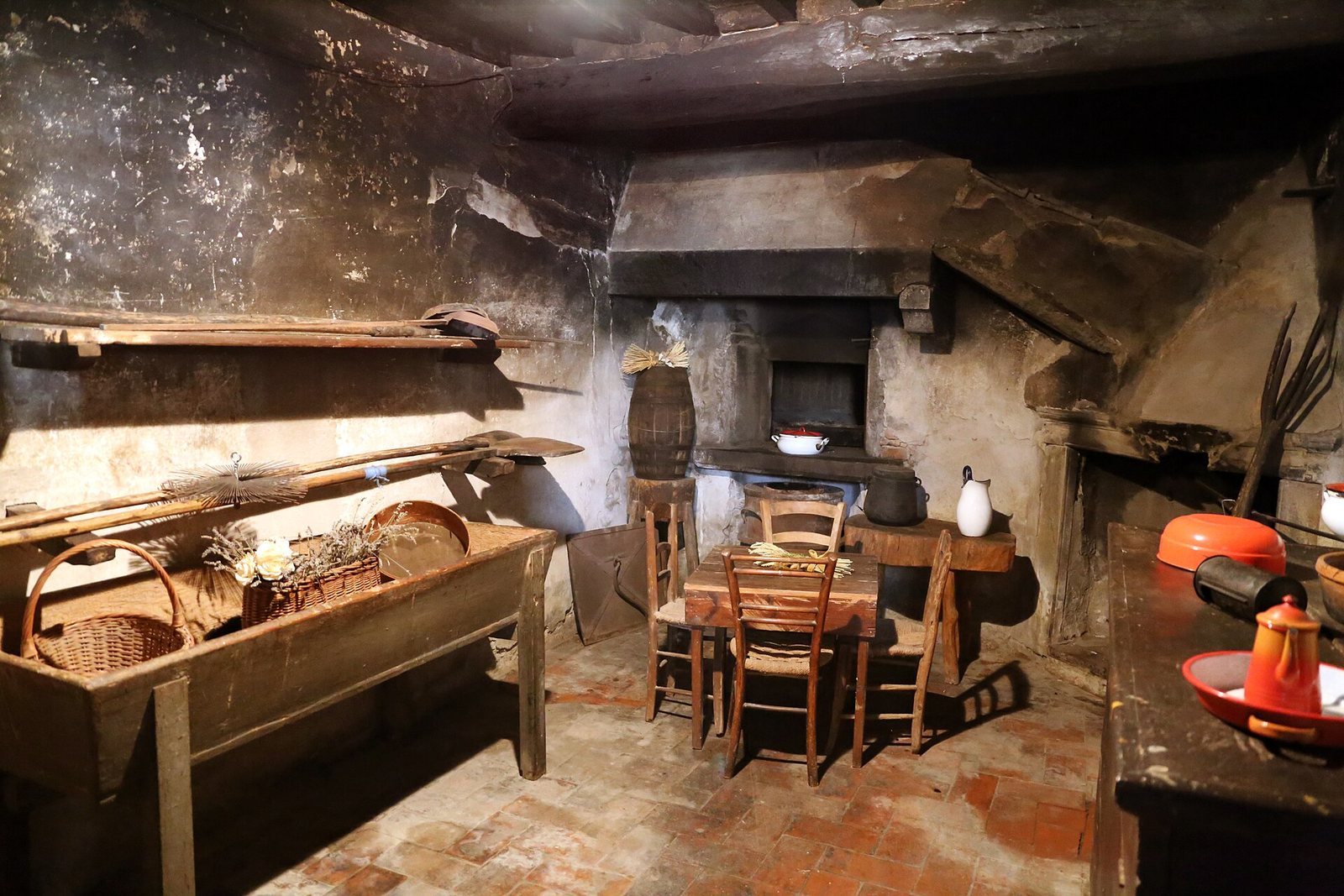
In July 1273, Bonaventure of Bagnoregio received the insignia of a cardinal, a senior Catholic Church official, and was appointed bishop of Albano, the head of a diocese, while staying at the convent. Tradition places the news in the kitchen: Bonaventure was washing dishes in a stone basin when he learned of his appointment.
Medici rebuilding and religious life
The Black Death brought the convent close to abandonment in 1349. Its fortunes changed when Cosimo de’ Medici the Elder, a leading Florentine political figure and arts patron, bought it in 1420 and paid for rebuilding and expansion. The architect Michelozzo designed major works, and Cosimo’s son Piero also contributed to the convent’s development. In 1427, a decree from Pope Martin V authorized the return of Franciscan religious life.
Around 1430, Cosimo established a library of valuable books and manuscripts. The choir also had three lecterns for books of Mass chants and chants for the Divine Office. Eighteen illuminated choirbooks by Fra Angelico were later held at Florence’s Museum of San Marco. Other illuminated manuscripts went to the Biblioteca Medicea Laurenziana, while books printed before 1501 were transferred to the Moreniana and Riccardiana libraries. Most of the silver objects and vestments Cosimo had provided were dispersed.
The convent also acquired works of art that later left its church. Fra Angelico’s Bosco ai Frati Altarpiece, painted on wood in tempera between 1450 and 1452, is now in the Museum of San Marco. Nicolas Froment’s triptych, signed in 1461 and commissioned by Francesco Coppini, came to the church after Coppini fell from favor. It remained there until the suppressions under Napoleon and is now in the Uffizi.
The convent was badly damaged in the 1542 earthquake, particularly its bell tower. In 1564, a chapel dedicated to the Annunciation and St Bonaventure was built beside the older part of the church. Giuliano Ughi della Cavallina, a sixteenth-century Observant Franciscan, a branch of the order emphasizing strict observance of its rule, wrote about the convent’s origins and development. He died there and was buried there.
Suppressions and restoration
Napoleon’s government suppressed the convent in 1811 as part of its suppression of religious institutions. The friars returned after Napoleon’s fall, but the Italian government suppressed the community again in 1866. Marquis Carlo Gerini bought the property at auction in 1869, restored the church, and returned the convent to the Franciscans in 1870. In 1949, the Gerini family gave the convent’s properties to the Tuscan province of the Order of Friars Minor.
During the 1910s or 1920s, the chapel of the Annunciation and St Bonaventure was demolished, and a mortuary chapel was made in a crypt. Giuseppe Castellucci later carried out further restoration work. A crucifix that had been kept in the sacristy, perhaps made by Baccio da Montelupo, was stolen in 1979.
Remains
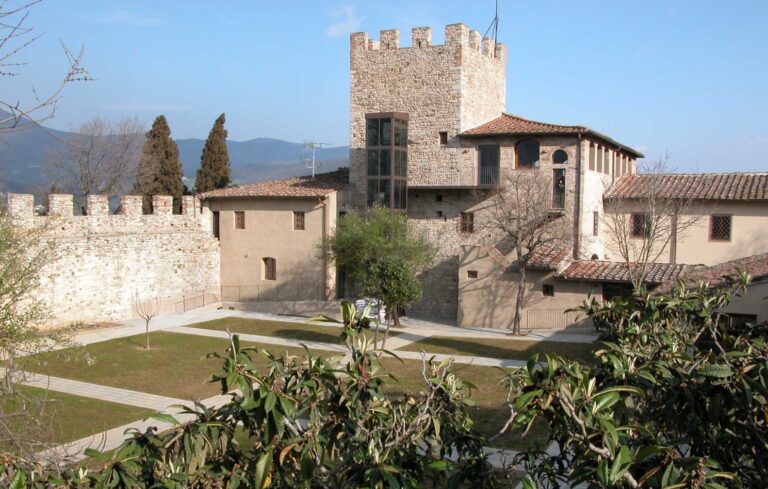
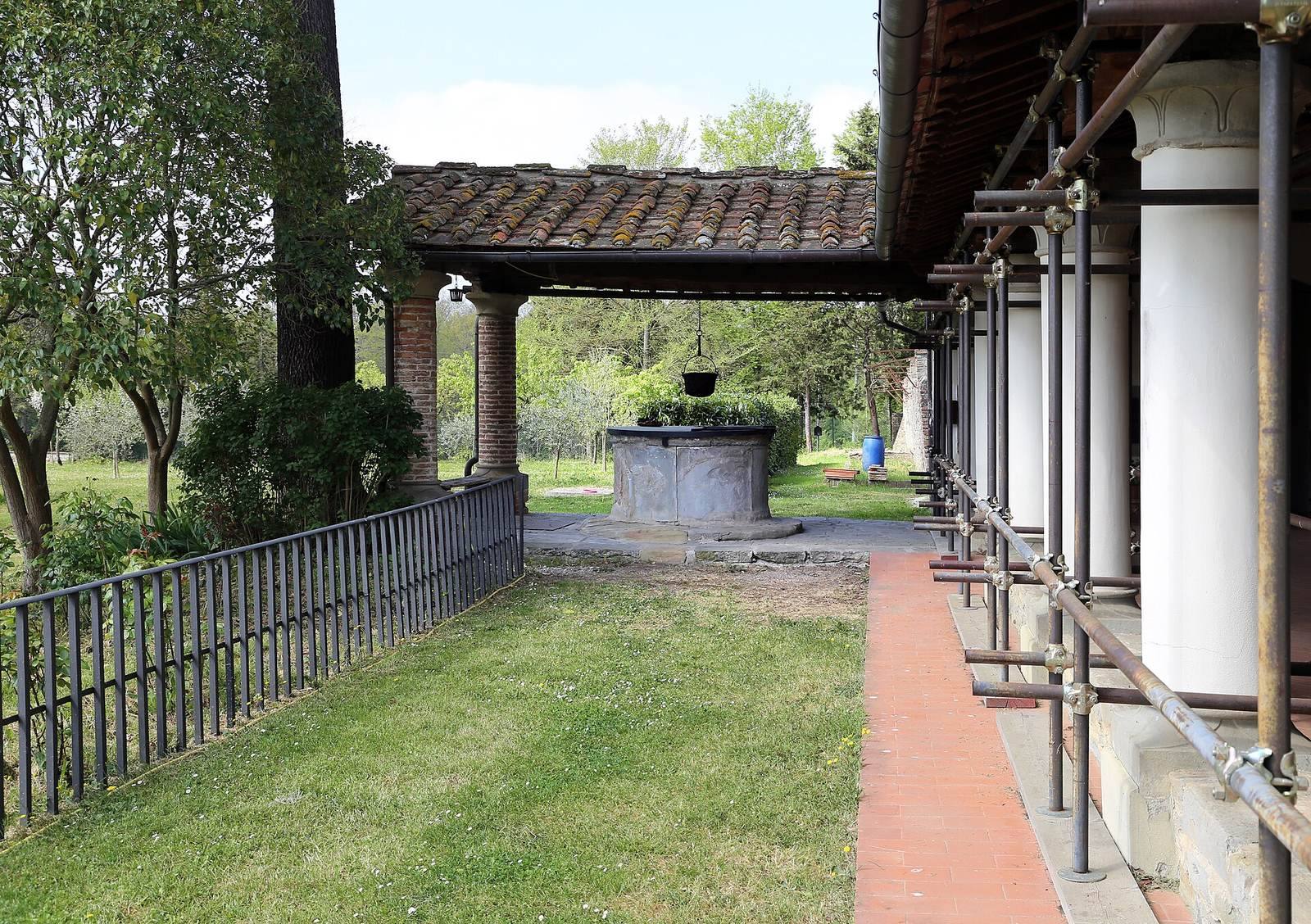
Set among Turkey oak woods, the complex brings together the church, cloister, bell tower, sacristy, cistern, loggia, and refectory. The cloister, enclosed in 1611, connects with the refectory and a kitchen garden adjoining the friars’ cells. A rear building with a portico leads into the garden. Renaissance design and medieval architectural features are both present in the surviving buildings.
The church
Plan and construction
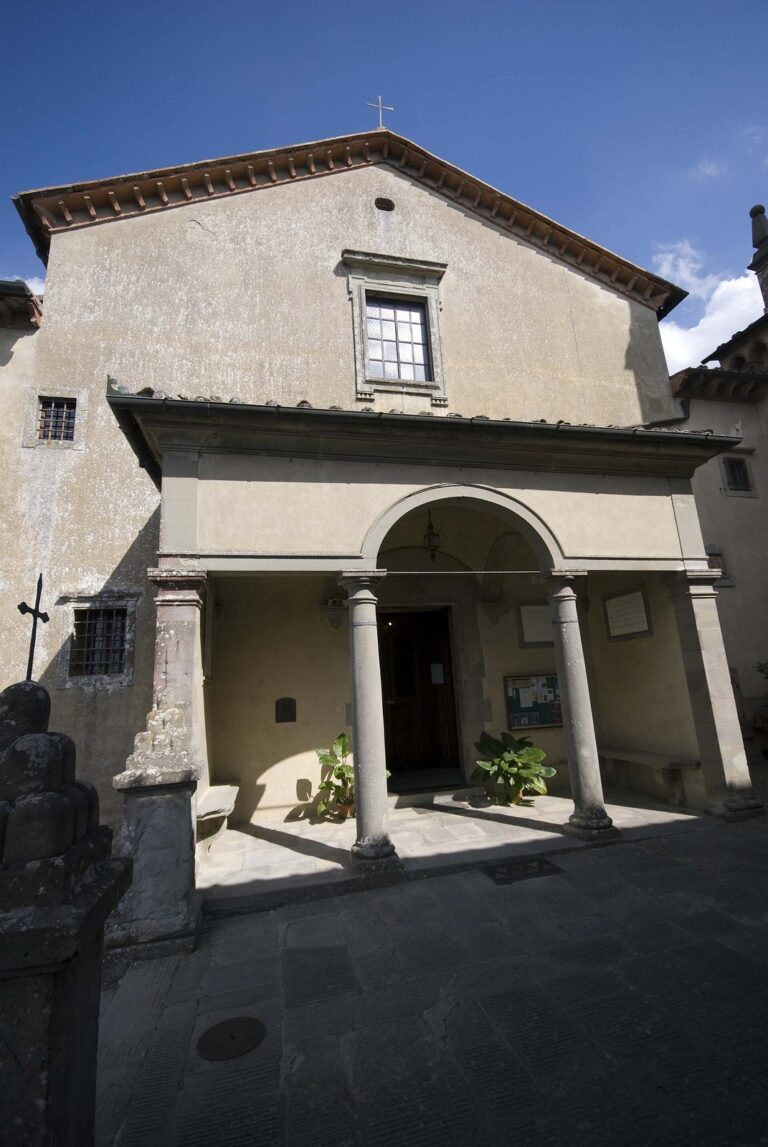
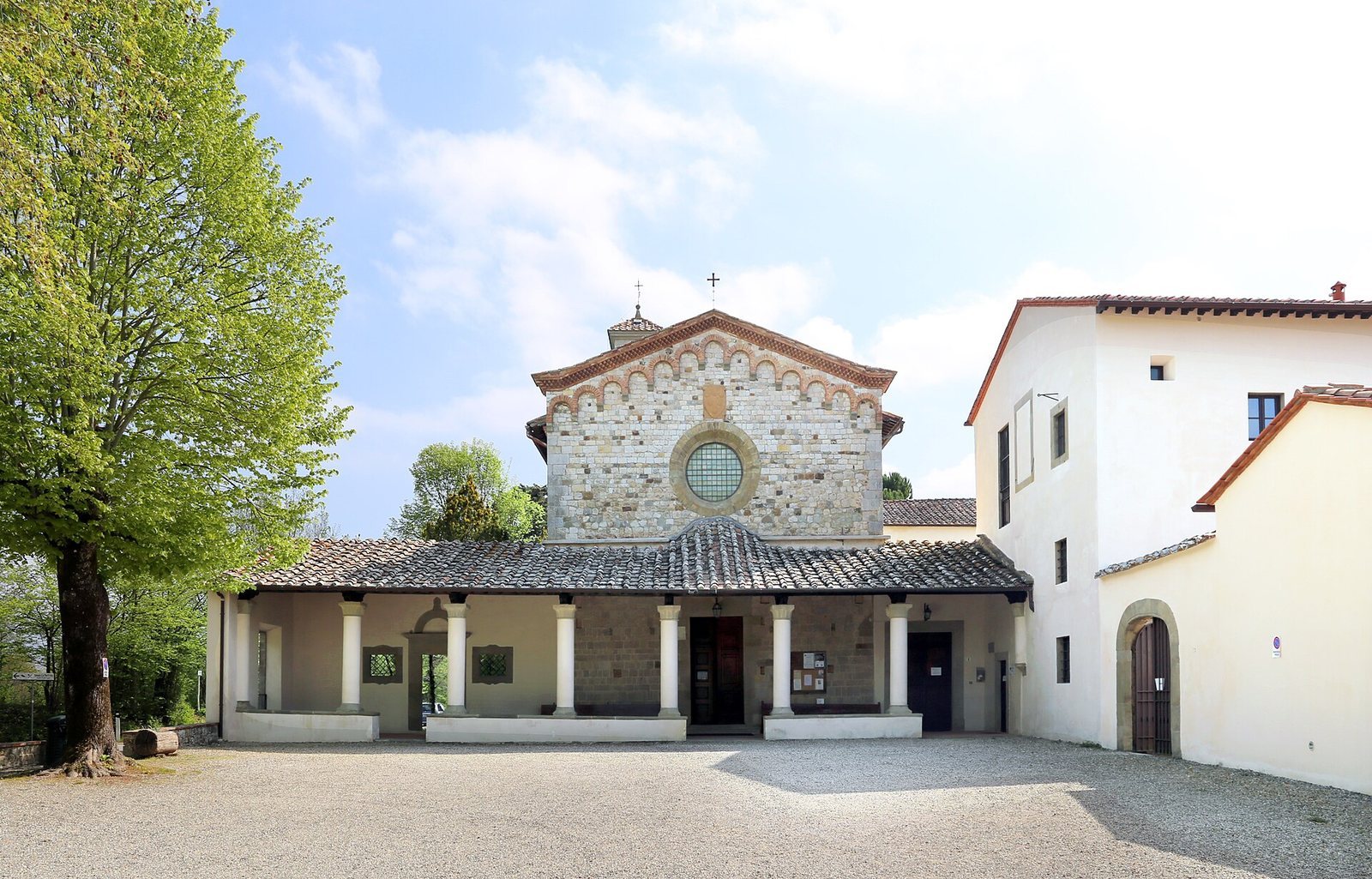
The church is a modest hall without columns. Carefully cut stone blocks form its facade, which has a large circular window and a double-sloping top. Small arches beneath the eaves were added during Castellucci’s twentieth-century restorations. A masonry portico with a timber roof stands in front. The entrance portal probably belonged to the thirteenth-century building and was incorporated into the fifteenth-century church. A second portal on the left side of the facade, dated 1564, opens onto a lawn and survives from the demolished chapel.
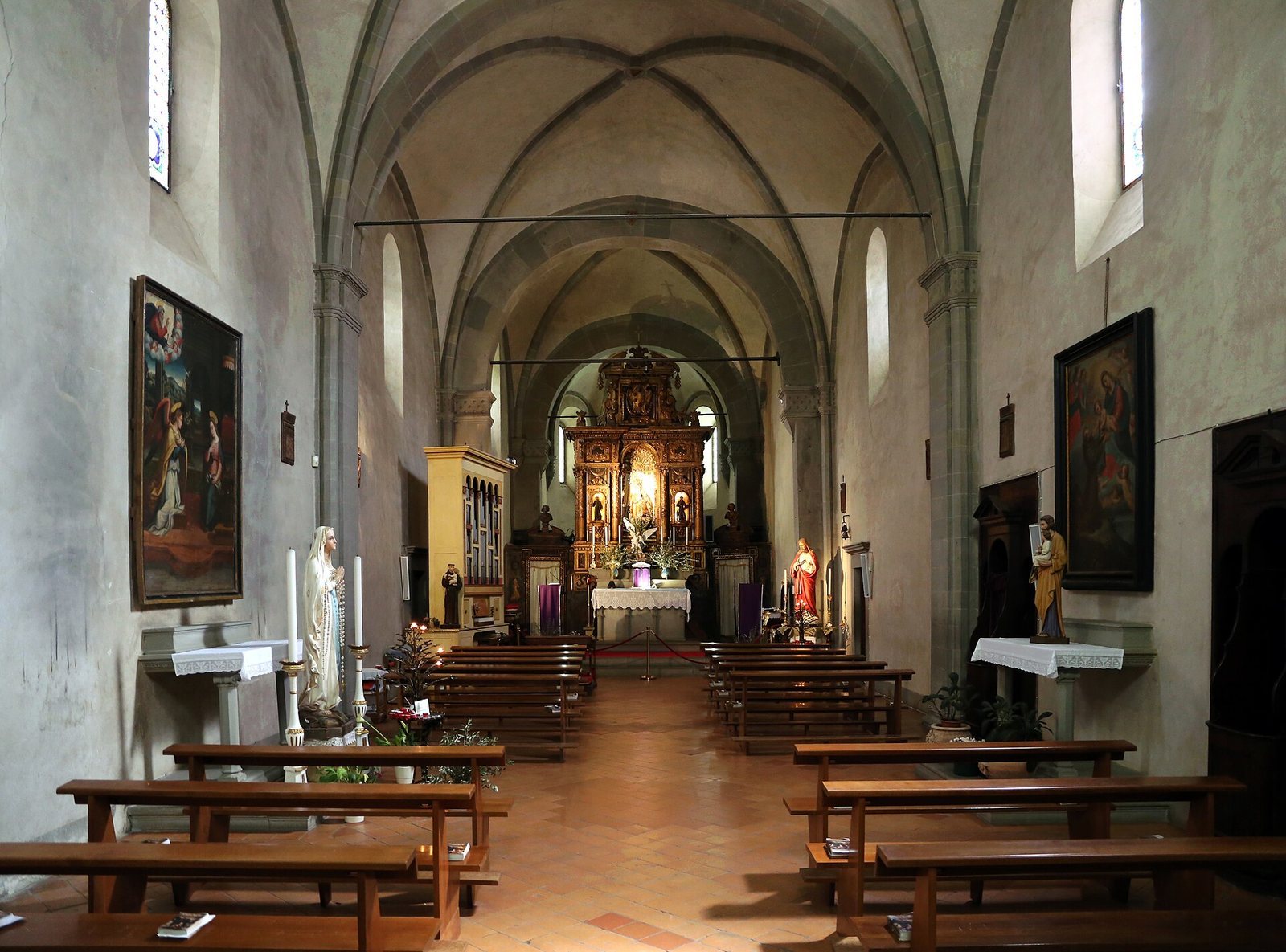
Inside, four square bays have rib-vaulted ceilings, with projecting ribs dividing the ceiling into sections. The ribs are gray sandstone and meet pilasters along the walls. The enlarged choir has a many-sided plan and retains late Gothic features in its vaulting and framing.
Paintings and high altar
A painting of the Deposition by Lodovico Cardi, known as Cigoli, hangs on the right wall. It was probably made with help from his workshop in the early seventeenth century. Nearby is an early-seventeenth-century painting of the Madonna presenting the Child to St Francis, attributed to Vincenzo Rustici after its restoration in 2018.
On the left wall, an Annunciation attributed to Antonio del Ceraiolo dates to the 1520s. Its figures and grand architectural setting reflect interest in the work of Fra Bartolomeo and Mariotto Albertinelli, while the scene opens onto a softly rendered, luminous landscape. Also on this side is Jacopo Ligozzi’s signed and dated 1589 painting, the Allegory of the Cord of St Francis. Commissioned by Grand Duke Ferdinand I, who appears on the right, it uses dramatic lighting and animated figures.
At the end of the nave stands a carved, gilded wooden altarpiece commissioned by Grand Duke Ferdinand II in 1626. Its elaborate frame bears the Medici arms above three niches. The central niche holds a statue of the Immaculate Conception from the same period, later repainted; the side niches contain anonymous statues of St Francis and St Bonaventure, sometimes associated with the style of Andrea Sansovino. The painting of the Immaculate Conception that the statue replaced is preserved in the convent.
The altarpiece’s reverse has paintings of St James of the Marches and St Bernardino of Siena, along with scenes from the lives of St Catherine of Siena and St Dominic. An Ubaldini coat of arms, set behind a small door, recalls the family’s original patronage.
Convent buildings and garden
Cloister and refectory
The cloister gives access to the enlarged refectory and to the kitchen garden beside the friars’ cells. The refectory has a vaulted ceiling. At its end, a relief of the Last Supper by Father Edoardo Rossi, dated 1934, decorates a curved wall panel.
Chapel of St Bonaventure
Reached from the area around the cloister, the chapel of St Bonaventure stands on the loggia, a roofed, open-sided gallery, facing the garden. It contains the stone basin linked by tradition to Bonaventure’s dishwashing when he received news of his appointment in 1273.
Sacristy
The sacristy, a room where clergy prepare for services and sacred objects are kept, has a design associated with Michelozzo and contains large walnut cupboards. Its Florentine-school fresco of St Francis dates to around the turn of the fifteenth century.
Museum of Sacred Art
Wooden crucifix
The cloister houses the Museum of Sacred Art. In its chapter room, where the religious community meets, is a fifteenth-century wooden crucifix found in the church crypt in 1950. It was restored after the 1542 earthquake. Donatello is its principal attribution, although Desiderio da Settignano and Michelozzo have also been proposed. It may originally have stood above the high altar, and its style has been associated with Michelozzo’s work in the Mugello around 1430–1435.
Other works and objects
The museum holds ritual vestments and objects used in church services, some bearing the Gerini arms. It also contains paintings of St Helena and St Catherine of Alexandria attributed to Francesco Curradi.