Compton Castle: A Fortified Manor House in Devon


Site at a Glance
- Rating
- 4.2
- Popularity
- Low
- Country
- United Kingdom
- Primary era
- Medieval
- External website
- Open
- Eras represented
- Medieval, Early Modern
- Civilizations
- English
- Site type
- Domestic
- Remains
- Castle
On this page8 sections
History
Medieval origins
Compton Castle is a fortified manor house in the United Kingdom, in the village of Compton, Devon. Its history reaches back to the reign of Henry II, king of England from 1154 to 1189, when a castellated house was the seat of Sir Maurice de la Pole. After the manor passed to Sir Peter Compton, it became known as Compton Pole, while the village itself retained that name for a period.
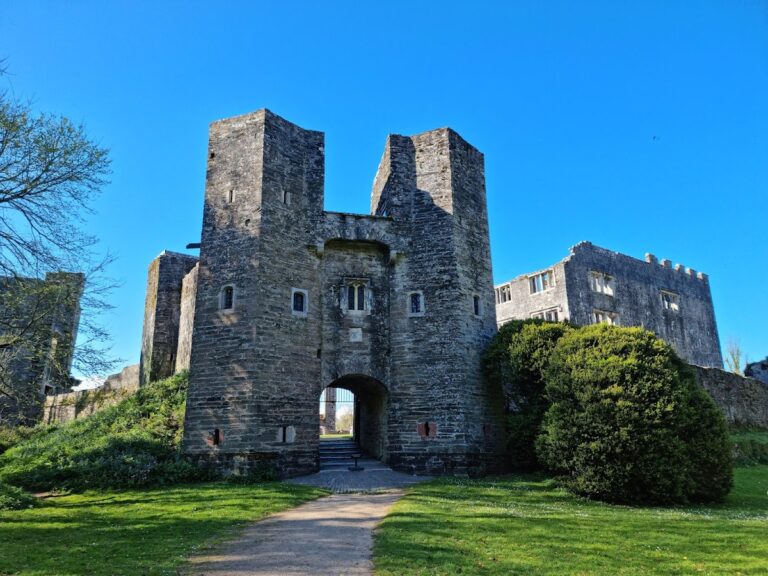
The original undefended manor house was built in the mid-fourteenth century. During the later Middle Ages, its hall, private solar, and service rooms were rebuilt. Around 1520, John Gilbert added the fortress-like front, giving the house much of its defensive character. The estate was associated with the Compton, de la Pole, Doddiscombe, Gilbert, and Templer families, although the Gilbert family occupied the castle for most of its history.
The Gilbert family and later history
Sir Humphrey Gilbert, the English explorer and coloniser associated with the attempted colonisation of Newfoundland, was the castle’s most famous inhabitant. His younger half-brother, Sir Walter Raleigh, was also associated with the house through a long-standing tradition. According to the legend, Raleigh smoked the first pipe of tobacco in Britain while visiting Humphrey Gilbert at Compton Castle.
The central hall had fallen into ruin by the eighteenth century. The estate was sold in 1785 and then declined gradually until a descendant of the Gilbert family bought it back in 1931. The great hall and other parts of the castle were extensively restored before the property passed to the National Trust in 1951. The gift was made on the condition that members of the Gilbert family could continue to live at the castle. They still do so and administer the property for the Trust.
Compton Castle is a Grade I listed group of buildings, a category in England reserved for buildings of exceptional architectural or historic interest. Its listing is dated 1952, and it has remained a National Trust property since 1951. The castle’s connection with the Gilbert family is also represented by a model of the Squirrel, the ship in which Humphrey Gilbert sailed to Newfoundland.
Remains
Plan and construction
The castle developed from a central hall flanked by a solar and service rooms at either end. The great hall was the principal communal room of the medieval manor house, while the solar, positioned west of it, served as a private retiring room. The buildings are constructed from limestone, sandstone, and granite, with slate roofing tiles. The central hall, once ruined, was faithfully reconstructed during restoration in the 1950s.
Fortified front and defenses
The fortress-like front dates from about 1520 and is associated with John Gilbert. Its defenses included two portcullises, heavy gates that could be lowered vertically during an attack. Loopholes overlooking the gateway allowed defenders to observe or fire at attackers, while openings in the enclosing curtain walls enabled stones and boiling oil to be dropped on those attempting to scale them.
Domestic buildings
The fifteenth-century staircase leading to the solar reflects the separation between the household’s private and communal spaces. The kitchen stands in a separate building because kitchen work created a fire risk. Beside its hearth, a stone staircase rises within a tower to a room probably used as a guard room. The great kitchen preserves evidence of medieval domestic life.
Gardens and family symbols
Small formal gardens are enclosed by a stone curtain wall. The Gilbert family crest shows a seated squirrel on a green hill feeding on nuts, an image also recalled by the model of the Squirrel associated with Humphrey Gilbert’s voyage.