Collegiate Church of Sant’Esuperanzio, Cingoli: A Regional Gothic Landmark


Site at a Glance
- Rating
- 4.6
- Popularity
- Low
- Country
- Italy
- Primary era
- Medieval
- External website
- Open
- Eras represented
- Medieval, Early Modern, Modern
- Civilizations
- Papal States
- Site type
- Religious
- Remains
- Church
On this page21 sections
History
The Collegiate Church of Sant’Esuperanzio is a medieval church in Cingoli, Italy, rebuilt from around 1250 in the late Romanesque and early Gothic traditions. Dedicated to Sant’Esuperanzio, a bishop of Cingoli and the town’s patron saint, it became the most important religious building in Cingoli and a major example of regional Gothic architecture.
Monastic origins and medieval rebuilding
The church is first documented on 24 May 1139, when Pope Innocent II confirmed its ownership to Fonte Avellana, a monastic abbey. A papal bull issued on 4 April 1184 and addressed to the abbot of Valfucina also lists Sant’Esuperanzio among the abbey’s possessions. The document indicates that the church may already have had approximately its present dimensions by that time.
After Sant’Esuperanzio was chosen as patron of Cingoli in the second half of the thirteenth century, the church acquired a more prominent place among the area’s religious institutions. Reconstruction of the present building began around 1250 on the site of earlier structures. Its portal was completed in 1295 during the priorship of Giacomo da Gubbio. The master named in the portal inscription, Giacomo, is identified with Giacomo da Cingoli, who is also associated with portals at San Francesco and San Niccolò in Cingoli and at Santa Maria della Castellaretta in Staffolo.
The municipal statutes of 1325 placed the church under the direct protection of the Comune, Cingoli’s municipal government. The connection with Fonte Avellana nevertheless remained visible in the building, including a fourteenth-century seal bearing the name of the abbey. Between the fourteenth and sixteenth centuries, worshippers commissioned frescoes that gradually covered the nave walls, while aristocratic families established chapels between the pillars.
Relics, chapels, and Renaissance devotion
The church was restored during the fifteenth century. Of the aristocratic chapels, the Silvestri chapel on the left and the Simonetti chapel are the surviving examples. Both contain Renaissance-style altars decorated with candelabra motifs.
On 24 January 1495, workers discovered the relics of Sant’Esuperanzio during repaving. The bones were placed in a sarcophagus, while the skull was enclosed in a gilded silver bust reliquary commissioned by the municipality in 1496 and attributed to Bernardino da Foligno. The discovery renewed devotion to the saint and strengthened the church’s role as the centre of his cult.
Between 1515 and 1518, Girolamo Nardini painted a Madonna and Child with Saints John the Baptist and Esuperanzio in the manner of Carlo Crivelli. The painting is now held by the Cingoli Municipal Art Gallery. Other commissions continued to shape the church’s interior, including the frescoes and altarpieces that remain in the building.
Early modern changes and collegiate status
During the plague epidemic of 1591, the church was used as a lazaretto, a building for isolating and caring for people during epidemics. Afterward, the interior was disinfected by burning bowls of sulfur and spreading quicklime over the walls, which were then whitewashed. The church’s monastic association also changed during the sixteenth century. A papal bull of 10 December 1569 suppressed the Avellanite congregation, closing the monastery of Sant’Esuperanzio and transferring its possessions to commendatory abbots, who held the abbey’s title and revenues without necessarily governing its monastic community directly.
In 1764, Pope Clement XIII raised the church to the rank of Insigne Collegiate Church. This status established a collegiate chapter of clergy, including canons and mansionaries, clergy assigned to particular liturgical or service duties. The change supported a major eighteenth-century renewal of the church’s imagery and furnishings.
Eighteenth- and nineteenth-century renewal
Between 1755 and 1777, the presbytery was raised to create a crypt for the saint’s relics and those associated with him. On 26 July 1777, the relics were transferred there in a solemn procession. Alessandro Ricci later painted seven vault frescoes illustrating the Life of Sant’Esuperanzio and produced four canvases, with work continuing into the early nineteenth century. Giuseppe Riposati painted the front and rear altarpieces in 1781.
In 1792, Gaetano Callido made the church organ, which was initially installed in the gallery above the sacristy. The collegiate church had previously held considerable goods and agricultural land, but Napoleon Bonaparte secularized it in 1810. The Italian government carried out a further secularization in 1861. In 1846, Alberando Leali designed the Neo-Gothic wooden choir behind the high altar, and on 15 August 1897 the church became a territorial parish.
Restoration and interpretation
Restoration in 1920 brought parts of the extensive fourteenth- to sixteenth-century fresco cycle back to light. The surviving medieval structure, later religious furnishings, and layers of painting preserve the changing functions of the church from monastic possession and civic-protected sanctuary to collegiate church and parish.
Remains
The church is built of sandstone and pink breccia and combines late Romanesque solidity with early Gothic forms. Its interior is approximately 15 metres wide, 33.50 metres long, and 14.10 metres high. The basilical plan has a single nave divided by six transverse pointed arches resting on rectangular pillars. These arches support a timber roof, while the building ends in a flat-ended choir with a tribune.
Façade and exterior features
Gabled façade
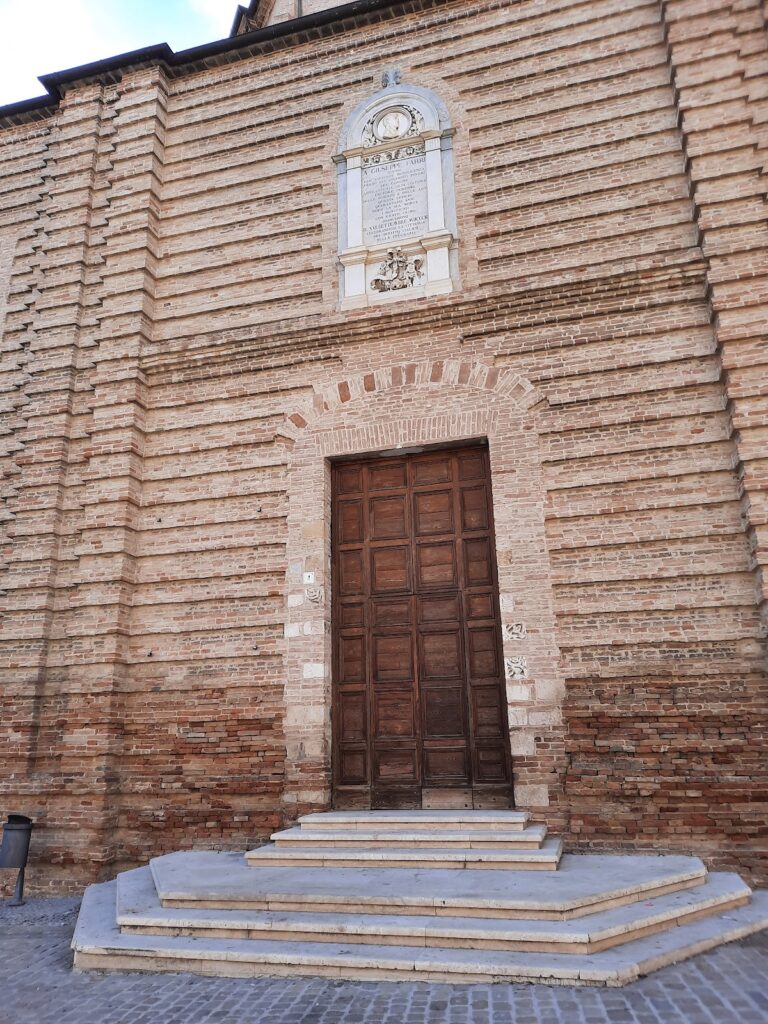
The simple gabled façade remains in exposed stonework. It was intended to receive a decorative marble facing, but that finish was not carried out. A small rose window occupies the centre of the front, above a single richly carved portal.
Carved portal
The portal has a concave recess formed by a series of columns and a rounded arch. Its architrave shows the Mystic Lamb between the symbols of the Evangelists. A Gothic inscription states that the work was completed in 1295 during the priorship of Giacomo da Gubbio and names its maker as Giacomo. The lunette contains a sculpted image of Sant’Esuperanzio between two angels holding thuribles.
Priory structure
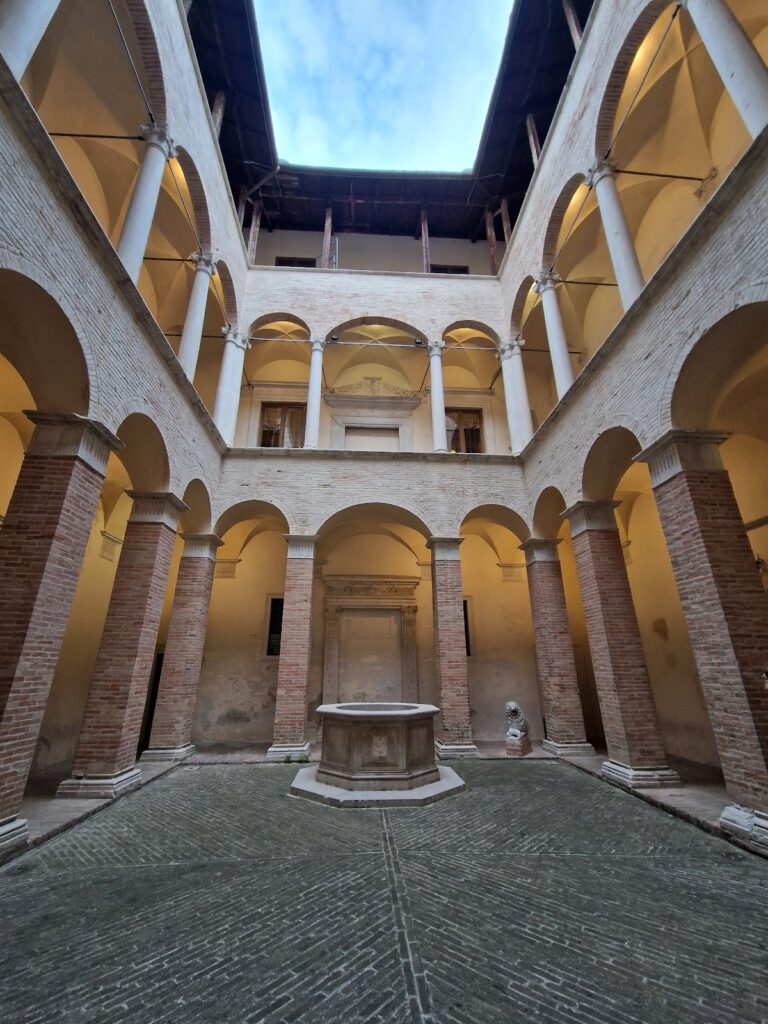
On the right side of the church, a priory structure has three arches supporting a loggia. This surviving feature recalls the building’s former connection with the monastic community and its associated religious administration.
Sanctuary, crypt, and chapels
Raised presbytery and crypt
The raised presbytery accommodates the crypt, where the relics of Sant’Esuperanzio and associated monks are preserved and venerated. One of the presbytery pillars contains a fourteenth-century sandstone seal bearing the inscription Sigillum Sanctae Crucis Fontis Avellanae, referring to Fonte Avellana Abbey.
Silvestri and Simonetti chapels
The Silvestri chapel on the left and the Simonetti chapel are the surviving aristocratic chapels. Their Renaissance-style altars include candelabra decoration. The Simonetti chapel also contains a thirteenth-century painted wooden crucifix and an altarpiece depicting the Flagellation, attributed to Sebastiano del Piombo.
Tribune decoration
The decorative program around the tribune includes sixteenth-century frescoes on the vault behind the high altar, where the Four Evangelists are depicted. The rear wall shows the Holy Spirit between angels with Saints Peter and Paul.
Frescoes and painted works
Right-hand altar fresco
At the second altar on the right is a fresco of the Madonna and Child with Saints Esuperanzio and Bernardino of Siena. Bernardino Brunetti commissioned it in 1503. It is the best-preserved and among the most notable in quality of the frescoes still in the church. The work has recently been attributed to Baldo de Sarofini and was formerly attributed to Antonio Solario.
Left-hand altar frescoes
The first altar on the left has a fresco of the Virgin and Child with Saint Catherine of Alexandria and Saint Ursula, accompanied by an Annunciation in the lunette. The work, formerly associated with the Vannucci family, dates to around 1434 and is attributed to Arcangelo di Cola of Camerino. At the third altar on the left, a 1508 fresco shows the Virgin and Child with Saints Roch and Sebastian and may be by Andrea da Jesi.
Counterfaçade Pietà
The counterfaçade contains a fifteenth-century Pietà with Saints Anthony Abbot, John the Baptist, and Christopher. It is attributed to Arcangelo di Cola and forms part of the surviving painted decoration within the nave.
Polyptych and sacristy panel
In the second half of the fifteenth century, Giovanni Antonio Bellinzoni da Pesaro produced a polyptych, a connected multi-panel artwork, showing the Madonna and Child with Saints Pier Damiani, Esuperanzio, Stephen, and Bonfilio. The sacristy preserves a panel of the Marriage of the Virgin with Saint Sperandia by Antonio Liberi of Faenza.
Architectural connections
The present arrangement reflects the essential forms of Gubbio Cathedral, whose main architectural structure was completed by 1229. At Sant’Esuperanzio, this medieval model survives alongside later chapels, paintings, furnishings, and the eighteenth-century crypt, allowing the building’s Romanesque and Gothic framework to be read together with its later transformations.