Clos Lucé: Leonardo da Vinci’s Residence in Amboise


Site at a Glance
- Rating
- 4.5
- Popularity
- Very High
- Country
- France
- Primary era
- Medieval
- External website
- Open
- Eras represented
- Medieval, Early Modern, Modern
- Civilizations
- French
- Site type
- Domestic
- Remains
- Palace
On this page14 sections
History
Clos Lucé is a château in Amboise, France, whose late-medieval buildings were transformed into a royal residence and later became known as Leonardo da Vinci’s final home. Built in the late fifteenth century on earlier Gallo-Roman foundations, the château combines late Gothic and Renaissance elements and is closely connected with the Château d’Amboise by an underground passage.
Medieval origins and royal acquisition
Formerly called Manoir du Cloux, Clos Lucé was a fief dependent on the Château d’Amboise. The lands of Lucé had been attached to that lordship from the fourteenth century. A recorded transaction shows Pierre du Perche transferring the Cloux estate to Marc Rabouin on 26 October 1460, while the late-medieval construction of the residence is dated to 1468–1471 and attributed to Hugues d’Amboise.
For a brief period, the buildings housed nuns from the Moncé priory. The estate was sold on 26 May 1471 to Étienne Le Loup, a royal councillor and bailli of Amboise. The buildings were then in ruins, and Le Loup restored them, reshaping the property into the fortified residence associated with Clos Lucé.
Charles VIII bought the château from Le Loup on 2 July 1490 for 3,500 gold écus. He adapted the medieval stronghold into a more comfortable residence, and Clos Lucé became the summer residence of French royalty for two centuries. In 1492, Charles commissioned an oratory, a small private chapel, for his wife Anne of Brittany. Anne lived at Clos Lucé until she left for the royal Château de Blois.
Royal household and the arrival of Leonardo
Between 1509 and 1515, Charles IV, Duke of Alençon, and Marguerite of Valois occupied the château. In 1515, the duke sold it to Louise of Savoy, who later governed France as regent, meaning that she ruled on behalf of an absent or otherwise unable monarch. Louise lived at Clos Lucé and raised her children there, including the Duke of Angoulême, the future Francis I, and Marguerite of Navarre.
In 1516, Francis I made the residence available to Leonardo da Vinci. Leonardo was an Italian Renaissance painter, engineer, architect, and draftsman whose work extended across art, scientific observation, engineering, and theatrical design. He arrived in France at the age of 64 with Francesco Melzi, Salaì, and his servant Batista de Vilanis. Francis I granted him a pension of 700 gold écus, bought his works, and appointed him First Painter, Engineer, and Architect of the King.
Leonardo lived at Clos Lucé for three years. He developed numerous projects, organized court festivities at Amboise, designed an ideal city for Romorantin, and planned canals intended to link two rivers and assist trade. His designs were also associated with the double spiral staircase at the Château de Chambord.
Cardinal Luigi d’Aragona visited Leonardo at Clos Lucé on 10 October 1517 and described the works he saw as being of “rare perfection.” On 19 June 1518, Leonardo organized a court fête at the château to thank Francis I for his patronage. Its elaborate machinery represented the celestial vault, planets, the sun, the moon, and the twelve signs of the zodiac.
Leonardo died in his room at Clos Lucé on 2 May 1519. He left his books, manuscripts, sketchbooks, drawings, and sketches to Francesco Melzi. The familiar story that Leonardo died in the arms of Francis I is an invented tradition rather than the documented event at the château.
Later ownership and public interpretation
Louise of Savoy briefly resumed possession after Leonardo’s death. Philibert Babou de La Bourdaisière and his wife occupied the château from 1523, and Michel de Gast, captain of the guards under Henri III, became its owner in 1583. In 1632, the marriage of Antoine d’Amboise to Michel de Gast’s granddaughter brought the château back to the Amboise family.
The property narrowly escaped pillage during the French Revolution and remained with the Amboise family until 1832. The Saint-Bris family had acquired the château by 1855, with the transfer recorded on 30 July that year. Hubert and Agnès Saint Bris opened it to the public in 1954, and extensive restoration followed during the 1960s. Jean Saint Bris continued the family’s work from 1979, while the family remained the owner.
Clos Lucé was listed as a protected historic monument in 1862. This status protects the property from demolition or reconstruction. The château subsequently developed into a museum and interpretive institution dedicated to Leonardo’s life, work, and memory. Rooms and gardens were reorganized and redecorated in the eighteenth century, and later alterations adapted the property for public visitation.
In 2017, eighteenth-century salons protected as historic monuments were removed and replaced by newly created interiors intended to evoke Leonardo’s period. The intervention led to notification of the regional cultural authorities to the public prosecutor. In 2021, two galleries devoted to Leonardo’s architectural and painting projects opened in a rehabilitated former industrial building, extending the site’s exhibition and interpretive functions.
Remains
The château and medieval fabric
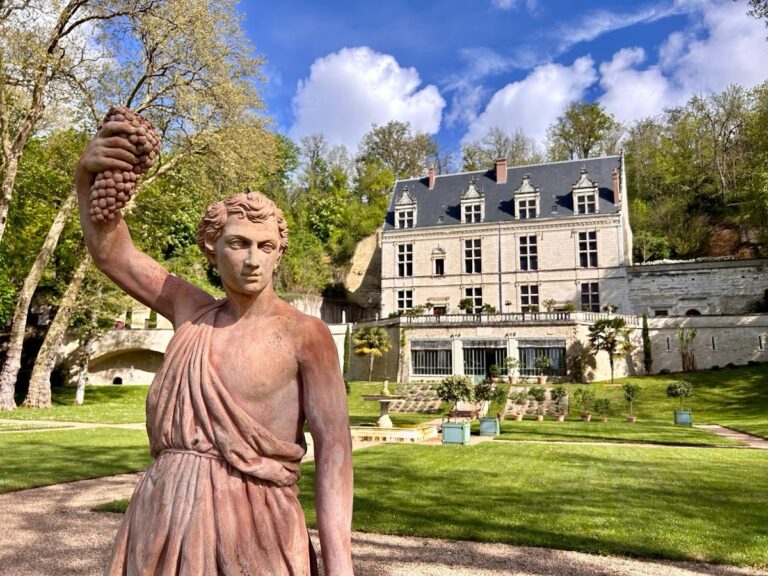
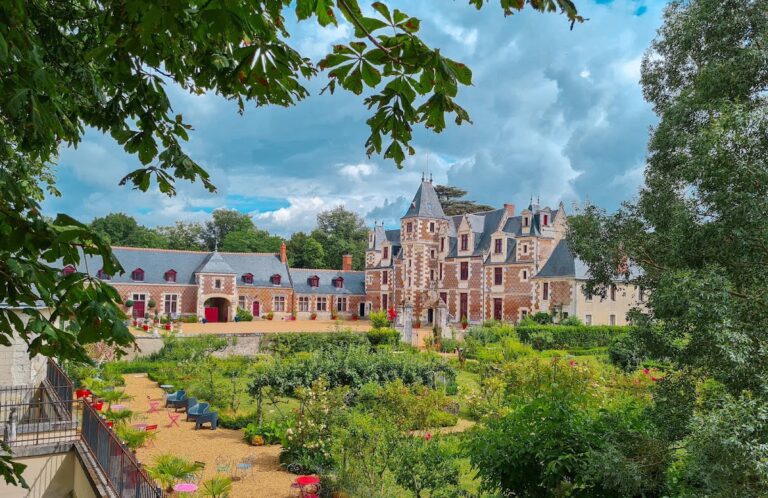
Clos Lucé is a late-Gothic and Renaissance residence arranged around an octagonal corner tower containing a spiral staircase. Two two-storey buildings meet the tower at right angles. The principal façade combines pink brick with white tuffeau, a soft limestone widely used in the Loire Valley, and retains the characteristic appearance of a fifteenth-century residence. Although the interiors have been altered extensively, this façade has remained almost unchanged since the Renaissance.
Fortifications and covered gallery
The medieval complex included defensive works, a square tower with Gothic windows, a watchtower, and a covered gallery connecting the watchtower with the right wing. An old rampart walkway survives as part of the château’s medieval fabric. These elements belong to the fortified phase of the residence before Charles VIII adapted it for more comfortable royal use.
Historic rooms and interpreted interiors
The château contains the council room, the oratory of Anne of Brittany, the room associated with Marguerite of Navarre, Leonardo’s death room, a kitchen, a great hall, and other historically themed interiors. The first-floor bedrooms, including Leonardo’s death room and Marguerite of Navarre’s room, were restored in 2011 with period-style details, furniture, and objects from various origins.
Several interiors created during the twentieth and twenty-first centuries interpret rooms that Leonardo might have used. They include a bedroom, a kitchen, and an imagined studio. The original appearance and furnishings of Leonardo’s rooms are not documented, and no original furniture from those spaces is known to survive. Other restoration work evokes the château during his residence through his bedroom, a basement studio, wall frescoes, and the high stone hearth in the kitchen. The museum also contains a copy of the Mona Lisa painted by Ambroise Dubois in 1654.
Chapel and estate grounds
Oratory of Anne of Brittany
The oratory commissioned for Anne of Brittany in 1492 is a Gothic chapel built of tuffeau stone. Its later wall paintings are attributed to Leonardo’s disciples and include an Annunciation, a Last Judgment, and a painting above the door called Virgo Lucis. This title may have contributed to the name Clos Lucé.
Park, watercourse, and pigeon house
The château stands within a seven-hectare park crossed by the Amasse, a small tributary of the Loire. The grounds include a garden presenting Leonardo’s studies of plants and a two-level bridge based on one of his sketches. A fifteenth-century pigeon house built by Étienne Le Loup also survives. It contains approximately 1,000 pigeon niches and could shelter up to 1,000 birds.
Leonardo exhibitions and models
Machines and outdoor displays
A cultural and educational route established in the park in 2003 includes sound terminals and twenty large machines inspired by Leonardo’s drawings. An open-air exhibition with forty translucent panels presents full-size models of inventions attributed to Leonardo, including a chariot, a multi-barrelled gun, an aerial screw, and a revolving bridge.
Basement models and 2021 galleries
Four basement rooms contain forty models made by IBM from Leonardo’s drawings and sketches. Three-dimensional animations demonstrate how the inventions operate. The rehabilitated former industrial building opened in 2021 provides approximately 500 square metres of exhibition space. Its displays include a multimedia reconstruction of the planned royal palace at Romorantin and Leonardo’s flying machines.
Clos Lucé is also associated with the three paintings Leonardo brought to France in 1516: the Mona Lisa, The Virgin and Child with Saint Anne, and Saint John the Baptist. These works are now held by the Louvre in Paris.