City Museum Rimini: A Civic Museum in Italy’s Historic Jesuit Complex


Site at a Glance
- Rating
- 4.5
- Popularity
- Low
- Country
- Italy
- Primary era
- Early Modern
- External website
- Open
- Eras represented
- Stone Age, Bronze Age, Classical, Medieval, Early Modern, Modern
- Civilizations
- Italian, Roman
- Site type
- Museum
On this page15 sections
History
City Museum Rimini is a civic museum in Rimini, Italy, founded in 1981 to continue the work of Luigi Tonini, the historian who established the city’s first civic museum. Since 1990, its collections have occupied a former Jesuit seminary and convent built between 1746 and 1755, giving the museum a setting closely connected with Rimini’s religious and civic history.
The Jesuit complex and civic hospital
The former complex was designed by the eighteenth-century Italian architect Alfonso Torreggiani for the Jesuits, the Catholic religious order formally known as the Society of Jesus. After the order was suppressed, the buildings passed to the Dominicans, another Catholic order associated with preaching, teaching, and theological study. In 1797, the complex became Rimini’s civic hospital, a function it retained until the hospital closed in 1977.
Bombing during the Second World War heavily damaged the buildings. Recovery and restoration were directed by the architect Pier Luigi Foschi, who later served as museum director from 1985 to 2010. His work returned the former convent to civic cultural use and made it possible for the museum’s collections to develop within the historic complex.
Development of the museum
The museum is an Italian cultural property with collections covering archaeology, the Middle Ages, modern art, ethnography, natural history, and historic houses. It stands beside the Church of the Suffrage and near the archaeological complex of the Domus del Chirurgo, a Roman private urban house discovered in Piazza Ferrari in 1989.
Since 2010, the museum has included a section tracing Rimini’s past from prehistory through late antiquity. Its chronological range begins with evidence of Homo erectus, an extinct human species of the Paleolithic or Old Stone Age, dating from about one million years ago. The displays continue through early ceramics and Bronze Age hoards, deliberately concealed groups of objects associated in archaeological interpretation with storage, trade, or metalworking.
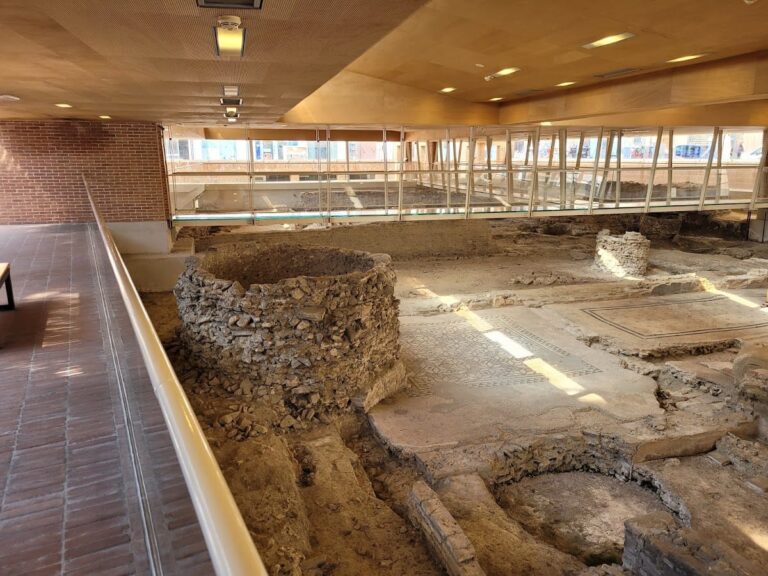
The archaeological section also presents material from the Domus del Chirurgo. That archaeological complex was inaugurated in 2007, and a glass structure encloses the Roman remains in Piazza Ferrari. More than 150 ancient Roman surgical instruments from the house form an especially notable medical assemblage because of their number and variety.
Alongside its archaeological displays, the museum holds a substantial collection of medieval and Renaissance painting, including works associated with the Rimini school. Its permanent presentation also includes works by the fashion illustrator René Gruau and a display of Federico Fellini’s Libro dei sogni, or “Book of Dreams.” Other rooms accommodate temporary exhibitions and cultural displays. In 2015, the museum garden was dedicated to the archaeologist Khaled al-Asaad, who was murdered at the archaeological site of Palmyra in Syria.
Remains
The former seminary and convent
Historic Jesuit buildings
The museum occupies the former Jesuit seminary and convent at Via Luigi Tonini 1, at the corner of Piazza Ferrari, beside the Church of the Suffrage. The complex was constructed between 1746 and 1755 to designs by Alfonso Torreggiani. Its later use as a Dominican institution and civic hospital forms part of the building’s physical history, while postwar recovery adapted the surviving complex for museum purposes.
Cloister courtyard
The cloister courtyard contains a Roman lapidarium dedicated to Professor Giancarlo Susini. A lapidarium is a display of inscribed or sculpted stones, particularly ancient architectural and funerary pieces. First arranged in 1981, the courtyard presentation includes inscriptions dating from the first to the fourth centuries.
Archaeological displays
Basement collections
The basement contains archaeological material from the Domus del Chirurgo and mosaics discovered in Palazzo Diotallevi. These displays bring together remains from the Roman house with decorated architectural material recovered elsewhere in Rimini.
Domus del Chirurgo
The Domus del Chirurgo dates to the second half of the second century. A domus was a private Roman urban house, generally arranged around interior rooms and courts rather than planned as a public monument. The remains preserve mosaics and frescoes, while the more than 150 surgical instruments connect the building with Roman medical practice. The ruins in Piazza Ferrari are enclosed by a modern glass structure that allows the excavated remains to be viewed within their archaeological setting.
Prehistory and the Bronze Age
The section devoted to prehistory and late antiquity includes chipped and polished flints associated with early human presence on Covignano Hill. The objects include arrowheads, leaf-shaped blades, axes, and perforated hammers. Their forms are comparable with material from Cà Belvedere di Monte Poggiolo near Forlì.
Early ceramic forms are also displayed, including small jars, bowls, and flask-shaped vessels with smooth or decorated surfaces. They were used to contain seeds and liquids. Bronze Age hoards add groups of objects deliberately concealed by merchant-founders, extending the archaeological sequence from early human activity to later prehistoric economies and metalworking.
Painting gallery
Medieval and Renaissance works
The museum’s pinacoteca, a gallery devoted primarily to paintings, occupies the ground and first floors. Its works date from the eleventh to the twentieth century and include a large Last Judgement fresco attributed to Giovanni da Rimini and a Last Supper attributed to Benedetto Coda.
The collection includes Giovanni Bellini’s Pietà, dated to about 1470, as well as Giovanni da Rimini’s Crucifix. Other works associated with the Rimini school include Giovanni Francesco da Rimini’s Saint John the Baptist and The Virgin Mary, painted on the panels of a painted cross; Lattanzio da Rimini’s Holy Conversation; Francesco da Cotignola’s Saint Veronica and the Veil; Girolamo Marchesi’s Saint Bishop; and Giuliano da Rimini’s Coronation of the Virgin and Saints.
Domenico Ghirlandaio is represented by the San Vincenzo Ferrer Altarpiece, begun by Ghirlandaio and completed in 1496 by members of his workshop, and by a Pietà. Jan Baegert’s works include the Annunciation and Christ before Pilate. The gallery also contains Pomponio Amalteo’s Deposition, Niccolò Frangipane’s March to Calvary, Bittino da Faenza’s Crucifixion, and works by Benedetto and Bartolomeo Coda with their workshop, including Virgin and Child with Saints and Angels and Marriage of the Virgin.
Religious and Baroque painting
The gallery’s religious paintings extend into the Baroque period. Guercino’s works include Saint Jerome and Saint Anthony of Padua, while Guido Reni is represented by the seventeenth-century Saint Joseph with the Christ Child. The collection also holds a copy of Reni’s Saint Joseph and the Christ Child, Simone Cantarini’s Saint James in Glory, Paolo Veronese’s San Giuliano Altarpiece, Francesco Maffei’s Scenes of the Apocalypse, Giovan Battista Langetti’s Temptation of the Philosopher, and an Adoration of the Shepherds attributed to a seventeenth-century Neapolitan master.
Guido Cagnacci is represented by The Calling of Saint Matthew, Saint Anthony the Abbot with Two Saints, Saint Peter, Saint Francis, Portrait of a Young Priest, and Cleopatra. Giovanni Francesco Nagli, known as Il Centino, contributed David and Goliath, Moses and the Brazen Serpent, Saint Bishop, and Saint John the Evangelist.
Several paintings came from the former Oratory of Santa Maria in Acumine, which was suppressed in 1798. These include the works by Il Centino, Bernhard Keil’s Jewish Passover and David Playing the Harp before Saul, and paintings by Carlo Leoni and Giovanni Laurentini, known as L’Arrigoni. Guercino’s Saint Jerome came from the Oratory of the Confraternity of Saint Jerome, a religious association of lay members, while his Saint Anthony of Padua came from the Church of San Francesco di Paola.
Historical and civic subjects
Seven of the eleven original panels from Marco Marchetti’s cycle on Publius Cornelius Scipio during the Punic Wars survive in the gallery. The Punic Wars were conflicts between Rome and Carthage in the western Mediterranean. The surviving scenes are Conquest of Carthage, Punishment of the Rebel Leaders, Defeat of Hasdrubal, Fire of Orangis (Jaén), Defeat of Hanno, Offering the Crown to the Valiant Soldiers, and Continence of Scipio. Marchetti, a sixteenth-century painter associated with Giorgio Vasari’s circle, created the cycle for the Sala Nobile, the principal reception room, of Palazzo Marcheselli-Lettimi.
Further works include paintings by Giovanni Battista Costa and Giuseppe Soleri Brancaleoni, along with Clemente Albèri’s Paolo and Francesca. The range of the gallery, from medieval religious imagery to Renaissance altarpieces, Baroque scenes, and historical subjects, reflects the breadth of the museum’s art collections, many of which belong to the Fondazione Cassa di Risparmio di Rimini.
Nearby sites