National Archaeological Museum of Palestrina: Collections of Ancient Praeneste


Site at a Glance
- Rating
- 4.7
- Popularity
- Low
- Country
- Italy
- Primary era
- Classical
- External website
- Open
- Eras represented
- Iron Age, Classical
- Civilizations
- Ancient Greek, Roman
- Site type
- Museum
On this page25 sections
History
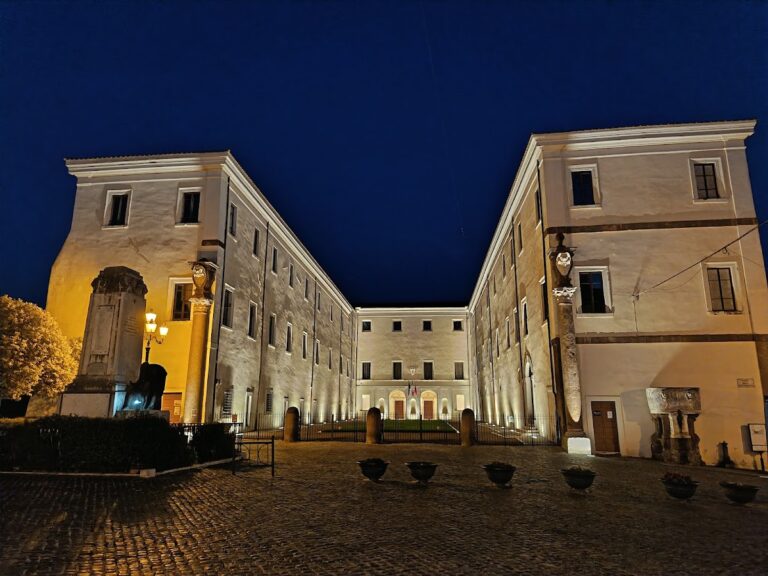
The National Archaeological Museum of Palestrina is an archaeological museum in Palestrina, Italy, devoted to the remains of ancient Praeneste and its surrounding sanctuaries. Inaugurated in 1956 and renovated in 1998, it occupies the Palazzo Colonna Barberini on the upper terraces of the Sanctuary of Fortuna Primigenia, a major Roman sanctuary dedicated to Fortuna, the goddess associated with fortune and destiny. Its collections bring together roughly 2,000 objects across an exhibition area of about 3,200 square metres.
Praeneste and the Sanctuary of Fortuna
The museum’s historical focus is the ancient city of Praeneste, whose religious, civic, funerary, and artistic life is represented throughout the building. A central subject is the cult of Fortuna Primigenia and the sanctuary that occupied the terraces beneath the palace. Objects associated with the sanctuary include a head of Fortuna found in a well on the upper terrace, probably from the cult statue itself.
The collections also illuminate the Hellenistic and Roman development of the city. They include sculpture, public and religious inscriptions, funerary inscriptions, material from urban cemeteries, and votive offerings from sanctuaries within and beyond the city. Together, these groups reflect the different settings in which religious practice, public commemoration, burial, and domestic or civic display took place at Praeneste.
Roman religious and civic life
Several works connect Praeneste with the religious imagery and political language of the Roman Republic and Empire. The museum displays a copy of the Fasti Praenestini, a Roman festival calendar developed between AD 6 and 10 by Verrius Flaccus, a grammarian and educator of the Augustan period. Fragments of the original calendar were found in the forum of Praeneste in 1770 and 1864. The original is now held by the Museo Nazionale Romano in Rome, while the copy allows the calendar’s connection with Praeneste to remain part of the museum’s presentation.
Imperial-era sculpture and altars further show how Roman religious and political themes appeared in the city. Among them are an altar dedicated to the deified Augustus, Rome’s first emperor, and two altars dedicated to Pax and Securitas, personifications of peace and security. A relief of the triumph of Trajan preserves its left half and combines conventions associated with official art with altered proportions and limited spatial depth characteristic of plebeian art.
Excavation, preservation, and administration
The museum’s present form results from the combination of archaeological excavation, the preservation of older collections, and the adaptation of the palace to museum use. The Nile Mosaic was removed in the early seventeenth century from an Isis sanctuary beside the basilica in the forum of Praeneste. It was taken to Rome and given to Cardinal Francesco Barberini before returning to Palestrina for installation in the Palazzo Colonna Barberini. Damage during transport led to a restoration that changed parts of the work.
An excavation undertaken by chance in 1999 and 2000 at the tenth milestone of the Via Latina, near the ancient locality of Ad Decimum and a short distance from Grottaferrata, brought another group of evidence into the museum. The finds came from the Garland Hypogeum and its burials, adding material from outside the urban centre to the collections devoted to Praenestine archaeology.
Since December 2014, the museum and the Sanctuary of Fortuna Primigenia have been managed by Italy’s Ministry of Culture. They were first administered through the Regional Museum Complex of Lazio and, since December 2019, through the Regional Museums Directorate. Under organizational regulations issued on 15 March 2024, the museum, the sanctuary, the Forum of Praeneste building complex, and the Archaeological Park of Gabii became cultural institutions with scientific, financial, organizational, and accounting autonomy. The Palazzo Colonna Barberini is also identified as Italian cultural heritage.
Remains
Palace, terraces, and surviving sanctuary structures
Palazzo Colonna Barberini
The museum is arranged within the Palazzo Colonna Barberini, a palace built across the upper terraces of the Sanctuary of Fortuna Primigenia. Its exhibition rooms occupy approximately 3,200 square metres. The ground-floor route begins in rooms opening to the left of the entrance atrium, while the upper level contains the large Nile Mosaic and a reconstruction model of the sanctuary. The model presents the ancient sanctuary’s appearance and organization as part of the museum’s archaeological interpretation.
Cortina Terrace and cryptoporticus
The front part of the palace’s ground floor incorporates the rear portico of the large Cortina Terrace. The terrace is now cut by a modern road, while its central section continues as a cryptoporticus, a covered or partly underground passage, beneath the curved seating area of the ancient theatre. This surviving passage forms the museum’s access staircase. It preserves several columns from the middle row with their Corinthian capitals, along with architectural fragments, sculptures, and inscriptions from different parts of Praeneste.
Tholos of the sanctuary
At the rear of Room XII, a glass floor reveals the foundations of the sanctuary’s tholos, a circular shrine. The structure formed the upper termination of the sanctuary and housed the cult statue. Its foundations remain integrated into the museum, linking the exhibition rooms directly with the ancient building beneath the palace.
Religious sculpture and Roman public art
Fortuna and Isis
Sala I contains an Isis-Fortuna statue from the Iseum, a sanctuary dedicated to Isis, the Egyptian goddess whose worship spread through the Roman world. The statue dates to the second century BC and is carved from gray marble from the island of Rhodes. The same room contains the head of Fortuna found in a well on the hemicycle terraces of the sanctuary. Its probable connection with the cult statue makes it an important part of the presentation of Fortuna Primigenia’s worship.
Hellenistic and Republican sculpture
Rooms II and III contain Hellenistic sculptures from Praeneste, including a veiled female head assembled from two different pieces of marble. Republican-period portraits and inscribed marble bases accompany the sculpture. Republican refers to the period before the establishment of the Roman Empire, and these works place local artistic production and public commemoration within that earlier phase of Roman history.
Imperial sculpture and altars
Rooms V and VI contain sculptures from the period of the Roman emperors. A relief of a sow suckling her piglets comes from the Grimani slabs, which originally decorated a fountain and were later reused in a Late Antique building in the lower city. The same rooms contain the altar dedicated to the deified Augustus, with his bust between cornucopias supporting a garland, and altars to Pax and Securitas decorated with ox-head motifs and garlands.
The surviving left half of the relief showing Trajan’s triumph uses the conventions of official art while also displaying features associated with plebeian art. Figures are given altered proportions that emphasize their relative importance, and the composition has little spatial depth. Rooms VII and VIII add a late-first-century-BC frieze showing a battle in a Hellenistic compositional scheme, together with part of an Attic sarcophagus, a coffin associated with the region of Attica, decorated with scenes connected with Dionysus. The sarcophagus dates to AD 170–180.
Funerary archaeology
Urban necropolises and grave goods
Room IX presents grave goods from Praeneste’s urban necropolises, or cemeteries, dating from the fifth to the third centuries BC. The material comes from both excavated contexts and the Barberini collection, whose owners possessed the palace from the seventeenth century. Bronze cistae, containers often elaborately decorated, and bronze mirrors with engraved scenes form an important part of the display. During the fourth century BC, Praeneste was one of the principal production centres for bronze cistae.
Funerary markers and sarcophagus
Room X contains funerary cippi, commemorative markers used to identify graves. Their forms include pinecones and female busts, and many bear inscriptions naming the deceased. Room XI preserves the lid of a roof-shaped sarcophagus with a pediment and carved frieze. This piece dates to the beginning of the fourth century BC and provides another example of the forms used to mark and furnish burials at Praeneste.
Garland Hypogeum
Room XII displays finds from the Garland Hypogeum at Ad Decimum. The small underground tomb was built from squared peperino blocks and contained two marble sarcophagi arranged in an L-shaped layout. The burial group extends the museum’s funerary evidence beyond the urban necropolises and preserves the relationship between the tomb’s construction and its sarcophagi.
Ring of Carvilius
The same room displays the Ring of Carvilius, a gold ring set with an oval crystal gem. Its polished, convex outer surface was hollowed to produce a lens-like effect. Through the crystal appears a realistic portrait of a young man with a lean face, a dreamy expression, and thick curls. The portrait was made in solid gold by the lost-wax technique, in which a wax model is replaced by molten metal, and was finished with chasing and engraving.
Floors, votive offerings, and sacred decoration
Republican pavements
The large central Room XII is used for temporary exhibitions and also contains Republican-period pavements. One of them is an opus scutulatum floor, a Roman pavement made with small geometric stone or marble insets. It came from the Sanctuary of Fortuna Primigenia and dates from between the end of the second century BC and the beginning of the following century.
Votive offerings
Rooms XIII and XIV contain terracotta votive offerings from the Sanctuary of Hercules, which stood outside the walls of the lower city where major communication routes crossed. The rooms also include votive material from other places of worship within the city. These objects present the range of religious offerings associated with Praeneste’s sanctuaries and urban sacred spaces.
Archaic and later architectural decoration
Room XV contains fired-clay architectural fragments from archaic sacred areas at San Rocco and Santa Lucia, near two of the city’s principal entrances. They include a sixth-century-BC sima frieze, a raised gutter or roof rim, showing a procession of chariots. A later frieze, dated from the late fourth to the early third century BC, depicts a fight between griffins.
Nile Mosaic and the Iseum
Nile Mosaic
Room XVI contains the Nile Mosaic of Palestrina, which depicts the river’s course from the borders of Ethiopia to the Mediterranean. Animal hunts appear across the scene, with their subjects identified by Greek inscriptions. Temples and cities are included, and the port of Alexandria occupies the lower right. The mosaic was made at its original location with small tesserae, the individual pieces set into a mosaic, using a refined technique. Alexandrian artists probably produced it, and their presence in Italy is known for the second century BC.
Obelisk fragments
Two fragments of a red-granite obelisk are also displayed in Room XVI. They bear imitation hieroglyphs and belong to the period of the emperor Claudius. The fragments probably came from the same Iseum beside the forum basilica as the Nile Mosaic, connecting the room’s large pavement with the Egyptian sanctuary from which it was removed.