Saint Demetrius Church, Veliky Novgorod: A Medieval Orthodox Church


Site at a Glance
- Rating
- 4.9
- Popularity
- Medium
- Country
- Russia
- Primary era
- Medieval
- External website
- Open
- Eras represented
- Medieval, Early Modern
- Civilizations
- Novgorod Republic, Russian
- Site type
- Religious
- Remains
- Church
On this page6 sections
History
Saint Demetrius Church is a Russian Orthodox cross-domed church in Veliky Novgorod, Russia, founded in 1381 and completed in 1382 during the medieval period of Novgorodian architecture. Its construction commemorated Dmitry Donskoy’s victory over Mamai at the Battle of Kulikovo in 1380, a victory traditionally regarded as an important stage in Moscow’s struggle with the Mongol-Tatar rulers. The church is dedicated to Saint Demetrius of Thessalonica, an early Christian martyr and soldier-saint widely venerated in Eastern Orthodoxy.
From wooden church to stone foundation
A wooden church stood on the site by 1261, when it burned on 22 November. A stone replacement was founded on historic Slavkov Street in 1381. Novgorod’s bishop Alexei consecrated the completed building in 1382, accompanied by priests and the choir of Saint Sophia Cathedral.
The new church reportedly began to collapse soon after its construction. It later suffered repeated fires and was restored several times. Following one of these fires, a major rebuilding took place in 1463, using the earlier foundations and forms. In the fifteenth century, the church contained altars dedicated to Saint Demetrius of Thessalonica and the Beheading of John the Baptist. Later additions included an altar for Boris and Gleb on the galleries and, in 1810, a western altar dedicated to Nil Stolobensky, a Russian Orthodox hermit and saint associated with Nilov Monastery on Stolobny Island. Boris and Gleb, brothers and the first saints canonized in Kievan Rus, are venerated in the Orthodox tradition as martyrs.
Parish life and modern history
Saint Demetrius Church remains a parish church of the Russian Orthodox Church and belongs to the Novgorod Eparchy. From 2005, the Russian Orthodox Old-Rite Church community sought its transfer. In July 2012, the church was transferred to the Novgorod Eparchy of the Moscow Patriarchate under federal legislation governing the transfer of state- and municipally owned religious property.
The church suffered comparatively limited damage during the Second World War. The crowning element of its cupola was lost, while the drum and domed vault survived. The roofs and ceilings of the western and southern chapels were destroyed, but the bell tower remained undamaged. Restoration was carried out from 1947 to 1949 with the participation of Lyubov Shulyak and P. N. Maksimov.
Saint Demetrius Church is an officially protected cultural-heritage monument of federal significance in the Russian Federation. It also forms part of the cultural heritage of Veliky Novgorod, recognized as a UNESCO World Heritage property in 1992.
Remains
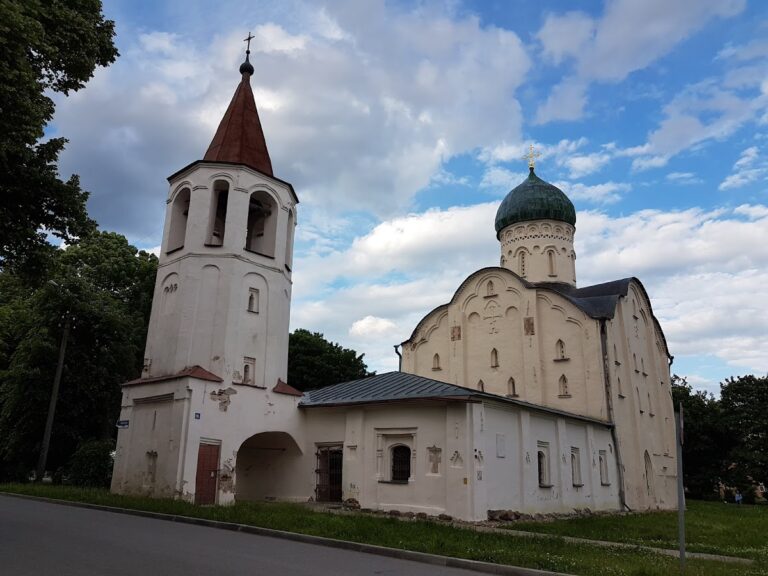
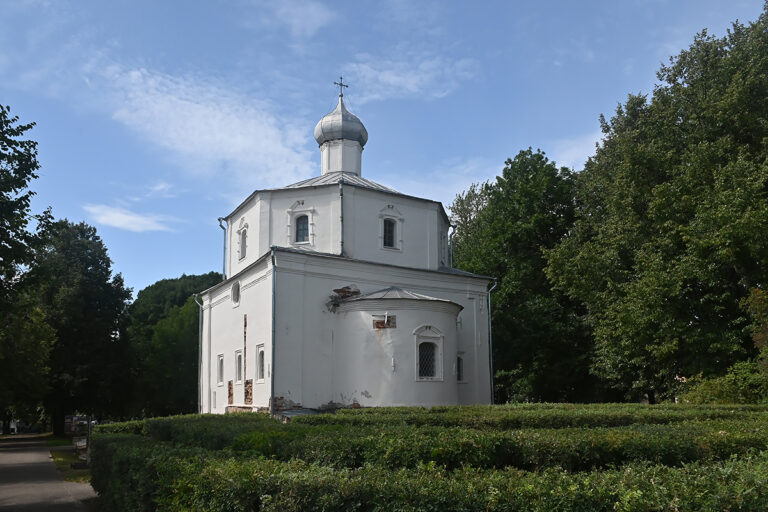
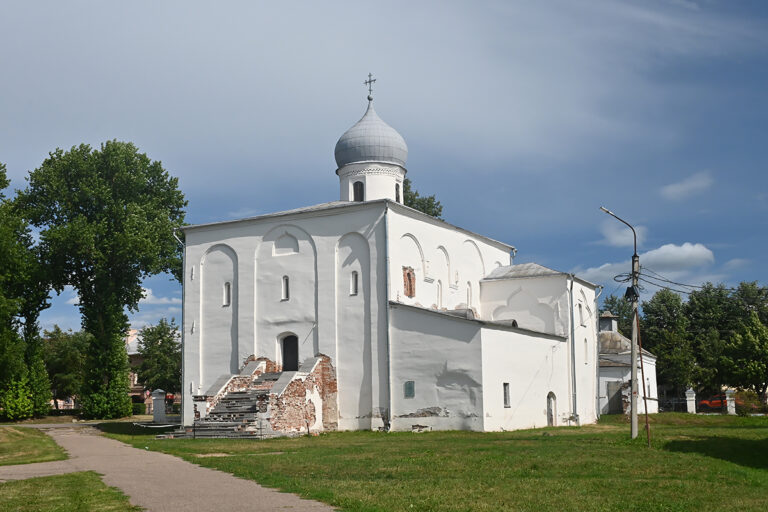
The surviving complex consists of the cross-domed church and a detached bell tower near the intersection of Fedorovsky Creek Street and Bolshaya Moskovskaya Street. The church stands close to Saint Clement Church and occupies the historic site on Slavkov Street. A cross-domed church is organized around a central dome whose supporting spaces form a cross-shaped structural plan.
The church
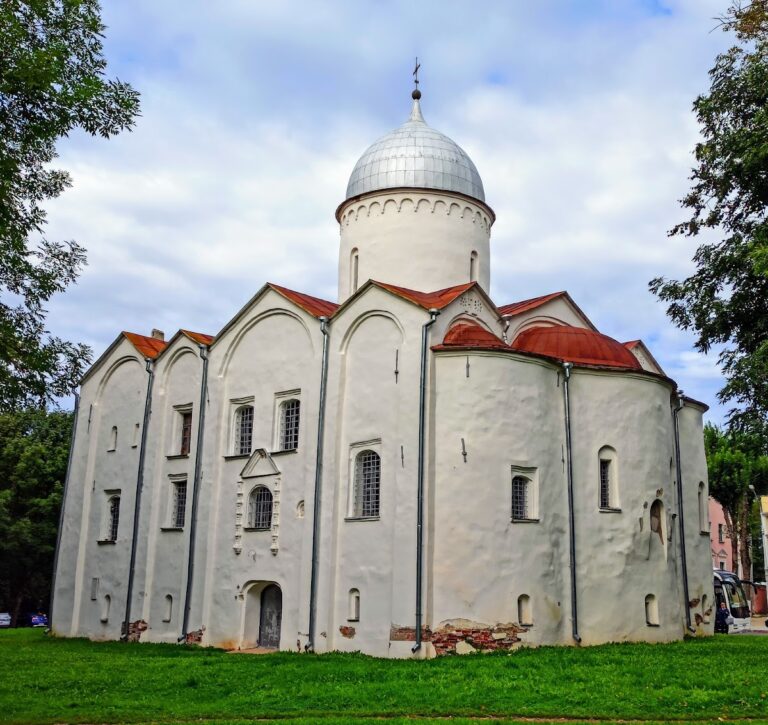
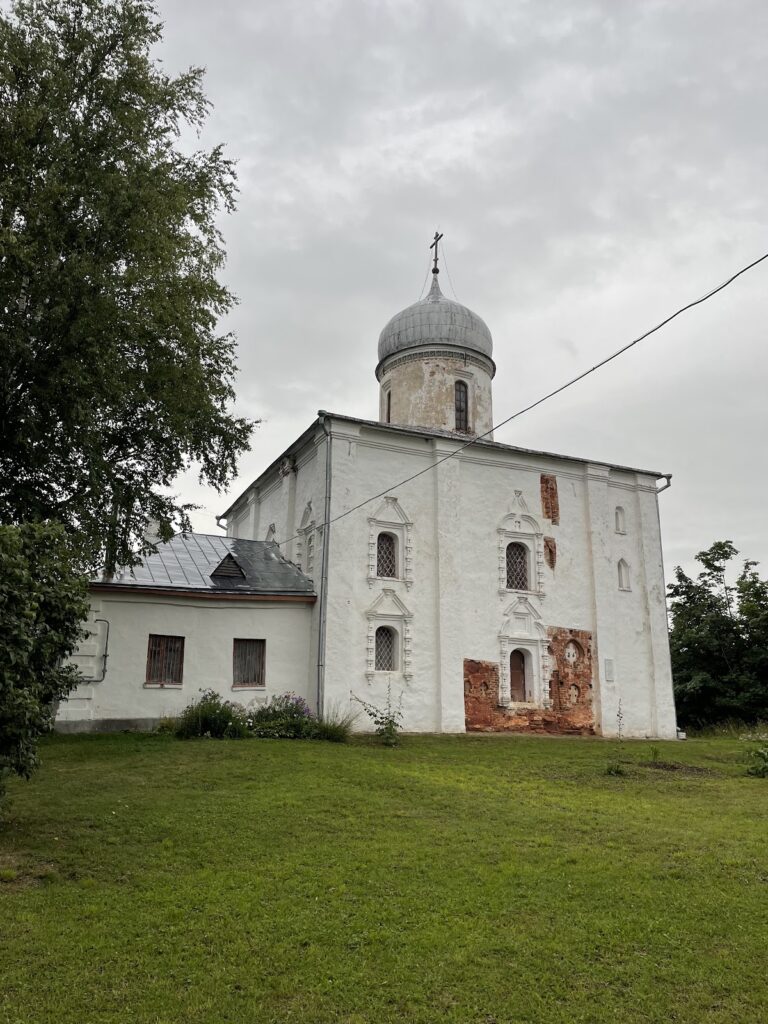
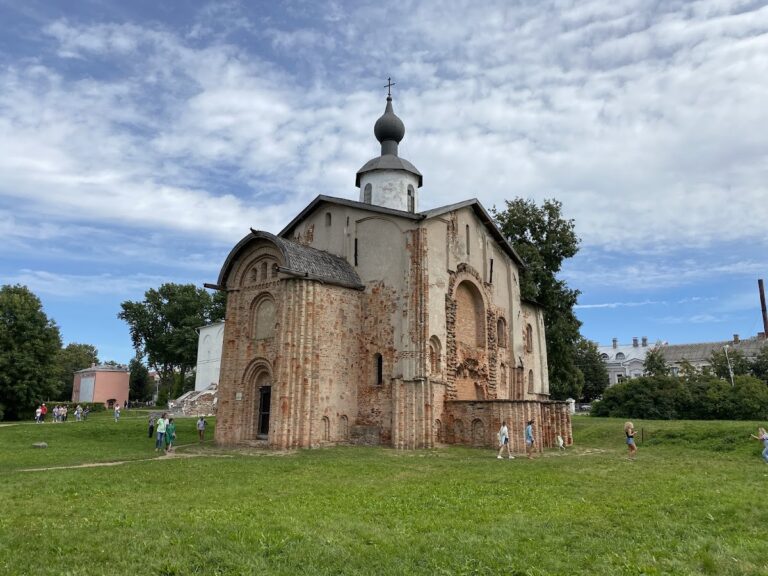
Saint Demetrius Church is distinguished by rich brick ornamentation. On the upper parts of the middle wall sections of the south and east facades, angled bricks alternate with projecting bricks to create patterned decoration. Related brickwork appears at the base of the dome drum. When the church was built, its principal entrance was on the south side. The main Moscow road then ran between the church and its bell tower, which stood farther away.
The detached bell tower
The bell tower stands approximately 20 metres south of the church. Its construction date is not established, although tradition assigns it to 1691. It has survived with almost no rebuilding and is now a separate structure with an entrance on its west side.
The tower has a stone tent roof formerly covered with wrought iron. Its cupola was clad in white sheet metal and topped by a gilded cross. The ringing tier held nine bells, including a large bell cast in 1735 that weighed 76 poods, a traditional Russian unit of weight representing more than a metric tonne.
Small annexes were added to three sides of the bell tower during the second half of the nineteenth century. These included a western stone residential building, an elongated single-storey wooden structure on the east, and a southern extension. The additions blocked the doorway to the tower’s internal staircase, so another doorway was made. The western annex was the portion that survived after the Second World War and was later demolished, leaving the bell tower standing separately.