Church of the Immaculate Heart of Mary in Barciany: A Gothic Parish Church in Poland


Site at a Glance
- Rating
- 4.4
- Popularity
- Very Low
- Country
- Poland
- Primary era
- Medieval
- External website
- Open
- Eras represented
- Medieval, Early Modern, Modern
- Civilizations
- Crusader, Duchy of Prussia, Kingdom of Prussia, Teutonic Order
- Site type
- Religious
- Remains
- Church
On this page11 sections
History
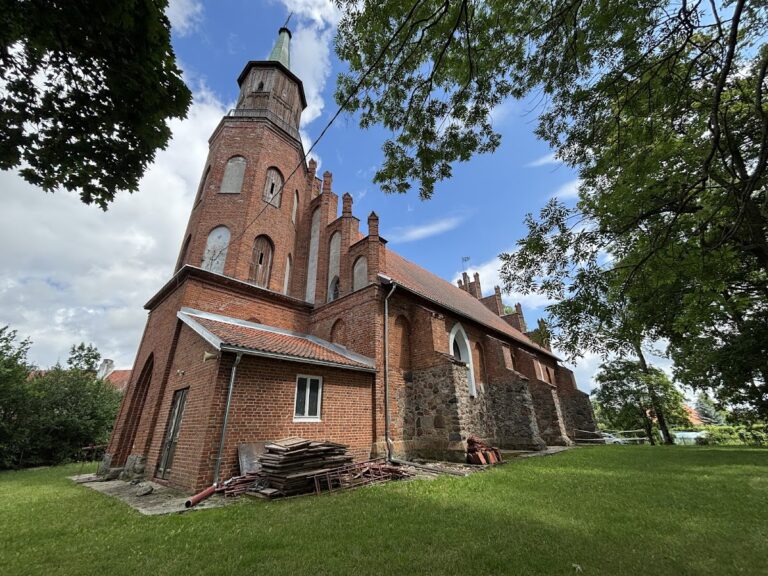
The Church of the Immaculate Heart of Mary in Barciany, Poland, is a late fourteenth-century Gothic hall church built before the Reformation. A sixteenth-century source places its construction around 1325 to 1330, but the more generally accepted dating places it in the last quarter or at the end of the fourteenth century. The church became the principal parish church of Barten in East Prussia and continued in that role through major changes in the region’s religious and political history.
From pre-Reformation church to Lutheran parish
With the arrival of the Reformation, the sixteenth-century movement that brought Protestant forms of Christianity to much of northern and central Europe, the church became Lutheran. An evangelical clergyman was serving there by 1528, and Christoph Meddingen is recorded as pastor from 1528 to 1535. From the late sixteenth century until the Second World War, the parish also had a second pastor.
Until 1945, the church served as the central parish church of the Lutheran parish of Barten. The parish first belonged to the Rastenburg ecclesiastical inspection and later to the Rastenburg church district within the East Prussia ecclesiastical province of the Church of the Old Prussian Union. In 1925, it had 3,880 members and covered the town and about twenty surrounding settlements. The town itself then had 1,293 Lutheran members and 24 Catholics.
Postwar religious transformation
The flight and expulsion of the local population ended the historic Lutheran congregation after the town came to be called Barciany. After 1945, predominantly Polish settlers greatly increased the Catholic population, and the former Lutheran church was taken over as a Roman Catholic parish church. The Roman Catholic parish dedicated to the Immaculate Heart of Mary was reactivated in 1962. It belongs to the Kętrzyn II deanery, an administrative subdivision grouping neighboring parishes, in the Archdiocese of Warmia. Barciany also has a Greek Catholic congregation.
The church underwent a fundamental renovation in 1989 and 1990, when its interior was adapted to changed Roman Catholic liturgical practices. It is entered in the heritage register under number 31 (5/9), dated 27 June 1953. Historic parish registers preserve baptisms from 1743 to 1944, marriages from 1748 to 1764 and from 1787 to 1944, burials from 1757 to 1944, confirmations from 1886 to 1928, and communicants from several periods between 1787 and 1944. Numerous name lists and alphabetical registers also survive.
Remains
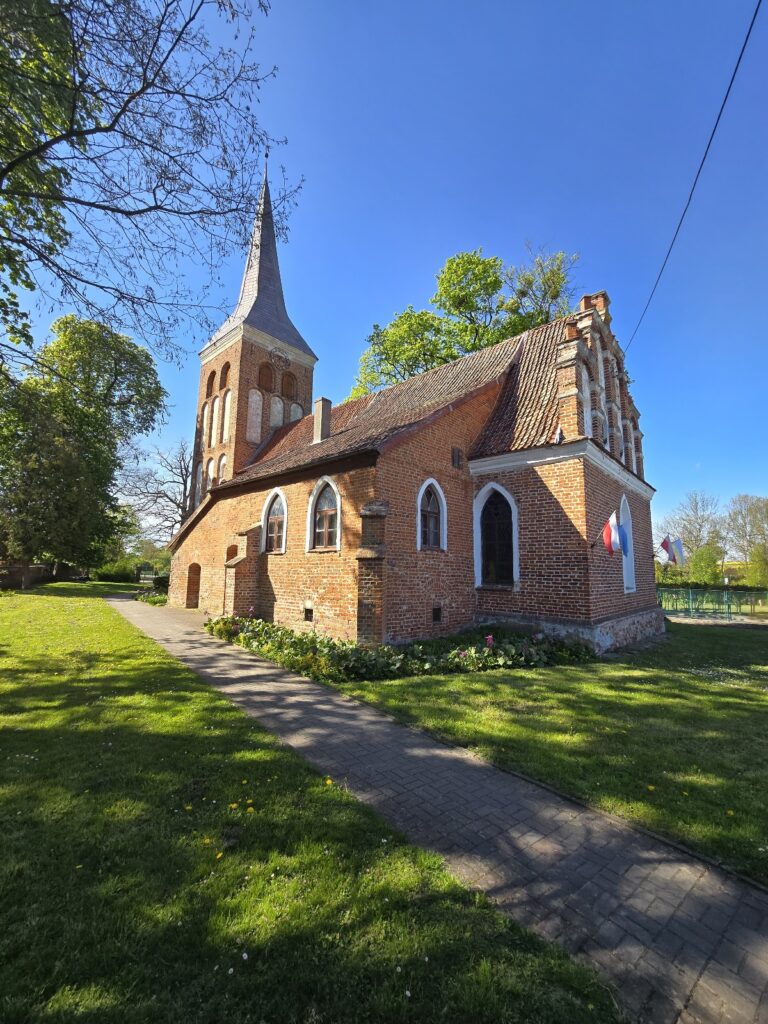
The church is an oriented, single-nave Gothic hall church, meaning that its main interior forms one unified space rather than a high central nave flanked by separate aisles. Brick walls rise from a fieldstone foundation, and buttresses reinforce the nave. Narrow, tall windows with pointed arches articulate the walls, while the main body is covered by a tiled gable roof. A sacristy and porches were added later. The southern porch dates from 1783 and received a new ribbed cross-vault. The eastern gable was rebuilt in 1714.
Western bell tower
A substantial square bell tower stands at the western end of the church. Built in the late sixteenth century, it has three storeys, horizontal cornice divisions between the elevations, and a four-sided tiled roof. The tower was rebuilt between 1729 and 1741 by the master mason Hünchen and the carpenter Effried of Königsberg. A roof was added in 1804, giving the tower its later form.
Interior and furnishings
Altar, pulpit, and seating
The interior was originally vaulted but now has a flat ceiling made of wooden boards. Sections of Gothic and Baroque wall paintings have been uncovered. The high altar is a simple carved work in the late Mannerist style, a refined artistic tradition that developed after the High Renaissance. Dated to 1643, it was funded by Sebastian Rautter and bears the Rautter family arms. The pulpit dates from 1664 and is also carved. Wooden seating with painted panels belongs to the seventeenth century, while the choir stalls are dated to the fifteenth century.
Confessionals and angel sculptures
Two confessionals from the eighteenth century remain in the church. Other surviving furnishings include a Baroque angel sculpture dated to 1753 and a baptismal angel made around 1750. Baroque art, which followed the Mannerist period, is associated with movement, ornament, and dramatic visual effects.
Brass chandeliers
Two brass chandeliers are traditionally attributed to Empress Elizabeth of Russia. One, made in 1699, bears a double-headed eagle. The other is marked as having been renovated in 1751.
Casparini organ
The Baroque organ was built in 1749 and 1750 by Adam Gottlob Casparini, an eighteenth-century organ builder active in Königsberg and known for instruments in the Baltic region and eastern Europe. It originally had one manual and twelve stops, without a pedal division. Johann Scherweit extensively restored it in 1820, and Johann Rohn of Wormditt added a pedal division with four stops in 1861.
In 1934, the organ was unplayable and was repaired by Emanuel Kemper. The keyboard removed during that work survived and was later used in 2003 to reconstruct Casparini’s organ for the Catholic Church of the Holy Spirit in Vilnius.
Bells
The church has three bells. One of them was cast in 1425, linking the present building’s soundscape with the late medieval period in which the church was established.