Church of the Holy Mother of God, Plovdiv: An Orthodox Cathedral and Center of Bulgaria’s Church Independence Movement
Site at a Glance
- Rating
- 4.8
- Popularity
- High
- Country
- Bulgaria
- Primary era
- Modern
- Eras represented
- Modern
- Civilizations
- Bulgarian, Ottoman
- Site type
- Religious
- Remains
- Cathedral
On this page16 sections
History
Early church and medieval destruction
The Church of the Holy Mother of God, Plovdiv, is a Bulgarian Orthodox cathedral in Plovdiv, Bulgaria, rebuilt in its present form from 1844 by craftsmen from Bratsigovo as a three-aisled pseudo-basilica, a basilica-like plan without the full basilica form. A Christian sanctuary probably stood on the site by the ninth or tenth century. The church later became a center of the struggle over Greek and Bulgarian authority in the Orthodox Church.
The Byzantine historian and official Niketas Choniates mentions a church dedicated to the Virgin Mary at Philippopolis, the city’s historical name. In 1189, Metropolitan Constantine Pantehi, a senior bishop, oversaw its renovation, and the church had cathedral status by that time. Crusaders taking part in the Third Crusade, a late-twelfth-century military campaign in the eastern Mediterranean, looted the church. It was subsequently rebuilt.
Ottoman rule and restoration
After Plovdiv came under Ottoman rule in 1371, the church and its associated monastery were destroyed. A tradition Antun Vrančić recorded in 1553 attributed the monastery’s disappearance to a fissure opening on a hilltop and swallowing it. The story said that monks escaped and the tops of submerged walls remained visible.
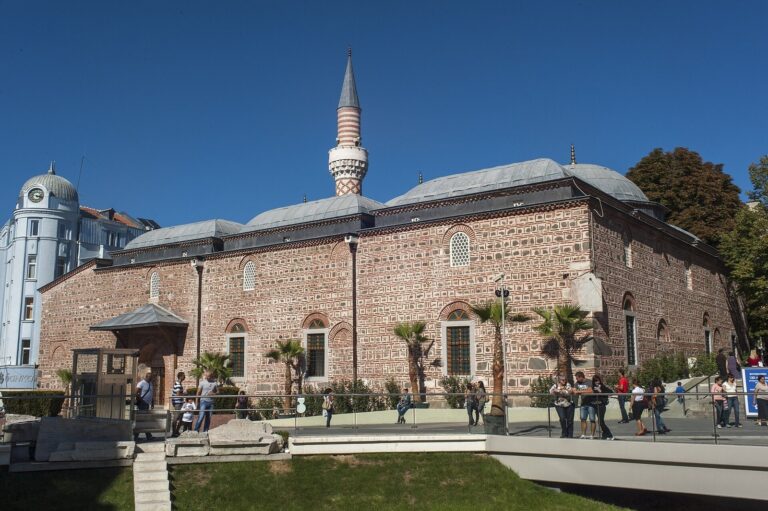
A successor church was built north of the city center, near the river, after the conquest. It was demolished in 1444 during construction of the Imaret Mosque. Stephen Gerlach mentioned a church at Philippopolis in 1578. The Marian church was restored on its original site in 1688. A now-lost inscription recorded another renovation and the painting of the church in 1698, under Metropolitan Neofit and with funding from the rhetoric teacher Andronik. Until 1825, church income supported teachers at Plovdiv’s Main Greek School.
Nineteenth-century rebuilding and church authority
In 1844, the older church was demolished and a larger building erected in its place. Craftsmen from Bratsigovo carried out the work, which was probably completed around 1852. The wealthy merchants Vulko and Stoyan Teodorovich Chalukov of Koprivshtitsa were its first ktitors, or founders and benefactors.
The church became a focal point of disputes over the language of worship and the authority of Greek and Bulgarian church leaders. In 1857, services in Plovdiv’s seven city churches were held only in Greek. The Phanariot Chrysanth, a Greek-speaking cleric from Constantinople’s Phanar district, had forbidden even the Bulgarian rendering of “Lord, have mercy.” After his removal, Bulgarian activists sought permission to hold services in Church Slavonic, a historical liturgical language used in Slavic Orthodox worship. Bishop Paisius could not authorize them without the Patriarchate’s consent, and petitions went unanswered.
The St Cyril and Methodius School helped bring the dispute to a head. On 14 November 1859, student Nesho Braykov’s attempt to read the Epistle in Church Slavonic at the church failed. On 30 November, protected by classmates after a confrontation with Greeks, he succeeded. On 25 December, Paisius and the priest Zlatan celebrated a festive liturgy entirely in Church Slavonic.
In 1860, Paisius held another service in Bulgarian on 10 January and publicly declared that his congregation rejected the Greek Patriarch’s authority. More than 40 clergy from the main centers of the Plovdiv diocese attended a liturgy on 12 March. On 30 April, Paisius convened a Church and People’s Council, with citizens represented, to consider the church question. Plovdiv sent a delegation to the Ottoman government to request an autonomous church, one governing itself rather than answering to another church authority. The council continued to meet annually until the Bulgarian Exarchate, the Bulgarian Orthodox body leading the movement for church independence, was recognized in 1870.
Bulgarian church life and the present cathedral
The 1870 decree establishing the Bulgarian Exarchate assigned the Holy Mother of God neighborhood in Philippopolis to it. Until 1906, the city had both a Greek metropolitan see at the Church of St Marina and a Bulgarian one at this church. The Bulgarian metropolitan Panaret was received here in 1872.
On 5 January 1878, a thanksgiving service at the church marked Plovdiv’s liberation during the Russo-Turkish War. Russian troops had entered and liberated the city the day before. The church remains an active cathedral of the Bulgarian Orthodox Church and the Plovdiv diocese. Its annual patronal feast is the Dormition of the Holy Mother of God, observed on 15 August; the Dormition commemorates the Virgin Mary’s death, or “falling asleep.” The church was designated a cultural monument of national importance in 1995, and restoration took place around the turn of the twenty-first century in connection with the 2,000th anniversary of the birth of Jesus Christ.
Remains
Church and bell tower
Main church
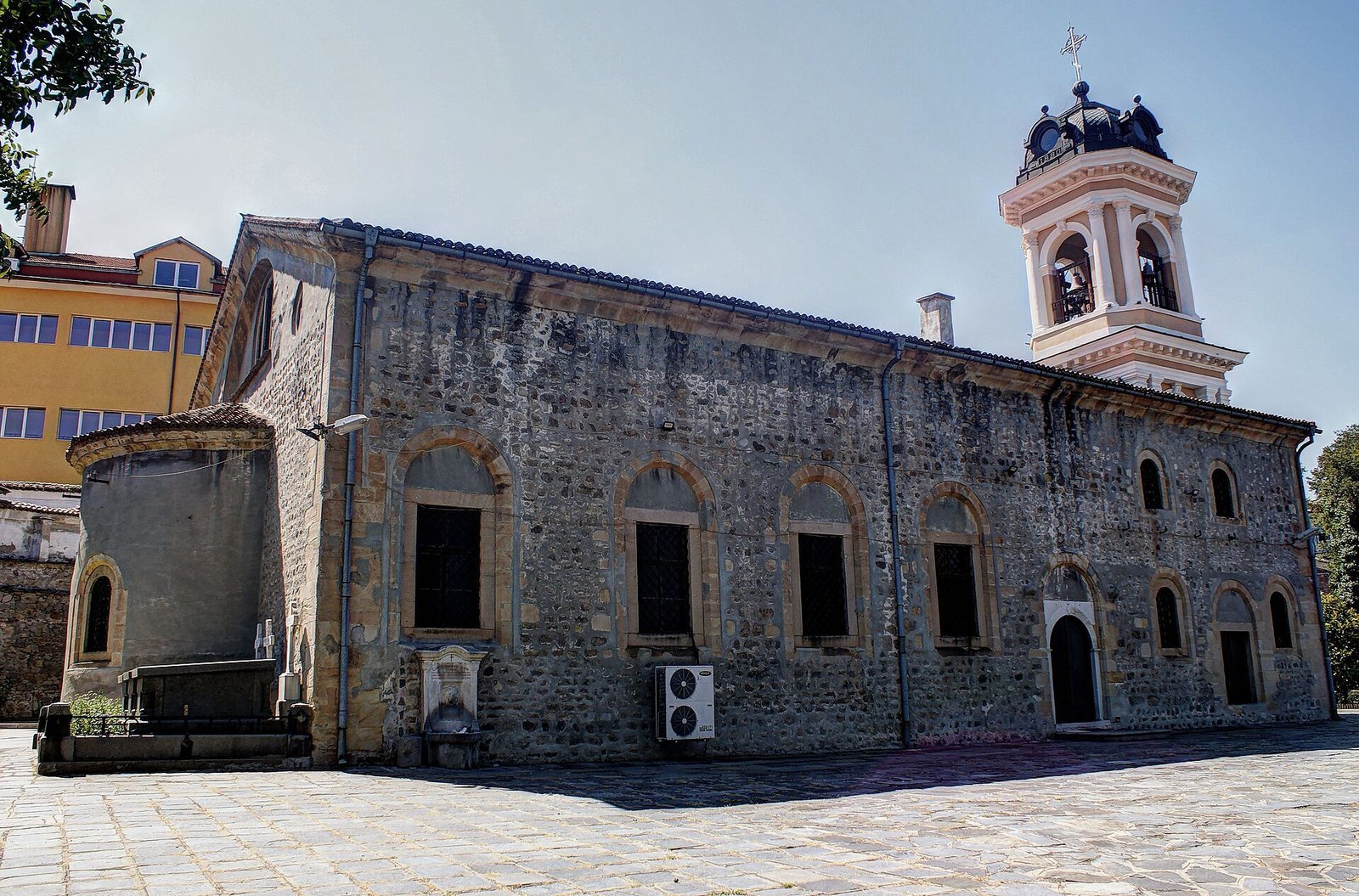
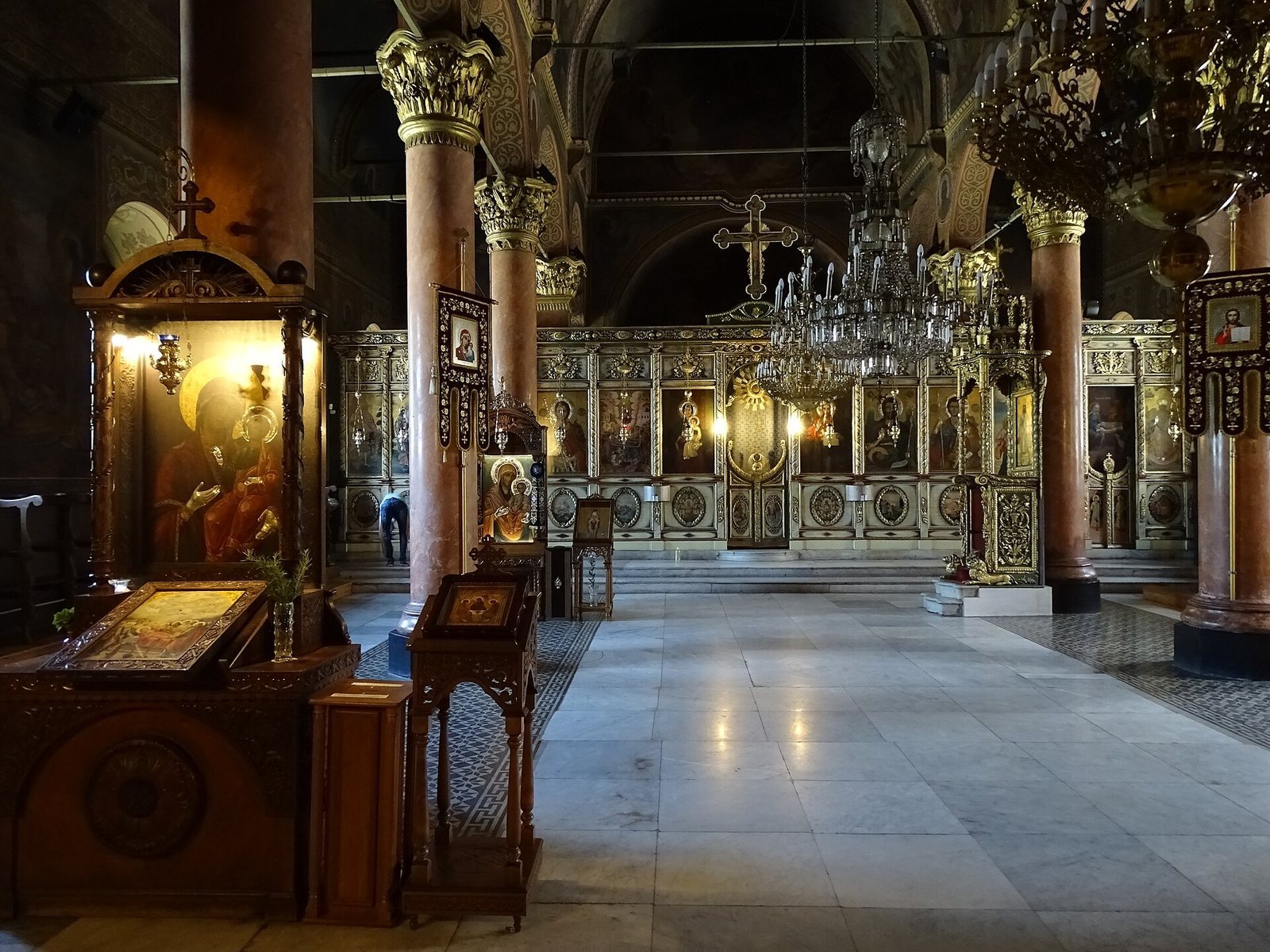
The church stands in Plovdiv’s Old Town, on Nebet Tepe within the city’s Three Hills. Its stone building measures 32 by 17 metres. Two rows of six substantial stone columns divide the main worship space into three aisles. The columns, reflecting the Bratsigovo building tradition, are linked by arches and topped with ornate Baroque-style capitals. The central aisle is higher than the side aisles and measures 11 by 9 metres. Each aisle has its own vaulted ceiling beneath the shared gabled roof.
A single apse, a recess marking the sanctuary, is at the east end; a vestibule occupies the west. An upper gallery at the western end of the main space was used by women during services. Above the north door, a marble tablet bears a Bulgarian inscription stating that construction began on 25 April 1844. A tombstone slab found beneath the altar during the rebuilding carries an undated Greek inscription naming the distinguished Byzantine nobleman Epiphanius Aliat as the church’s ktitor.
Bell tower
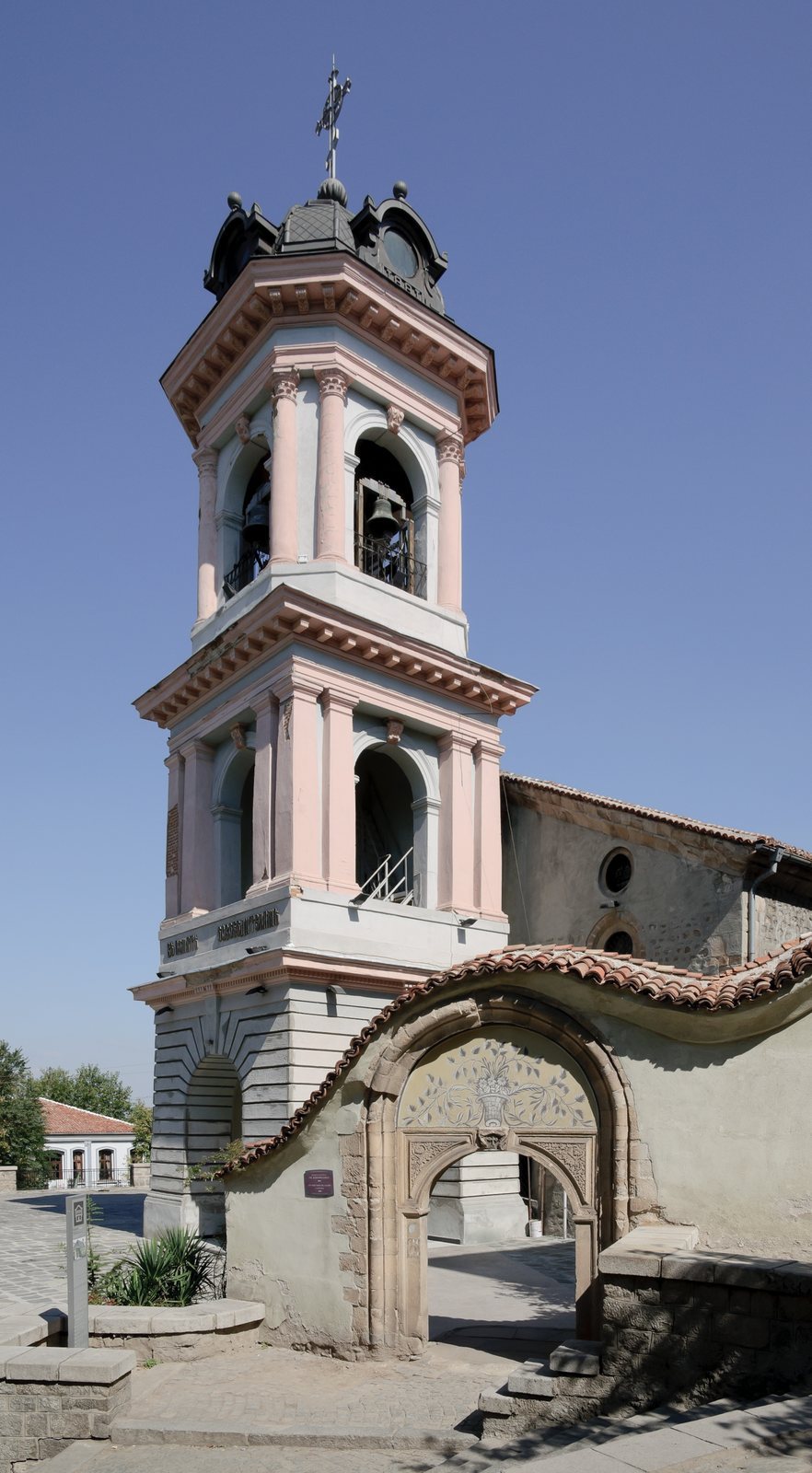
A three-storey bell tower was added at the west end of the church in 1881. Four pillars support it, and a dome tops the structure. Its Russian pseudo-classical design imitates features of classical architecture. The four bells were cast by Lazar Veleganov, and an inscription on the tower commemorates Plovdiv’s liberators.
Churchyard and cemetery
Boundary and staircase
A 10-metre-high wall built in 1873 borders the churchyard on the south. The courtyard was enlarged in 1930, when a monumental staircase leading to the church was also constructed.
Cemetery
A small cemetery occupies the southern and eastern parts of the courtyard. Those buried there include publisher and educator Hristo Danov, educator and public figure Yoakim Gruev, and merchant Stoyan Chalakov. The graves also include Plovdiv metropolitans Panaret, Nathanael, Maxim, Varlaam, and Arseny; Bishop Neofit of Branitsa; Russian officers killed during the 1878 liberation; and clergy and parish representatives involved in the campaign for an autocephalous, or self-governing, Bulgarian Orthodox Church.
Interior decoration
Iconostasis
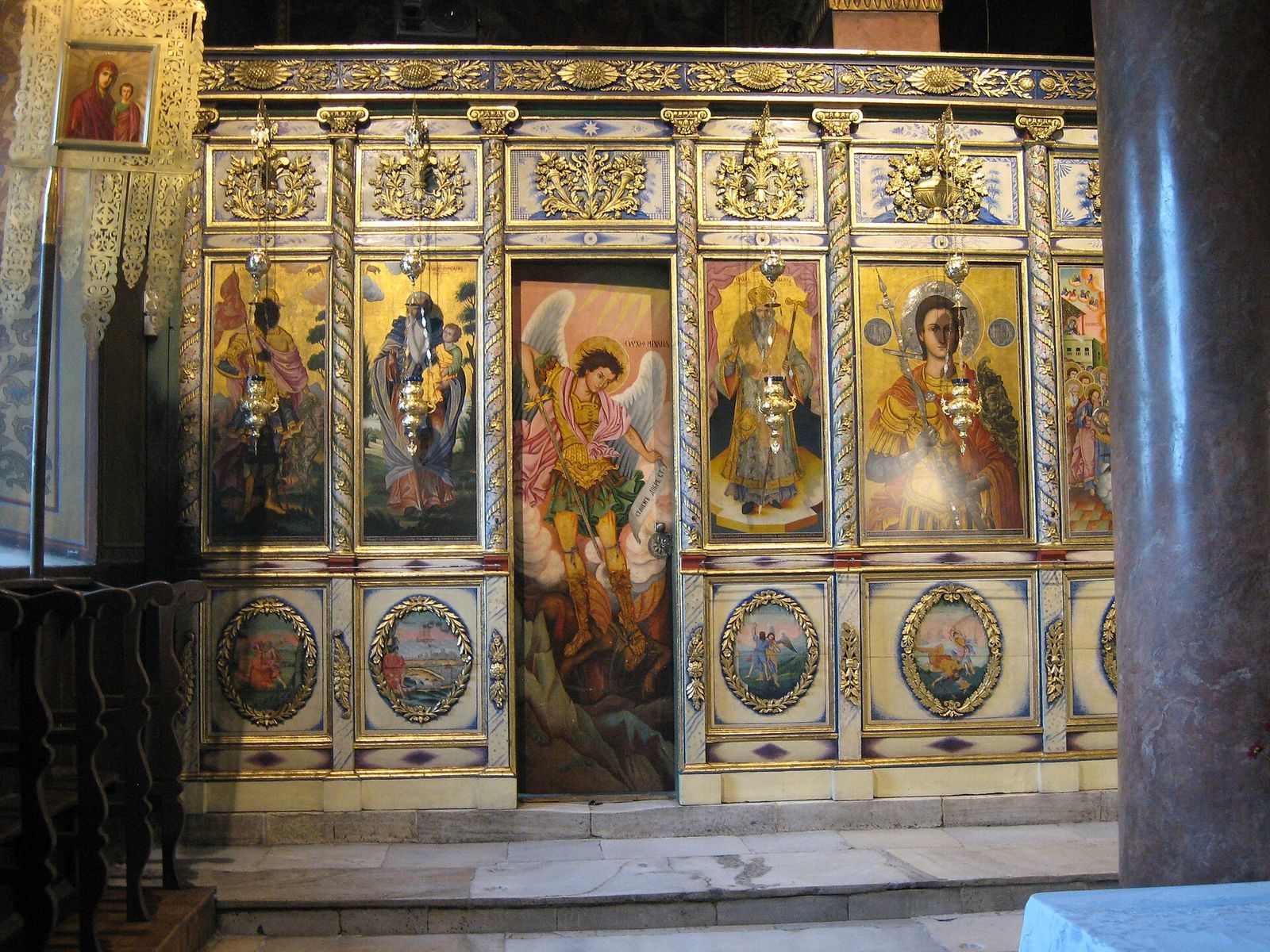
The iconostasis, a screen of icons separating the sanctuary from the congregation, measures 14.30 by 3.75 metres. Carved in the Empire style, an early nineteenth-century form of neoclassicism, it has a wooden base with relatively few, large attached carvings. Roses, grapes, leaves, daisies, and oak-leaf garlands form its plant decoration. Medallions beneath the royal icons show events from the Old Testament. The carving is probably the work of Dimitar and Anton Stanišev and is associated with the Debar school, a regional tradition of church woodcarving.
Icons
Nikola Odrinčanin painted most of the church’s icons, including those on the iconostasis and the Old Testament scenes in its medallions. In 1912, the main icons of Christ and the Holy Mother of God were added to the iconostasis, replacing works by Stanislav Dospevski. Dospevski’s 1875 image of the Mother of God with the Christ Child is also preserved in the church, outside the iconostasis.
Wall paintings
The church’s ornamental wall painting is probably by Makriy Negriev. Additional paintings were made in 1952 and 1953 by Nikola Kozhuharov, Dimitar Gyudzhenov, Vasil Stoilov, Zlatyu Boyadzhiev, Vasil Zahariev, and other artists.