Church of the Ascension in Jabukovac: A Serbian Orthodox Church
Site at a Glance
- Rating
- 5
- Popularity
- Very Low
- Country
- Serbia
- Primary era
- Modern
- Eras represented
- Modern
- Civilizations
- Serbian
- Site type
- Religious
- Remains
- Church
On this page10 sections
History
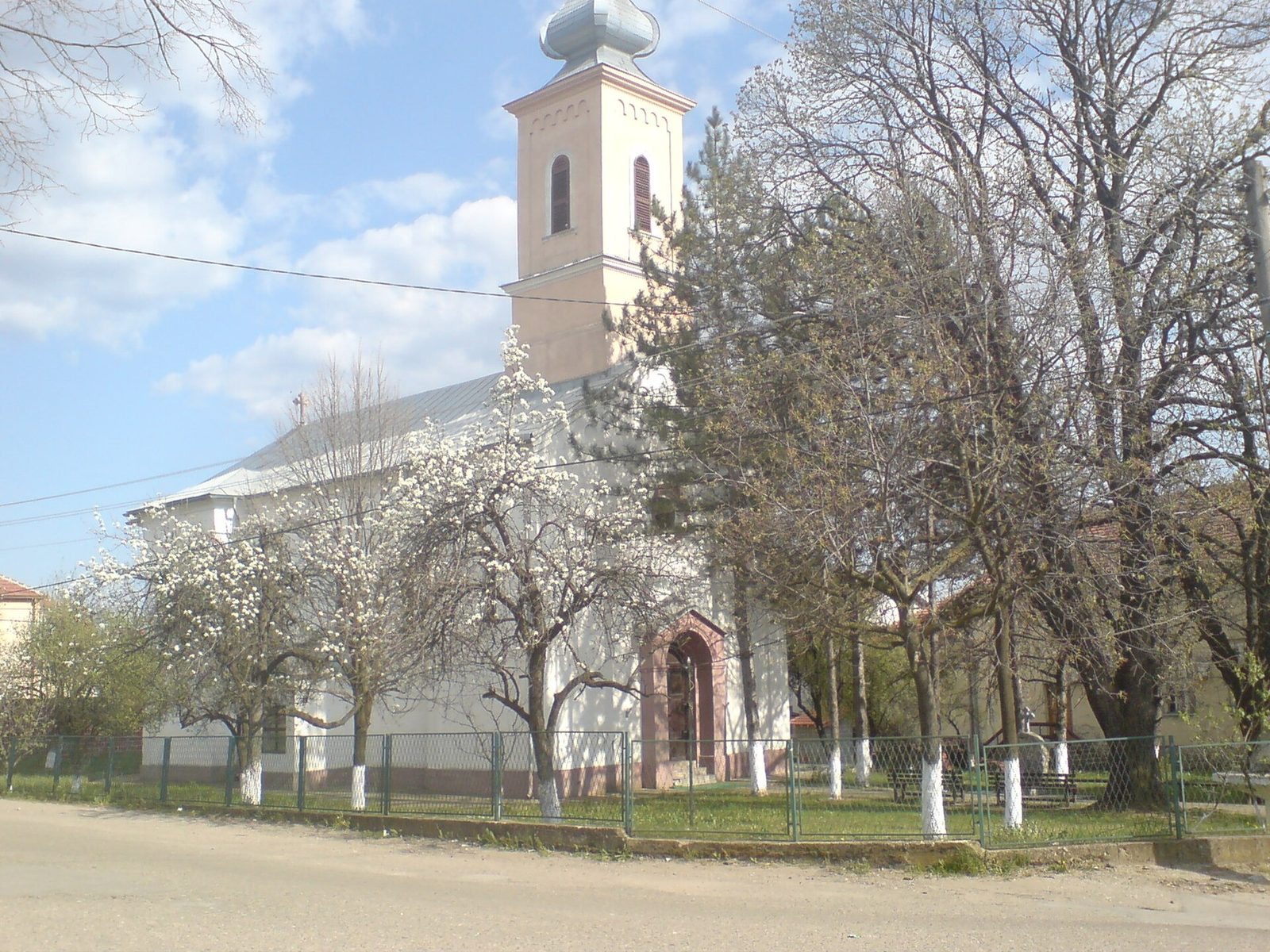
The Church of the Ascension in Jabukovac is a Serbian Orthodox parish church in Serbia, belonging to the Timok Eparchy, an Orthodox diocese. It is dedicated to the Ascension of Christ, commemorating his ascent into heaven after the Resurrection. Built between 1868 and 1871, it combines historicist architecture, which draws on earlier styles, with Serbian-Byzantine elements associated with Serbian and Byzantine building traditions.
Earlier churches
Jabukovac’s first church was built in the seventeenth century and dedicated to the Ascension. It was burned by the Turks.
Parishioners then built a wooden church in 1814–1815. It continued to serve the community until the present church was completed.
The present church
In 1866, a plot in the village centre was bought from Jona Radivojević for the new building. The site was 200–250 metres from the earlier church. Construction began in 1868 and was completed in 1871. Karlo Ščaski was the builder, and most of the masons came from German communities in Austria-Hungary.
Teodor Franković and his son Lazar, who came from the area around Vršac, were engaged to decorate the church walls and make and decorate the iconostasis. A room was added on the north side in the 1960s. The church is protected as a cultural monument of the Republic of Serbia.
Remains
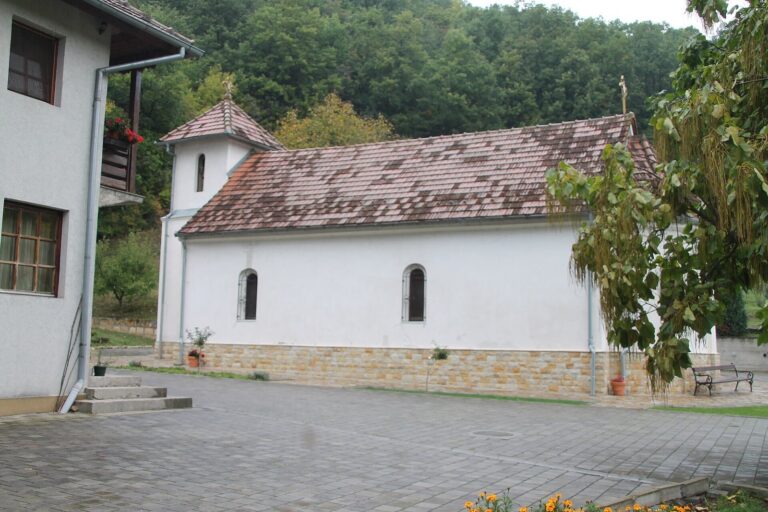
The church is built of brick covered with plaster and whitewash. Its plan comprises an altar, a nave (the main body of the church), and a western narthex (the church’s entrance vestibule). A gallery stands above the narthex, with the bell tower rising over it.
Building and layout
Two large rectangular piers divide the narthex from the nave. Together with pilasters, shallow supports attached to the north and south walls, they carry three broad semicircular arches. A staircase in the north part of the narthex leads to the gallery and bell tower. The room added in the 1960s stands against the north façade. The design follows church-building practice in the Principality of Serbia, the Serbian polity before it became a kingdom in 1882. Churches of the 1860s and 1870s commonly used lengthwise plans, a tower above the entrance vestibule, blind arcades above the roof cornice, broad projections, and arched windows.
Interior furnishings and artworks
Iconostasis
The iconostasis, the screen separating the sanctuary from the main worship space, carries icons painted by Vatroslav Beković in 1873–1874. Beković was an academic painter and drawing teacher at the gymnasium in Negotin. The icons are painted on canvas fixed to wooden supports and arranged in two zones. The first includes a large cross and images of the Virgin Mary, Saint John, and the Holy Trinity, the Christian belief in one God in three persons. Twelve framed panels, or cartouches, depicting apostles make up the second zone.
The lower part includes scenes of Abraham and the angel stopping him from sacrificing Isaac on the north side, and Pharaoh’s daughter Bithiah finding the infant Moses in a basket on the Nile while his sister Miriam approaches on the south. The central royal doors, which lead to the sanctuary, show the Annunciation. Archdeacon Stephen appears on the north doors and Archangel Michael on the south doors. The principal icons in the lower tier show Saint Nicholas, the Virgin and Child, Jesus Christ, and Saint John the Baptist. Above the doors are scenes of the Last Supper, the Nativity of Christ, and the Ascension. A medallion of the Holy Trinity is flanked by six apostle panels on each side in the second zone. At the top, a large cross depicting the Crucifixion stands between the Virgin Mary and Saint John the Theologian, traditionally identified with the apostle John.
Other icons
Several icons in the church date from the first half of the nineteenth century and were made by Vlach painters, members of a Balkan Romance-speaking community. They include a Saint Nicholas dated 1815, the Virgin and Child, Saint Michael the Archangel, and Saint Petka, also known as Paraskeva of the Balkans. Another church-held icon depicts the prophet Elijah. Painted in oil on canvas in the second half of the nineteenth century, it is signed by Radovan Kazimirović, a writer and son of Jabukovac priest Nikola Kazimirović.
Liturgical objects and Gospel
The church holds a Eucharistic tabernacle from the second half of the nineteenth century and a wooden cross from the nineteenth century with prosphora, bread prepared for Orthodox worship. A brass cross bears a painted Crucifixion and is dated 1932. An epitaphios, a cloth depicting Christ laid in the tomb and used in Orthodox Holy Week services, is thought to date from the last decade of the nineteenth century or the beginning of the twentieth. The collection also includes a metal-bound Gospel printed in Moscow in the late nineteenth century.
Bell
The church bell was cast by Pavle G. Pantelić of Zemun and donated in 1925.