Bukovo Monastery: A Serbian Orthodox Monastery near Negotin


Site at a Glance
- Rating
- 4.8
- Popularity
- Low
- Country
- Serbia
- Primary era
- Medieval
- External website
- Open
- Eras represented
- Medieval, Early Modern, Modern
- Civilizations
- Serbian
- Site type
- Religious
- Remains
- Monastery
On this page16 sections
History
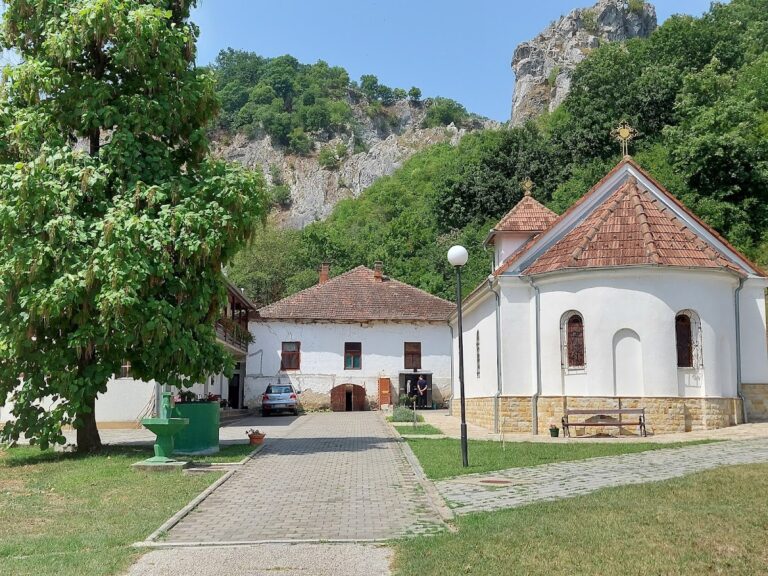
Bukovo Monastery is a Serbian Orthodox monastery in Serbia, located about 4 kilometres from Negotin on the slope of Bratujevac. Its church is dedicated to Saint Nicholas the Wonderworker, and the monastery belongs to the Timok Eparchy, the territorial diocese of the Serbian Orthodox Church. The foundation date and founder are uncertain, but the monastery is generally placed in the late thirteenth or early fourteenth century and is associated with the medieval Serbian religious tradition.
Uncertain medieval origins
Several traditions explain the monastery’s foundation. One attributes it to Serbian King Stefan Milutin, who ruled from 1282 to 1321 and was a major patron of Orthodox foundations. In this version, the monastery followed his victory over the Bulgarian emperor Ivan Shishman. Other traditions name Saint Nikodim Tisman, an Orthodox monk associated with the Timok region, or an eastern Serbian nobleman of the fifteenth century. These accounts place Bukovo within a long medieval history, while leaving its precise foundation date unresolved.
The earliest firm written evidence is a Serbian inscription above the church entrance hall. It records the monastery and the church of Saint Nicholas of Myra in 1654. At that time, Mihailo, an abbot associated with Dečani, served as superior. The monastery’s patron was kir Simeon, Prince of Trn, a Serb from the Bulgarian town of Tran. Frescoes produced during this period of leadership and patronage survive in the church as part of its later visible history.
Destruction and nineteenth-century renewal
Bukovo was destroyed or seriously damaged and rebuilt several times. Ottoman forces plundered and burned the monastery during the uprising in 1813, after which the complex was reconstructed. A further restoration was completed in 1837. Prince Miloš Obrenović, the Serbian ruler associated with the establishment of the modern Serbian principality, subsequently donated bells to the monastery. Two residential and administrative buildings, known as konaks, were erected in 1839, and a narthex, or entrance vestibule adjoining the church, was added in 1877.
The monastery also served as a religious and administrative centre for surrounding villages. In 1864, its parish jurisdiction covered Vidrovac, with 177 houses; Jasenica, with 133; Karbulovo, with 96; and Čubra, with 172. Together these communities comprised 588 parish households. The monastery’s cash capital that year was 113,288 groschen.
Bukovo continued to possess substantial agricultural land late in the century. In 1895, its estate covered 326 hectares, including 264 hectares of woodland and 49 hectares of arable land, together with smaller areas of meadow, vineyard, and orchard. The property was valued at approximately 120,000 dinars. In 1898, the monastery was classified as a second-rank monastery. Its clergy included the superior Gavril and the hieromonks Damjan and Jeronim, while Archimandrite Gavril made a pilgrimage to the Holy Land in spring 1899.
Twentieth-century history
The monastery’s later history includes both personal and institutional changes. Archimandrite Ruvim Okanović died by suicide in May 1936 after a mental breakdown aggravated by severe diabetes. He was buried without a priest or requiem service, but a large crowd accompanied him. A bell tower was begun above the northern entrance in 1940, on the eve of the Second World War, and was completed in 1966.
Bukovo has also been associated with wine production and has received several awards in wine competitions. The writer Svetolik Ranković wrote his novel Porušeni ideali, or Ruined Ideals, at the monastery. Bukovo is protected as a cultural monument of the Republic of Serbia under identifier SK 319.
Remains
The monastery complex consists of the single-nave church, the konaks, the entrance bell tower, a spring dedicated to the Life-Giving Spring of the Virgin Mary, and the monastery library. The church is a cruciform building of hewn stone, classified as a distinctive variant of the Morava school, a late medieval Serbian architectural tradition known for articulated church plans and stone decoration. Its overall appearance has remained substantially unchanged.
Church architecture
Saint Nicholas Church
The church measures 18.80 metres in length, 8.55 metres in width, and 6.90 metres in height. It has a single nave, choir apses, and no dome. The later narthex extends the entrance end of the building. Together with the cruciform plan and hewn-stone construction, these features define the church’s present architectural form and its connection with the Morava school.
Frescoes and furnishings
Fourteenth-century paintings
The interior contains three layers of fresco painting, or wall painting applied to plaster. Restoration in 2023 revealed fragments of the earliest layer in the altar area. These fourteenth-century remains include an image of John Chrysostom, the Christian theologian and archbishop of Constantinople known for his preaching. Small fragments of the same layer were also found in the nave.
Seventeenth-century frescoes
A second important painted layer dates from 1682, during the tenure of Abbot Mihailo Dečanac and the patronage of Prince Simeon of Trn. It includes Saint Michael the Archangel, fragments of warrior saints in the northern choir, and the Virgin Mary surrounded by angels on the church vault.
Twentieth-century decoration
Most of the frescoes visible today were painted in 1902 by Milisav Marković of Mali Izvor. He worked from designs by the Belgrade painter and iconographer Steva Todorović, who had also been associated with the decoration of the church in Zaječar.
Iconostasis
The carved and gilded iconostasis, the screen separating the sanctuary from the nave and carrying icons, was made in Austria toward the end of the nineteenth century. Lazar Krdžalić painted its icons and also created a medallion for the narthex. Some icons were painted by Pavle Čortanović, a drawing teacher at the secondary school in Negotin. Icons from the former iconostasis are preserved in the monastery library.
Entrance and grounds
Bell tower
The square-plan bell tower forms part of the entrance to the monastery complex and stands above the northern entrance area. Begun in 1940 and completed in 1966, it belongs to the complex’s modern architectural fabric.
Life-Giving Spring
A spring in the monastery grounds is dedicated to the Life-Giving Spring of the Virgin Mary. This Orthodox title associates the Virgin Mary with a healing spring, and numerous healings are connected with the Bukovo spring.
Konaks and library
The two konaks built in 1839 form part of the monastery’s residential and administrative buildings. The library preserves icons from the former iconostasis, extending the surviving material record of the church beyond its current furnishings.
Nearby sites