Church of the Addolorata, Acqui Terme: A Romanesque Basilica and Former Cathedral
Site at a Glance
- Rating
- 4.6
- Popularity
- Very Low
- Country
- Italy
- Primary era
- Medieval
- Eras represented
- Classical, Medieval, Early Modern, Modern
- Civilizations
- Duchy of Savoy, Holy Roman Empire, Italian, Lombard, Roman
- Site type
- Religious
- Remains
- Church
On this page9 sections
History
The Church of the Addolorata, Acqui Terme, is a Roman Catholic church in Italy, substantially rebuilt in the late tenth and early eleventh centuries in the Romanesque style. Also known as San Pietro, it is dedicated to Our Lady of Sorrows and Saint Peter, belongs to the Diocese of Acqui, and holds the status of a minor basilica, an honorific title granted by the Catholic Church to churches of religious or historical importance.
Early Christian origins
The site began as an early Christian cemetery. An ancient funerary inscription commemorates the martyrdom of two Christians, indicating that the burial ground existed before the construction of an early church dedicated to Saint Peter. The date of that predecessor is uncertain, but inscriptions and written records connect the church with burials of late-antique dignitaries and early bishops. Late antiquity was the period of transition between the ancient world and the Middle Ages.
An eleventh-century diocesan chronology names Saint Maggiorino as the first bishop of Saint Peter between 353 and 358. This has raised the possibility that the church served as Acqui’s early Christian cathedral. During the early seventh century, the church was enlarged under Agilulf, a Lombard king, and it is believed to have been completed in the ninth century. It then functioned as a bishop’s church and later as Acqui’s cathedral until 1067.
Medieval rebuilding and monastic life
Ecclesiastical construction in Acqui expanded under Bishop Primo from the late tenth century into the early eleventh century. The present church was substantially rebuilt during this period, while the cathedral of Santa Maria Assunta was also being developed. The building incorporated an older eastern section with archaic elements, alongside a western section generally attributed to the eleventh century.
Under Primo’s successor, Bishop Dudone, the cathedral canons were transferred to the new cathedral. Cathedral canons were clergy attached to a cathedral chapter who assisted with its religious and administrative life. Saint Peter then became a Benedictine monastery, meaning a community belonging to the Western monastic order that followed the Rule of Saint Benedict. Dudone endowed the monastery with property and parish rights and was buried in the church. In 1034, his successor, Guido of Acqui, confirmed its privileges and enlarged its endowment.
The church and monastery remained an important center of Acqui for several centuries. Their decline began in the fifteenth century and became irreversible after the last Benedictine monk left the monastery in 1477.
Division and later alteration
In 1718, Bishop Carlo Antonio Gozani divided the building with masonry partitions. Five bays became a separate church dedicated to Our Lady of Sorrows, a Marian devotion centered on Mary’s grief at the Passion and death of Christ. The remaining section, still dedicated to Saint Peter, entered a period of semi-abandonment. The division also supplied a church for the Santa Caterina confraternity, a voluntary religious association organized around a religious devotion. Gozani donated the wooden statue of the Sorrowful Madonna, which dates from 1720.
During the Napoleonic administration, the building became state property, while only the Addolorata section continued to serve religious purposes. In the nineteenth century, the deconsecrated part was partly demolished for residential buildings and partly converted into commercial premises. The structures that survived were heavily altered.
Twentieth-century restoration
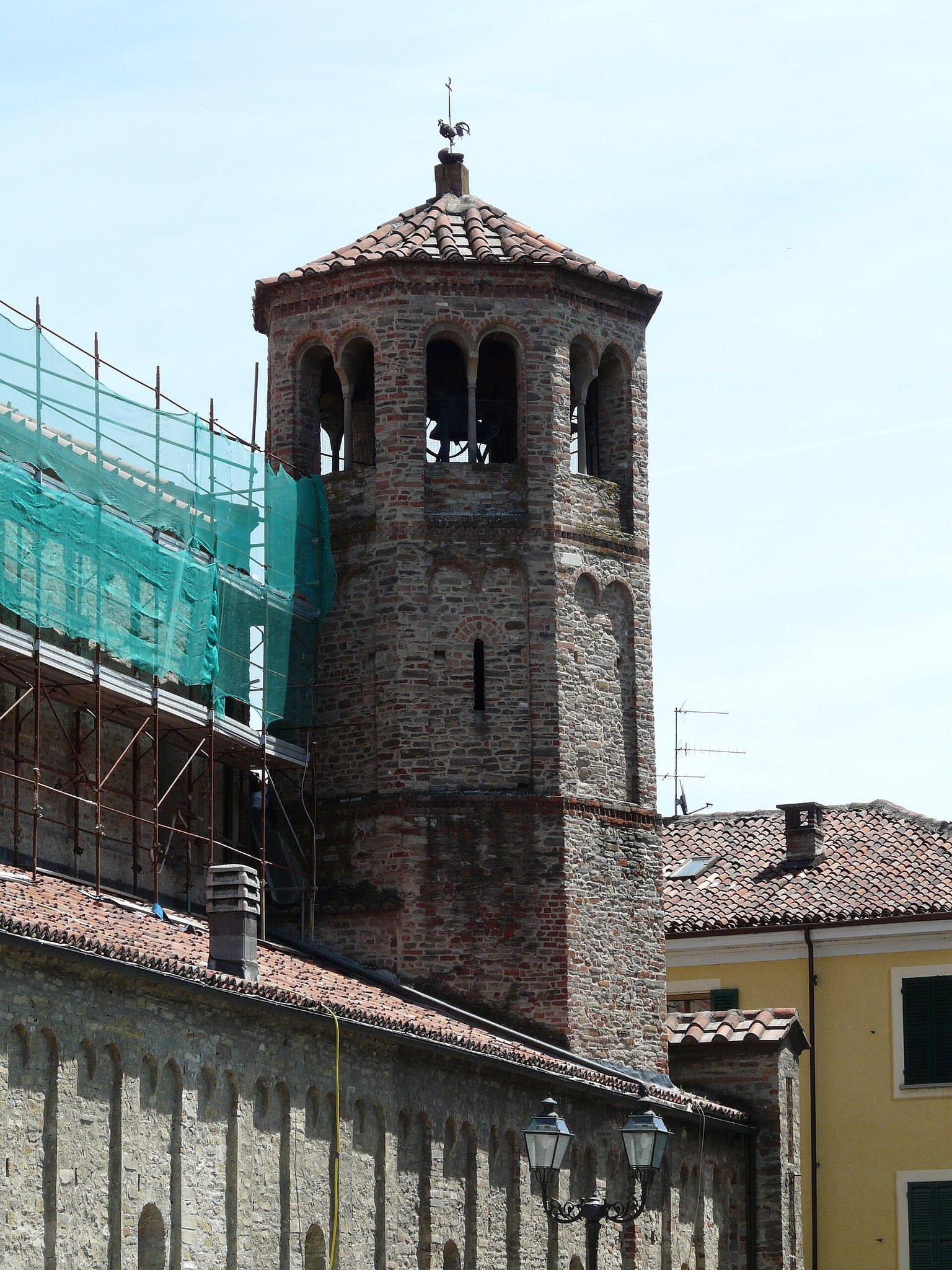
Extensive restoration and reconstruction began in 1927, or in the late 1920s, under the initial direction of Vittorio Mesturino of the Royal Superintendency of Medieval and Modern Art, a state heritage authority responsible for historic and artistic works. The work continued under different direction until 1963, with a major restoration completed around 1960. The project broadly respected the church’s original plan and volume and removed much of the later stucco and decoration. Some elements were reconstructed conjecturally, including the bell chamber added to the octagonal tower.
Remains
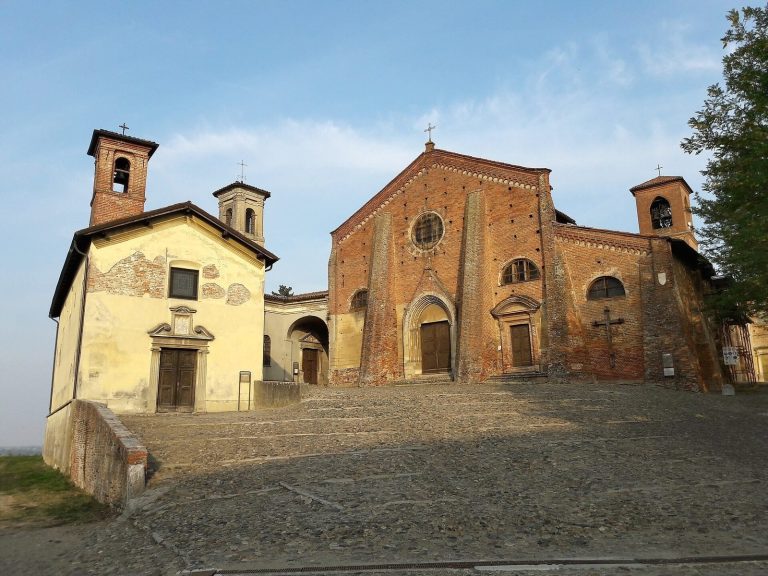
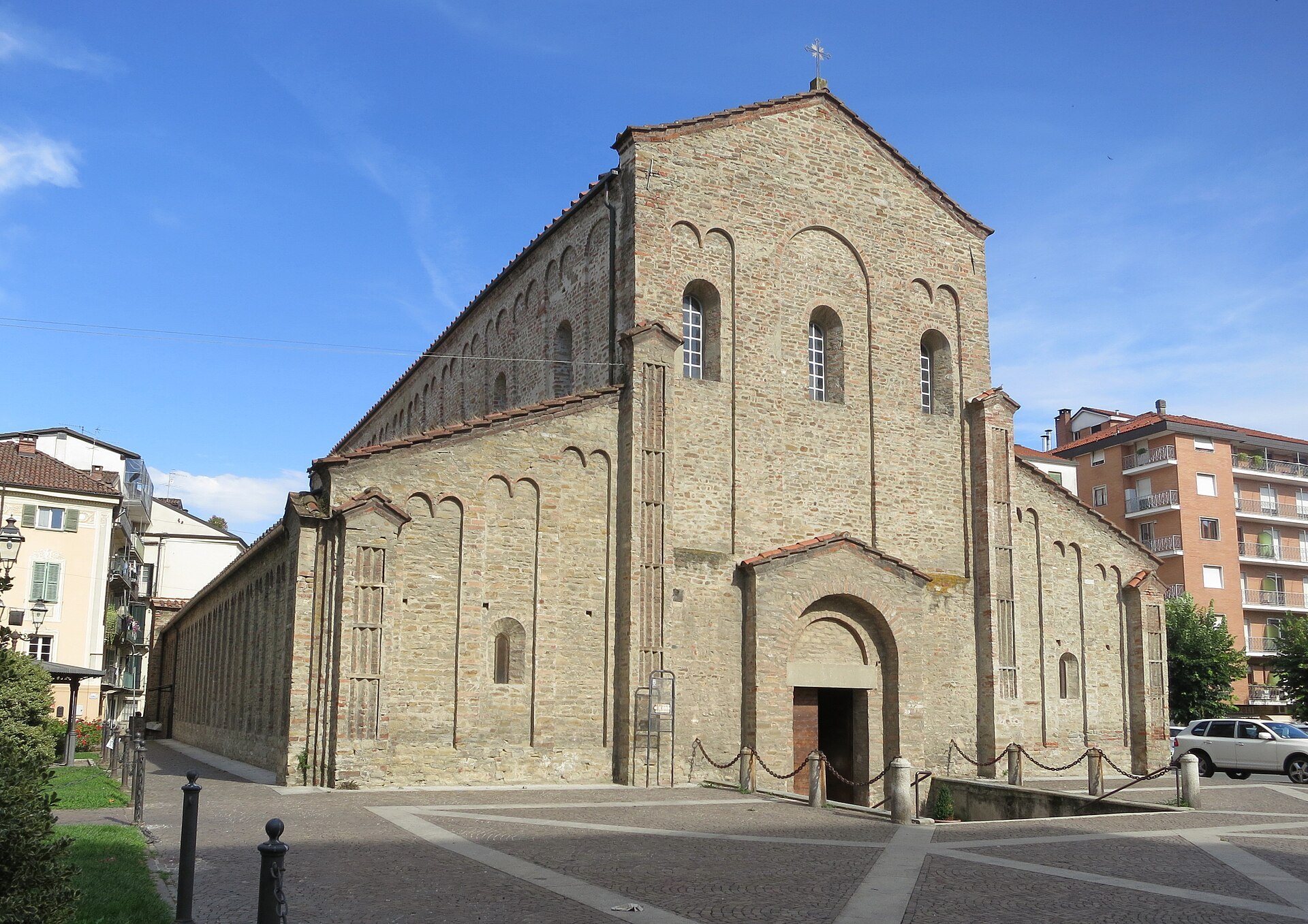
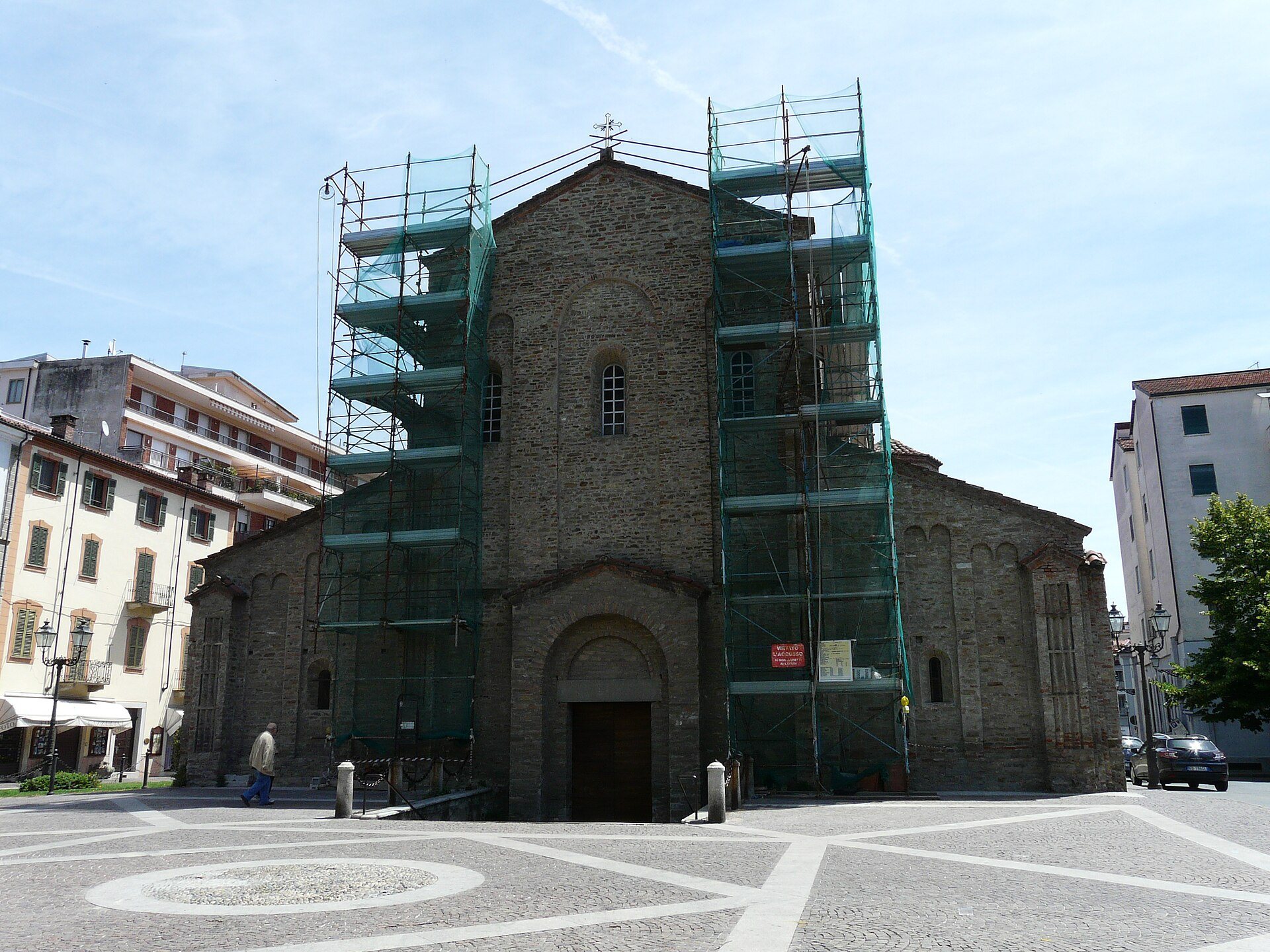
The surviving church is a Romanesque basilica with three naves and three apses, arranged on an unusually elongated plan without a transept. In church architecture, the nave is the main lengthwise interior space, an apse is the sanctuary end, and a transept is a crosswise section that intersects the nave. The eastern part retains older elements that predate the rebuilding under Bishop Primo, while the western portion is generally associated with the eleventh century. The church was probably unusually tall for its period, with an original height likely comparable to the width of its naves.
Exterior and structural remains
The tripartite brick facade is organized by four pilasters with truncated-section profiles. Their projection and strong vertical emphasis give the front its characteristic form. The side aisles were rebuilt during the twentieth-century restoration. Inside, the nave and its supports, the rear parts of the side aisles, and the three apses preserve elements of the earlier structure. Prominent octagonal pillars are among the church’s notable interior features, and their early use in the region may have influenced similar solutions in other churches.
Bell tower
An octagonal bell tower stands beside the southern apse. Its design is particularly bold, while its medieval base preserves traces of the earlier structure. The bell chamber was introduced during the twentieth-century restoration as a conjectural reconstruction rather than as a feature supported by earlier documentary evidence.
Paintings and devotional objects
The church contains a mid-fifteenth-century fresco of the Pietà with Bishops Maggiorino and Titus. The fresco was detached from the wall and restored. Two early-modern canvases depict Christ Crowned with Thorns and Christ before Pilate. The wooden statue of Our Lady of Sorrows, donated by Bishop Carlo Antonio Gozani, dates from 1720.