Church of St. Nicholas: A Historic Merchants’ Church in Brussels


Site at a Glance
- Rating
- 4.3
- Popularity
- Very Low
- Country
- Belgium
- Primary era
- Medieval
- Eras represented
- Medieval, Early Modern, Modern
- Civilizations
- Belgian, Duchy of Brabant, Habsburg, Holy Roman Empire
- Site type
- Religious
- Remains
- Church
On this page21 sections
History
The Church of St. Nicholas is a Catholic church in Brussels, Belgium, founded around 1125 by the medieval Christian community. It is one of Brussels’s earliest churches and stands near the former small river port and the present-day Brussels Stock Exchange. In 1174, it was still a dependent chapel of the parish of Saint Michael. Its dedication reflects Saint Nicholas of Myra, a fourth-century Christian bishop traditionally associated with charity and the protection of merchants, sailors, and children.
A church of the merchants’ quarter
The church served the merchants’ quarter and people whose work depended on the small river port. Its substantial medieval bell tower also served as Brussels’s belfry, a civic or ecclesiastical tower whose bells regulated urban activities. The tower is mentioned in 1289 and housed the city bells. From at least 1439, municipal charters were kept there, while the city administration and its seal were also associated with the building. The suggestion that the tower had originally been an older donjon remains uncertain.
A night storm partly brought down the tower in 1367, and the church was reportedly destroyed during the same year. Reconstruction followed around 1380, retaining the Romanesque lower part of the tower. The choir dates from 1381. In 1486, the Chapel of Our Lady of Peace was added as an extension of the left aisle. The church was damaged during the religious disturbances of 1579, a period of conflict between competing religious and political forces in the Low Countries.
The belfry and its clocks
The belfry contained a carillon, a set of tuned bells played mechanically or from a keyboard. It may also have housed one of the world’s oldest visual clock mechanisms, perhaps dating from 1362, and one of the earliest clock automata, perhaps dating from 1551. An automated bell mechanism is documented by 1662, when a new carillon was installed. Between 1662 and 1665, the architect Leo van Heil added another storey and a dome to the tower.
War damage and collapse
The church was damaged and partly burned during the French bombardment of Brussels in August 1695. Bells falling from the tower, some partly melted by the fire, destroyed its lower levels. Repairs took place in 1712 and 1713, when Willem De Bruyn replaced the upper structure with three new storeys. The tower nevertheless collapsed on 25 July 1714.
Revolution, recovery, and preservation
After the French Revolution, the church was nationalized. It closed on 12 December 1797, and the church together with its adjoining houses was sold in lots in 1799. The furnishings had already been sold. Parishioners bought the property, and after Catholic worship was restored in 1802, former churchwardens, the lay officials responsible for the church’s administration and material affairs, Ferdinand Meeus, Guillaume Vandenesse, and Pierre-Jean de Noville reacquired the lots. Restoration and the reinstallation of the furnishings were completed in 1807.
During Brussels’s major urban projects in the late nineteenth century, proposals were made to demolish and rebuild the church. Similar plans continued into the 1930s but failed because of the churchwardens’ property rights and the high cost of expropriation. The church was designated a protected historic monument on 5 March 1936. Its main façade was rebuilt in 1956, and the work revealed Romanesque remains in the entrance porch, including the base of an earlier porch column.
Artists, worship, and the Martyrs of Gorcum
Michael Sweerts, a Brabant painter, was baptized in the church in 1618. In 1648, the carillonneur and painter Théodore de Sany prepared a collection of hymns and songs for the Brussels carillon for use at St. Nicholas.
The church became associated with the Martyrs of Gorcum after their canonization in 1867. The nineteen Catholic clergy and laypeople had been killed in the Netherlands in 1572 during the religious conflicts of the sixteenth century, for their Eucharistic faith and loyalty to papal authority. In 1618, friars from the Recollect monastery opposite the church secretly recovered their relics and transferred them in procession to Brussels, where they were venerated. After the French Revolution, the shrine was moved to the Church of St. Nicholas.
In 1867, the archbishop-cardinal of Mechelen presented the church with a relic of one of the martyrs, and celebrations in their honor were established there. The nineteenth-century shrine, made of gilded copper, remains in the church.
Remains
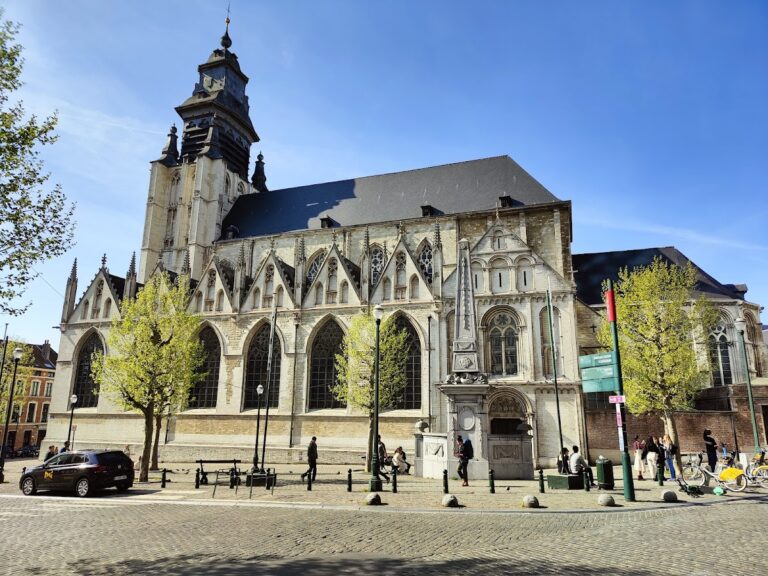
The surviving church combines medieval masonry and later rebuilding with a west-facing façade, side aisles, a crossing, and an off-axis choir. The tripartite exterior is built in Massangis stone, while the interior is plastered and painted white. Small houses built against the side façades, including the Baroque De Goude Huyve house, partly conceal the church’s large ogival windows.
Exterior and surviving medieval fabric
Main façade
The main façade was rebuilt in 1956 by the architect J. Rombaux. Powerful stepped buttresses reinforce its three-part composition and end in saddleback caps. The central portal follows a Classical design, with flat rounded pilasters carrying Ionic capitals. Above them are a high, undecorated architrave and a projecting cornice. The 1956 bas-relief above the cornice, by J. Lacroix, shows the Madonna and Child as Sedes Sapientiae, or “Seat of Wisdom,” flanked by two angels. The left angel plays a harp, while the right carries a censer.
Above the portal are a large Gothic-style stained-glass window and a gilded clock set into the gable. The stained glass, made by Guy Chabrol for the 1956 restoration, depicts the Assumption of the Virgin. The entrance porch contains Romanesque remains revealed during the rebuilding, including the base of a former porch column.
Bell turret and crossing
The transept arms do not extend beyond the line of the side façades. Only the northern arm, on Rue de Tabora, has a triangular gable. A square bell turret with louvres rises over the crossing. It has a small bulb, a gilded ball, a wrought-iron cross, and a rooster.
Side façades
The side façades contain large pointed windows and stepped buttresses without saddleback caps. Their lower portions are partly concealed by the houses built against the church, including De Goude Huyve.
Nave and choir
Nave and rood screen
The interior walls, pillars, and ribbed vaults are plastered and painted white. At the western end, an imposing rood screen, a substantial partition separating the nave from the choir, rests on unplastered blue-stone columns crowned with Corinthian capitals.
A cannonball remains lodged high in one of the nave’s pillars. It came from the French bombardment of Brussels in 1695, and a small plaque beneath it records the year.
Choir
The choir is markedly off-axis from the central nave. It ends in a central five-sided apse, the polygonal termination of a church, with a single smaller apse, or apsidiole, on the left. The unusual alignment is probably related to the course of an earlier river.
Pulpit
The late-eighteenth-century Louis XVI pulpit, named for the French neoclassical style associated with the reign of Louis XVI, is attached to a column and reached by a curved staircase. Its sounding board bears the Holy Spirit surrounded by rays of light. Carved panels on the body depict Saint Nicholas and the story of his resurrection of three children.
Choir stalls and screen
The choir stalls date from 1734 and were made by Jan Baptiste van der Haeghen. Their ten medallions depict episodes from the life of Saint Nicholas. A partly gilded wrought-iron screen encloses the choir. Designed by Jacobus Delmotte in 1765, it is decorated with floral and tendril patterns.
Statues, shrine, and paintings
Statues and transferred works
A polychrome seventeenth-century Ecce Homo statue shows Christ after the flagellation, seated on a black rock with bound wrists, a crown of thorns, a red tunic, and a reed sceptre. Ecce Homo, meaning “Behold the Man,” refers to Christ presented after his scourging and before his crucifixion. A reliquary was inserted into the statue’s left foot in 1815, while the gilded right foot rests on a pedestal marked with an Ecce Homo plaque.
The church also contains polychrome statues of Francis of Assisi and Anthony of Padua by the Antwerp sculptor Willem Ignatius Kerrics. They came from the former Recollect monastery opposite the church, on the site of the present Stock Exchange. Other works include a Madonna and Child by a disciple of Peter Paul Rubens and paintings by Jean van Orley, Guillaume Herreyns, and G. Kerricks.
Shrine of the Martyrs of Gorcum
The gilded-copper shrine of the Martyrs of Gorcum contains relics of the nineteen Catholic martyrs. It rests on chased lions. Its front shows Francis de Roye between Saint Michael and Saint Nicholas, while nine martyr figures occupy niches on each side. On the reverse, the enthroned Virgin appears with Boniface and Francis of Outers. Six scenes on the roof portray episodes from the martyrs’ history, including their capture and torture, transport to Brielle, interrogation, hanging, the transfer of their relics, and their canonization by Pope Pius IX in 1867.
Opposite the shrine hangs Joseph Stallaert’s painting of the last Communion of the Martyrs of Gorcum.
Other paintings
The church contains The Last Supper, an oil painting on canvas dated 1790 by Willem Herreyns; The Deliverance of Saint Peter and Jesus among the Doctors by Jan van Orley; and David Begging God’s Forgiveness and Praying for His People Struck by the Plague by Victor Honoré Janssens. The collection also includes Moses Fighting the Amalekites by Egide Smeyers, Mary with the Sleeping Child from the workshop of Peter Paul Rubens, and Jesus and the Canaanite Woman by Jakob Zeger Van Helmont.
Dispersed guild triptych
A triptych by Aert van den Bossche, The Martyrdom of Crispin and Crispinianus, dates from 1494. It was formerly displayed in the church for the shoemakers’ guild, but its panels have since been dispersed among museums. The central panel is in the National Museum in Warsaw, while the transferred front of the right panel is preserved in the Broodhuis.