Church of the Santissima Annunziata dei Catalani: A Norman-Era Church in Messina


Site at a Glance
- Rating
- 4.6
- Popularity
- Low
- Country
- Italy
- Primary era
- Medieval
- External website
- Open
- Eras represented
- Medieval, Early Modern, Modern
- Civilizations
- Italian, Norman, Spanish
- Site type
- Religious
- Remains
- Church
On this page14 sections
History
The Church of the Santissima Annunziata dei Catalani is a twelfth-century Norman church in Messina, Italy, built during Norman rule in Sicily in a cross-cultural architectural tradition that combined Latin Christian, Byzantine, and Islamic elements. Construction began in the second half of the twelfth century, probably between about 1150 and 1190, and the building may have replaced an earlier Greek-Siceliot temple dedicated to Poseidon, also associated with the Roman Neptune.
Earlier traditions and Norman construction
A Siculo-Arabic inscription once set into the portal jambs referred to “Messala, son of Charam, king of the Alamids.” Athanasius Kircher, a seventeenth-century German Jesuit scholar of languages and antiquities, translated the inscription in a way that supported the theory that the church had previously been converted into a mosque during the Emirate of Sicily. This interpretation remains a historical thesis rather than a certain fact.
The church was remodelled under William II of Sicily, the Norman king who ruled from 1166 to 1189, between the twelfth and thirteenth centuries. It stood within the walls of the Castello a Mare, the fortress guarding the port entrance, beside the military arsenal and shipyards. Later urban redevelopment progressively demolished those fortifications, opened new streets and squares, constructed housing, and removed the arsenal and shipbuilding facilities.
Dominican and royal associations
In 1271, Dominican friars established their first house in the Kingdom of Sicily at the church after arriving in the kingdom. Under the Aragonese dynasty, the building became a Royal Chapel, meaning that it stood under the direct patronage or jurisdiction of the monarch rather than ordinary ecclesiastical administration.
During the reign of Peter I of Sicily, or more probably under his nephew Peter II, Iberian dignitaries obtained the church for spiritual gatherings. They formed a confraternity of Iberians of the Crown of Aragon, a lay religious association that combined worship, communal organization, charitable activity, and burial. The association annually appointed a consul and other officers.
Much of the money collected from Aragonese-flagged ships entering Messina supported the church’s maintenance and decoration. Most of the remaining revenue went to the Hospital of the Foundlings. In 1347, Louis I of Sicily reaffirmed the church’s title as a Royal Chapel and its exemption from ordinary jurisdiction over its property under papal bulls.
The Catalan confraternity and later changes
After the unification of Sicily under the Spanish Crown, the confraternity admitted Iberians from outside the former Crown of Aragon from the late fifteenth century onward. Catalan merchants established in Messina during the sixteenth century became especially associated with the church, which gradually acquired its present name. Catalan and other Hispanic merchants, nobles, and knights commissioned works of art for the medieval building. Their confraternity also created an altar dedicated to Our Lady of Solitude and a crypt for the burial of its members.
On 26 March 1507, Ferdinand II of Sicily granted the church, its revenues, and the Hospital of the Foundlings to the Senate of Messina. The Confraternity of the Candelora, also known as the Greens, received responsibility for administering the property. When the hospital was incorporated into the Great Hospital under the title of Madonna della Pietà in 1542, the church returned to royal disposition and jurisdiction.
After the third decade of the sixteenth century, members of the Theatine order, the Catholic community of Clerics Regular, were temporarily housed at the church while they awaited the construction of their own house and church. Following the 1783 earthquake in southern Calabria, which severely damaged Messina, the Santissima Annunziata dei Catalani became a parish church in place of the badly affected Church of San Nicolò at the Archbishopric.
Earthquakes and continuing religious use
The 1908 Messina earthquake destroyed much of the city, but the church survived. Rubble was levelled around it and the rebuilt street surface was raised by approximately three metres, leaving the building partly below the surrounding roads. The former portal jambs had already been transferred to the Civic Museum in the late nineteenth century, and after the earthquake they entered the collections of the Regional Museum of Messina.
After the earthquake, the Catalan confraternity donated Polidoro da Caravaggio’s Way to Calvary to Ferdinand III of Sicily. The painting was later placed in the royal picture collection at the Capodimonte Gallery in Naples, while other works were transferred to the Regional Museum of Messina. The church is now the seat of the Noble Archconfraternity of the Santissima Annunziata dei Catalani, which conducts religious activities there and celebrates the Feast of the Annunciation.
Remains
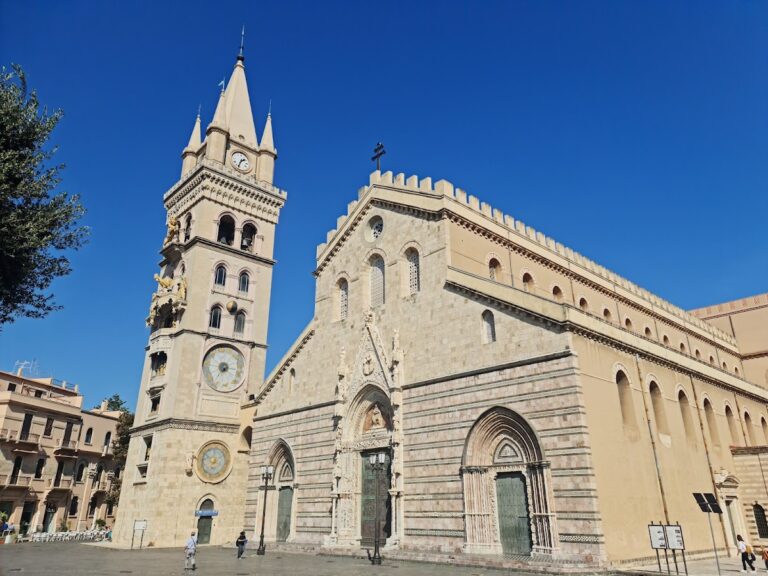
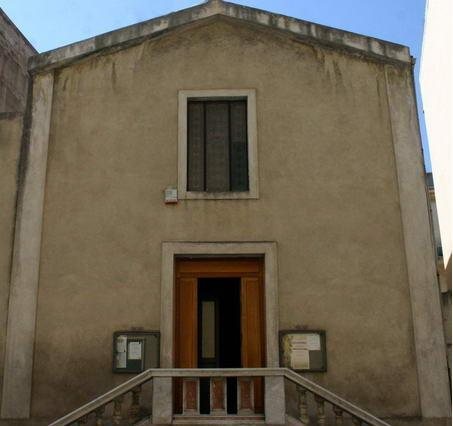
The surviving church stands between Via Cesare Battisti and Via Garibaldi, a short distance south of the Cathedral of Messina. Its former name, Annunziata di Castellammare, recalled its position near the medieval Castello a Mare, the fortress associated with the port and shipyard. The building has a basilical plan with three naves, a distinct separation between the area for the congregation and the choir, and a transept supporting a dome. Its architecture combines Norman, Byzantine, Arab, Roman, and Gothic elements.
Exterior and structural form
Dome and transept
The transept carries black-and-white inlay and supports the dome on a cylindrical drum. The drum has blind arcades, meaning decorative arches that do not open through the wall, resting on small columns, together with narrow windows. Similar arcades on small columns and polychrome geometric decoration ornament the exterior walls.
Apse group
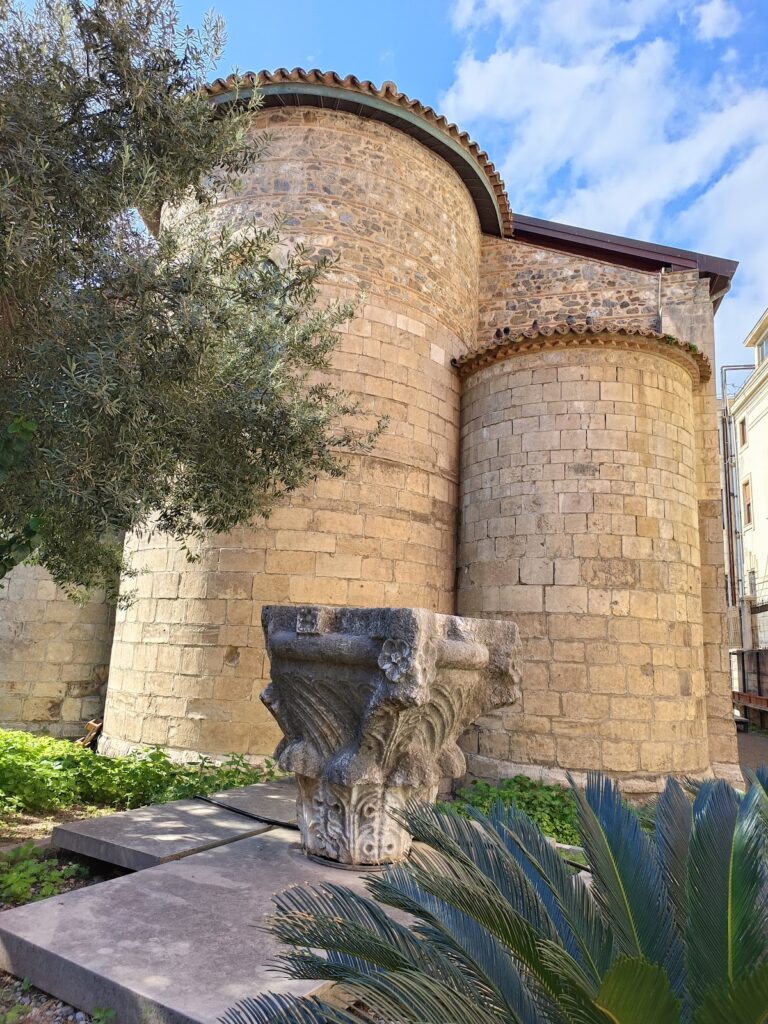
The eastern end contains three apses, with two set within the rear wall and a larger central apse projecting outward. This apse group is particularly well preserved. A sixteenth-century crucifix from the Monastery of Elenuccia, acquired by the archconfraternity, now stands in the central apse.
Portal and reused materials
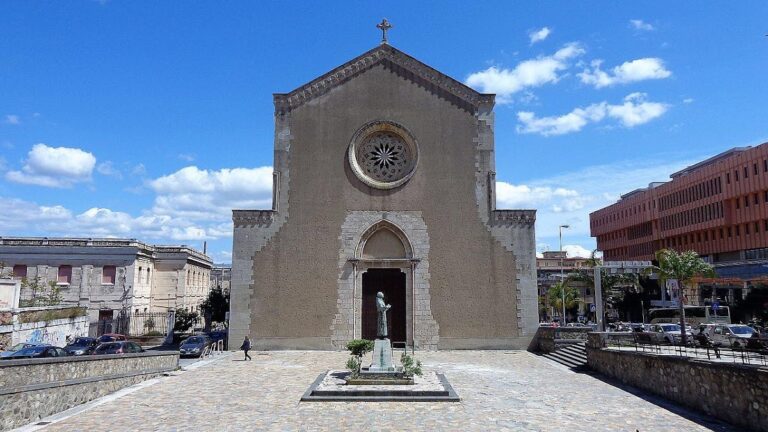
The facade and porches were completed in the early thirteenth century. The original central portal had jambs decorated with ancient Arabic inscriptions in green-marble inlay praising Roger I, the Norman Great Count of Sicily, whose conquest and consolidation of the island preceded the later Norman monarchy. The former facade was remodelled after 1908. Columns from an ancient temple of Neptune may also have been reused in the church, although that possibility is not certain.
The church is partly buried in relation to the modern street level because the surrounding roadway was raised by approximately three metres after the 1908 earthquake. This altered relationship with the streets is one of the clearest physical effects of the disaster on the surviving building.
Chapels, artworks, and liturgical furnishings
Gospel-side chapel
A chapel on the Gospel side formerly held Polidoro da Caravaggio’s 1534 Way to Calvary, a processional painting based on a composition associated with Raphael. The work is now in the Capodimonte Museum in Naples.
High altar and central apse
The high altar formerly displayed an Annunciation commissioned in 1505 from the Carmelite friar Giovanni d’Anglia. The painting showed the Virgin Mary with the announcing angel and Saint Eulalia, patron saint of Catalans, at her feet, together with a view of Messina. It is now held by the Regional Museum of Messina. The apse served as a family chapel patronized by the family of the Messina historian Giuseppe Buonfiglio.
Epistle-side chapel
A chapel on the Epistle side contained Girolamo Alibrandi’s 1514 Last Judgment. The painting is now in the Regional Museum of Messina. The church also possessed Tomas Montella’s 1606 Immaculate Conception, which was transferred to the museum after the 1908 earthquake and returned to the church in recent years.