Bruxella 1238: The Archaeological Remains of Brussels’ Franciscan Convent


Site at a Glance
- Rating
- 4.2
- Popularity
- Very Low
- Country
- Belgium
- Primary era
- Medieval
- External website
- Open
- Eras represented
- Medieval, Early Modern
- Civilizations
- Duchy of Brabant, Holy Roman Empire, Spanish
- Site type
- Religious
- Remains
- Monastery
On this page15 sections
History
Bruxella 1238 is the archaeological site of a Franciscan convent in Brussels, Belgium, founded by the Friars Minor in the thirteenth century. The earliest known reference to the friars in Brussels dates to 1238, giving the site its name, and their church was built beside the Senne in 1241. The convent became an important religious and civic institution in the medieval city and remained in use until the community was expelled under French rule in 1796.
The Franciscan foundation
The Friars Minor, members of the Franciscan Order founded by Francis of Assisi, probably reached Brussels between 1227 and 1231. As a mendicant order, they supported themselves through preaching, charitable work, and begging rather than the revenues of a large enclosed monastery. They first settled near the early fortifications before moving inside the walls to the commercial Saint Nicholas district, close to the future Grand Place.
The friars were the first mendicant order to establish itself in Brussels. Their ministry included preaching, assisting at funerals, hearing the confessions of the sick and dying, joining religious processions, and caring for people during epidemics. The convent also maintained a hospital, school, library, brewery, cooperage, cemetery, and storage area for fire hoses. The friars helped combat urban fires and tended plague victims, while their night bell became known to Brussels residents as the “brotherhood time.”
The community received continuing support from the dukes of Brabant. In 1261, Duke Henry III appointed a Brussels Friar Minor to supervise the execution of his will. Duke John I of Brabant and Lower Lorraine, Henry’s successor, was buried in the church choir in 1294 beside his wife, Margaret of Flanders, and their daughter Maria. John I was also known for his victory at the Battle of Worringen in 1288 and his association with courtly poetry.
Conflict, reform, and rebuilding
The convent’s history was shaped by the hazards and conflicts of Brussels. Floods from the Senne, urban fires, the plague of 1489, later epidemics, and the sieges or bombardments of 1695, 1708, and 1746 repeatedly affected the community. The friars were forced to leave during the Calvinist occupation of Brussels from 1579 to 1585, but otherwise continued to inhabit the convent until the French expulsion.
On 5 June 1568, the beheaded bodies of the Counts of Egmont and Horn were brought into the church. During the Protestant takeover of Brussels, the convent was looted in June 1579. The church choir and many funerary monuments, including the monument of John I, were destroyed in 1581 or 1583. After the Catholic reconquest of Brussels in 1585, the choir was rebuilt. Alexander Farnese, governor-general of the Spanish Netherlands, imposed a subsidy of 10,000 florins on the city for the reconstruction, which was under way by 1588.
The destroyed memorial to John I and Margaret was replaced around 1624 to 1627 by a copper engraved monument financed by Archduchess Isabella. The church itself was enlarged between 1621 and 1623. In 1618, the relics of the Martyrs of Gorkum were secretly exhumed and carried in procession to the Brussels convent, where they were placed in a shrine and venerated.
The Brussels friars joined the Recollect observance within the Franciscan Order in 1517. Recollects were Franciscans who followed a reform emphasizing stricter observance of the order’s rules. In Brussels, the friars were again identified as Recollects after an internal reform in September 1669.
A new heating room was built behind the cloister between 1663 and 1666, and the convent acquired a brewery in 1707. During the plague outbreak in Brussels from 1667 to 1670, the friars assisted the population and suffered sixteen deaths. The city later funded a new Baroque facade for the church, including a statue of Saint Michael, Brussels’ patron.
Bombardment and final dissolution
French artillery bombarded Brussels from 13 to 15 August 1695 during the Nine Years’ War, a conflict between France and a broad European coalition. The convent and church were heavily damaged, part of the convent burned, and most of the conventual archives and many artworks were destroyed. Reconstruction of the cloister began in 1697. The rebuilt church, dedicated to Saints Martin and Catherine, was consecrated on 30 August 1699 with support from the Brussels administration and Maximilian II Emanuel of Bavaria, governor-general of the Spanish Netherlands.
The convent’s religious life ended under the French regime. The friars were expelled in October 1796, and the convent was sold as national property in January 1797. The community was dispersed in 1799. The church was demolished on 15 May 1799 and replaced by the Marché au Beurre, or Butter Market, which survived until 1871.
Burial beneath the modern city
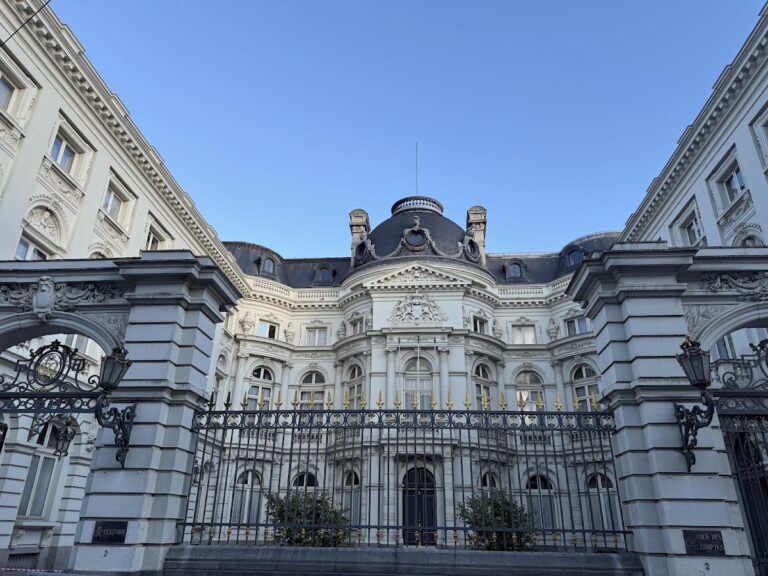
The Senne was straightened, vaulted, and covered during the major redevelopment of central Brussels in the 1860s. The former Butter Market was then replaced by the Brussels Stock Exchange, constructed between 1868 and 1873 on the site of the former convent and market.
The convent was rediscovered during roadworks in June 1988. Emergency excavations conducted that summer by the Royal Society of Archaeology of Brussels, in collaboration with the excavation service of the Université libre de Bruxelles and under the direction of Pierre-Paul Bonenfant, revealed the importance of the buried remains. Public interest and support from the mayor of Brussels helped persuade the municipal council to establish an in situ museum. Bruxella 1238 opened on 27 May 1993 with support from the City of Brussels and private patronage.
A preventive archaeological campaign in 2020, carried out before the conversion of the Stock Exchange into Belgian Beer World, confirmed habitation at the site from at least the late tenth century and revealed further burials dating from the thirteenth to the eighteenth century. During the redevelopment, the archaeological museum was restored and redesigned. Its earlier glass roof and concrete slabs were dismantled, a new entrance was made through the Stock Exchange, and the renovated museum was inaugurated on 17 July 2024. The site is now associated with the Museum of the City of Brussels and the Belgian Beer World complex.
Remains
Layout and construction
The archaeological remains lie beneath and around the Brussels Stock Exchange, especially beneath Rue de la Bourse. The excavated area corresponds to the former Franciscan convent and church. The medieval convent probably occupied only the right bank of the Senne; a garden on the opposite bank was acquired in the 1620s. Excavations on the south side of the Stock Exchange, along Rue Maus, produced no significant remains, while the southern side of the exchange probably follows the line of the former church facade.
Excavations along Rue de la Bourse exposed the foundations of the convent enclosure wall, the former cemetery, the church choir, and convent buildings. The choir was aligned on a north to south axis, and its construction-period floor lies about 1.40 metres below the present ground level. The site preserves an interwoven sequence of walls from several periods. White stone was used in the foundations, while later work employed brick, thinner walls, and mixed or reused materials. Architectural fragments range from the Gothic to the Baroque periods.
Church and burial areas
Church choir
The earliest church walls date from the thirteenth century. Built of white stone and strengthened with buttresses, they formed part of the church established beside the Senne in 1241. A buttressed building was added alongside the choir in the fifteenth century, followed in the early sixteenth century by a partition wall founded on arches. Together, these surviving elements illustrate successive changes to the church precinct.
Funerary vaults
The choir contained a succession of funerary vaults for prominent individuals from different periods. The central burial was associated with John I, Duke of Brabant and Lower Lorraine. Five pillars from the later Baroque cenotaph were found. A cenotaph is a memorial for someone whose body is absent or not buried beneath it, and John I’s bones may already have disappeared during the period of the Brussels republic.
Cemetery and graves
Simple graves for friars were aligned with the north to south axis of the church. Near the boulevard, beneath the former cloister, archaeologists found monks’ graves containing several complete skeletons still in anatomical connection. Numerous human bones also came from the former cemetery. The 2020 campaign exposed additional burials dating from the thirteenth to the eighteenth centuries.
Convent buildings and archaeological finds
Cloister and service buildings
The former convent included a cloister, heating room, brewery, hospital, school, library, cooperage, cemetery, and fire-hose store. These facilities represent the religious, charitable, educational, craft, and civic activities carried out within the convent complex. A well, probably dug by nineteenth-century merchants, remains connected to the groundwater table.
Architectural fragments and pottery
Pottery fragments from the excavations trace changes in ceramic production, from simple earthenware through the development of glazed wares to the appearance of stoneware. Gothic finds include fragments of sculpted architecture, among them a canopy made of black stone. Baroque remains include sections of stuccoed archivolts painted to imitate marble.
Presentation of the archaeological site
The first museum arrangement, opened in 1993, placed a glass roof over the central area above the choir so that the ruins could be seen from outside. Metal walkways allowed the remains to be viewed, while climate-control equipment maintained stable temperature and humidity to limit deterioration. The later redevelopment dismantled the glass roof and concrete slabs, created a tunnel through the Stock Exchange foundations, and connected the archaeological site with the redeveloped complex.