Šášov Castle: A Medieval Royal Fortress in Slovakia


Site at a Glance
- Rating
- 4.7
- Popularity
- Low
- Country
- Slovakia
- Primary era
- Medieval
- Eras represented
- Medieval, Early Modern
- Civilizations
- Hungarian
- Site type
- Military
- Remains
- Castle
On this page12 sections
History
Šášov Castle is a thirteenth-century royal castle in Slovakia, established at a strategic crossroads above the Hron valley. It guarded the route through the valley, controlled roads leading from Banská Štiavnica toward Kremnica and Turiec, and collected tolls. Its position also helped protect access to the mining region, especially Banská Štiavnica.
Foundation and royal administration
The castle was recorded in 1253 as the property of the brothers Vincent and Peter de Vancha, whose name also appears as de Bancsa. Their relative Stephen was then Archbishop of Esztergom. Together with Revište Castle, about 15 kilometres south on the opposite bank of the Hron, Šášov protected the passage toward the mining districts.
In 1320, Šášov was acquired by the chamber count of Banská Štiavnica, a royal official responsible for a mining and revenue district. The castle then became the administrative center of the Šášov estate. Its location allowed it to control the strategically important gorge through which the Hron ran toward Banská Štiavnica and Zvolen.
Early records also associate the castle with a place called Susol or Šúšol. The location and origin of that place, and even its existence, remain unconfirmed. The name was added retrospectively to a 1253 charter defining the property of the monastery at Hronský Beňadik.
Conflict and changing ownership
The castle’s castellans, its military and administrative governors, repeatedly harassed Hronský Beňadik monastery and damaged its properties when they could. Baško of Kostoľany caused particularly severe damage in 1362, followed by Peter of Branč in 1373.
In 1387, King Sigismund, the late medieval king of Hungary who later became Holy Roman Emperor, granted Šášov Castle and its estate to the barons Frank and Simon Szécsényi. Sigismund transferred it to his queen consort, Barbara, in 1424. Ján Jiskra, a fifteenth-century military commander and power-holder in northern Hungary, held the castle in 1447.
In 1490, Queen Beatrix, the wife of King Matthias Corvinus, granted Šášov to the Dóci family. The family retained the estate until it became extinct in 1647. Gašpar Lipai then purchased the castle estate in 1650.
Destruction and decline
During the Thököly uprising in 1677, an anti-Habsburg revolt associated with the nobleman Imre Thököly, insurgents captured and plundered the castle. Šášov subsequently came under chamber administration, meaning direct management by the royal fiscal authorities rather than by a private noble owner. Transfers to this administration are recorded for 1676 and 1678.
In 1708, Imperial General Sigbert Heister captured Šášov, had it burned, and left it to decay. The castle lost its defensive function, and its decline continued from the eighteenth century onward.
The settlement of Šášovské Podhradie developed below the castle during the thirteenth century. It was first identified as castle property in 1388 and remained historically connected with Šášov. In 1971, it became a municipal part of Žiar nad Hronom.
Conservation in the modern period
Efforts to save Šášov Castle began in 2003 with the establishment of the Association for the Rescue of Šášov Castle under Rastislav Uhrovič. In 2013, the association secured a lease for the land beneath the castle with financial support from the Ministry of Culture of the Slovak Republic. Conservation work then began at the ruin.
Remains
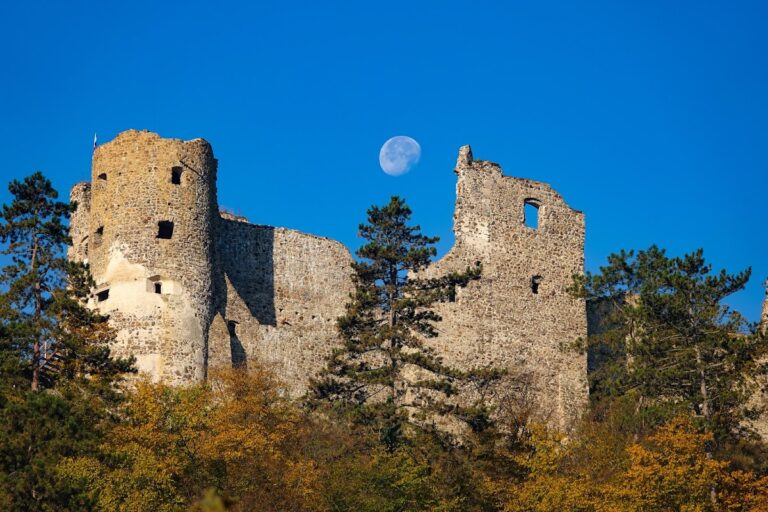
Šášov Castle is an extensive ruin on a steep rocky promontory above Šášovské Podhradie, on the left bank of the Hron at an elevation of 340 metres above sea level. The complex was arranged around an elongated central inner castle. The upper castle occupied the higher ground, descending from the palace toward a courtyard, while fortified areas extended toward the approach road and the mountain ridge.
Upper castle
Gothic palace
The uppermost Gothic palace formed the core of the upper castle and was rebuilt repeatedly. Residential buildings stood along a long, narrow inner courtyard, creating the main organized space within the upper complex. The surviving ruins remain concentrated around this elongated inner castle.
Triangular tower and circular bastion
At the highest point of the terrace, a triangular tower was later added to protect the palace. A large circular bastion enclosed the courtyard and guarded the entrance to the upper castle. The present remains are especially concentrated around this terminal circular bastion.
Forecourt and outer defenses
Fortified forecourt
A fortified forecourt lay in front of the upper castle. Residential buildings lined the approach area, and the road reached the main complex through this enclosed space. The forecourt and its small bastion are now almost completely lost and survive only faintly in the terrain.
Guard tower and ridge fortification
The forecourt ended in a circular guard tower. Traces of further buildings survive at the narrow neck separating the castle from the mountain massif, while the ridge contains the remains of a small fortification. Architectural details remain throughout the ruin, although the castle continues to deteriorate.