Church of St. John the Warrior: An 18th-Century Orthodox Church in Moscow
Site at a Glance
- Popularity
- High
- Country
- Russia
- Primary era
- Early Modern
- Eras represented
- Early Modern, Modern
- Civilizations
- Russian
- Site type
- Religious
- Remains
- Church
On this page13 sections
History
The Church of St. John the Warrior is a Russian Orthodox church in Moscow’s Yakimanka District, Russia, built in the early 18th century with Baroque elements and European influences associated with the reign of Peter I. Dedicated to the Christian martyr John the Warrior, it was moved to ground less exposed to flooding and has remained active as a place of worship.
The earlier church and relocation
An earlier wooden church dedicated to St. John stood nearer the Moskva River, close to the present-day Krymsky Bridge. It is known to have existed by 1625. Repeated spring floods damaged the building, and, at the initiative of the Streltsy, Russian military servicemen who also lived in Moscow settlements, a masonry church replaced it in 1671. After the Streltsy were expelled from Moscow following a failed revolt, the church deteriorated. Floodwater destroyed it in 1708.
The low-lying area between the river and present-day Bolshaya Yakimanka Street regularly flooded in spring. Its residents included Streltsy, Poles, and farmers, so the replacement church was placed farther from the river on safer ground. The new site had been acquired in 1701, and plans for rebuilding may already have existed before Peter I became involved. Tradition says that, after seeing the earlier church’s flood damage in 1709, Peter ordered and financed a new building to commemorate the Battle of Poltava, a major Russian victory over Sweden in the Great Northern War. Another tradition credits him with sketching the design. His involvement may have hastened a project already under consideration.
Construction and 18th-century worship
The southern adjoining hall and its chapel were completed in 1711, and services began at an altar dedicated to Saints Gurias, Samon, and Aviv. The church as a whole was consecrated on 12 June 1717 by Stefan Yavorsky, Metropolitan of Ryazan and Murom, who was temporarily exercising the duties of the Moscow patriarchal throne. The northern chapel was completed in 1759, and its altar, dedicated to Saint Demetrius of Rostov, was consecrated the following year. Another chapel is dedicated to the Great Martyr Barbara.
From 1779 to 1791, Gavriil Domozhirov decorated the church with frescoes, and Vasily Bazhenov made an icon screen for its interior. Both were lost in the 1860s. Matvey Desnitsky served at the church from 1785 to 1796; later known as Metropolitan Michael of Novgorod and St. Petersburg, he had a reputation as a preacher from his youth.
Occupation and recovery
During the French occupation of Moscow, troops looted and desecrated the church, causing substantial losses. The building escaped damage in the Moscow fire. It was reconsecrated in 1813, and repairs to its furnishings continued through 1840.
The church in the 20th century
Christopher Nadezhdin served as rector from 1906 until his death in 1922. The church marked its 200th anniversary in 1912, when Metropolitan Vladimir of Moscow and Kolomna celebrated the jubilee liturgy and feast on 30 July. In 1922, Nadezhdin was accused of resisting the confiscation of church valuables and was executed, with other Moscow clergy, by order of the Moscow Revolutionary Tribunal. He was canonized in 2000 as a New Martyr, a person honored in Russian Orthodoxy for dying for the faith during modern-era persecution.
Valuable church furnishings were confiscated in 1922, but worship continued. During the 1920s and 1930s, sacred objects from churches that had closed or been demolished were brought to St. John’s. In the 1930s, objects from the closed Church of Maron the Hermit in Old Panekh also arrived. Alexander Voskresensky, formerly rector there, became rector of St. John’s in 1930 and served until his death in 1950. The church was never closed for worship or transferred to the Renovationist movement, a reform current within Russian Orthodoxy that emerged after the Russian Revolution. It has federal-level cultural heritage status in Russia.
Remains
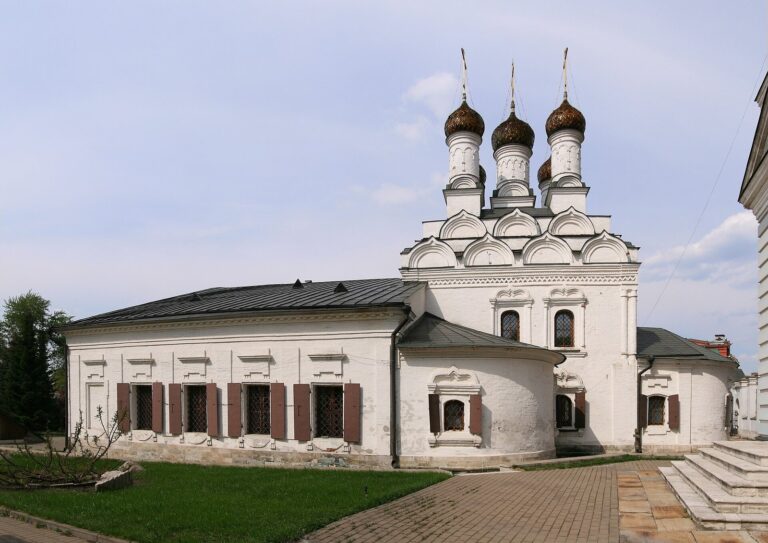
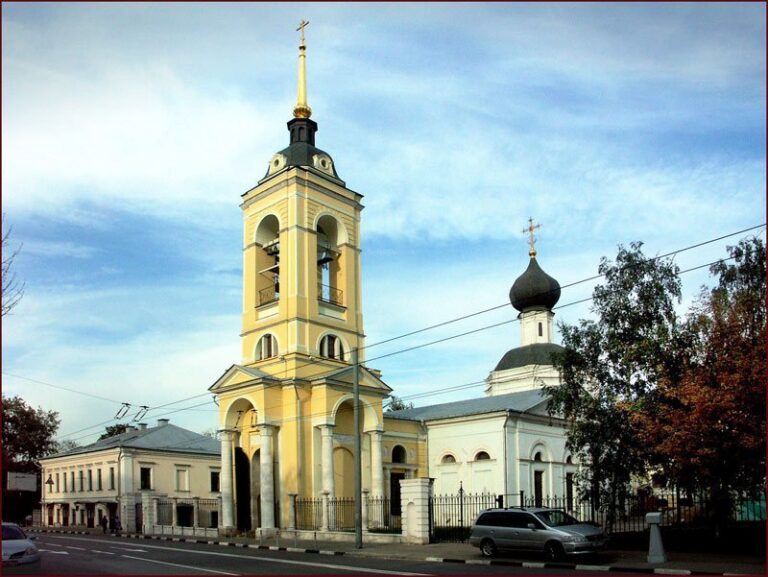
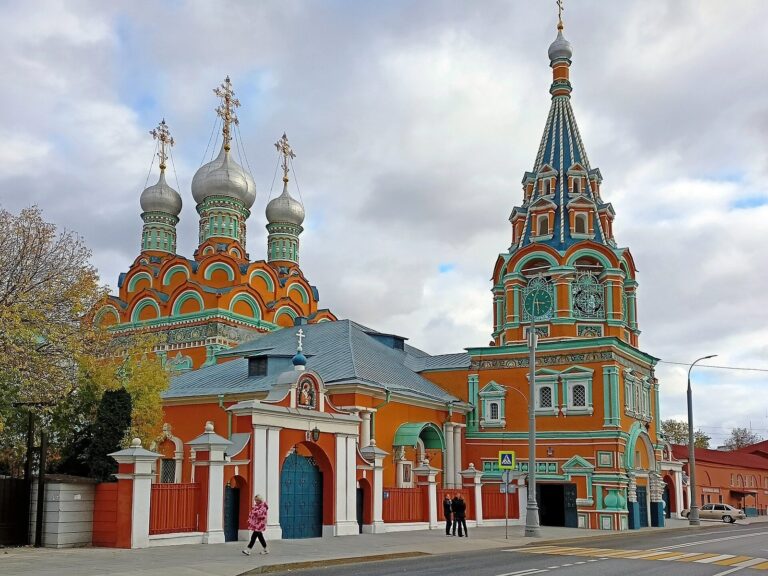
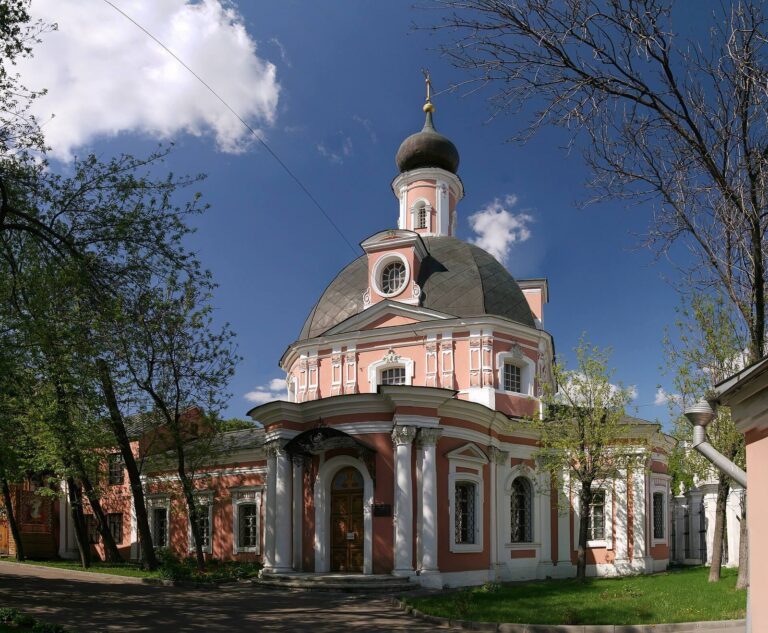
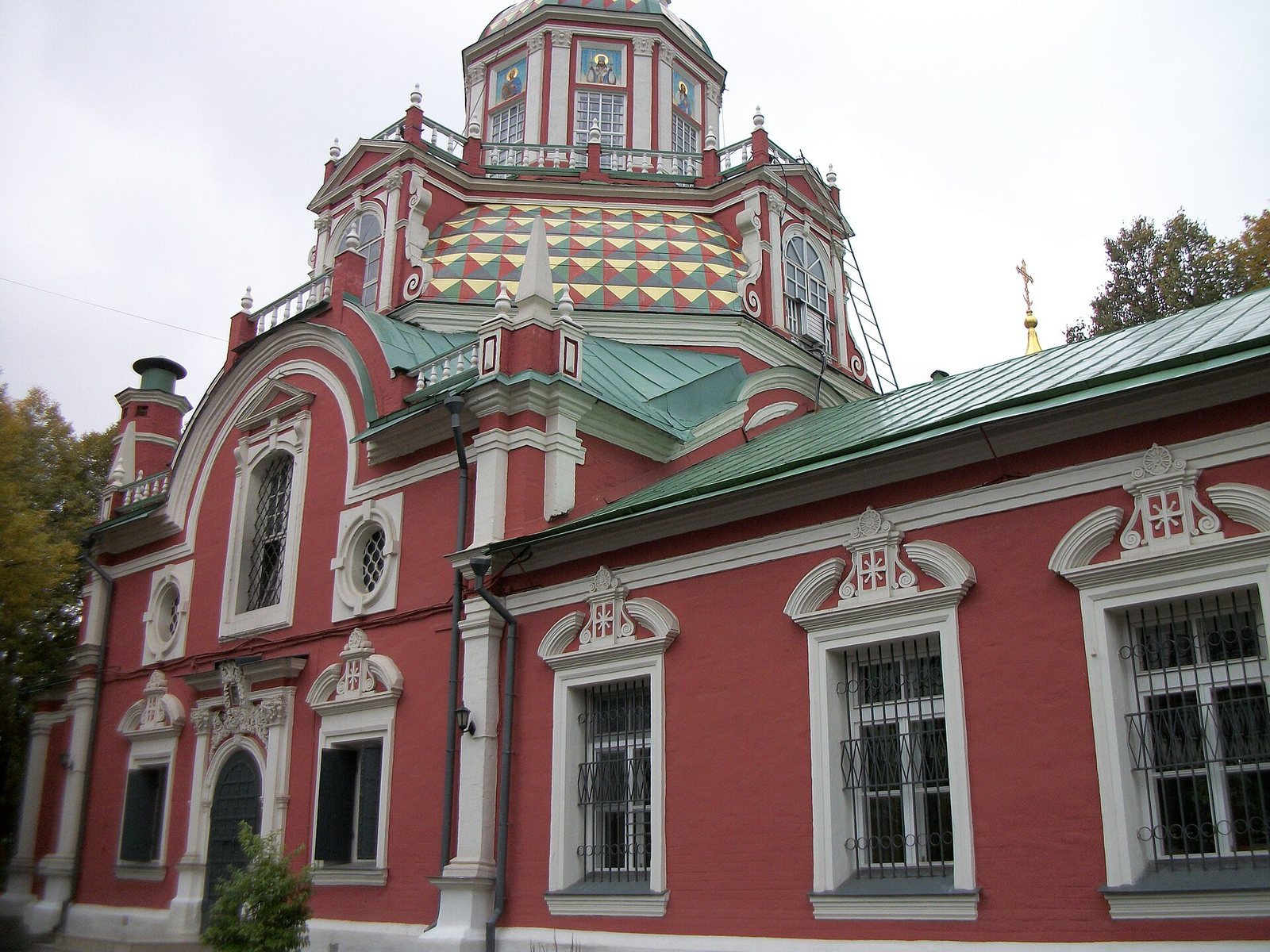
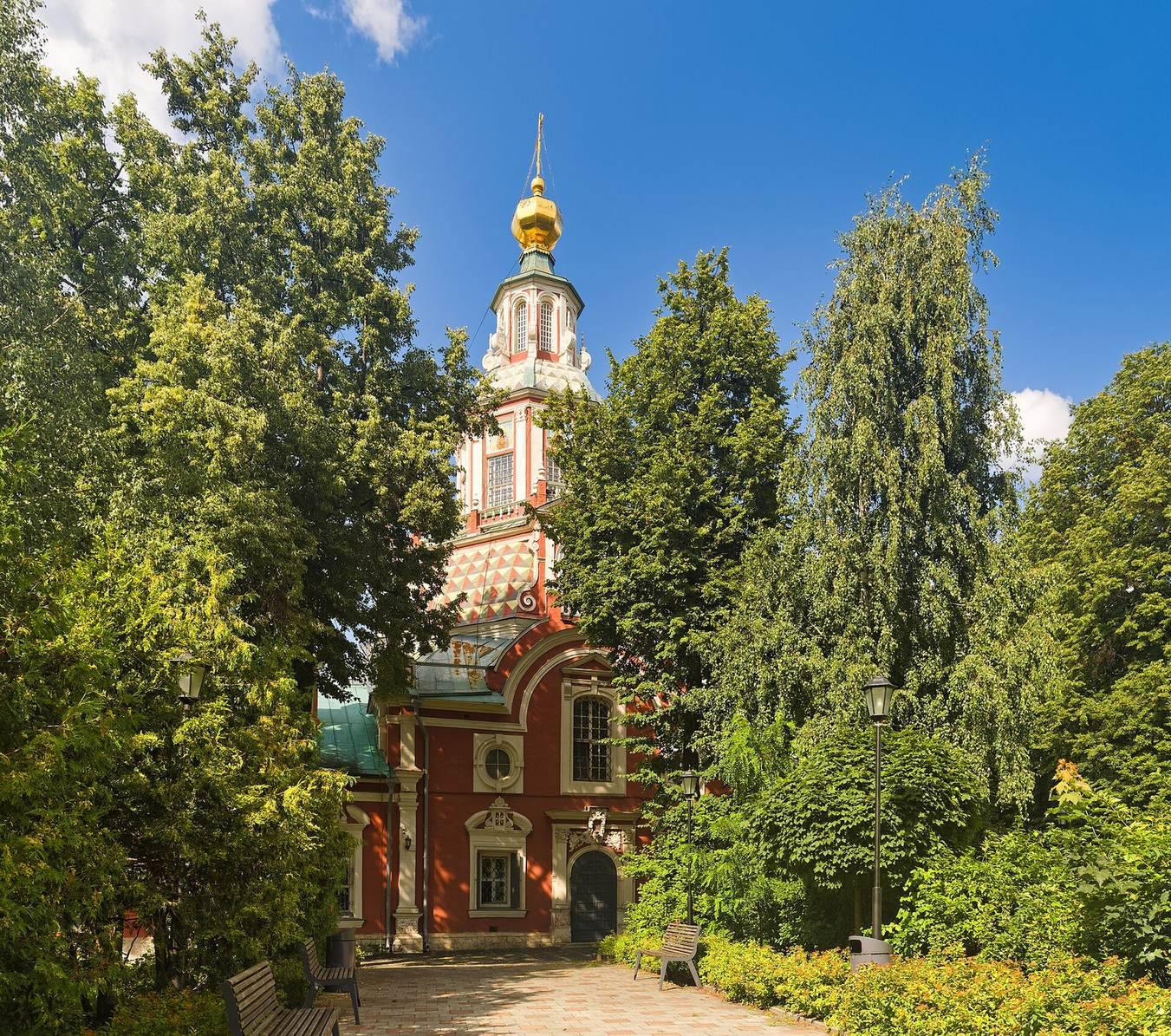
The brick church rises from a square base into two aligned octagonal stages, combining Muscovite and Ukrainian Baroque elements with European influences associated with Russian architecture under Peter I. Its surviving interior includes three altars, an additional chapel, icons, and sacred relics.
Building and enclosure
Main structure
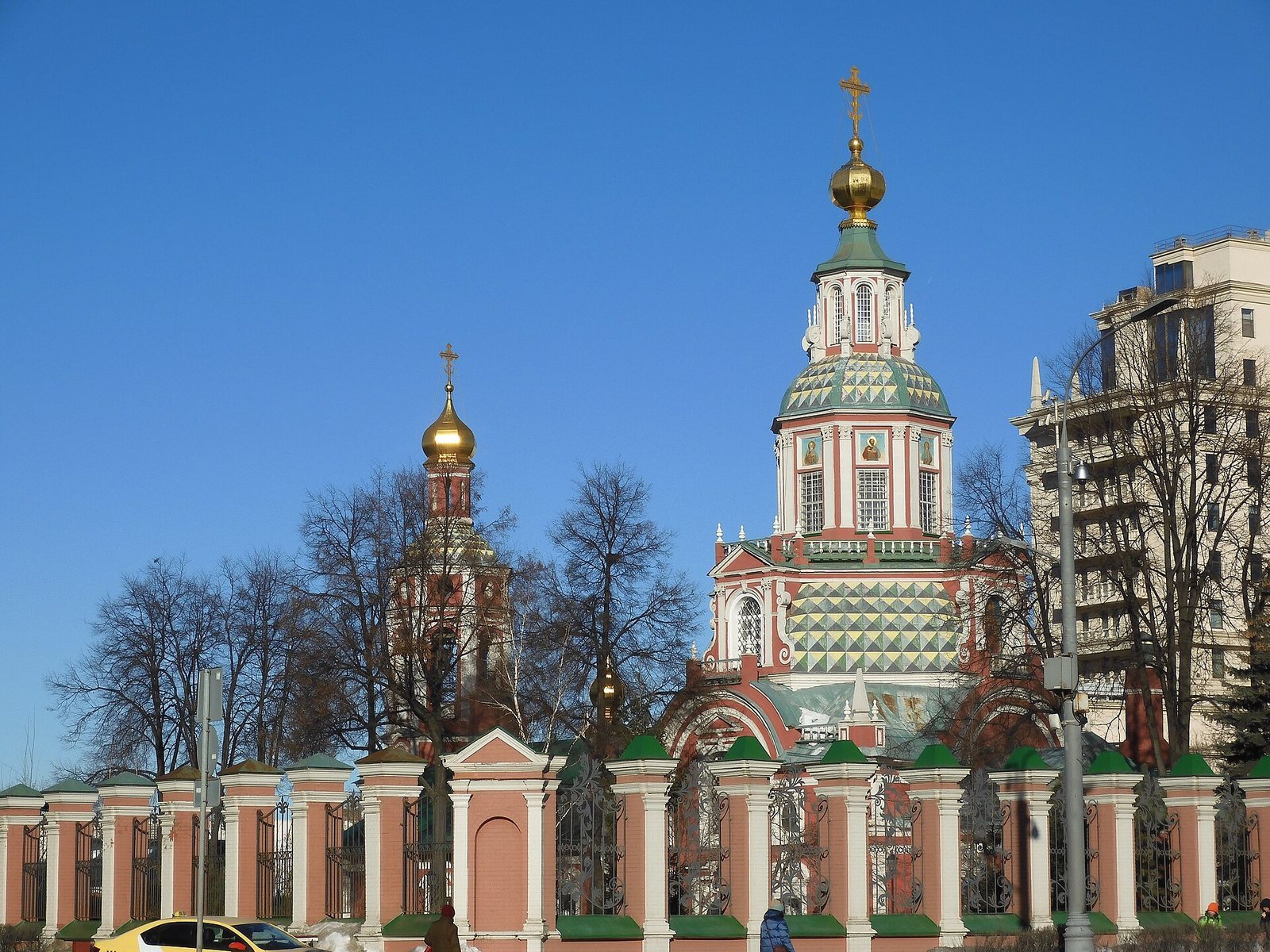
Two coaxial octagons rise above the square base, each crowned by a half-dome. An octagonal tower with an ornamental balustrade and colored ceramic tiles forms part of the composition. The church is also described as having one dome. Its architect remains uncertain, though its resemblance to Menshikov Tower has been used to support an attribution.
Wrought-iron fence
An ornamental wrought-iron fence stands on a brick foundation around the church. It was built between 1754 and 1758. In 1984, the eastern side was moved substantially closer to the building when the street was widened. The southern section was added later, after a house on that side was demolished.
Altars and sacred objects
Altars and chapels
The main altar is dedicated to John the Warrior. The two side altars honor Saints Gurias, Samon, and Aviv, and Saint Demetrius of Rostov. The chapel of Gurias, Samon, and Aviv adjoins the southern hall, while the Demetrius altar is in the northern chapel. An additional chapel is dedicated to the Great Martyr Barbara.
Icons and relics
A revered icon of John the Warrior and a relic, a bodily remain associated with a saint, consisting of part of Saint Barbara’s finger came from the Church of St. Barbara on Varvarka. Reliquaries and icons in the church contain fragments associated with more than 150 saints. In the northern chapel, an icon of Joachim and Anna depicts the Conception of Saint Anne with subsidiary scenes. Before the main altar, beside the icon of John the Warrior, is an image of Christ under the title Angel of the Great Council, a name used for Christ in Orthodox iconography.
Transferred images and icon screen
The church holds icons of the All-Merciful Savior and St. Nicholas that formerly hung above Kremlin gates. An 18th-century icon screen from the Church of the Three Saints at Red Gates was installed here in 1928. An icon of Joachim and Anna also came from the destroyed Church of Joachim and Anna.